
How to Reconstitute Peptides: Diluents, Maths and Storage

How do you reconstitute peptides?
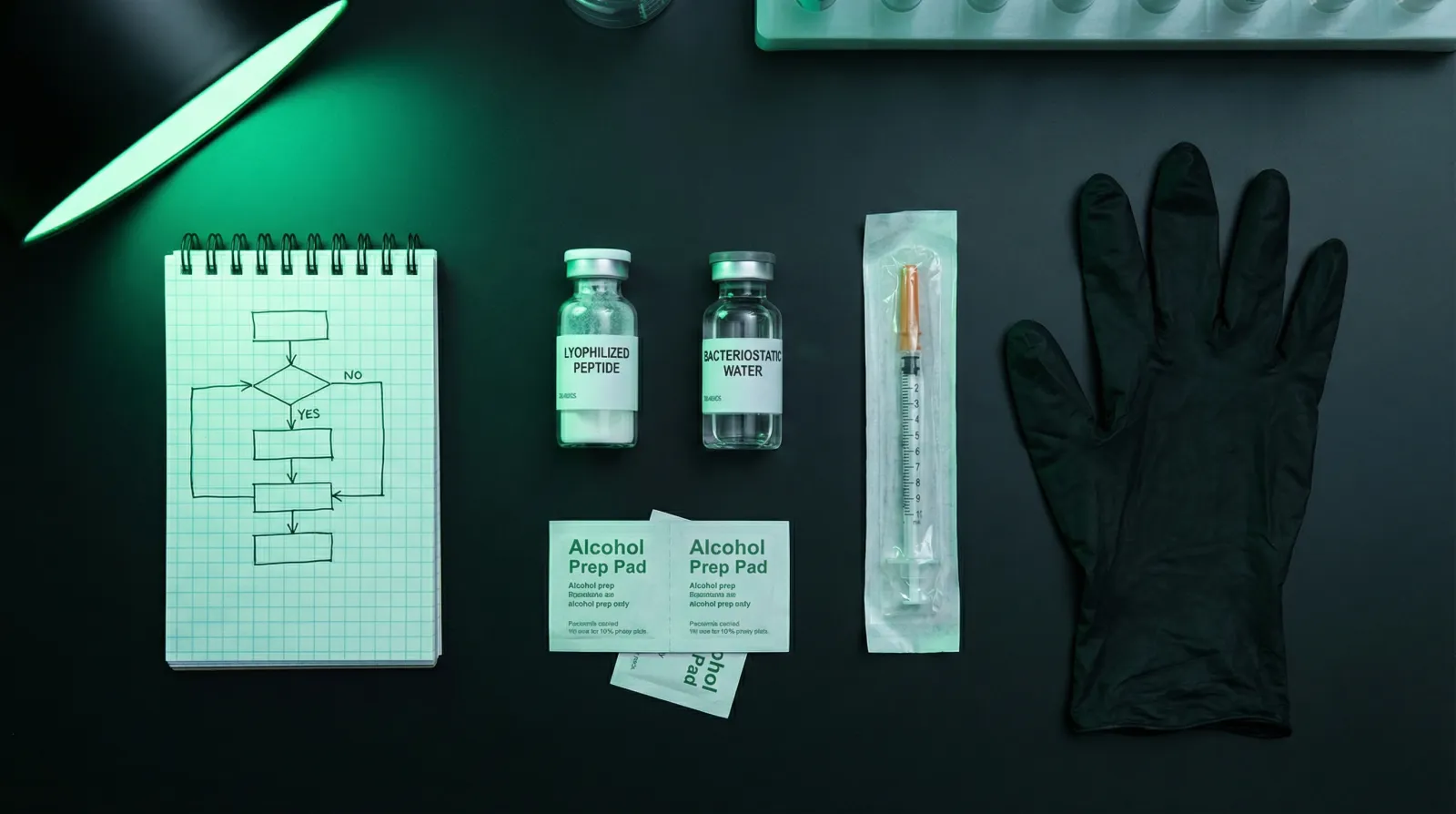
How to reconstitute peptides comes down to one step: a sterile liquid is added to the freeze-dried powder in a sealed vial until it dissolves. That liquid is called the diluent. One FDA drug label describes running it down the glass and swirling gently, never shaking. We found no primary source that sets a method for research peptides.
FDA is the US Food and Drug Administration. Research peptides are often sold as a dry powder. FDA's 2026 briefing on TB-500 found websites selling it as a powder for reconstitution. Those websites said the products were for research use only.
The clearest written method we found is on the FDA label for Zorbtive, a growth hormone drug sold as a powder. Its label sets out these steps for that one product.
- The diluent goes in slowly, with the needle tip resting against the inner wall, so the water flows down the side of the vial.
- Squirting the water straight onto the powder makes the solution foamy and hard to use, the label says.
- The vial is then moved in slow, gentle circles. The label says not to shake it or turn it upside down.
- The solution should be clear straight after mixing. The label says not to inject it if it is cloudy, either then or after time in the fridge.
- Mixed with bacteriostatic water, the solution is kept in a fridge at 2-8°C for up to 14 days. The label says to avoid freezing it.
Those steps were written for one approved drug. They are not tested instructions for any research peptide.
This content is for educational purposes only. These compounds are intended for research use. Nothing here is medical advice.
What do you reconstitute peptides with?
The Zorbtive label names two diluents. The first is Bacteriostatic Water for Injection, which contains 0.9% benzyl alcohol as a preservative. Bacteriostatic means it holds back the growth of bacteria. The second is Sterile Water for Injection, which the label allows for patients sensitive to the first.
| Diluent | What the label lists in it | What the Zorbtive label says |
|---|---|---|
| Bacteriostatic Water for Injection (BAC water) | Water with 0.9% benzyl alcohol, a preservative | Mixed solution kept at 2-8°C for up to 14 days. Not for patients with a known benzyl alcohol sensitivity. Benzyl alcohol has been linked to toxicity in newborns. |
| Sterile Water for Injection | Water, with no preservative named | Allowed if a patient is sensitive to the first diluent. The mixed solution is used at once, and any unused portion is thrown away. |
Those rules come from one drug's label. None of the sources we read names a diluent for a research peptide such as BPC-157 or TB-500.
How much BAC water to reconstitute peptides?
BAC water is short for bacteriostatic water. We found no primary source that sets how much BAC water goes into a research peptide vial. The amount added sets the concentration, which is the peptide's mass divided by the liquid's volume. More liquid makes a weaker solution, so the same dose takes up more volume.
Can you reconstitute peptides with saline?
Saline, a salt solution, is not one of the diluents the Zorbtive label names. That label names bacteriostatic water, and sterile water for patients sensitive to benzyl alcohol. We found no primary source that tests saline with a research peptide.
FDA notes that peptides such as BPC-157 can be extremely sensitive to how they are made up. Its 2026 briefing lists pH, heat, concentration, impurities and added ingredients. Each can lead to the peptide clumping or breaking down.
What size syringe to reconstitute peptides?
The Zorbtive label recommends a standard insulin-type syringe for injecting that drug. For mixing, the label supplies a separate 3 cc syringe. Its patient instructions give that mixing syringe a 1-inch needle. The 1 cc syringe for injecting has a 29-gauge needle. Insulin syringes are marked in units. A U-100 syringe holds 100 units in 1 mL, so one unit is 0.01 mL.
Unit markings can be misread. In a 2024 alert on compounded semaglutide, FDA said mixing up millilitres, milligrams and units may have contributed to dosing errors. Patients had been told to draw small doses with a U-100 (1 mL) insulin syringe. In several reports, patients told to give 5 units gave 50 units instead.
How to reconstitute lyophilized peptides without wrecking them
Lyophilised means freeze-dried. FDA reports that freeze-dried BPC-157 is a white to off-white powder. In that dry form it is reported to stay stable at room temperature for 3 weeks. The same briefing says moisture greatly lowers the long-term stability of freeze-dried peptides.
Once dissolved, a peptide can clump. FDA calls this aggregation, where peptide chains join into larger clusters. FDA says this could cost a peptide its biological activity. It also names aggregation as a risk factor for immune reactions.
The research behind this comes mostly from protein drugs. Manning et al. (2010), in Pharmaceutical Research, reviewed how protein drugs break down, both chemically and physically. The review also covers how they are kept stable in water and in dried form.
Bekard et al. (2011) reviewed studies of shear, the drag force inside flowing liquid. In Biopolymers, they describe shear as able to damage protein structure and function.
Work on antibody solutions by Fesinmeyer and colleagues found that shaking made the antibodies clump. The clumping happened mainly at the air-water interface, the boundary where liquid meets air. Shaking kept refreshing that surface. Storage at high heat also formed clumps in that work.
These studies used proteins and antibodies. None of them tested a research peptide.
How to reconstitute peptides: calculator or paper maths?
How to reconstitute peptides with a calculator rests on two lines of arithmetic. Our peptide reconstitution calculator runs the same sums.
| What is being worked out | The formula |
|---|---|
| Concentration created | Concentration (mcg/mL) = Total peptide mass (mcg) / Volume of BAC water added (mL) |
| Volume for a given amount | Volume (mL) = Amount (mcg) / Concentration (mcg/mL) |
| Units on a U-100 syringe | Units = Volume (mL) x 100 |
Note: 1mg = 1000mcg.
FDA said confusion over units may have contributed to its semaglutide dosing errors. Our mcg to insulin syringe units chart sets out that conversion in full.
Is it safe to reconstitute peptides at home?
The primary sources we read raise three concerns. None of them shows that mixing a research peptide at home is safe.
First, the products are sold for research only. FDA's 2026 briefings found BPC-157 and TB-500 products offered online for research use only. One website described its combined BPC-157 and TB-500 products as "not for human or veterinary use".
Second, FDA warns that injected BPC-157 may pose a significant risk of immune reactions. It says aggregation and impurities may add to that risk. Injection under the skin is called subcutaneous. FDA says it is linked with more immune response than taking a peptide by mouth or rectally.
Third, measuring at home can go wrong. In its semaglutide alert, FDA reported dosing errors from patients measuring and giving themselves incorrect doses.
Do you have to reconstitute peptides every time?
Not with a multi-dose vial. The Zorbtive label describes multi-dose vials, mixed with bacteriostatic water and kept in the fridge for up to 14 days. Mixed with sterile water instead, the solution is used at once and the rest thrown away.
Before mixing, the label stores Zorbtive at room temperature, 15-30°C. FDA's briefing reports a recommendation to keep freeze-dried BPC-157 dry, below -18°C.
How to properly reconstitute peptides: what do the sources warn against?
These are the handling risks the primary sources name.
| Risk | What the source says | Source |
|---|---|---|
| Squirting the liquid onto the powder | Makes the solution foamy and hard to use | Zorbtive label (FDA) |
| Shaking the vial or turning it upside down | The label says not to do either | Zorbtive label (FDA) |
| A cloudy solution | Not to be injected, after mixing or after time in the fridge | Zorbtive label (FDA) |
| Freezing a mixed vial | The label says to avoid it | Zorbtive label (FDA) |
| Benzyl alcohol sensitivity | A bacteriostatic water mix is not given to patients with a known sensitivity | Zorbtive label (FDA) |
| Mixing up mL, mg and units | May have contributed to dosing errors, including 50 units given instead of 5 | FDA semaglutide alert (2024) |
| Heat, pH and impurities | Can lead to clumping and breakdown, which could cost the peptide its activity | FDA BPC-157 briefing (2026) |
Reconstitute peptides with bacteriostatic water: storage and shelf life
Once you reconstitute peptides with bacteriostatic water, how long they last depends on the product. No single figure covers them all. FDA attributes the BPC-157 and TB-500 figures to other sources.
| Product and state | Storage reported | Source |
|---|---|---|
| Zorbtive, before mixing | Room temperature, 15-30°C | Zorbtive label (FDA) |
| Zorbtive, mixed with bacteriostatic water | 2-8°C for up to 14 days; avoid freezing | Zorbtive label (FDA) |
| Zorbtive, mixed with sterile water | Used at once; unused portion thrown away | Zorbtive label (FDA) |
| BPC-157, freeze-dried powder | Reported stable at room temperature for 3 weeks; storage dry and below -18°C recommended | FDA BPC-157 briefing (2026) |
| BPC-157, in solution | Reported stable for 2-3 weeks at 4°C and 3-4 months at -20°C | FDA BPC-157 briefing (2026) |
| TB-500 (free base), powder | -80°C for 2 years or -20°C for a year, sealed, under nitrogen, away from moisture and light | Product data sheet, as reported in the FDA TB-500 briefing (2026) |
| TB-500 (free base), in solvent | -80°C for 6 months or -20°C for one month, sealed, under nitrogen, away from moisture and light | Product data sheet, as reported in the FDA TB-500 briefing (2026) |
The sources differ on freezing. The Zorbtive label says to avoid freezing its mixed solution. The figures FDA reports for BPC-157 and TB-500 include frozen storage.
Where to buy research peptides
The hard part with research peptides isn't the protocol. It's finding a supplier that can prove what's in the vial. We assessed dozens against per-batch, third-party testing. A handful passed.
See the sources that passed →What do I need to reconstitute peptides I can trust?
The first need is a batch whose identity and purity have been tested. Good technique cannot fix a bad vial.
Work by De Spiegeleer and colleagues tested one peptide, obestatin, from five manufacturers. One product turned out to be a completely different peptide. Two-thirds of the others fell short of the quality needed for lab and animal work. The team used liquid chromatography and mass spectrometry, lab methods that separate and identify the molecules in a sample.
FDA found a similar gap for BPC-157. Most certificates of analysis (CoAs) it found showed only a purity result. A CoA is a lab report on one batch. Those reports gave no information on impurity limits. So FDA could not rule out immune reactions caused by impurities or clumped peptide. Our guide on how to read a peptide CoA covers what those reports contain.
FDA's compounding advisers reviewed BPC-157 and TB-500 at a meeting on 23-24 July 2026. See our breakdown of what the FDA reclassification means for peptide research, and the update on which peptides are available again in 2026.
Always consult a qualified clinician before considering any protocol.
Share this article
Frequently Asked Questions
How much bacteriostatic water do you add to reconstitute peptides?
Can I use sterile water instead of bacteriostatic water to reconstitute peptides?
Is there a calculator for reconstituting peptides, or can I do the maths myself?
How long does a reconstituted peptide vial last in the fridge?
What does a properly reconstituted peptide look like?
Is it safe to inject bacteriostatic water and what is the benzyl alcohol risk?
Read Next

Disclaimer: This content is for educational purposes only. These compounds are intended for research use. Nothing here is medical advice. Always work with a qualified clinician before making changes to your health protocol.