
Best Peptides for Injury Recovery: What the Evidence Shows

What Are the Best Peptides for Injury Recovery?
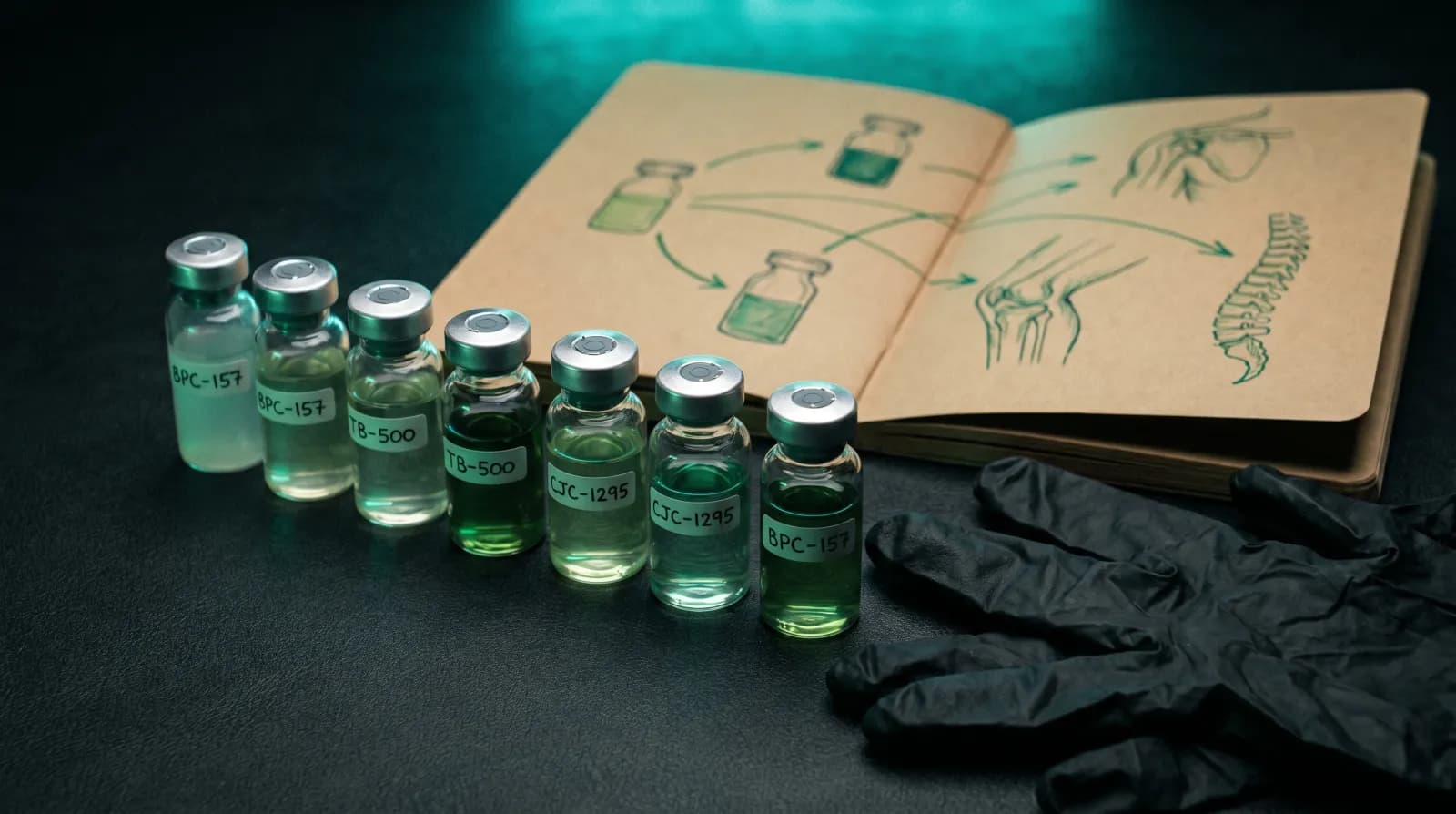
The best peptides for injury recovery have not been settled by any human trial. The seven compared here are BPC-157, TB-500, the Wolverine Stack (those two together), GHK-Cu, CJC-1295 with Ipamorelin, Thymosin Alpha-1 and KPV. A recent review covering five of these peptides found their injury benefits unproven in people.
That review looked at the sports medicine research on these peptides. Most of it was in animals, and the human studies were few and weak (Tewari et al. 2026). We say so each time a result comes from animals or cells. None of these peptides is an FDA-approved drug in the US. The legal section below sets out FDA's record, and our peptide legality guide covers the wider picture.
Is BPC-157 One of the Best Peptides for Injury Recovery?
It has the most injury studies of the seven. Nearly all of them are in animals.
BPC-157 is a 15-amino-acid piece of a larger protein first found in human gastric juice. In lab work, tendon fibroblasts (the cells that build connective tissue) grew out of rodent (rat) Achilles tendon pieces significantly faster with it. It also helped those cells survive stress and move faster. It did not change how fast they divided (Chang et al. 2011). The tendon evidence is cell and animal work, not human trials.
A review of the peptide in sports medicine found 35 animal or lab studies and just 1 in humans (Vasireddi et al. 2025). Those studies point to healing of fractures, tendon ruptures, ligament tears and muscle injury. The one human study looked back at 17 people given knee shots for knee pain, and reached 16 of them (Lee and Padgett 2021). Twelve got BPC-157 alone, and four also got thymosin beta-4. The review reports that 7 of the 12 on BPC-157 alone had relief for more than 6 months. The study had no control group. The review found no human safety data. The same review notes it has no FDA approval. It is also barred in pro sport.
FDA found no human study of the peptide in tendonitis, a sore and swollen tendon (FDA review). A newer review for sports doctors adds that the right dose, how often and how long are still unknown (Mayfield et al. 2026). Our BPC-157 dosing protocol guide and our oral vs injectable comparison go further.
Studied in: tendon (including the Achilles), ligament, muscle and bone injuries in animals, and long-term knee joint pain in one small human study. The review found no human study of post-surgical healing.
TB-500: A Fragment of Thymosin Beta-4, With No Human Data
TB-500 is not the same molecule as thymosin beta-4. FDA describes it as a piece of that protein seven amino acids long, coded LKKTETQ (FDA review). The full protein, thymosin beta-4, is the main actin-holding molecule in our cells. Actin is the protein cells use to move and change shape.
A review gives thymosin beta-4 a key role in skin and eye wound healing. It also points to possible uses in repair after low-oxygen injury, such as heart attack and stroke (Goldstein et al. 2005). That is review-level evidence on the full protein, not a trial in hurt athletes.
TB-500 itself has far less behind it. For its July 2026 meeting, FDA found no data on it in people. It found no animal test of it for wound healing either. In one lab test, it did not heal scratch wounds in dishes of fibroblasts. None of the three papers sent to FDA to back it studied TB-500 given to people.
One rodent (rat) study has tested TB-500 since then. That paper describes its TB-500 only as a synthetic peptide derived from thymosin beta-4, with no sequence. After Achilles tendon repair, tendons treated with it held more load before breaking at four weeks than untreated ones (Biçer et al. 2026). The authors call it an exploratory study with preliminary findings. Our TB-500 complete guide, TB-500 dosage page and side effects profile go further.
Studied in: skin and eye wounds, as the full thymosin beta-4 protein. As TB-500 itself, one rodent (rat) tendon study. FDA found no human study of it.
Wolverine Stack: Are These the Best Peptides for Injury Repair?
The Wolverine Stack is BPC-157 and TB-500 used together. The idea is that the two do different jobs.
In animal and lab studies, BPC-157 turned up signals for cell growth and new blood vessels, per the sports medicine review above. Thymosin beta-4, the protein TB-500 comes from, holds actin, which cells need to move. On paper, the jobs differ.
The one controlled study of the pair we found is the rodent (rat) study above. After Achilles tendon repair, 32 animals got one peptide, both, or neither for four weeks. TB-500 alone made the repaired tendons significantly stronger than no treatment. BPC-157 alone did not reach significance. The pair did no better than either peptide alone. We found no human trial of the pair.
Our Wolverine Stack guide covers the pair in more depth. For a side-by-side view, see our BPC-157 vs TB-500 comparison. If you are healing from an operation, our post-surgery recovery guide goes further than this page.
Studied in: one rodent (rat) Achilles tendon study, where the pair added nothing over either peptide alone.
GHK-Cu: The Copper Peptide Studied in Skin Repair
GHK is a small peptide in human blood. Its level falls with age (Pickart et al. 2014). Bound to copper, it is called GHK-Cu.
A review by the same group reports that GHK raises collagen and elastin. It also supports skin fibroblasts and acts against inflammation. The review lists repair of skin, lung connective tissue, bone, liver and stomach lining (Pickart and Margolina 2018). The same group reports that GHK can reset genes in diseased cells toward a healthier state (Pickart et al. 2014). Those cells came from patients with cancer or the lung disease COPD.
Both papers come from the same research group, Skin Biology. Read them as a case, not a verdict. The sports doctors' review found no clinical data backing GHK-Cu for muscle, bone or joint problems. Our GHK-Cu guide covers the skin research.
Studied in: skin and wound repair, mostly in reviews from one research group. No clinical data for muscle, bone or joint injuries.
CJC-1295 and Ipamorelin: Hormone Levels, Not Healing
This pair aims at growth hormone. CJC-1295 is a long-acting, lab-made copy of GHRH, the body's signal to release growth hormone. Ipamorelin copies ghrelin, another hormone that sets off growth hormone release. FDA notes it does this without much effect on cortisol, a stress hormone (FDA review).
In healthy adults, one shot of CJC-1295 raised mean growth hormone by 2 to 10 times for 6 days or more. IGF-1, a growth factor the body makes in response, rose 1.5 to 3 times for 9 to 11 days (Teichman et al. 2006). Those were randomised trials in which some people got a placebo, a dummy shot. They measured hormone levels, not healing.
The safety record is thin. FDA counts 63 healthy adults across the published CJC-1295 studies. Its maker withdrew it from trials in 2006 after someone died in a phase 2 trial, a mid-stage test in patients (FDA review). Ipamorelin was tried by vein after bowel surgery and did no better than placebo. Two people on it died in that trial. FDA says it is unclear whether the drug caused those deaths.
For injuries, the sports doctors' review describes animal results for this pair. The study we found behind that claim tested ipamorelin alone, not CJC-1295. It was a rodent (rat) study, and the animals were given a glucocorticoid, a strong anti-inflammatory drug that weakens muscle and bone (Andersen et al. 2001). Ipamorelin offset the loss of muscle strength and bone building. It was not an injury study, and we found no injury study of CJC-1295. Our CJC-1295 complete guide and our best peptides for men over 40 guide go further.
Studied in: hormone levels in healthy adults (CJC-1295), and glucocorticoid muscle weakness in one rodent (rat) study (ipamorelin alone). No injury study of either.
Thymosin Alpha-1 and KPV: Immune and Inflammation Signals
These two are support acts, not headliners. Their studies are in immune and gut disease, not injuries.
Thymosin Alpha-1 is a peptide 28 amino acids long. In lab and animal studies, it boosted T-cells and dendritic cells, two kinds of immune cell (FDA review). Outside the US it is sold as Zadaxin. FDA's review cites approvals in Italy, India and Hong Kong, for uses such as flu vaccine support and hepatitis B. Most of its clinical studies used 1.6mg under the skin. FDA's 2024 review found it well tolerated in most of them. It called the safety data insufficient only for its use with US flu vaccines. Compounded means made to order by a pharmacy. FDA's safety page covers compounded Thymosin Alpha-1 (FDA safety page). It says the safety information "is inadequate for the agency to sufficiently understand the extent of any safety issues".
KPV is a three-amino-acid piece of alpha-MSH, a pituitary hormone that calms inflammation (FDA review). In human gut and immune cells grown in a lab, tiny amounts of KPV curbed NF-kB, the master switch for inflammatory genes. In rodent (mouse) models of colitis (bowel inflammation), KPV in drinking water reduced the inflammation (Dalmasso et al. 2008). FDA found no human data for KPV by any route.
Our KPV peptide guide covers the gut research on that peptide.
Studied in: Thymosin Alpha-1 in hepatitis and vaccine studies, and KPV in human cell lines and rodent (mouse) colitis. Neither in injuries.
Which Are the Best Peptides for Recovery 2026, by Injury Type?
The reviews and FDA papers cited here show no controlled human trial of these peptides in an injury. So this table sorts them by what was actually studied. Read each row as a research record, not a plan.
What Each Peptide Was Studied In
| Injury or condition | Peptide | What was studied |
|---|---|---|
| Tendon, including the Achilles | BPC-157, TB-500 | Rodent (rat) tendon cells and tendon repairs only |
| Ligament, muscle and bone | BPC-157 | Animal models only |
| Knee pain | BPC-157 | One look-back study of 16 people, 12 on BPC-157 alone |
| Skin and eye wounds | Thymosin beta-4, the protein TB-500 comes from | Reviews of the full protein, not TB-500 |
| Skin repair | GHK-Cu | Reviews from one research group |
| Muscle weakness from a glucocorticoid drug | Ipamorelin alone, not with CJC-1295 | One rodent (rat) study |
| Gut inflammation | KPV | Human cell lines and rodent (mouse) colitis |
| Immune disease | Thymosin Alpha-1 | Hepatitis and vaccine studies, not injuries |
We found no study of bigger stacks, such as the pair plus GHK-Cu or KPV. In the one rodent (rat) study of the Wolverine pair, it did no better than either peptide alone.
Are the Best Peptides for Injury Recovery 2026 Legal to Buy?
Six of these peptides cannot be lawfully made by any US pharmacy today. They are BPC-157, TB-500, KPV, CJC-1295, Ipamorelin and Thymosin Alpha-1. Section 503A of US drug law sets three tests for a raw drug ingredient a pharmacy uses (21 USC 353a). It must have a USP monograph (an official quality standard), be part of an FDA-approved drug, or be on FDA's 503A bulks list.
FDA's own reviews say none of those six has a USP monograph or is part of an approved drug. The bulks list holds six substances, and none is a peptide (21 CFR 216.23). A prescription does not change that.
The 2026 change people cite was a list change, not a new route. In April 2026, FDA took BPC-157, TB-500, KPV and injectable GHK-Cu off its 503A Category 2 list. The requests to add them to the bulks list had been withdrawn (FDA list, 22 April 2026). Category 2 is FDA's list of risky substances. FDA's safety page still names all four as once in Category 2 (FDA safety page).
FDA then weighed BPC-157, TB-500 and KPV for the bulks list. In its papers for the July meeting, it proposed leaving all three off (FDA briefing). Its advisers only give advice, and FDA does not have to follow it (FDA meeting page). CJC-1295, Ipamorelin and Thymosin Alpha-1 left 503A Category 2 the same way in September 2024 (FDA list, 2024). Ipamorelin is still in Category 2 on FDA's separate list for outsourcing facilities, known as 503B (FDA 503B list). FDA's advisers then voted against listing each one (FDA minutes; FDA minutes).
GHK-Cu is split. FDA lists non-injectable GHK-Cu, such as creams, in 503A Category 1 (FDA list). That only means FDA does not intend to take action against compounding it, if certain conditions are met, while it weighs the substance. Injectable GHK-Cu is in no such category, and FDA warns it may trigger immune reactions.
Some sellers label peptide vials "research use only". In a 2024 warning letter, FDA said that label did not protect one seller (FDA letter). Its websites showed the peptides were meant for people. So FDA counted them as unapproved new drugs, meaning drugs sold without the FDA approval the law requires.
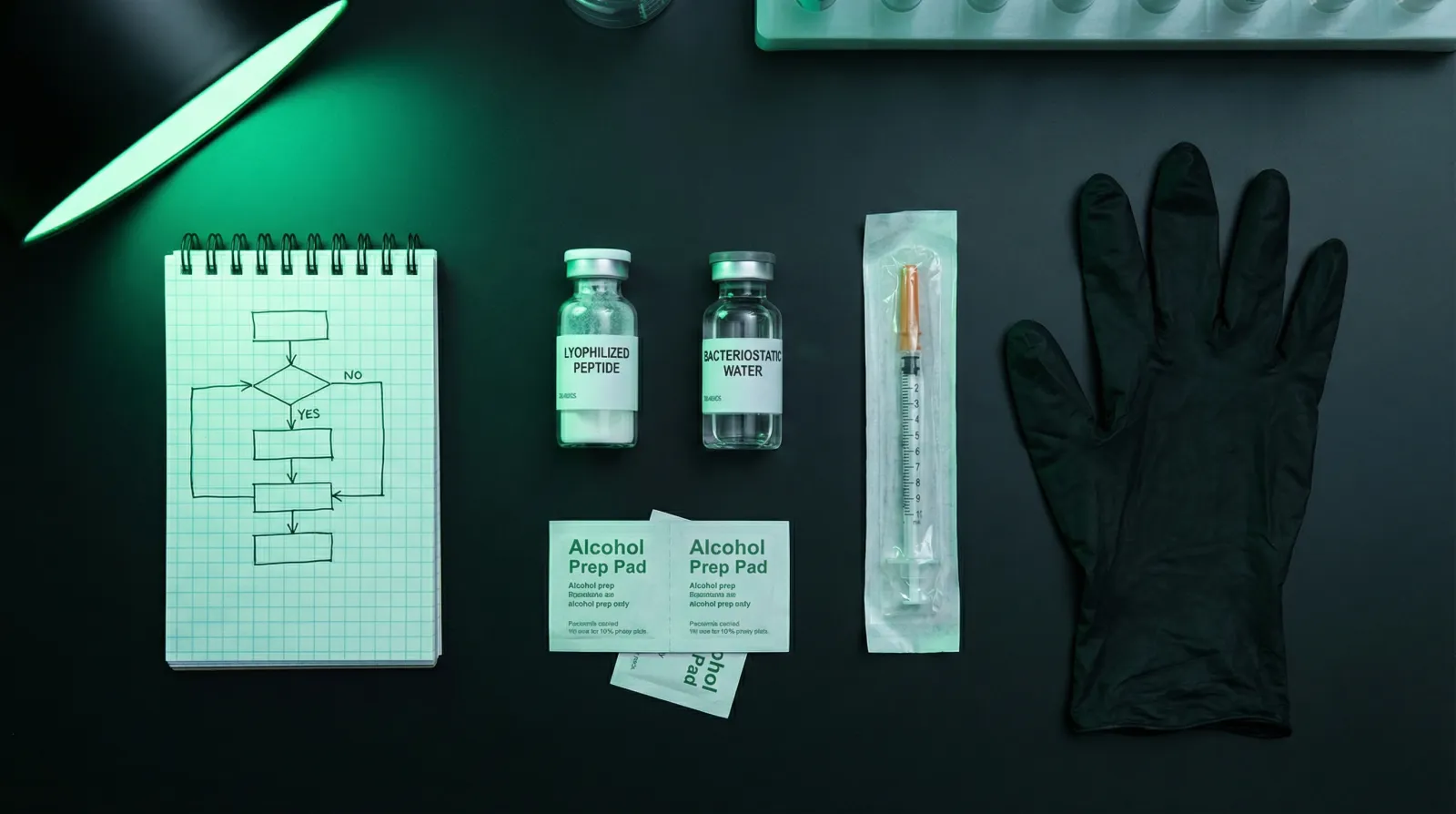
Our reconstitution guide covers how freeze-dried peptide powders are mixed and stored. We do not rank suppliers on this page. Our sources page sets out the seven criteria we check suppliers against.
Where to buy BPC-157
The hard part with BPC-157 isn't the protocol. It's finding a supplier that can prove what's in the vial. We assessed dozens against per-batch, third-party testing. A handful passed.
See the sources that passed →So What Are the Best Peptides for Injury, in Short?
On the evidence, none of the seven is proven to heal injuries in people. BPC-157 has the most injury studies, and nearly all are in animals. TB-500 has one rodent (rat) tendon study and no human data. The others were studied for skin, hormones, immunity or gut inflammation, not injuries.
The right dose, how often and how long to use any of them for injuries remain unknown. If you are weighing any of them, have a qualified clinician assess the injury first.
This content is for educational purposes only. These compounds are intended for research use. Nothing here is medical advice. Always consult a qualified clinician before considering any protocol.
Where to buy BPC-157
The hard part with BPC-157 isn't the protocol. It's finding a supplier that can prove what's in the vial. We assessed dozens against per-batch, third-party testing. A handful passed.
See the sources that passed →Share this article
Frequently Asked Questions
What is the best peptide for injury recovery?
Can you stack multiple recovery peptides together?
How long does peptide therapy take to work for injuries?
Are recovery peptides legal in 2026?
Do I need to inject peptides near the injury site?
Can I keep training while running a recovery peptide protocol?
Read Next

Disclaimer: This content is for educational purposes only. These compounds are intended for research use. Nothing here is medical advice. Always work with a qualified clinician before making changes to your health protocol.