
CJC-1295 Complete Guide: Mechanism, Dosing, Cycle Length

What is CJC-1295 and why is the standard story incomplete?
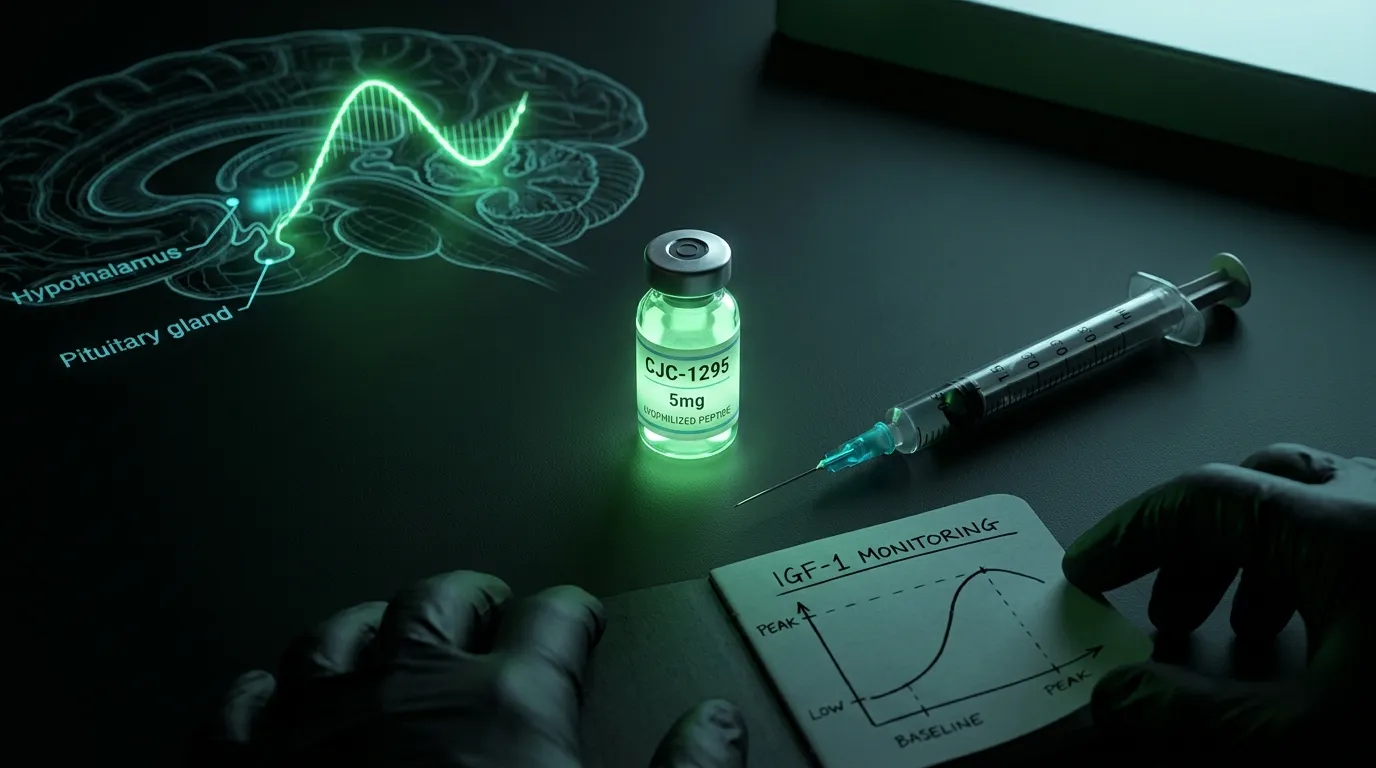
CJC-1295 is a long-acting GHRH analogue. That means a lab-made copy of the hormone that tells your pituitary to make growth hormone. In trials it raised GH 2- to 10-fold. It raised IGF-1 up to 3-fold. The famous 6-to-14-day window matters less than the folklore says.
The usual story is short. You dose CJC-1295 with DAC once a week. Sellers call it set-and-forget. The long half-life is the whole pitch.
I think that story misses three things. First, the trial that built its name used one big dose. The people in it were healthy adults. It was not a weekly protocol. Second, steady GHRH signalling can turn the receptor down. Sales copy skips that. Third, DAC versus no-DAC gets sold as a half-life contest. The case for pulsed dosing is stronger than that.
So I wrote this from the studies outward. I did not start with a protocol and defend it later.
With CJC-1295, the supplier matters as much as the dose. We only list sources that publish an independent, per-batch certificate of analysis. See the ones that clear it.
Why the 6-to-14-day elevation window is oversold
The half-life data is real. In 2006, Teichman and colleagues ran the landmark study. Healthy adults got one shot under the skin. Mean terminal half-life was 5.8 to 8.1 days. GH rose 2- to 10-fold. IGF-1 rose about 1.5- to 3-fold. For a peptide you inject, those numbers are strong. Teichman et al. 2006
Here is what that design cannot tell you. Does days-long GHRH signalling beat short bursts? Short bursts are how the body does it. The trial cannot say.
The GH axis never evolved to take steady GHRH. It evolved to take pulses. Native GHRH lasts two to three minutes. An enzyme called DPP-IV (dipeptidyl peptidase IV) breaks it down. So each signal is sharp and separate. Somatostatin, the brake hormone, then rises. The pulse ends. The quiet gap lets the cells reload.
Turn that signal steady and cells stop listening. Animal studies used non-stop GHRH infusion. GH output fell over time. The receptor gets pulled inside the cell. The cAMP signal fades too. The Teichman trial did not run long enough to see this in people. That gap is why I would go slow.
None of this makes DAC useless. It means the long window is not a free win.
What is the CJC-1295 mechanism of action?
The hypothalamus sends out GHRH(1-44) in pulses. Deep slow-wave sleep drives them. So do low calories and hard exercise. GHRH then reaches the front of the pituitary. There it binds the GHRH receptor (GHRHR). It is a G-protein-coupled receptor (GPCR). It sits on somatotroph cells, the cells that make GH.
The receptor couples to Gs. That switches on adenylate cyclase. Cyclic AMP rises inside the cell. Cyclic AMP turns on protein kinase A (PKA). PKA tags CREB (cAMP response element-binding protein). CREB then switches on the GH gene. PKA also lets calcium in. Stored GH spills into the blood.
CJC-1295 uses the same door as native GHRH. It just lasts days, not minutes. Two design changes do that. Amino acid swaps at positions 2, 8, 15, and 27 resist DPP-IV. A maleimide DAC (Drug Affinity Complex) linker sits at the C-terminus. It bonds to Cys34 on your own serum albumin.
That bond is the trick. Albumin stays in blood for about 19 days. It sits at roughly 40 grams per litre. So the peptide rides the body's main transport protein. The bond is reversible. Active peptide drips out over days. Teichman et al. 2006
Pulse shape still survives early on. Somatostatin still swings up and down. When the brake is on, little GH gets out. When it lifts, the waiting signal makes the pulse bigger. Ionescu and Frohman saw exactly that. Pulse height went up. GH did not sit high all day.
One question stays open. How long does that effect last before it fades?
CJC 1295 with DAC or CJC 1295 no DAC: which should I pick?
The sales framing is simple. DAC buys a long half-life and few shots. No-DAC, also called MOD-GRF 1-29, needs daily or twice-daily shots. Pick by convenience.
That framing skips the mechanism.
MOD-GRF 1-29 keeps the same DPP-IV-resistant swaps. It just has no albumin linker. Half-life drops to roughly 30 minutes, not 6 to 8 days. Each shot is one clean signal. Then the receptor rests. That is closer to normal biology.
My point is not that MOD-GRF 1-29 makes bigger pulses. Head to head, it likely does not. My point is about sensitivity. Repeated pulses may protect the receptor better. The wider GPCR literature backs that idea. No long human trial has tested it for CJC-1295.
| Feature | CJC-1295 with DAC | MOD-GRF 1-29 (No DAC) |
|---|---|---|
| Plasma half-life | 5.8 to 8.1 days | Approximately 30 minutes |
| Albumin binding | Yes (covalent, reversible) | No |
| DPP-IV resistance | Yes | Yes |
| Dosing frequency | Once or twice weekly | Daily to twice daily |
| GH pulse architecture | Pulse amplitude increased, pulsatility preserved short-term | Discrete pulses, more physiological pattern |
| Desensitisation risk | Theoretical over long protocols | Lower, refractory windows preserved |
| IGF-1 elevation duration | 6 to 14 days per injection | Hours per injection |
| Clinical trial data | Teichman 2006 (human, single dose) | Limited direct human data |
With CJC-1295, the supplier matters as much as the dose. We only list sources that publish an independent, per-batch certificate of analysis. See the ones that clear it.
See CJC-1295 dosage: DAC vs. no-DAC for a finer protocol split.
What the Teichman trial can and can't tell us
The 2006 study is still the main human evidence. It rewards a close read. Teichman et al. 2006
It enrolled healthy adults. Each got one shot under the skin. Doses ran 30 to 60 micrograms per kilogram of body weight.
Key findings:
- Mean GH rose 2- to 10-fold above baseline. Peaks came within hours.
- IGF-1 rose about 1.5- to 3-fold. It stayed up for 6 to 14 days.
- Mean terminal half-life was 5.8 to 8.1 days.
- Tolerability was acceptable. Injection site reactions were the most common adverse event.
- No serious adverse events were reported.
What it cannot tell you:
- Whether weekly dosing for 12 to 24 weeks holds the same GH and IGF-1 rise.
- Whether people over 40 with weaker somatotroph function respond the same way.
- Whether higher IGF-1 delivers the body composition, recovery or longevity results people want.
- Anything about safety past the study window.
That is not a knock on the study. It was a solid phase one trial. Phase one trials check kinetics and safety. The problem comes later. People treat one-dose data as proof for long protocols. It is not.
What is the right CJC 1295 dosage?
This part is educational only. A qualified clinician should supervise any human research use. This is not medical advice.
With DAC: how much and how often
The trial dosed by weight, 30 to 60 micrograms per kilogram. Most research protocols use a fixed dose instead. That is 1,000 to 2,000 micrograms per shot. Give it under the skin, one to two times per week. The low end is the careful choice: 1,000 mcg once weekly. It leaves a washout gap between doses.
Timing matters less here. The albumin store keeps releasing peptide anyway. Many researchers still inject at night. It loosely matches the body's own GH release.
MOD-GRF 1-29 without the linker
Half-life here is about 30 minutes. So timing matters a lot. Protocols use 100 to 300 micrograms per shot, under the skin. A pre-sleep shot rides the night GH surge, when the brake is low. A second shot 30 to 60 minutes before hard training lifts the exercise pulse.
Pairing it with a GHRP (growth hormone-releasing peptide) is best studied. Ipamorelin is the usual choice. GHRPs briefly lower somatostatin. That widens the window for GHRH to work. The result is more than simple addition. The CJC-1295 ipamorelin stack protocol guide has the detail.
How long should a cycle run?
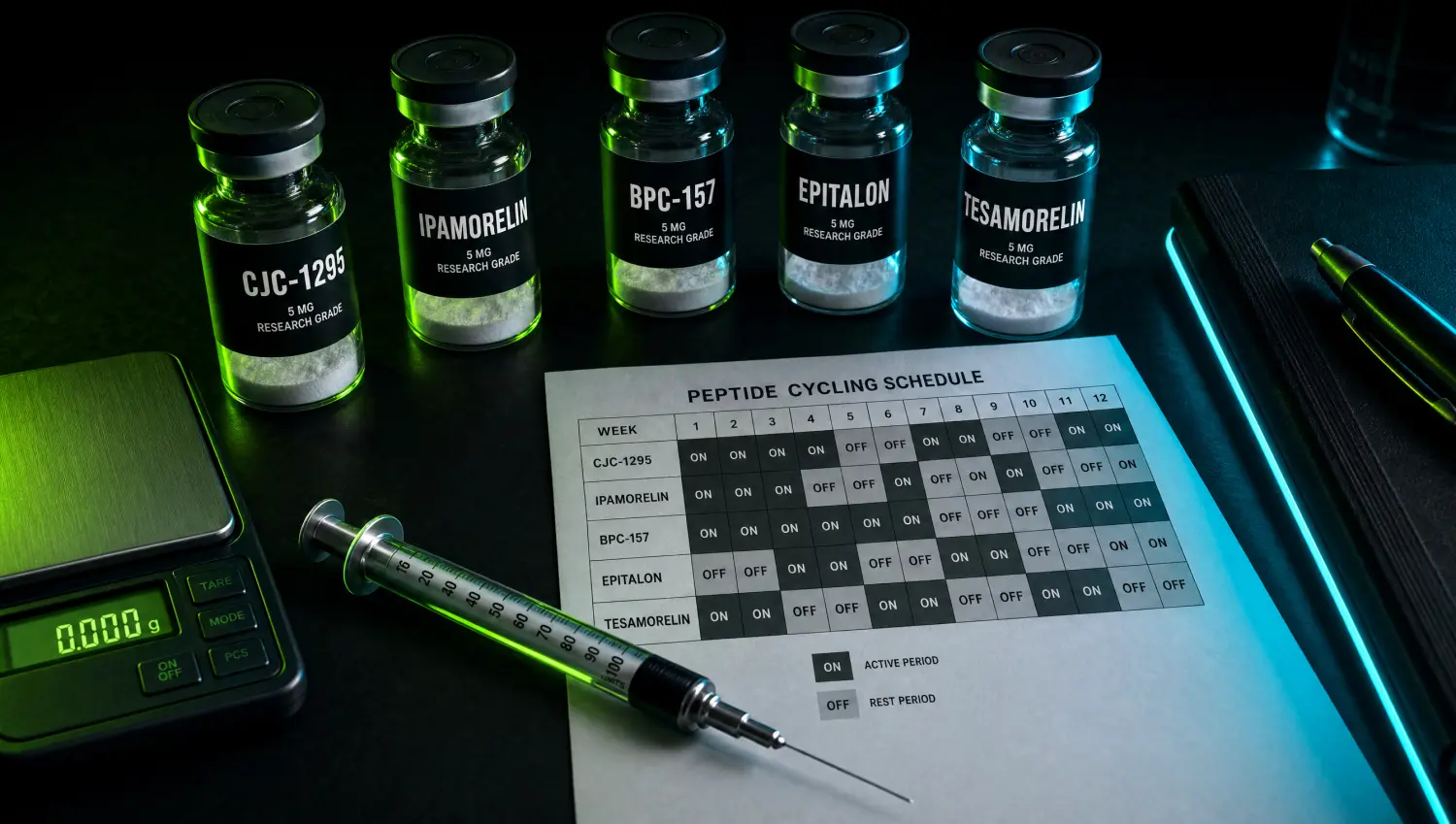
Community protocols run 8 to 16 weeks. The 16-week cap has a rationale. IGF-1 should drift back to baseline in the off weeks. That is reasoning, not trial data.
The careful read is an 8-week protocol with an equal break. That fits what we know about GPCR desensitisation. I would lean that way with DAC. Constant receptor occupancy is a real worry there.
| Protocol Variable | CJC-1295 with DAC | MOD-GRF 1-29 with GHRP |
|---|---|---|
| Dose per injection | 1,000 to 2,000 mcg | 100 to 300 mcg |
| Injection frequency | 1 to 2 times weekly | 1 to 3 times daily |
| Optimal timing | Flexible, evening preferred | Pre-sleep, pre-training |
| Protocol length | 8 to 12 weeks | 8 to 16 weeks |
| GHRP pairing benefit | Moderate | High (synergistic) |
| Administration complexity | Low | Moderate to high |
What are the CJC-1295 side effects in trial data?
Human data looks kind on tolerability. But the trial base is small and short. These effects come from the Teichman 2006 study. They also fit GHRH analogues as a class.
Water retention and soft tissue oedema (swelling): GH makes the kidneys hold sodium. Fluid then builds outside the cells. The 2- to 10-fold GH rise shifts real fluid in some people. It is the top complaint in research use. It shows up early and usually settles.
Injection site reactions: Redness, mild swelling and brief pain led the list in the Teichman cohort. They tracked with dose. They cleared on their own.
Headache and flushing: Both showed up at higher doses. Both passed. That fits a sharp rise in GH and IGF-1. IGF-1 also relaxes blood vessels through nitric oxide.
Insulin sensitivity: High GH works against insulin inside the cell. It blocks IRS-1 signalling. CJC-1295 does not reach the GH levels seen in acromegaly. Still, the 2- to 10-fold range is worth watching. Check fasting glucose and insulin. That matters most with metabolic risk factors. A clinician should assess it first.
Desensitisation, in theory: Human trials have not shown it. The wider GPCR work raises the flag. So does animal data on non-stop GHRH infusion. Tracking IGF-1 through a protocol is the practical check.
The data also shows what does not happen. Your own GHRH is not suppressed. There is no axis shutdown, as with injected HGH. Cortisol, TSH and LH look unchanged at the doses studied. The peptide works upstream of the pituitary. It does not replace it.
Is CJC 1295 ipamorelin worth stacking?
Alone, CJC-1295 hits one of two main GH switches. The other is the ghrelin receptor (GHSR). Somatostatin is the brake. A full approach touches all three.
Plus ipamorelin: This pairing has the most research. Full detail sits in the CJC-1295 ipamorelin guide. Ipamorelin turns on GHSR. It also lowers somatostatin for a short while. Together they release more GH than either one alone. Older GHRPs like GHRP-2 and GHRP-6 raise cortisol and prolactin. Ipamorelin does not, to any real degree. Johansen et al. 1999
Plus BPC-157: BPC-157 is a repair peptide. It works through growth factor signalling and nitric oxide. It also drives new blood vessel growth. It does not touch the GH axis. The two do not compete at any receptor. So they fit together in research use. See BPC-157 and TB-500 post-surgery recovery.
Plus GHK-Cu: GHK-Cu is the copper peptide. It acts on copper-driven gene switches and wound healing. Some researchers pair the two in anti-ageing work. The GHK-Cu complete guide covers it.
Two things I would not do. Do not stack DAC with another long-acting GHRH analogue. Do not add anything that blocks somatostatin all day. Both push GH past studied ranges.
Where this fits in an anti-ageing plan
GH and IGF-1 fall about 14 to 15 percent per decade. That starts after the early-adult peak. Some call the slide somatopause. By the fifth and sixth decades, pulses are small. IGF-1 is low too. Body composition, bone density, ageing markers, sleep and thinking all track with it.
CJC-1295 aims at that decline. It restores the GHRH signal. It does not bypass the pituitary. In a 40-year-old, the gland often has reserve left. The weak link is the signal from above. Boosting the signal is more targeted than replacing GH.
Common research goals: lean mass and less fat. Better slow-wave sleep. Bone and connective tissue support, through IGF-1-driven collagen. Faster recovery. For context, see best peptides for anti-ageing and longevity 2026. There is also best peptides for men over 40.
Mixing, storing and injecting the powder
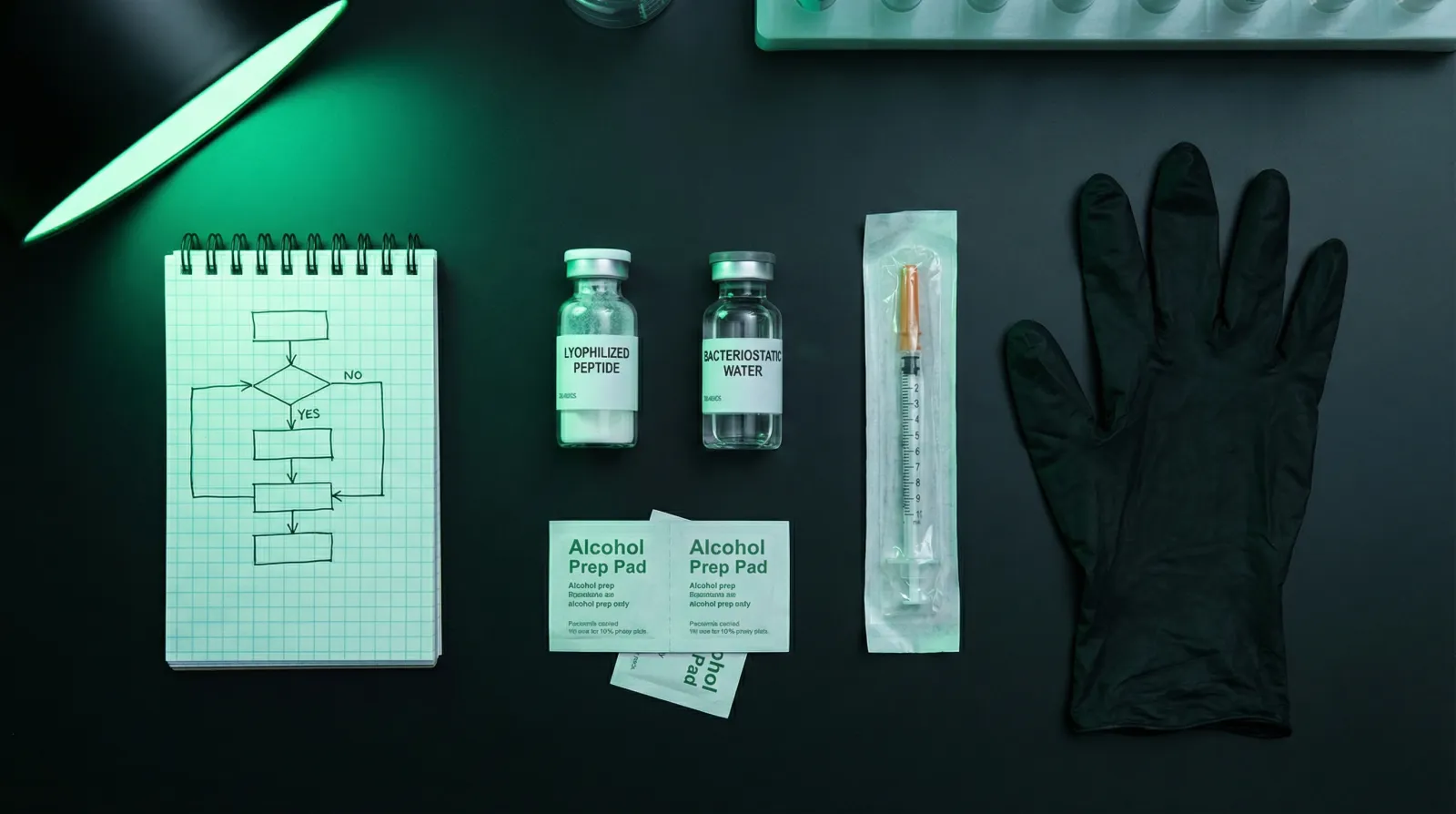
It ships as a freeze-dried powder. Vials are usually 2 mg or 5 mg. You mix it with bacteriostatic water. Run the water down the vial wall. Do not squirt it on the pellet. Swirl it gently. Never shake it. The how to reconstitute peptides guide walks through each step.
Once mixed, keep it at 2 to 8 degrees Celsius. Use it within 28 to 30 days. Sealed vials handle short trips at room temperature. Store them in the fridge. Freeze them for the long term, before mixing.
Inject under the skin, usually into lower belly fat. Rotate sites to avoid fat loss at one spot. A 29 or 31-gauge insulin syringe is standard. All research use needs proper oversight. Get clinician guidance first.
Where to source it
The hard part with CJC-1295 isn't the protocol. It's finding a supplier that can prove what's in the vial. We assessed dozens against per-batch, third-party testing. A handful passed.
See the sources that passed →The legal picture in 2026
The rules here are messy. The FDA has not approved it as a therapy. In the US, suppliers sell it under a research use only label. That means lab and study use, not human dosing. The compounding pharmacy route has faced heavy FDA scrutiny. Rules there have changed. The FDA reclassification guide covers the shift.
WADA bans GH-releasing peptides. It bans GHRH analogues too. If you get tested, read the full list first. The peptides legal again 2026 update has the current picture.
With CJC-1295, the supplier matters as much as the dose. We only list sources that publish an independent, per-batch certificate of analysis. See the ones that clear it.
My bottom line
This peptide is a real advance. The DAC albumin trick is clever. The trial data is strong for a peptide you inject. Lifting GHRH is a smarter answer to somatopause than replacing GH.
But the standard pitch is too neat. Steady signalling is not clearly better than bursts. The good data came from single doses in healthy young adults. The repeat-dose question is still open.
So I am not saying it fails. I am saying MOD-GRF 1-29 deserves a fairer hearing. The short-term data is firm. The long-term assumptions built on it are not. Used for research, with a clinician, it stays one of the most interesting GHRH analogues around.
This article is for educational purposes only.
Where to source it
The hard part with CJC-1295 isn't the protocol. It's finding a supplier that can prove what's in the vial. We assessed dozens against per-batch, third-party testing. A handful passed.
See the sources that passed →Share this article
Frequently Asked Questions
Does CJC-1295 with DAC cause receptor desensitisation over time?
What is the difference between CJC-1295 with DAC and MOD-GRF 1-29?
How long does it take for CJC-1295 to raise IGF-1 levels?
Can CJC-1295 be stacked with ipamorelin?
What are the main side effects of CJC-1295 documented in clinical trials?
Is CJC-1295 legal to buy and use?
Read Next
Disclaimer: This content is for educational purposes only. These compounds are intended for research use. Nothing here is medical advice. Always work with a qualified clinician before making changes to your health protocol.