
BPC-157 Dosage: What Human and Animal Studies Actually Used

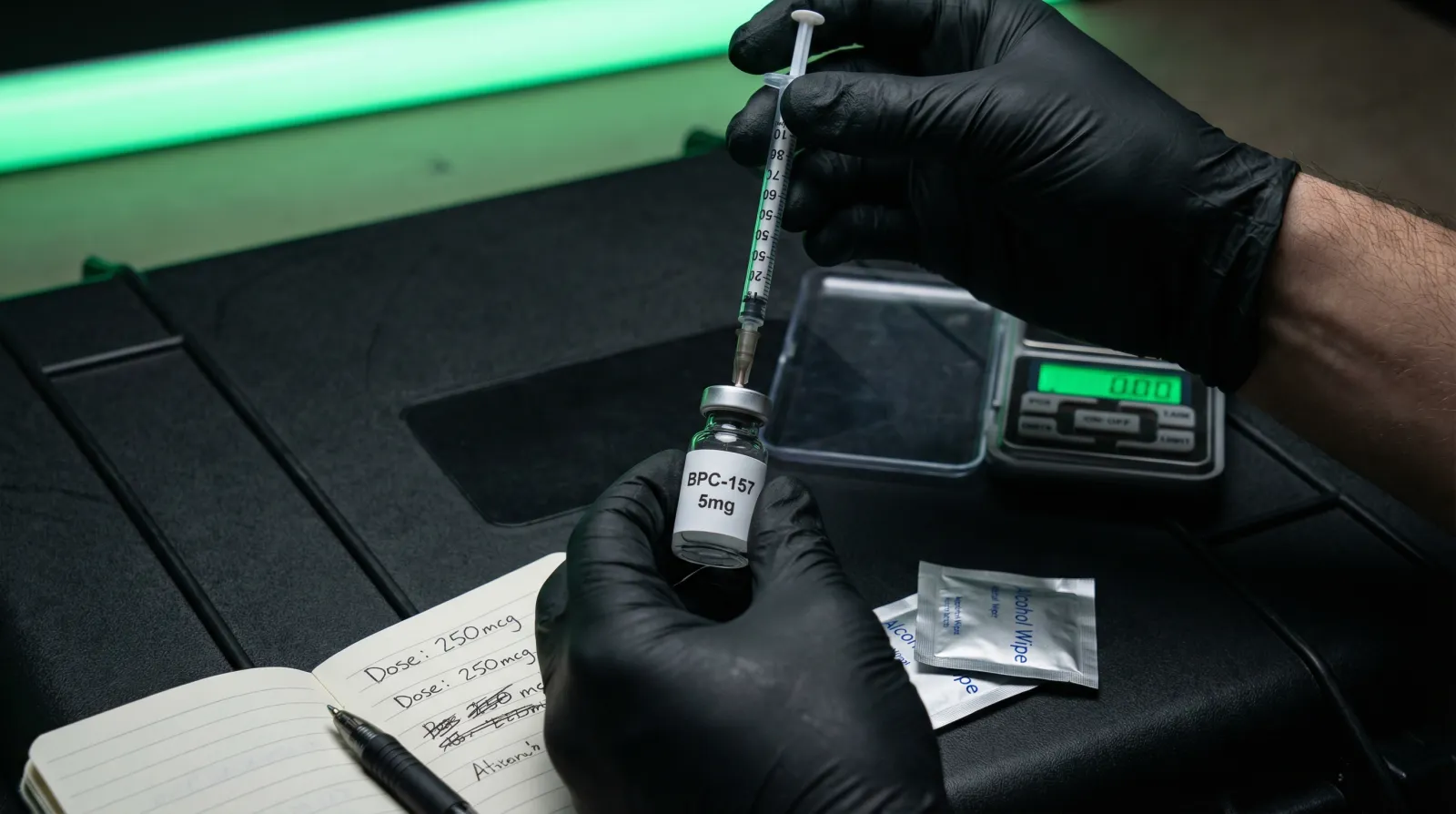
Is There a Standard BPC-157 Dosing Protocol?
There is no standard BPC-157 dosage. No full journal paper on a controlled trial of any dose has been published. Two small studies gave it into the rectum and compared it with a placebo, a dummy treatment. Both were only summarised at conferences. Other human doses come from an unreported trial plan and three small clinic reports.
That is the short version of what the sources say. This page sets out each dose a named study used, in that study's own terms. It gives the species, the route and the length of dosing. It does not turn any of them into advice. For back injuries, see our BPC-157 herniated disc page.
This content is for educational purposes only and is not medical advice. These compounds are intended for research use. A qualified clinician can advise on any health decision.
What Does a BPC-157 Dosing Chart From Published Studies Show?
This chart lists the doses named in published studies and one trial record. Each row names its source. The animal doses are per kilogram (kg) of body weight. No study has shown that any of them is right for a person.
| Source | Who | Route | Dose (as reported or planned) |
|---|---|---|---|
| NCT02637284 (Phase I plan, a first safety trial in people) | Healthy adults, 18-35 | By mouth | Planned: tablets of 1 mg: one dose of 1, 3 or 6 tablets, then 3 tablets three times daily for 14 days. No results posted. |
| Veljaca 2002 and 2003, meeting abstracts (short conference summaries), per the FDA briefing | Healthy volunteers; 24 got BPC-157, 8 a placebo | Enema (liquid given into the rectum) | 0.25, 0.5, 1 or 2 mg per kg once, then once daily for 7 days |
| Ruenzi 2005, meeting abstract, per the FDA briefing | 53 people with ulcerative colitis (a bowel disease), split by chance 1:1 to BPC-157 or placebo | Enema | 80 mg once daily for 2 weeks |
| Lee et al. 2024 | 12 women with bladder pain | Injected into the bladder wall during cystoscopy (a camera passed into the bladder) | 10 injections of 1 mg, 10 mg total, in one procedure |
| Lee and Burgess 2025 | 2 adults | Drip into a vein | 10 mg on day 1, then 20 mg on day 2 |
| He et al. 2022 | Rodents (rats) | Into a muscle | 20, 100 or 500 mcg per kg once. Also 100 mcg per kg daily for 7 days. |
| He et al. 2022 | Beagle dogs | Into a muscle | 6, 30 or 150 mcg per kg once. Also 30 mcg per kg daily for 7 days. |
| Gjurasin 2010 | Rodents (rats), cut sciatic nerve | Into the belly, by stomach tube, or at the nerve | 10 mcg, or 10 ng per kg (as given in the abstract) |
A nanogram (ng) is one thousandth of a microgram (mcg).
How Does Dosing for BPC-157 Relate to Body Weight?
In animal studies, the dose is set per kilogram of body weight. Only one human study did the same. It was the Veljaca enema study, a liquid dose given into the rectum, at 0.25 to 2 mg per kg. The other human doses are flat amounts per person.
One research group did link the two. He et al. 2022 wrote that their proposed clinical dose was 200 mcg per person per day. They planned trials for severe trauma and burns in China. They converted that dose to 20 mcg per kg for rats and 6 mcg per kg for dogs. The conversion used body surface area, not body weight alone. The same paper says earlier work found doses of 6 to 50 mcg per kg effective in mice, rats and rabbits.
That 200 mcg figure is a proposal for a trial. The paper reports no human dosing, and no result for that dose in people.
How BPC-157 Works in the Body
BPC-157 is Body Protection Compound-157. It is a chain of 15 amino acids, a short protein. It is part of a larger protein first found in human gastric juice, the fluid in the stomach Chang 2011. The BPC-157 used in research is synthetic, made in a lab Yuan 2026. He et al. 2022 write that it can be stored at room temperature and is resistant to gastric juice. Our BPC-157 guide covers the compound in full.
Three lab studies looked at how it acts on cells. First, it raised growth hormone receptor levels in tendon fibroblasts. Fibroblasts are the cells that rebuild connective tissue. Chang 2014 showed this in rodent (rat) tendon cells in a dish. The cells then grew more when growth hormone was added.
Second, it switched on the FAK-paxillin pathway, a signal chain that controls how cells move. In rodent (rat) tendon cell work, it helped fibroblasts grow out of tendon pieces, survive stress and migrate Chang 2011.
Third, it raised VEGFR2, a receptor that tells blood vessels to grow. It also switched on the VEGFR2-Akt-eNOS pathway, a signal chain linked to new vessel growth. Hsieh 2017 found this in human cells that line blood vessels. In rodents (rats) with poor blood supply to a hind leg, blood flow recovered faster.
A separate study cut the sciatic nerve, the main nerve of the leg, in rodents (rats). BPC-157 improved nerve healing and walking recovery after the cut Gjurasin 2010.
What Does BPC-157 Human Clinical Trial Dosing Show?
The human record on dosing is thin, and published reviews count it differently. A 2025 systematic review (a structured search of three medical databases, up to June 2024) looked at BPC-157 in sports medicine. It found 36 studies. 35 were preclinical, meaning animal or cell work. Just 1 was clinical, meaning it was done in people. The review found no clinical safety data at all Vasireddi et al. 2025.
A 2026 review describes human research as limited to small pilot studies. The FDA's 2026 briefing document for its advisory panel lists five clinical studies. Two were placebo-controlled enema studies, reported only as meeting abstracts (short conference summaries). The FDA also lists the Phase I trial record, a first safety trial in people. The table below sets out all of them.
| Study | Who | BPC-157 Dose | What Came Out |
|---|---|---|---|
| Veljaca 2002 and 2003, Phase 1 safety study (meeting abstracts, summarised in the FDA briefing) | 32 healthy volunteers: 24 given BPC-157, 8 a placebo | Enema of 0.25, 0.5, 1 or 2 mg per kg. One dose, a week off, then once daily for 7 days. | The authors reported no significant adverse events linked to treatment. Headache and flatulence were most common, with no clear difference from placebo. Blood levels of BPC-157 were mostly too low to measure. |
| Ruenzi 2005, randomised (split by chance), double-blind (neither patients nor staff knew who got what), placebo-controlled study (meeting abstract, summarised in the FDA briefing) | 53 people with mild to moderate ulcerative colitis; 46 finished | Enema of 80 mg or placebo, once daily for 2 weeks | The FDA found "a lack of evidence to make a conclusion on the effectiveness of BPC-157 for treating UC." |
| Phase I trial NCT02637284 | 42 healthy adults, aged 18-35 (planned) | Oral tablets of 1 mg each: one dose of 1, 3 or 6 tablets, then 3 tablets three times daily for 14 days. Some were to get a dummy tablet instead. | Status unknown. No results ever posted. |
| Lee et al. 2024 pilot, bladder pain (interstitial cystitis) | 12 women | Injected into the bladder wall during cystoscopy, a camera passed into the bladder (10 injections of 1 mg, 10 mg total) | 10 of 12 reported full symptom relief. No adverse events reported. No comparison group. |
| Lee and Padgett 2021, knee pain chart review | 16 patients reached by phone | Injection into the knee joint; 2-4 mg (1-2 doses), per the FDA's 2026 briefing document | 11 of 12 given BPC-157 alone reported significant improvement in knee pain. A look back at clinic records, not a trial. |
| Lee and Burgess 2025 pilot, drip into a vein (intravenous) | 2 adults who had both had BPC-157 by drip before | 10 mg on day 1, then 20 mg on day 2, each given over one hour | No side effects reported. No change in the heart, liver, kidney, thyroid or blood sugar markers tested. |
The two enema studies are the only placebo-controlled human results. Both exist only as meeting abstracts, and a PubMed search we ran found no full journal paper on a controlled trial. On the colitis study, the FDA wrote that "interpretation of the results is limited." It gave two reasons: "the lack of details provided in the meeting abstract and the exploratory nature of the study." On the human studies as a group, the FDA said they "were of short duration" and "had small sample sizes." It added that they "evaluated doses that were likely exploratory in nature." It also said "the authors provided limited information on safety data."
The Phase I trial planned oral tablets with a placebo group. Its ClinicalTrials.gov status is unknown, and it has never posted results. The three Lee clinic reports had no comparison group.
What Is Known About the BPC-157 Dosing Schedule?
No human study has compared one schedule with another. Four multi-day human schedules are on record. The two enema studies gave it once daily, for 7 days and for 2 weeks. A two-person IV (drip into a vein) report gave 10 mg on day 1 and 20 mg on day 2. The oral Phase I plan set 3 tablets of 1 mg, three times daily for 14 days, and posted no results.
The animal data is about how fast the body clears it. In rodents (rats) and beagle dogs, the half-life was under 30 minutes He et al. 2022. Half-life is the time it takes for half the drug to leave the blood. The intact peptide could not be found in the blood 4 hours after a dose. Daily doses for 7 days gave much the same blood levels as a single dose.
The 2025 review also puts the half-life under 30 minutes Vasireddi et al. 2025. In people, the FDA's briefing says "there is no information to assess the pharmacokinetics of BPC-157 in humans." Pharmacokinetics is how the body takes in and clears a drug. None of these sources turns the half-life into a human schedule.
Is BPC-157 Oral Dosing Different From Injectable?
No published study we found has compared the two in people. Each route has a little data behind it.
By mouth, the only human record is the Phase I trial plan, which used tablets and posted no results. The FDA found no human data on how BPC-157 is absorbed after oral or under-the-skin dosing. By enema, it noted that BPC-157 does not appear to be absorbed into the blood. In rodents (rats), Gjurasin 2010 gave it by stomach tube, into the belly or at the nerve, and reports improved nerve healing.
By injection into a muscle, He et al. 2022 measured how much reached the blood. It was about 14-19% in rats and 45-51% in beagle dogs, compared with a dose into a vein. No study has measured this in people. Our breakdown of oral versus injectable BPC-157 covers the two routes in more depth.
What Is Known About BPC-157 Safety
The safety data is almost all from animals. Xu 2020 tested BPC-157 in rodents (mice and rats), rabbits and dogs. A single large dose caused no effects linked to the peptide. Per the FDA's review, that dose was 20 mg per kg into a muscle in rats and 10 mg per kg in dogs. With 28 days of daily dosing in dogs, creatinine fell. Creatinine is a blood marker of kidney function. The authors' abstract reports this at 2 mg per kg only. The FDA's review of the paper reports it in female dogs at 2 mg per kg. In male dogs, it reports it at 0.5 mg per kg and above. The dogs recovered within 2 weeks of stopping. The study found no genetic or embryo-fetal toxicity, meaning harm to an unborn animal. The authors concluded that the peptide was well tolerated, with no serious toxicity in mice, rats, rabbits or dogs.
In people, the 2025 review found no clinical safety data Vasireddi et al. 2025. The FDA's 2026 briefing did find five small human studies. It said no serious adverse events appear to have been reported. Its conclusion was that "there is insufficient clinical safety information to characterize the safety profile" of BPC-157.
USADA, the US anti-doping agency, puts it plainly. Because BPC-157 has not been studied much in people, it says, it is unknown if there is a safe dose. The FDA says it lacks enough information to know whether the drug would cause harm in humans.
One open question follows from the lab work. Hsieh 2017 found that BPC-157 promotes new blood vessel growth. No study we found has tested what that means for people with cancer.
Where BPC-157 Stands With the FDA and WADA
USADA says no health authority has approved BPC-157 for human clinical use. The FDA lists BPC-157 on its page of bulk substances that may pose safety risks in compounding. Compounding is when a pharmacy makes a drug to order. BPC-157 sits in the group whose nominations were withdrawn.
On that page, the FDA says compounded BPC-157 may carry an immunogenicity risk by some routes. That is the risk of an immune reaction. The FDA also says it has found no, or only limited, safety information for the proposed routes.
In July 2026, an FDA advisory panel reviewed BPC-157 for the 503A bulks list. That is the list of substances pharmacies may compound from. The use put to the panel was ulcerative colitis, a bowel disease. The FDA has posted no vote record. The trade journal PharmExec reported that the panel voted in favour of allowing it to be compounded. PharmExec also noted that the FDA is not bound by the vote. Our guide to getting a BPC-157 prescription covers what that means in practice.
In sport, USADA says BPC-157 is banned under the S0 Non-Approved Substances part of the list kept by WADA, the World Anti-Doping Agency. A therapeutic use exemption is a medical waiver to use a banned drug. USADA says one is unlikely to be approved for BPC-157. It also says it looks at each request case by case. Two anti-doping labs have published urine tests for it, one in the US Cox 2017 and one in China Tian 2023. The Chinese method uses mass spectrometry, a lab test that weighs molecules. See our full breakdown in is BPC-157 banned by WADA.
Where to buy BPC-157
The hard part with BPC-157 isn't the protocol. It's finding a supplier that can prove what's in the vial. We assessed dozens against per-batch, third-party testing. A handful passed.
See the sources that passed →Product Quality, and Related Guides
A label is only as good as the product. The FDA notes that compounded BPC-157 may have complexities with peptide-related impurities and with characterising the active ingredient. The 2025 review says harm is possible from contamination. It also names unregulated manufacturing as a risk.
Concentration is plain arithmetic: mcg per ml equals the peptide amount in mcg divided by the liquid added in ml. It is arithmetic, not a dose. The BPC-157 dosage calculator runs the same division.
A US sports testing lab reported finding BPC-157 in confiscated vials Cox 2017. We keep a vendor-neutral breakdown on our sources page. For quality checks, see how to know if peptides are real and the peptide purity crisis.
We also have guides on other peptides. Our Wolverine stack guide covers BPC-157 with TB-500. The TB-500 dosage guide covers TB-500 alone. We also cover GHK-Cu for wound healing and a guide to peptides for knee cartilage and osteoarthritis.
Every dose on this page comes from a named study or trial record, not from approved labelling. For the compound's full profile, see the BPC-157 compound page.
Where to buy BPC-157
The hard part with BPC-157 isn't the protocol. It's finding a supplier that can prove what's in the vial. We assessed dozens against per-batch, third-party testing. A handful passed.
See the sources that passed →Share this article
Frequently Asked Questions
Is there a correct BPC-157 dosage for beginners?
How is BPC-157 concentration worked out from a vial?
What doses have been given to people in BPC-157 studies?
Is there a difference between BPC-157 dosage and BPC-157 dosing frequency?
Can BPC-157 dosage be too high?
Is there a tested BPC-157 dosing cycle?
Read Next
Disclaimer: This content is for educational purposes only. These compounds are intended for research use. Nothing here is medical advice. Always work with a qualified clinician before making changes to your health protocol.