
Semax Complete Guide: Neuropeptide for Focus and Memory

What Is Semax, and What Does It Actually Do?
Semax is a Russian peptide taken from ACTH(4-10), a fragment of a natural hormone. Doctors there have prescribed it since 1994. In rats, one nasal dose raised BDNF, a growth signal for nerve cells, in the hippocampus, the brain's memory hub. In stroke patients, a course raised BDNF in the blood.
Most nootropics, the drugs people take to sharpen thinking, are stimulants in a lab coat. They borrow against tomorrow's focus and call it energy. Semax works on something else. It acts on the signalling that keeps your brain plastic and well connected. That difference matters more than most guides admit.
This guide covers the mechanism, the evidence and its limits, the doses named sources report, the three variants, side effects and sourcing. Studies are named where we use them, and the References list gives the details. Nothing here is medical advice. This content is for educational purposes only and is intended for research use.
Where did it come from?
Semax is a synthetic heptapeptide, which means a chain of seven amino acids. Its sequence is Met-Glu-His-Phe-Pro-Gly-Pro. It comes from the ACTH(4-10) fragment of adrenocorticotropic hormone. Researchers at the Institute of Molecular Genetics in Moscow built it in the 1980s. They wanted the nerve-supporting part of ACTH without the hormone effects. Russia and Ukraine have used it in clinics since the mid-1990s, first for stroke recovery and memory problems.
It is a registered medicine in Russia. ADDF lists its Russian uses as stroke, poor blood flow in the brain, Parkinson's, optic nerve damage and nerve problems in newborns. It is not FDA-approved. Western regulators have never reviewed its file. That gap reflects where the research was done. It is not a verdict on the science.
Biohackers picked it up for a reason. The reported effects are not stimulant effects. Caffeine and modafinil speed up processing. Semax appears to improve the wiring that processing runs on.
It sells in two strengths, 0.1% and 1%. The 1% solution holds ten times as much peptide per millilitre. Two modified versions also sell: N-Acetyl Semax and N-Acetyl Semax Amidate, sometimes shortened to NASA. No published trial has tested a dose of either one.
This content is for educational purposes only. These compounds are intended for research use. A qualified clinician can advise on any health decision.
How Does Semax Peptide Work in the Brain?
Several systems move at once. The studies below take them one at a time.
How does it raise BDNF and TrkB?
The main effect is more BDNF. That is brain-derived neurotrophic factor, a growth signal for nerve cells. Its receptor TrkB rises too. Both climbed in the rat hippocampus. A landmark animal study in Brain Research gave one nasal dose of 50 mcg/kg. BDNF protein rose 1.4-fold. TrkB phosphorylation, the switch that turns the receptor on, rose 1.6-fold. BDNF mRNA, the gene's working copy, rose 3-fold in the rat hippocampus. (Dolotov OV et al., 2006, PMID 16996037)
BDNF is the main signal behind synaptic plasticity. That is how a brain stores learning. Low BDNF tracks with memory decline, stubborn depression and faster nerve loss.
A later rat study looked wider. It tracked the BDNF and NGF genes over 24 hours. NGF is nerve growth factor. It measured the hippocampus, frontal cortex and retina. The changes ran in different directions. At 20 minutes, both genes fell in the hippocampus and retina. They rose in the frontal cortex. In the retina, BDNF gene activity was significantly increased 90 minutes after dosing. (Shadrina et al., 2010, PMID 19662538)
What about dopamine?
It also nudges dopamine. Animal work shows two things. It can amplify the dopamine release caused by stimulants. It can raise BDNF on its own. That pairing is why ADHD came up. A 2007 paper links ADHD to disturbed dopamine and BDNF function. (Tsai SJ, 2007, PMID 16996699) The studied effects sit on focus and memory.
How does it calm inflammation after an injury?
In stroke models it quietens genes that drive inflammation. MMP-9, an enzyme that breaks down tissue, is one. JNK, a stress signal inside cells, is another. It also switches on repair signals such as CREB, a protein that turns on survival genes. A 2021 study went further. It measured proteins in a rat stroke model, not just gene readouts. It confirmed both halves. (Sudarkina OY et al., 2021, PMID 34201112) Damage down, repair up.
What Does the Research Actually Show?
PubMed lists roughly 226 citations. They go back to the 1990s. This is not a fringe compound. The evidence is real, and it clusters in a few areas. The honest summary runs like this. Strong mechanism work. Solid Russian clinical data. Little Western trial replication.
What does the stroke data show?
Russian clinics have used it after ischaemic stroke, a stroke from a blocked artery, since 1994. One study examined 110 patients. Those in the Semax subgroups took 6,000 mcg a day. That ran across two 10-day courses, split by a 20-day gap. Plasma BDNF rose. It stayed up for the whole study. That held whether rehabilitation started early or late. Higher BDNF tracked with better Barthel index scores. That scale measures how well a patient copes alone. The authors concluded that Semax and early rehabilitation speed recovery and improve motor performance. (Gusev EI et al., 2018, PMID 29798983)
An earlier study set the first marker. It gave the peptide to 30 acute stroke patients, against 80 controls. Adding it to intensive therapy had some influence on how fast damaged functions returned. Motor problems improved most of all. (Gusev EI et al., 1997, PMID 11517472)
Both trials have limits. Neither was double-blind and placebo-controlled. Neither was repeated in the West. Neither abstract reports randomisation. Those limits are real. They should shape how much weight you give the human data. They do not make it worthless. It stays the best human evidence we have. The compound has more than 30 years of clinical use behind it.
What happens in healthy people?
A 2018 fMRI study scanned 24 healthy volunteers at rest. fMRI is a brain scan that tracks blood flow. The front (rostral) part of the default mode network grew after a nasal dose, against placebo (Lebedeva et al., 2018, PMID 30225715). That network handles inward-facing thought. So the scan shows real change in healthy brains. Not just in damaged tissue.
Does it help attention and ADHD?
A 2007 paper proposed it for ADHD. In animals, Semax boosted the dopamine release that stimulants cause. It also raised BDNF. That case is a proposal, not a result. We found no published ADHD trial of Semax on PubMed.
How strong is each claim?
| Indication | Evidence Level | Best Study Design | Notes |
|---|---|---|---|
| Ischaemic stroke recovery | Moderate (human) | Controlled clinical studies, n=110; randomisation not reported | 30+ years clinical use in Russia; no Western RCT |
| BDNF upregulation | Strong (preclinical) | Several animal studies | Brain data from animals only |
| Cognitive enhancement (healthy) | Low | One placebo-controlled fMRI study, n=24 | Brain network change only; no cognitive endpoint cited |
| Neuroprotection (anti-inflammatory) | Moderate (preclinical) | Protein + transcriptome studies in ischaemia models | Animal data only |
| ADHD attention improvement | Low | Hypothesis paper only (Tsai 2007) | Mechanistic rationale only; no published ADHD trial found |
Why Is Nasal Semax the Standard Route?
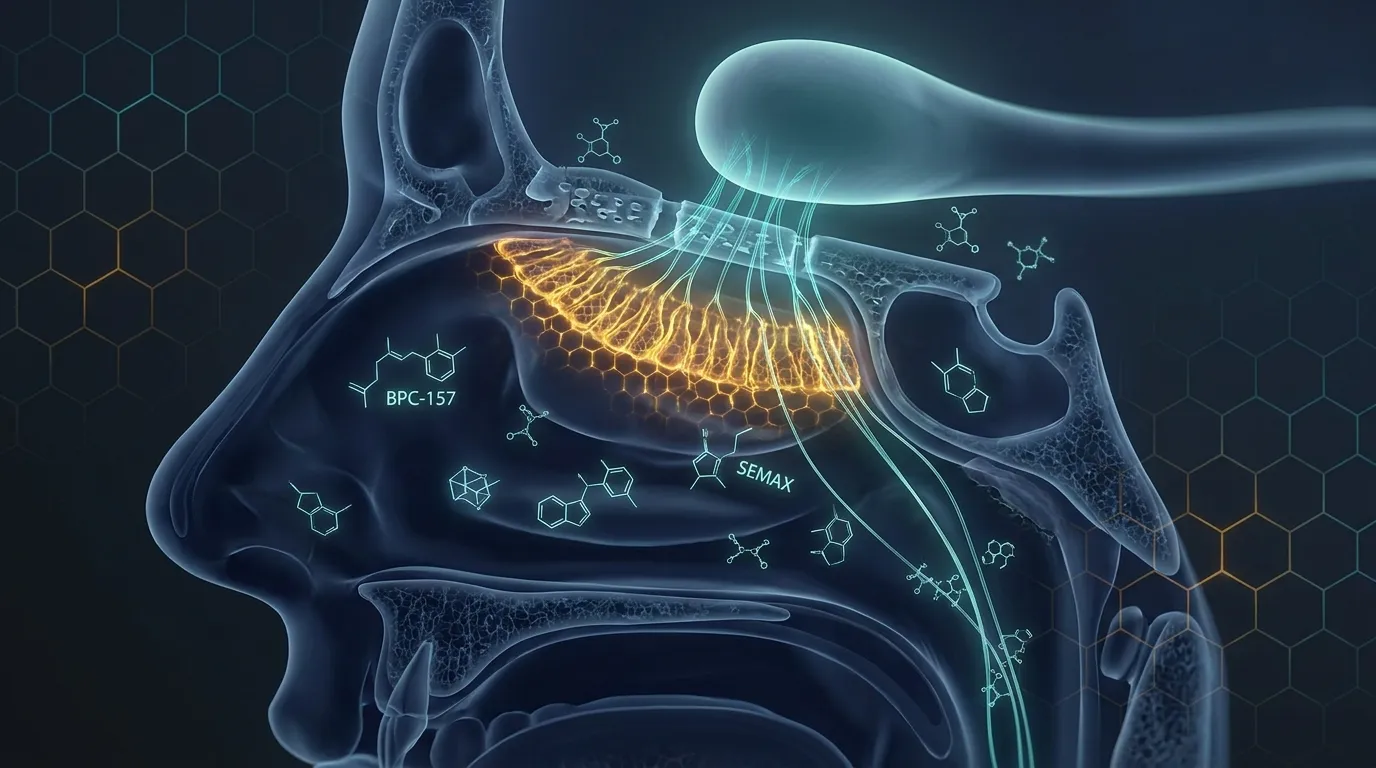
ADDF says Semax is usually taken through the nose, by dropper. The Dolotov rat study gave its single dose by nose. Another rat study measured gene changes from 20 minutes to 24 hours after a dose.
What Does the Semax Peptide Dosing Data Show?
No trial has set a dose for nootropic use. The figures below are the ones named sources report. Our nasal versus injection dosage guide covers route choice in more depth.
Which concentration are you holding?
Semax sells in two strengths, 0.1% and 1%. The 1% solution holds ten times as much peptide per millilitre. A mix-up is a tenfold error.
What doses have named sources used?
- Healthy people: ADDF reports that healthy individuals use 1-2 drops of the 0.1% solution twice a day. (ADDF Cognitive Vitality report)
- Stroke patients: the 2018 study gave its Semax subgroups 6,000 mcg a day. That ran as two 10-day courses with a 20-day gap. (Gusev EI et al., 2018, PMID 29798983)
- Nootropic use: no trial has set a dose, a timing or a cycle.
What does the protocol chart cover?
| Protocol | Daily Dose | Concentration | Cycle | Best For |
|---|---|---|---|---|
| Healthy individuals (ADDF) | 1-2 drops, twice a day | 0.1% | Not stated | Healthy individuals |
| Stroke trial (Gusev 2018) | 6000 mcg | Not stated | 10 on / 20 off x2 | Ischaemic stroke recovery |
For sourcing quality-checked material, see our recommended sources and our guide to reading a peptide Certificate of Analysis.
Is N-Acetyl Semax Amidate Stronger Than the Original?
No published trial has compared them.
Three versions share the same core seven amino acids. They differ at the ends of the chain.
What do the two changes do?
Standard Semax is the plain heptapeptide. It carries the most safety and dosing data.
N-Acetyl Semax adds an acetyl group, a small chemical cap, to the methionine end of the chain.
N-Acetyl Semax Amidate adds a second cap, an amide, at the other end.
Is there a dose for the modified forms?
No. No published trial has tested N-Acetyl Semax or N-Acetyl Semax Amidate, or compared their potency with Semax.
| Variant | Modifications | Relative Potency | Typical Research Starting Dose | Evidence Base |
|---|---|---|---|---|
| Standard Semax | None (parent compound) | 1x (reference) | ADDF reports that healthy individuals use 1-2 drops of the 0.1% solution twice a day. | Controlled clinical studies in Russia (n=30 vs 80 controls; n=110); randomisation not reported in the abstracts. |
| N-Acetyl Semax | N-terminal acetylation | None published | None published; no trial has tested a dose | Thin: preclinical + community data only |
| N-Acetyl Semax Amidate | N-terminal acetylation + C-terminal amidation | None published | None published; no trial has tested a dose | Very thin: no published clinical trials |
See also: best nootropic peptides for focus and memory, for a wider comparison of cognitive peptides.
What Are the Semax Side Effects?
The published human safety record is thin. The Alzheimer's Drug Discovery Foundation has reviewed it. It found little human evidence on side effects, against many preclinical studies. It adds that long-term side effects are unknown. (ADDF Cognitive Vitality report)
What do the clinical records show?
ADDF, which could not access the original data, cites a 2013 review by Kolomin and colleagues. The most common adverse events it reports are two. One is discoloration of the nasal cavity (~10% of patients). The other is an increase in blood glucose levels in diabetics (~7.4% of patients). (ADDF Cognitive Vitality report)
The same report lists drug interactions as not known.
What do the sources say about risk groups?
| Group | What the sources report |
|---|---|
| Diabetes | ADDF, citing a 2013 review, reports an increase in blood glucose levels in diabetics in about 7.4% of patients |
| Pregnancy / breastfeeding | No source cited here reports safety data in these groups |
| Long-term use | ADDF: long-term side effects are unknown |
| Other medicines | ADDF: drug interactions are not known |
What mistakes do people make?
- Mixing up the 0.1% and 1% solutions. The 1% solution holds ten times as much peptide per millilitre, so a mix-up is a tenfold error.
- Buying without a COA. See how to know if peptides are real and our guidance on reliable peptide sources first.
Where Does This Fit in a Nootropic Stack?
It comes up often in stack discussions.
Where does Selank sit alongside it?
These two get compared more than any other cognitive peptides. Both came out of the Institute of Molecular Genetics in Moscow. Both turn up in the same stack discussions. The functional split is simple. One is studied for thinking and nerve protection. Selank is studied for anxiety and stress. Our head-to-head comparison takes that apart properly.
| Feature | Semax | Selank |
|---|---|---|
| Amino acid sequence | Met-Glu-His-Phe-Pro-Gly-Pro | Thr-Lys-Pro-Arg-Pro-Gly-Pro |
| Enkephalin-degrading enzymes in human serum (lab study) | Slowed (Kost 2001) | Slowed (Kost 2001) |
One lab study found that both peptides slow the enzymes that break down enkephalins, the body's own calming signals, in human serum. (Kost NV et al., 2001, PMID 11443939)
No trial has tested the two together. Full protocol guidance is in the Selank complete guide. For a wider cognitive stack, the peptide stacks that work guide covers combinations with evidence behind them.
Which other partners are worth knowing?
BPC-157 and Thymosin Alpha-1 also come up in stack talk. No source cited here tests any of them with Semax. ADDF lists Semax drug interactions as not known.
Building a wider plan? The best peptides for men over 40 guide shows where this one sits beside growth hormone and healing peptides. For longevity frameworks, see best peptides for anti-ageing and longevity 2026.
Where to buy Semax
The hard part with Semax isn't the protocol. It's finding a supplier that can prove what's in the vial. We assessed dozens against per-batch, third-party testing. A handful passed.
See the sources that passed →How Do You Check Quality Before You Buy?
Quality decides everything here.
Minimum standards for any purchase:
- Third-party Certificate of Analysis: HPLC purity at 99% or above. HPLC is a lab test that separates a sample and measures each part. Mass spectrometry, a test that weighs molecules, should confirm identity. An independent lab issues it, never the vendor's own.
- Endotoxin testing: a LAL test, or equal. LAL is a standard lab test for bacterial toxins.
- An open maker: US-based makers working close to GMP, the Good Manufacturing Practice rules for drug makers, are best.
The how to vet a peptide supplier checklist walks you through the rest.
Treat every purchase as research material. This content is for educational purposes only, and it does not endorse any vendor. A qualified clinician can advise on any health decision.
References
- Dolotov OV et al. Semax, an analog of ACTH(4-10) with cognitive effects, regulates BDNF and trkB expression in the rat hippocampus. Brain Res, 2006. PMID 16996037
- Shadrina M et al. Comparison of the temporary dynamics of NGF and BDNF gene expression in rat hippocampus, frontal cortex, and retina under Semax action. J Mol Neurosci, 2010;41(1):30-5 (online 2009). PMID 19662538
- Tsai SJ. Semax, an analogue of adrenocorticotropin (4-10), is a potential agent for the treatment of attention-deficit hyperactivity disorder and Rett syndrome. Med Hypotheses, 2007. PMID 16996699
- Gusev EI et al. The efficacy of semax in the treatment of patients at different stages of ischemic stroke. Zh Nevrol Psikhiatr Im SS Korsakova, 2018. PMID 29798983
- Gusev EI et al. Effectiveness of semax in acute period of hemispheric ischemic stroke. Zh Nevrol Psikhiatr Im SS Korsakova, 1997. PMID 11517472
- Lebedeva IS et al. Effects of Semax on the default mode network of the brain. Bull Exp Biol Med, 2018;165(5):653-656. PMID 30225715
- Kost NV et al. Semax and selank inhibit the enkephalin-degrading enzymes from human serum. Bioorg Khim, 2001;27(3):180-3. PMID 11443939
- Sudarkina OY et al. Brain protein expression profile confirms the protective effect of the ACTH(4-7)PGP peptide (Semax) in a rat model of cerebral ischemia-reperfusion. Int J Mol Sci, 2021. PMID 34201112
Where to buy Semax
The hard part with Semax isn't the protocol. It's finding a supplier that can prove what's in the vial. We assessed dozens against per-batch, third-party testing. A handful passed.
See the sources that passed →Share this article
Frequently Asked Questions
What is the right starting dose of Semax for a first-time user?
Can Semax help with post-concussion syndrome and persistent brain fog months after a head injury?
Is N-Acetyl Semax Amidate more potent than standard Semax and what dose adjustment is needed when switching forms?
Can Semax be stacked with Selank and does combining them produce better results than either alone?
What is the difference between the 0.1% and 1% Semax solutions and which one should I use?
Read Next


Disclaimer: This content is for educational purposes only. These compounds are intended for research use. Nothing here is medical advice. Always work with a qualified clinician before making changes to your health protocol.