
6 Best Peptides for Anti-Ageing and Longevity (2026)

Which Anti-Aging Peptides Actually Have Human Evidence?
Of the best peptides for anti-ageing and longevity, only two hold up well. Thymosin alpha-1 and the CJC stack with ipamorelin carry solid human data. The rest are thinner. Work on epitalon and telomeres is almost all preclinical, which means cells and rats. Skin claims for GHK-Cu outrun its human trials. MOTS-c has zero clinical dosing guidance.
What Do Most Best Anti-Aging Peptides Lists Get Wrong?
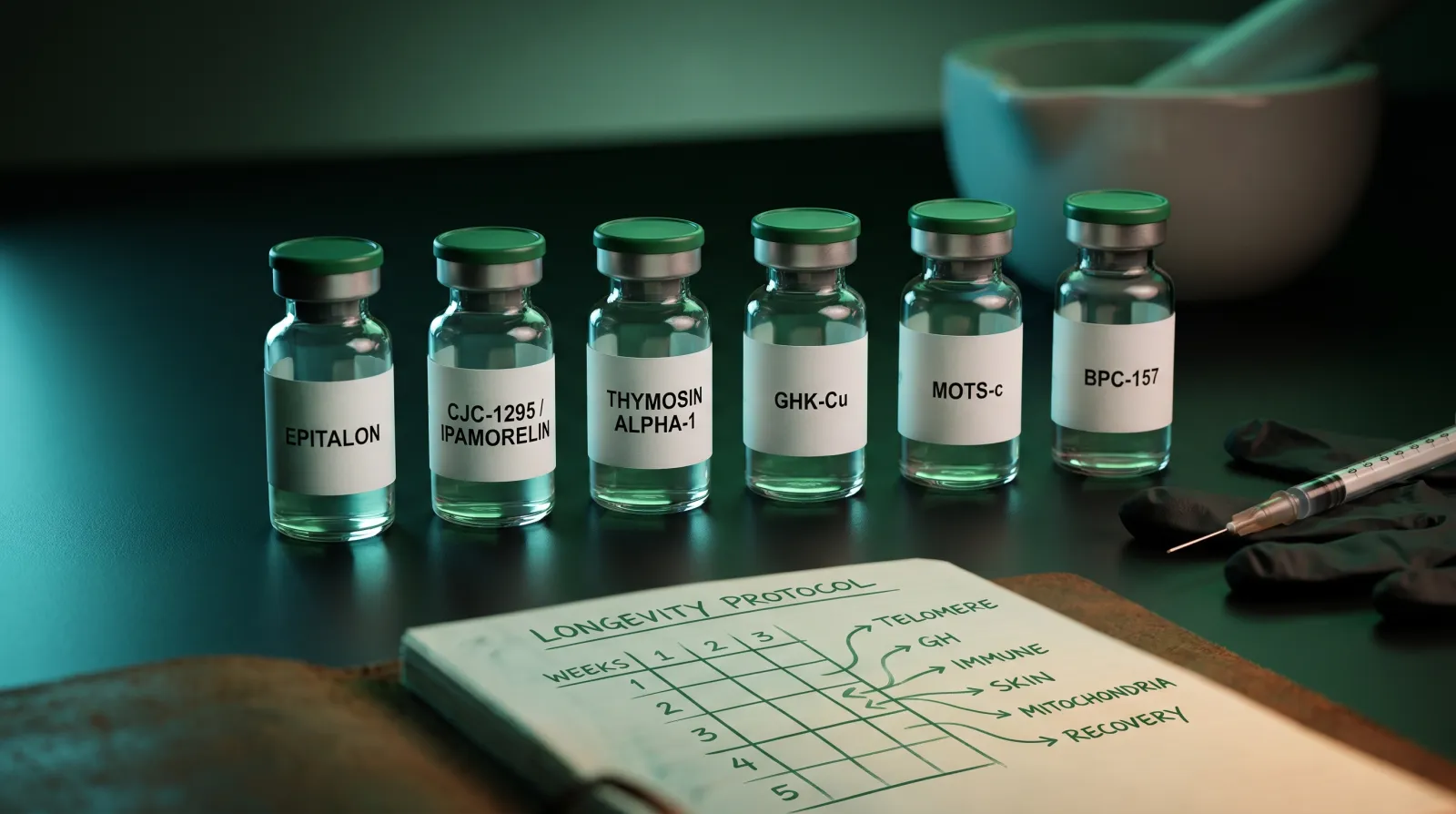
Open any peptide guide on ageing from the last two years. You will find the same six to eight compounds, ranked with the same confidence. Epitalon for telomeres. CJC-1295 plus ipamorelin for growth hormone. Thymosin alpha-1 for immunity. GHK-Cu for skin regeneration. MOTS-c for mitochondria. BPC-157 for systemic repair. That framing implies a roughly equal evidence base. It is misleading.
Read the primary literature and a steep hierarchy shows up. Some of these peptides have decades of clinical trial data. Some hold regulatory approval in more than one country. Others have rodent data and a handful of in vitro (test tube) studies. Mechanistic language dresses that up. Marketing compresses the gap. This article does not.
I am not dismissing peptide research. I want to hand you an accurate map instead. Where does the evidence actually sit? Which claims rest on human data? Where do animal studies only suggest promise? Which compounds does the community overvalue? Researchers and clinicians using this for educational purposes should calibrate their expectations.
What Evidence Levels Should You Judge Peptides for Anti-Aging By?
Grade the evidence before you rank a compound. This literature spans four distinct levels. Most popular guides treat all four as interchangeable.
| Evidence Level | Description | Peptides With This Level |
|---|---|---|
| Level 1: RCT / Regulatory Approval | Randomised controlled human trials, regulatory approval in at least one jurisdiction | Thymosin alpha-1 (Zadaxin), CJC-1295 (Phase II clinical data) |
| Level 2: Human Observational / Phase I-II | Open-label human studies, pharmacokinetic data, clinical outcome tracking | BPC-157 (oral Phase II), GHK-Cu (topical clinical series) |
| Level 3: Animal / In Vitro With Strong Mechanistic Logic | Rodent lifespan studies, cell-line data, mechanistic consistency | Epitalon (rodent lifespan, human cell lines), MOTS-c (mouse metabolism) |
| Level 4: Theoretical / Mechanistic Only | Plausible mechanism, minimal experimental confirmation | Several marketed "longevity peptides" not covered here |
With that frame in place, here is the reassessment. 6 compounds, ranked by evidence rather than by marketing noise.
Why Thymosin Alpha-1 Leads the Best Peptides for Anti-Aging
Thymosin alpha-1 (Ta1) gets listed beside far more speculative compounds. It does not belong on that tier. Ta1 is approved as Zadaxin in over 35 countries to treat hepatitis B. Clinicians have used it for more than two decades. No other peptide on a mainstream list has that backing.
What the research shows. Ta1 is a 28-amino acid peptide. It comes from thymosin fraction 5. Allan Goldstein and colleagues at George Washington University first isolated it in the 1970s. Their work set the base for all of it. We know how it acts. It drives T-cell growth in the thymus, a gland in the chest. It builds up the pool of new T-cells. It also shifts how dendritic cells work.
Ageing matters here. The thymus involutes, or shrinks, steadily from adolescence. That shrinks the pool of naive T-cells. It also narrows T-cell receptor diversity. This is immunosenescence, the ageing of the immune system. It is one of the best-documented drivers of age-related disease.
Randomised controlled trials in hepatitis B and C, run across several journals, showed measurable immune reconstitution in people. In plain terms, the immune system rebuilt itself. Studies in elderly groups showed T-cell subsets move back toward a younger phenotype profile. That is not rodent data stretched to fit humans. It is human data.
Where the hype overreaches. Calling Ta1 a broad anti-ageing peptide for healthy adults is a stretch. It rests on immunology, not on longevity trials. No randomised trial has measured longevity endpoints in healthy middle-aged people. The mechanistic case is strong. The direct human longevity data is absent. Honest framing matters.
Dosing context. Approved protocols use 1.6 mg twice weekly, under the skin. Longevity-adjacent clinical use mirrors that. It runs 1.6 mg twice weekly for 4 to 12 weeks. Clinicians tend to run it seasonally, or during periods of immune stress. Few peptides on this list are characterised that well. The thymosin alpha-1 complete guide goes deeper on the immune mechanisms.
Bottom line. Ta1 is the best-evidenced compound on any honest anti-ageing peptide list. The community undervalues it. Precise evidence lacks the narrative pull of telomere extension. That is the community's loss, not a flaw in the data.
Does CJC-1295 With Ipamorelin Extend Lifespan?
Not on the evidence we have. This stack is still the most practically useful foundation in the space. Its pharmacology is well established. The overstatement comes later. Practitioners jump from "restores GH pulsatility" to "extends lifespan", and the literature does not support that leap.
What the research shows. Growth hormone falls by roughly 14 percent per decade after age 35. CJC-1295 is a GHRH analogue, a copy of the signal that tells the body to make GH. It makes that signal last longer. Ipamorelin acts on the ghrelin receptor, and only on that one. So it gives a clean GH pulse. It does not stir up cortisol or prolactin. Teichman et al. (2006), in the Journal of Clinical Endocrinology and Metabolism, showed GH and IGF-1 held up in people on the drug. That is real Phase II human pharmacokinetic data. Most peptides on these lists cannot claim it.
Where the hype overreaches. The claim assumes that a restored GH and IGF-1 axis adds healthspan. The wider research is messier than that. Some of the longest-lived groups of people show lower IGF-1 signalling, not higher. Caloric restriction, which means eating less, extends lifespan in many organisms. It also lowers IGF-1. So the link is not a straight line. What this stack clearly improves is body composition, sleep quality and recovery. That holds in adults with somatopause-related decline. Calling that longevity is a stretch. Calling it real health upkeep is fair.
Dosing. The usual pair is CJC-1295 without DAC, also called Mod GRF 1-29, at 100 mcg. Ipamorelin sits at 200 to 300 mcg, under the skin, once a night. The no-DAC form keeps the GH release in pulses. For the detail, see the stack protocol and the DAC versus no-DAC dosing guide.
Bottom line. This is the best human pharmacology among GH-axis peptides. The practical benefits are real. The longevity claim is plausible but untested in people. Use it for what it demonstrably does.
Does Epitalon Really Lengthen Telomeres?
In cells, yes. In people, nobody has shown it. Epitalon is the most hyped peptide here. Its human evidence is also the most misread. The telomere story is compelling. The clinical data behind it is thin.
What the research shows. Epitalon is the AEDG tetrapeptide. That means a chain of four amino acids. Vladimir Khavinson and his team built it. They work at the St. Petersburg Institute of Bioregulation and Gerontology. Khavinson et al. (2003), in Bulletin of Experimental Biology and Medicine, showed two things. Telomerase switched on. Telomeres grew longer. Both in human somatic cell cultures. That was work in a dish, not a human clinical trial. In vitro means in glass, so in cells. Rodent lifespan studies showed a longer median survival. A 2025 paper in Biogerontology looked at several human cell lines. It confirmed telomere extension pathways in vitro.
Notice what is missing there. No randomised controlled trials in humans. No pharmacokinetic studies in humans, so no data on how the body handles it. No longevity endpoint data in humans. Almost all epitalon data is animal work or cell culture. That includes the Khavinson group's own work. The Russian research context matters too. Much of the foundational work comes from a single institution. Independent replication in Western peer-reviewed journals is thin.
Where the hype overreaches. People read the in vitro telomere data as proof of age reversal in humans. It may carry across. That is an assumption, not an established fact. Telomere length is also a messier marker of ageing than early hope suggested. Some interventions extend telomere length and improve no health outcome. Some short-telomere conditions arise by paths that have nothing to do with telomerase activity.
What is genuinely interesting. The logic here is sound. Telomerase activation does extend how long cell lines keep dividing. The pineal gland link and the body-clock effects are plausible. So epitalon earns a place on a research list. It does not earn the trust we give thymosin alpha-1 or the GH-axis peptides.
Dosing context. Standard protocols use 5 to 10 mg a day, under the skin. They run for 10 to 20 days in a row, once or twice a year. That cycling pattern comes from clinical habit, not from trials. Dose-optimisation data does not exist.
Bottom line. Compelling mechanism, credible preclinical data, not enough human validation. Include it in a research protocol with humility about what is known. Do not let the telomere narrative stand in for evidence.
Why Is BPC-157 Underrated for Healthspan?
Because its story lacks a hook. People fix on epitalon's telomeres and on GHK-Cu's skin work. BPC-157 may do more for healthspan than both of them. Most writing on ageing still under-rates it.
What the research shows. BPC-157, or Body Protection Compound 157, is a 15-amino acid peptide. It comes from a protein found in gastric juice, the acid in your stomach. Studies report that it guards organs across the body. It drives angiogenesis, the growth of new blood vessels. It shifts the nitric oxide pathway. It speeds up tendon and ligament healing. Those repair effects run through paths that matter to ageing. Low-grade inflammation drops. The gut barrier gets tighter. Connective tissue upkeep speeds up.
That inflammation point deserves weight. Low-grade inflammation that never switches off is sometimes called inflammaging. It is one of the best-backed drivers of ageing in the body. This peptide acts on it directly. It damps that inflammation and guards the gut lining. Most lists file it under injury recovery and move on. That misses the point for ageing.
It also reached human Phase II oral trial status for inflammatory bowel disease. So it holds more direct human safety data than epitalon or MOTS-c does. For the gut health side in detail, see my guide to BPC-157 and gut health.
Where the framing needs adjustment. BPC-157 research is extensive in animals. For systemic longevity claims it stays preclinical. The human oral trial data shows safety signals and gut lining effects. It does not establish longevity endpoints. The compound's regulatory status has shifted as well, so read the landscape before any research use. The FDA reclassification explainer covers that.
Bottom line. BPC-157 deserves a higher place on these lists. Its work on inflammaging and on tissue upkeep earns it. People rank it low for want of one dramatic hook. Its breadth of effect may count for more than several better-sold compounds. For repair work inside a wider plan, see the best peptides for injury recovery.
Do Peptides for Anti-Aging Skin Work? The GHK-Cu Evidence
On the skin, yes. GHK-Cu has a real base of proof in skin research. The story goes wrong at the next step. Guides stretch skin studies, done on the skin, into whole-body anti-ageing effects.
What the research shows. GHK-Cu is a copper-bound chain of three amino acids, a tripeptide-copper complex. Your body makes it. It sits in human plasma, saliva and urine. Plasma levels fall with age. They drop from roughly 200 ng/mL at age 20 to 80 ng/mL by age 60. Loren Pickart's early work set out its role in wound healing and skin remodelling. Pickart and Margolina's gene-data review drew together how GHK shifts gene expression. Array studies note effects on over 4,000 human genes. Those include more collagen, more elastin and stronger antioxidant defence genes.
Use on the skin has clinical backing. Trials show measurable gains in skin thickness. Skin stretch, or elasticity, improves. So does wrinkle depth. Randomised trials of topical GHK-Cu creams report statistically significant gains in facial skin appearance metrics. That is real proof, for a real effect, in real people.
Where the hype overreaches. Whole-body claims for injectable GHK-Cu rest on the gene arrays and on how it might work. No randomised human trial of injectable GHK-Cu has measured longevity or systemic anti-ageing endpoints. The jump is huge. Shifting antioxidant gene expression in a dish is not reversing ageing in a body. The GHK-Cu complete guide covers the topical versus injectable divide.
Dosing context. On the skin, 0.1 to 1 percent holds the best clinical proof. Shots run 1 to 2 mg under the skin, two to three times a week. Those numbers come from the skin data and from how it might work. They do not come from trials of the shot.
Bottom line. GHK-Cu is legitimate for skin health and wound support, with real human evidence in topical form. Injected as a whole-body anti-ageing tool, it is more speculative than most guides admit. Rank it accordingly.
Is MOTS-c Worth It Without Human Data?
That is your call, and the honest answer is that the human data does not exist yet. The science is genuinely fascinating. No compound here has a wider gap between mechanism and clinical evidence. The community adopted it on mouse studies, and mouse metabolism does not automatically translate.
What the research shows. MOTS-c is a peptide made inside the mitochondria, the cell's power plants. It is encoded within the 12S rRNA gene of the mitochondrial genome. Lee et al. at USC discovered it in 2015. Lee et al. (2015), in Cell Metabolism, showed that MOTS-c improves insulin sensitivity in mice. It switches on AMPK signalling. It extends metabolic healthspan in those mice. A 2021 paper showed the same peptide given across the body improved physical performance in aged mice. Their metabolic markers improved too.
The mechanism is neat. MOTS-c sends a signal back from the mitochondria to the nucleus. That shifts nuclear gene expression tied to energy use. Human MOTS-c levels do decline with age. Some studies of people who reach 100 link higher MOTS-c levels with longevity. Those findings are associative (a link, not proof from a trial).
Where the hype overreaches. No published human trial has given people MOTS-c from outside the body at the time of writing. Community protocols run 5 to 10 mg under the skin, two to three times a week. No human dose-finding data sits behind them. They come from mouse studies, scaled by body surface area. That method is rough, and often wrong for peptide dosing. Pharmacokinetics means how the body handles it. Bioavailability means how much gets in. In people, both are essentially unknown from a clinical trial standpoint. So is safety.
What is genuinely promising. Mitochondrial-nuclear crosstalk is a real and important part of ageing biology. MOTS-c sits where metabolic regulation, exercise response and mitochondrial quality control meet. Human trials may confirm the mouse findings. If they do, it could be one of the more important longevity compounds of this decade. That conditional carries a lot of weight.
Bottom line. MOTS-c is the most speculative compound on standard these lists. Rank it there. Including it in a research protocol suits people with high risk tolerance and real interest in the frontier. Presenting it with the confidence we give thymosin alpha-1 is not honest.
How Do the Best Anti-Aging Peptides Injections Compare?
Side by side, the confidence levels get hard to blur. Here is the comparison most guides leave out.
| Peptide | Human RCT Data | Human Pharmacokinetic Data | Animal Lifespan Data | Regulatory Status | Actual Evidence Tier |
|---|---|---|---|---|---|
| Thymosin Alpha-1 | Yes (hepatitis B/C, immune reconstitution) | Yes | Yes | Approved in 35+ countries as Zadaxin | Highest |
| CJC-1295 / Ipamorelin | Phase II data (CJC-1295) | Yes (CJC-1295 Teichman 2006) | Limited | Research use, 503A compounding | High |
| BPC-157 | Phase II oral (GI indication) | Limited human data | Extensive rodent data | Research use, regulatory scrutiny ongoing | Moderate-High |
| GHK-Cu (topical) | Yes (skin outcomes, topical) | Topical pharmacology established | Limited | Cosmetic ingredient (topical) | Moderate (topical), Low (injectable) |
| Epitalon | No human RCTs | No published human PK data | Yes (rodent lifespan extension) | Research use only | Moderate (preclinical) |
| MOTS-c | No human trials | No human data | Yes (mouse metabolic studies) | Research use only | Low (frontier research) |
How Do You Build a Protocol With Injectable Peptides for Anti-Aging?
Start from the evidence, not the marketing. A sound plan in 2026 looks different from the standard advice. It works in three tiers. The tier tells you how much trust to place in it.
| Tier | Compound | Dose in circulation | What it addresses |
|---|---|---|---|
| Foundation (strongest evidence) | Thymosin alpha-1 | 1.6 mg subcutaneously twice weekly, 4 to 8 weeks, seasonally | Immunosenescence, with the best human data here |
| Foundation (strongest evidence) | CJC-1295 without DAC plus ipamorelin | 100 mcg with 200 to 300 mcg, nightly | Somatopause-related decline, established human pharmacokinetics |
| Second tier (solid mechanism, partial human data) | BPC-157 | 250 to 500 mcg subcutaneously daily, 8 to 12 weeks | Inflammaging and gut barrier integrity |
| Frontier (compelling mechanism, clinically speculative) | Epitalon | 5 to 10 mg daily, 10 to 20 days, twice yearly | Telomerase pathways, preclinical only |
| Frontier (compelling mechanism, clinically speculative) | MOTS-c | 5 to 10 mg subcutaneously, two to three times weekly | Mitochondrial signalling, no human trials |
| Frontier (compelling mechanism, clinically speculative) | GHK-Cu | 1 to 2 mg subcutaneously, two to three times weekly | Systemic use only; topical stays the evidence-backed route |
The second tier is research use. The mechanism is strong there and safety signals look fine. Human longevity endpoints there are unproven. The frontier tier is speculative next to the foundation, not worthless. We just know less about what it does.
Anyone running a plan like this should work with a qualified clinician. Track the blood markers that match each mechanism. T-cell subset panels track thymosin alpha-1. IGF-1 levels track the GH-axis stack. Inflammatory markers track BPC-157.
Want a plan aimed at men in mid-life? My guide to the best peptides for men over 40 covers what to do first.
Where to source it
The hard part with anti-ageing peptide stack isn't the protocol. It's finding a supplier that can prove what's in the vial. We assessed dozens against per-batch, third-party testing. A handful passed.
See the sources that passed →Are Research Peptides for Anti-Aging Legal to Buy?
It depends on the compound, and on where you live. The rules shifted in 2024 and 2025. BPC-157 drew the most FDA heat. So check where things stand now. Do that before you buy. Read the peptides legal status overview first. Then read the FDA reclassification explainer.
With a stack like this, the supplier counts as much as the dose. We only list sources that publish an independent, per-batch certificate of analysis. See the ones that clear it.
Which Anti-Aging Peptides Claims Need Challenging?
Five come up again and again. Here is each claim, the evidence behind it, and a fairer way to say it.
| Common Claim | Evidence Reality | More Accurate Framing |
|---|---|---|
| "Epitalon extends telomeres in humans" | Demonstrated in human cell lines and rodents; no human in vivo trial data | "Epitalon activates telomerase in human cell cultures and extends lifespan in rodent models" |
| "GHK-Cu reverses skin ageing systemically" | Topical clinical evidence exists; injectable systemic anti-ageing is extrapolation | "GHK-Cu improves skin parameters in topical clinical trials; systemic effects are mechanistically plausible but untested in humans" |
| "MOTS-c improves mitochondrial function in humans" | Demonstrated in mouse models; no human interventional data exists | "MOTS-c improves metabolic parameters in aged mice; human effects are unknown from a clinical trial standpoint" |
| "CJC-1295/ipamorelin extends lifespan" | Restores GH pulsatility with human PK data; lifespan extension is extrapolation | "CJC-1295/ipamorelin improves body composition and GH/IGF-1 axis function in adults with age-related GH decline" |
| "Thymosin alpha-1 reverses immunosenescence" | Strong human RCT data for immune reconstitution; longevity-specific trials lacking | "Thymosin alpha-1 restores T-cell competence in immunocompromised and elderly populations with the strongest human evidence of any peptide on this list" |
What Does an Honest Anti-Aging Peptides Stack Look Like?
It looks smaller than the lists suggest, and it is honest about confidence. My position is not that peptides are useless for anti-ageing. It is that the evidence hierarchy matters, and most content on it is misleading. Build around real confidence levels and you make better decisions.
On a tight budget, or wary of risk? Thymosin alpha-1 and the CJC stack hold the best human data. Happy to sit at the frontier, with some humility? Then epitalon, BPC-157 and GHK-Cu make fair sense. MOTS-c suits true frontier work. Human dose and safety guides for it do not exist.
Before any of it, learn how to mix and handle peptides safely. My peptide reconstitution guide is a practical place to start.
None of this is medical advice. All of it is provided for educational purposes. Any plan that uses peptides for longevity research use should be built and watched with a qualified clinician. That clinician should understand the mechanism literature and the regulatory context in your jurisdiction. The compounds that survive honest scrutiny stay among the most interesting tools we have. The key word is honest.
Where to source it
The hard part with anti-ageing peptide stack isn't the protocol. It's finding a supplier that can prove what's in the vial. We assessed dozens against per-batch, third-party testing. A handful passed.
See the sources that passed →Share this article
Frequently Asked Questions
Which anti-ageing peptides actually have human clinical trial data?
Does epitalon actually lengthen telomeres in humans?
Is CJC-1295 with or without DAC better for longevity?
What does MOTS-c actually do and is there human evidence?
Can you stack multiple anti-ageing peptides at the same time?
Are anti-ageing peptides legal to buy in 2026?
Read Next

Disclaimer: This content is for educational purposes only. These compounds are intended for research use. Nothing here is medical advice. Always work with a qualified clinician before making changes to your health protocol.