
FDA Compounding Regulations Peptides Users Must Know


What Are the FDA Compounding Regulations Peptides Users Face Now?
The FDA compounding regulations peptides users care about moved twice in 2026, and neither step lets a pharmacy make them. Compounding means a pharmacy mixing its own version of a drug. In April FDA took 12 substances out of Category 2, its list of substances with significant safety risks. Their nominations had been withdrawn.
In July an FDA advisory panel voted to recommend six of them for the 503A bulks list, NCPA reported. The vote is advisory, and FDA's meeting page lists no minutes or vote record.
The 503A bulks list names raw drug ingredients a pharmacy may use when no official standard or approved drug covers them. None of these peptides is on it. FDA adds a substance only by a formal rule. It must first publish a proposal and take public comment.
This article carries a trusted-source link that supports the channel. It doesn't change a word of what's here.
A panel's vote is not FDA approval. By late September 2026, the Federal Register, the US government's daily journal of rules and notices, showed no FDA proposal to add any of them.
What Did the July PCAC Vote Decide, and Is Category 2 Removal Enough?
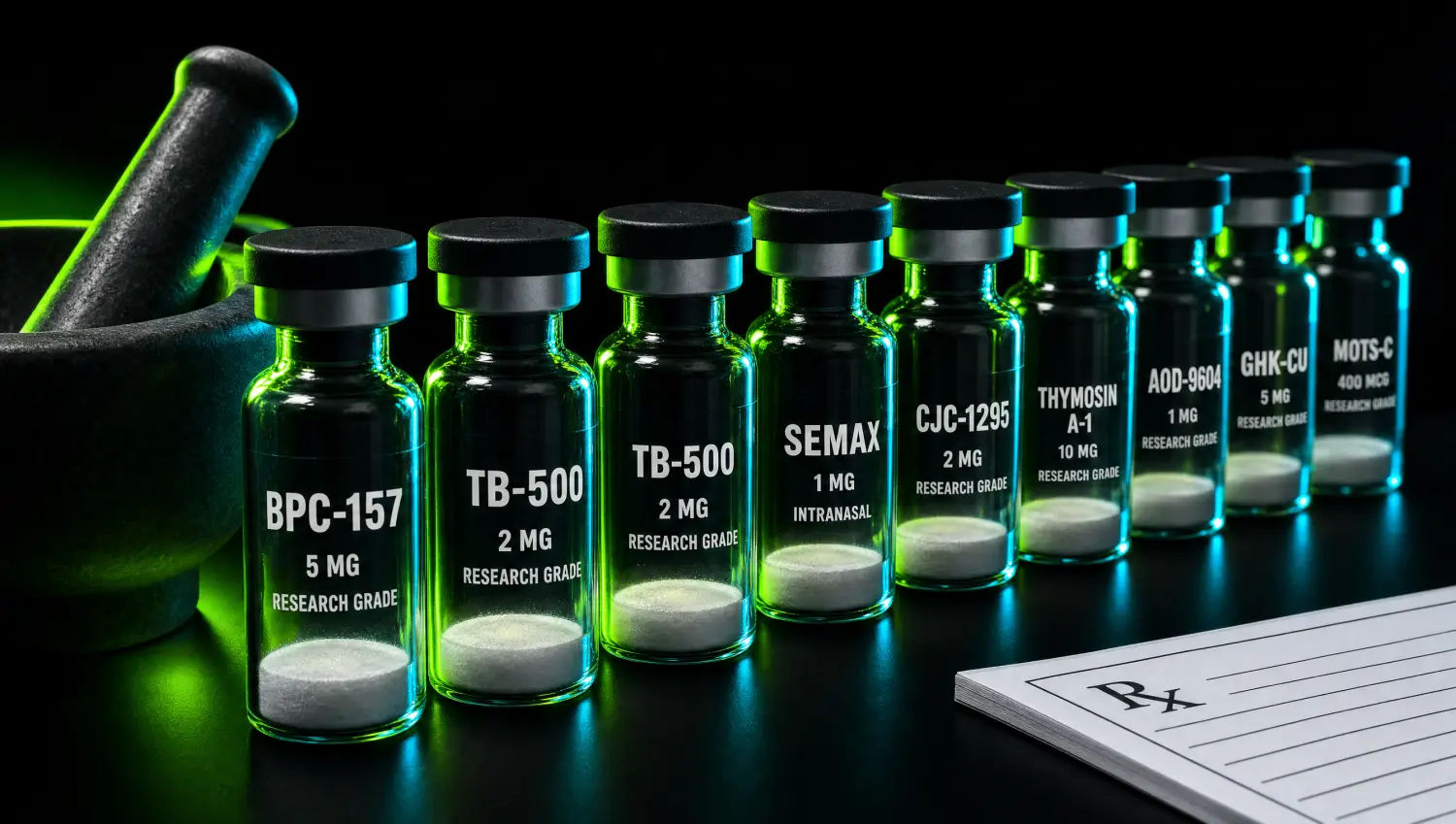
The Pharmacy Compounding Advisory Committee (PCAC) is an outside panel that advises FDA. It was scheduled to meet on 23 and 24 July 2026 on seven peptides, FDA's meeting notice shows. They were BPC-157, KPV, TB-500, MOTS-c, Emideltide, Epitalon and Semax.
NCPA reported that the panel voted to recommend six for the 503A bulks list. Those six are BPC-157, KPV, TB-500, MOTS-c, Epitalon and Semax. It reported that the panel rejected Emideltide. The vote is advisory, and FDA's meeting page lists no minutes or vote record.
FDA's own view is in its written briefings. For each substance, FDA weighs four things. They are how well its chemistry is known, its safety, evidence that it works, and its past use in compounding. In its reviews of BPC-157 and TB-500, FDA found that these weigh against listing them.
FDA says it will not decide until it has weighed the panel's input. It is still advice. The FDA can take it, take part of it, wait, or say no.
FDA also intends to consult the panel on five more substances before the end of February 2027, its April list shows. They are LL-37, dihexa, GHK-Cu, PEG-MGF and Melanotan II.
GHK-Cu for non-injectable use went back into Category 1 on 14 May 2026, FDA's current list shows. Category 1 holds substances under evaluation. For those, FDA does not intend to take action against a compounder, provided the conditions in its guidance are met.
Taking a peptide out of Category 2 in April did not clear it as safe. Removal from Category 2 happened because the nominators withdrew; FDA still lists each substance's safety risks on its page. The removal does not let a pharmacy prepare it. None was moved to Category 1, the group still under review.
To qualify under 503A, the substance must be added to the 503A bulks list. That comes after PCAC review and an FDA rule. It is a slower, separate step.
| Step | What happened | What it allows |
|---|---|---|
| Category 2 removal, April 2026 | Several peptides taken out of Category 2 after nominations were withdrawn (still on FDA's safety-risk page) | Nothing on its own. FDA still lists the safety risks; removal reflects withdrawn nominations |
| PCAC vote, July 2026 | NCPA reported six recommended for the 503A bulks list: BPC-157, KPV, TB-500, MOTS-c, Epitalon and Semax. It reported Emideltide rejected | Nothing yet. The vote is advisory, and FDA's meeting page lists no minutes or vote record |
| 503A bulks list | Needs FDA rulemaking after PCAC review | A 503A pharmacy may legally prepare the peptide on a valid prescription |
| Next PCAC review, before the end of February 2027 | Five more substances under review, including GHK-Cu | Nothing yet for the 503A bulks list. Non-injectable GHK-Cu is back in Category 1 while FDA reviews it |
This is where the confusion lives. Reading the Category 2 change as a green light skips the step that counts.
Until one of the seven July peptides is on that list, there is no gray zone for a 503A pharmacy. FDA still lists its safety risks. None of the seven July peptides meets the 503A conditions for compounding.
What Does the Evidence Show for the Peptides on the July Agenda?
The July peptides do not carry equal weight of evidence. For BPC-157, FDA's July 2026 review found one controlled study in patients. It is a meeting abstract, a short conference summary, on 53 people with ulcerative colitis, a bowel disease.
The authors put the gap from placebo, a dummy treatment, at 1.6 points, FDA's review notes. The margin of error included no difference at all. FDA also lists a Phase 1, or early human, study of BPC-157 enemas against placebo in 32 healthy people. It too exists only as abstracts.
A pilot safety study gave two healthy adults up to 20 mg of BPC-157 intravenously, into a vein, Lee and Burgess. Both had been given IV BPC-157 before the study. It reported no adverse effects. It found no change in heart, liver, kidney, thyroid or glucose markers. The sample was tiny.
A literature and patent review puts the regulatory side plainly, Jozwiak and colleagues. The FDA has not approved BPC-157 for standard medical use. The review says there are not enough full clinical studies to confirm a benefit in humans.
TB-500 needs a note. FDA describes it as a seven-amino-acid piece of thymosin beta-4. That natural protein is 43 amino acids long. TB-500 carries an acetyl group, a small chemical tag, on one end. FDA says results for the untagged (non-acetylated) form of this piece cannot be carried straight over to TB-500. It found no clinical studies or human exposure data for TB-500.
The pharmacokinetic work cited around this class (how a body handles the drug) is animal work, He and colleagues. It followed BPC-157 in rodent (rat) and dog studies, not in people. It is a gap to weigh.
CJC-1295 was not on the July list. The same panel voted against listing it in December 2024, FDA's minutes show. Two randomised, placebo-controlled trials found sustained, dose-dependent rises in growth hormone and IGF-1 in healthy adults, Teichman and colleagues. In a randomised trial, chance decides who gets the drug. IGF-1 is a growth factor made in response to growth hormone.
WADA, the World Anti-Doping Agency, bans it in sport as a growth hormone releasing factor, on its 2026 Prohibited List. A Norwegian doping lab identified it in a preparation sent by police and customs, Henninge and colleagues. The lab used mass spectrometry, a method that weighs molecules. That sits apart from the FDA question. It still counts in a tested sport.
Thymosin alpha-1 was not on the July list either. The panel voted against listing it in December 2024 too.
One review pooled more than a thousand sepsis patients across 11 randomised trials, Gu and colleagues. Sepsis is a deadly reaction to infection. It found a significant cut in 28-day mortality, meaning deaths within 28 days. In the high-quality and multi-centre trial groups, it found no such benefit.
How Do the FDA Compounding Regulations, Peptides Included, Work at a 503A Pharmacy?
A 503A pharmacy makes up drugs for a named patient, from a valid prescription for that patient. State pharmacy boards generally oversee it day to day, FDA says.
A 503B outsourcing facility may also fill a hospital's order that is not for one patient. FDA inspects it on a risk-based schedule. It must follow CGMP, the federal rules for drug-making quality. The 503A bulks list governs the 503A route.
Is a compounded peptide the same as an FDA-approved drug?
No. FDA says compounded drugs are not FDA-approved. It does not review them for safety, effectiveness or quality before they reach patients. Being allowed to compound is a supply and legal question, not proof that a drug works.
What happens if the FDA reverses course?
Say FDA turns down a yes vote. If the FDA declines to list a peptide, pharmacies never gain the legal ground to make it. The same holds for 503A and 503B: neither route exists today. None of the seven July peptides is on FDA's 503B category list either.
FDA also says its final choice may turn on issues the panel never discussed.
How should you plan while the rules keep moving?
The record is the place to plan from, not vendor claims. Today none of the seven July peptides meets the 503A conditions for compounding. Always work with a qualified clinician before making changes to your health protocol.
The primary sources are the Federal Register and PCAC docket FDA-2025-N-6895, not second-hand summaries. A docket is FDA's public file of papers and comments on one matter. Our breakdown of the July vote follows the same papers.
For what the studies gave for BPC-157, see our separate guide. For the wider legal picture, see where peptide law stands now.
If you want a vendor-neutral view of sourcing while this plays out, our recommended sources page sets out how we assess suppliers and pharmacies. It never points you at one vendor.
Where to buy compounded peptides
If you're researching compounded peptides, I've linked a trusted source below. It supports the channel.
See the sources that passed →References
- Lee et al. 2025, Safety of Intravenous Infusion of BPC157 in Humans: A Pilot Study, PubMed
- Jozwiak et al. 2025, Multifunctionality and Possible Medical Application of the BPC 157 Peptide, PubMed
- He et al. 2022, Pharmacokinetics, distribution, metabolism, and excretion of body-protective compound 157, a potential drug for treating various wounds, in rats and dogs, PMC
- Teichman et al. 2006, Prolonged stimulation of GH and IGF-I secretion by CJC-1295, PubMed
- Henninge et al. 2010, Identification of CJC-1295 in an unknown pharmaceutical preparation, PubMed
- Gu et al. 2025, Efficacy of thymosin alpha1 for sepsis, a systematic review and meta-analysis, PMC
- NCPA, 31 July 2026, FDA advisory committee nominates six peptides for pharmacies to compound, NCPA
- FDA, July 23-24, 2026 PCAC meeting page, FDA
- FDA, PCAC meeting notice, docket FDA-2025-N-6895, Federal Register, 16 April 2026, Federal Register
- FDA, Briefing Document introduction, PCAC, July 23-24, 2026, FDA
- FDA, Briefing Document, BPC-157-related bulk drug substances, July 2026, FDA
- FDA, Briefing Document, TB-500-related bulk drug substances, July 2026, FDA
- FDA, 503A category list, updated 22 April 2026 (archived copy), FDA
- FDA, Certain bulk drug substances for use in compounding that may present significant safety risks, FDA
- FDA, Final summary minutes, PCAC, 4 December 2024, FDA
- FDA, Final summary minutes, PCAC, 29 October 2024, FDA
- FDA, Compounding and the FDA: questions and answers, FDA
- FDA, Human drug compounding laws, FDA
- FDA, 503B category list, updated 21 March 2025, FDA
- WADA, 2026 Prohibited List, WADA
This content is for educational purposes only. These compounds are intended for research use. Nothing here is medical advice.
Share this article
Frequently Asked Questions
What did the July 2026 PCAC meeting actually decide?
What's the difference between Category 2 removal and 503A compounding approval?
What happens to compounding pharmacy peptide supply if the FDA reverses course at a future PCAC meeting?
How do 503A and 503B compounding pathways differ?
Is a peptide from a 503A compounding pharmacy the same as an FDA-approved drug?
Which peptides carry the most versus least regulatory certainty right now?
Read Next
Disclaimer: This content is for educational purposes only. These compounds are intended for research use. Nothing here is medical advice. Always work with a qualified clinician before making changes to your health protocol.