
GHK-Cu Peptide Guide: Skin, Dosage, Injection, Side Effects

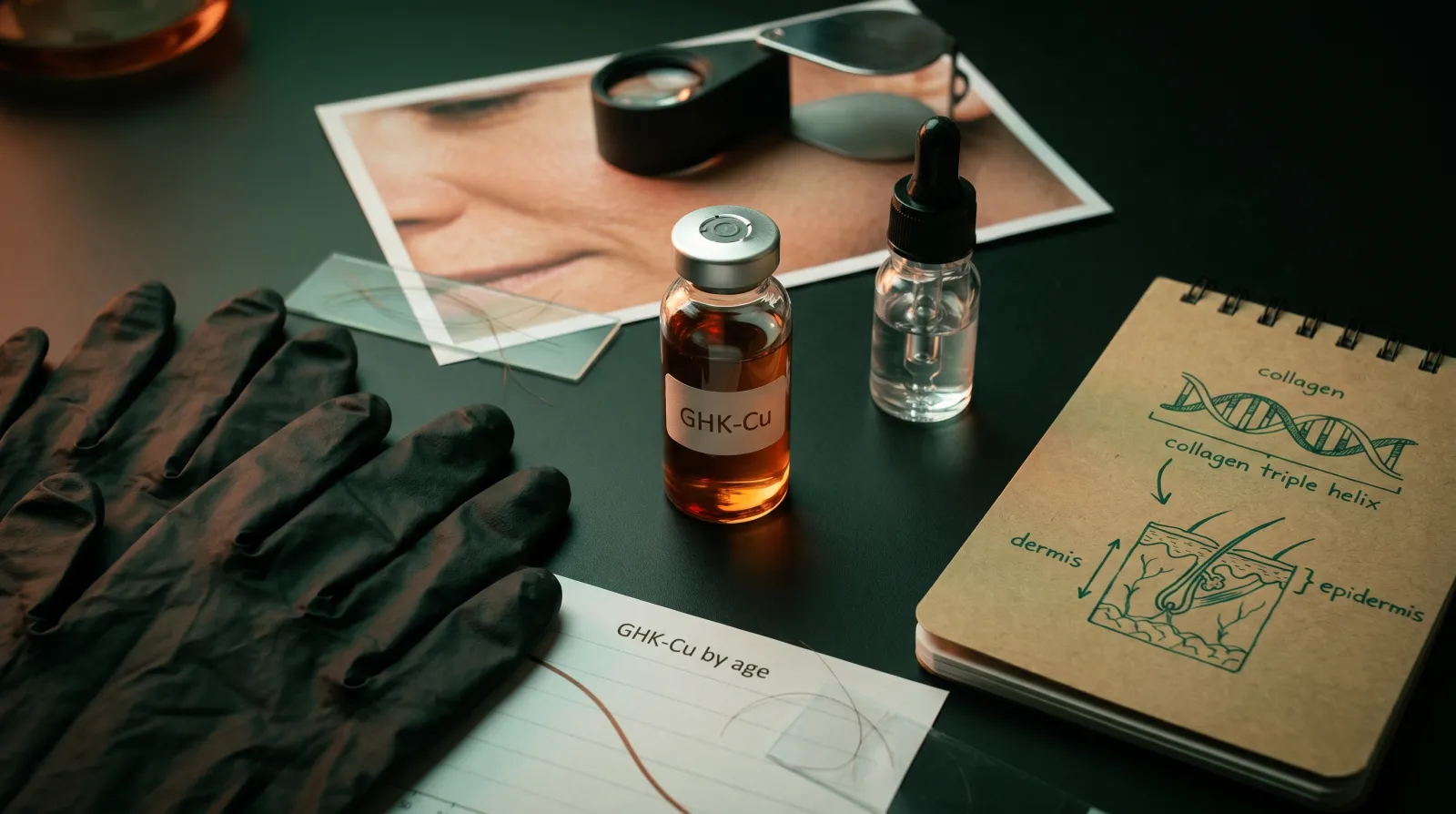
What Is GHK-Cu Peptide, and What Does GHK-Cu Do?
GHK-Cu peptide is a small copper-binding molecule found naturally in human blood plasma. Levels fall from about 200 ng/mL at age 20 to 80 ng/mL by age 60. Lab and animal studies link it to collagen building and tissue repair. In people, the trials we found mostly tested creams on ageing skin.
A peptide is a short chain of amino acids, the building blocks of proteins. The full name is glycyl-L-histidyl-L-lysine, bound to copper. It was discovered in 1973. In the experiment behind that discovery, plasma from young people made old liver tissue produce proteins more like young tissue (Pickart & Margolina 2018).
The same review notes that skin's ability to repair itself declines with age. This guide is the hub for everything we have written on GHK-Cu. Each section gives the short answer and says which study it comes from.
This content is for educational purposes only and is not medical advice. Nothing here is a guide to research use or to treatment. A qualified clinician can advise on any health decision.
Why does the copper matter?
Most authors credit GHK's effects to its ability to bind copper, a 2018 review says. The same review adds that copper alone does not explain the gene effects described below.
How wide is the effect?
Wide, on paper. Researchers used the Connectivity Map, a public gene database built by the Broad Institute. GHK changed the activity of 31.2% of the human genes it covers by half or more. A 2014 review links some of these genes to DNA repair and antioxidant defence (Pickart, Vasquez-Soltero & Margolina 2014). Pickart & Margolina 2018 describe repair effects in skin, lung, liver and bone. All authors of both reviews list Skin Biology, in Bellevue, Washington, as their affiliation.
For the compound's regulatory status in one place, see our GHK-Cu compound page. For the wound studies, see our GHK-Cu wound healing guide. For topical use, see our GHK-Cu topical guide and our GHK-Cu skin and hair page.
How Does the Copper Peptide GHK-Cu Work?
The copper peptide GHK-Cu acts on collagen, on the enzymes that break collagen down, and on gene activity. Most of this comes from cells grown in a dish or from animals.
Collagen, elastin and structural proteins
Collagen is the protein that gives skin its strength. Elastin is the protein that lets skin snap back. Glycosaminoglycans are sugar chains that help skin hold water. A 2018 review reports that GHK raises the making of all three.
One rat study put small mesh chambers under the skin, a wound model. GHK-Cu or salt water was injected into the chambers. With GHK-Cu, collagen and glycosaminoglycan content rose with the concentration used. Collagen synthesis rose twice as much as the making of other proteins. Type I and type III collagen mRNA rose too (Maquart et al. 1993). mRNA is the message a cell copies from a gene to build a protein.
Remodelling, not just more collagen
Matrix metalloproteinases are enzymes that break collagen down. GHK modulates them and the proteins that block them, a 2018 review reports. The authors suggest this helps prevent both a build-up of damaged protein and too much breakdown. That is their reading of lab data, not a tested outcome in people.
Keratinocytes and stem cell markers
Keratinocytes are the main cells of the skin's outer layer. One study used lab-grown skin models. Copper-GHK raised two markers in the deepest, or basal, keratinocytes. One is PCNA, which marks cells that are dividing. The other is p63, a likely marker of skin stem cells.
Integrin alpha6 and beta1 rose as well. Integrins are proteins that anchor cells in place. Western blot, a lab test for proteins, confirmed it. The authors suggest copper-GHK promotes the survival of basal stem cells in the skin (Kang et al. 2009).
Beyond skin: fibroblasts and TGF-beta
Researchers profiled gene activity in lung tissue damaged by emphysema, a lung disease. Using the Connectivity Map, they found GHK could reverse the gene pattern tied to that damage. It also induced patterns that fit TGF-beta pathway activation. TGF-beta is a signal that switches on tissue repair.
Fibroblasts are the cells that make collagen. Treating human fibroblasts with GHK reproduced the TGF-beta pattern. Integrin beta1 rose there too (Campbell et al. 2012). This was lab work on tissue samples and cells, not a patient trial.
Blood vessels, nerves and antioxidants
A 2014 review reports three more effects. GHK increases angiogenesis, the growth of new blood vessels. It increases nerve outgrowth. And it has antioxidant effects, meaning it helps limit damage from reactive oxygen molecules (Pickart, Vasquez-Soltero & Margolina 2014).
What Does the Research on GHK-Cu Peptide Show?
The research on GHK-Cu peptide does not all carry the same weight. Some claims rest on human trials. Others rest on cell culture or animal data that nobody has repeated in people. The table sorts them.
| Claim | What was studied | What it found |
|---|---|---|
| Raises collagen | Rat wound chambers; cells in a dish | Collagen rose with the concentration used |
| Firmer skin, fewer fine lines | Cream trials in 71 and 41 women, 12 weeks each | Denser, thicker skin; the eye cream beat placebo |
| Faster recovery after laser | One randomised trial, 13 patients | No faster fading of redness; higher patient satisfaction |
| Hair growth | Mice; one trial of a GHK combination in 45 men | Not tested as GHK-Cu alone in people |
| Injected GHK-Cu for repair | No published human trial found | FDA says human safety data are limited |
| Reverses a damage gene pattern | Gene profiling of lung tissue; fibroblasts | Lab finding, not a patient result |
Where is the human evidence strongest?
Creams on ageing skin. A 2018 review reports a facial cream trial in 71 women with sun-aged skin. After 12 weeks, skin was denser and thicker, with fewer fine lines and shallower wrinkles. An eye cream trial in 41 women beat both placebo and a vitamin K cream over 12 weeks. A placebo is a dummy product with no active ingredient.
A third trial looked at thigh skin over 12 weeks. Collagen production improved in 70% of the women using GHK-Cu cream. That compared with 50% on a vitamin C cream and 40% on retinoic acid (Pickart & Margolina 2018). The review does not give how many women took part.
Where does the evidence thin out?
At the needle. We found no published human trial of injected GHK-Cu. A 2026 review for sports doctors found no clinical data supporting GHK-Cu for muscle, bone or joint conditions. For the peptides it covers, it says dosing, frequency and treatment length remain unknown (Mayfield et al. 2026).
Even the skin data is thin. A systematic review pools every study that meets set rules. A 2026 one found 20 studies on GHK-Cu in aesthetic medicine. Only 2 were randomised trials, where people are assigned to groups by chance. The other 18 were preclinical, meaning lab or animal work. The authors called the biological basis reasonable. They asked for larger, controlled trials with standard formulas and doses (Mokhtar et al. 2026).
What Is the Studied GHK-Cu Dosage?
No human trial we found tested a GHK-Cu dosage given by injection. Two reviews by Skin Biology authors extrapolate human doses from animal experiments (Pickart, Vasquez-Soltero & Margolina 2014; Pickart et al. 2012). Those are estimates, not trial results. The table lists what the human studies used, in each source's own terms. None of it is a recommendation.
| Study | Who | What was used | How often and how long |
|---|---|---|---|
| Facial cream trial (2018 review) | 71 women with sun-aged skin | GHK-Cu cream; strength not given in the review | 12 weeks |
| Eye cream trial (2018 review) | 41 women | GHK-Cu eye cream against placebo and vitamin K cream | 12 weeks |
| Cream trial (2018 review) | Not stated in the review | GHK-Cu cream | Twice daily for 12 weeks |
| Serum trial (2018 review) | Female volunteers | GHK-Cu in a nano-lipid carrier, against the carrier alone and Matrixyl 3000 | Twice a day for 8 weeks |
| Bishop et al. 1992 | 86 people with venous leg ulcers | 0.4% tripeptide copper complex cream (the abstract does not name the tripeptide) | Not stated in the abstract |
| Lee et al. 2016 | 45 men with pattern hair loss | GHK combined with 5-aminolevulinic acid, 100 or 50 mg/ml | Once a day for 6 months |
| Injected GHK-Cu | No published human trial found | None | Unknown |
What do the studies leave out?
The 2018 review does not give the strength of GHK-Cu in its cosmetic trials. The 2026 systematic review asked for trials with standard dosing (Mokhtar et al. 2026). The hair trial named two strengths, 100 and 50 mg/ml, for a GHK combination product (Lee et al. 2016). The leg ulcer trial named a 0.4% strength for a tripeptide copper complex cream. Its abstract does not say which tripeptide. Venous leg ulcers are sores caused by poor blood flow in the veins. That cream did no better than a dummy cream (Bishop et al. 1992).
Is a stronger product a better one?
We found no study that compared GHK-Cu strengths in people. So no source we found shows that a higher strength works better, or worse.
What Should You Know About GHK-Cu Peptide Injection?
For GHK-Cu peptide injection, we found no published human trial. The human trial base we found is almost entirely creams and serums on skin.
Where injectable GHK-Cu stands with the FDA
Compounding is when a pharmacy makes a drug to order. FDA keeps a page of bulk drug substances that may present significant safety risks in compounding. GHK-Cu for injectable routes sits in the group whose nominations were withdrawn by the nominators.
On that page, FDA says injected compounded GHK-Cu may pose a risk of immunogenicity (FDA). That is the risk of an immune reaction. FDA links it to possible clumping and peptide-related impurities. It adds that there are limited data in humans to inform safety.
Non-injectable GHK-Cu has a different status. FDA's 503A list covers substances nominated for pharmacies that make drugs for individual patients. Its update of 14 May 2026 puts GHK-Cu (except for injectable routes) in Category 1, "Bulk Drug Substances Under Evaluation" (FDA 503A list). FDA says it intends to consult its compounding advisory committee before the end of February 2027.
Cosmetics follow separate rules. By law, cosmetic products and ingredients do not need FDA approval before they go on sale. Color additives are the exception (FDA).
Why the before-and-after photos prove little
A photo records no dose and no timeline. It has no comparison group and no lab work. We found no published trial that measured injected GHK-Cu before and after.
How Does a GHK-Cu Serum Help Skin?
The GHK-Cu serum and cream trials we found tested ageing skin. The review behind them reports denser, thicker skin and fewer fine lines after 12 weeks of cream.
One randomised, double-blind trial tested a serum. Double-blind means neither the volunteers nor the researchers knew who got what. Women applied GHK-Cu in a nano-lipid carrier, a tiny fat-based capsule, twice a day for 8 weeks. Compared with the carrier alone, wrinkle volume fell 55.8% and wrinkle depth 32.8%. Compared with Matrixyl 3000, another cosmetic peptide, wrinkle volume fell 31.6% (Pickart & Margolina 2018).
What happened after a laser?
Less than the marketing claims. CO2 laser resurfacing burns away the skin's top layers so new skin forms. One randomised trial put GHK-Cu skin care on skin after this treatment. Computer analysis and blinded reviewers found no faster fading of redness. They found no extra gain in wrinkles or skin quality either. Patients using GHK-Cu did rate their results higher. Thirteen patients completed that trial (Miller et al. 2006).
When did the trials measure change?
The cream trials in the 2018 review ran for 12 weeks. The serum trial ran for 8 weeks. We found no source that sets out a week-by-week timeline for when change appears.
GHK-Cu and Hair Growth
The hair evidence for GHK-Cu is thinner than the skin evidence. We found no published trial of GHK-Cu alone on hair growth in people.
What do the hair studies show?
The dermal papilla, a cell cluster at the base of each hair follicle, is important in hair growth. In one lab study, a related copper peptide, AHK-Cu, lengthened human hair follicles kept alive in a dish. It also made dermal papilla cells multiply (Pyo et al. 2007). AHK-Cu is not GHK-Cu.
A mouse study put GHK-Cu into a microemulsion, a carrier built to help it cross the skin. The microemulsion raised activation of the Wnt/beta-catenin pathway, a signalling route involved in hair growth (Liu et al. 2023).
One trial in people tested a combination product. It joined GHK with 5-aminolevulinic acid, another compound. It enrolled 45 men with pattern hair loss. Over 6 months, average hair count rose 52.6 and 71.5 in the two product groups, and 9.6 on placebo. Hair length and thickness did not differ between groups (Lee et al. 2016). That product was not GHK-Cu alone.
GHK-Cu Compared With Retinoic Acid and Vitamin C
Retinoic acid is a vitamin A compound used on skin. Vitamin C is an antioxidant used in skin creams. One trial compared GHK-Cu with both, on thigh skin over 12 weeks.
| Cream | Women whose collagen production improved |
|---|---|
| GHK-Cu cream | 70% |
| Vitamin C cream | 50% |
| Retinoic acid | 40% |
The 2018 review reports these figures (Pickart & Margolina 2018). It is one endpoint in one trial, and the review does not give the number of women. It does not show that GHK-Cu beats either active on other measures.
What Are the GHK-Cu Side Effects?
Few of the studies we found report on GHK-Cu side effects. Here is what they say.
- Injected GHK-Cu. FDA says injected compounded GHK-Cu may pose a risk of an immune reaction, and human safety data are limited (FDA).
- Toxic action. A 2012 review names GHK-Cu's toxic action as a lowering of blood pressure (Pickart et al. 2012).
- Skin irritation. A study using pig and cell models saw no obvious signs of skin irritation after microneedle pretreatment (Li et al. 2015). Microneedles are tiny needles that open small channels in the skin.
- Hair trial. The GHK combination trial in 45 men reported no adverse events in any group (Lee et al. 2016).
The 2018 review's authors write that GHK has been used in cosmetic products for decades without adverse effects. Both list R&D Skin Biology as their affiliation. We found no published long-term safety study of injected GHK-Cu in people.
Which Groups Has GHK-Cu Not Been Studied In?
GHK-Cu has gaps in who it has been tested on. We found no published study of GHK-Cu in pregnancy or breastfeeding.
Wilson's disease is an inherited condition in which copper builds up in the body. We found no published study of GHK-Cu in people with Wilson's disease or other copper disorders. A qualified clinician can advise on any of these.
Common GHK-Cu Claims the Studies Do Not Back
- "Every trial runs 8 to 12 weeks before change shows." The cream trials in the 2018 review ran 12 weeks and the serum trial 8 weeks. We found no source for a fixed timeline.
- "Injected GHK-Cu has the same evidence as creams." We found no published human trial of injected GHK-Cu.
- "A higher strength works better." We found no human study that compared GHK-Cu strengths.
- "GHK-Cu speeds healing after laser." The one randomised trial found no faster fading of redness (Miller et al. 2006).
- "GHK-Cu regrows hair in people." The one human hair trial we found tested a combination product, not GHK-Cu alone.
GHK-Cu Product Quality and Testing
GHK-Cu product quality is a separate question from the peptide itself. FDA links its injectable concern partly to possible peptide-related impurities. A certificate of analysis, or CoA, is a lab report on one batch of a product. Our guide to how to know if peptides are real explains what a CoA shows. Our sources page sets out how UB grades vendors.
GHK-Cu, BPC-157 and TB-500: What FDA Found
GHK-Cu is often discussed beside BPC-157 and TB-500. They are different peptides, and the GHK-Cu studies above say nothing about them. We found no study that tested GHK-Cu combined with either one.
FDA reviewed both for its July 2026 compounding advisory committee. For TB-500, FDA did not identify clinical studies of TB-500 in humans (FDA TB-500 review). For BPC-157, FDA found five clinical studies. It concluded there is insufficient clinical safety information to characterise its safety profile (FDA BPC-157 review).
See what studies tested in our BPC-157 dosing protocol guide and our TB-500 dosage guide.
This content is for educational purposes only and is not medical advice. A qualified clinician can advise on any health decision.
Where to buy GHK-Cu
The hard part with GHK-Cu isn't the protocol. It's finding a supplier that can prove what's in the vial. We assessed dozens against per-batch, third-party testing. A handful passed.
See the sources that passed →References
- Pickart L, Margolina A. Regenerative and protective actions of the GHK-Cu peptide in the light of the new gene data. Int J Mol Sci. 2018. PubMed
- Pickart L, Vasquez-Soltero JM, Margolina A. GHK and DNA: resetting the human genome to health. Biomed Res Int. 2014. PubMed
- Maquart FX, et al. In vivo stimulation of connective tissue accumulation by the tripeptide-copper complex glycyl-L-histidyl-L-lysine-Cu2+ in rat experimental wounds. J Clin Invest. 1993. PubMed
- Kang YA, et al. Copper-GHK increases integrin expression and p63 positivity by keratinocytes. Arch Dermatol Res. 2009. PubMed
- Campbell JD, et al. A gene expression signature of emphysema-related lung destruction and its reversal by the tripeptide GHK. Genome Med. 2012. PubMed
- Miller TR, Wagner JD, Baack BR, Eisbach KJ. Effects of topical copper tripeptide complex on CO2 laser-resurfaced skin. Arch Facial Plast Surg. 2006. PubMed
- Mokhtar J, et al. The regenerative potential of GHK-Cu in aesthetic medicine. Aesthet Surg J. 2026. PubMed
- Mayfield CK, et al. Injectable peptide therapy: a primer for orthopaedic and sports medicine physicians. Am J Sports Med. 2026. PubMed
- Bishop JB, et al. A prospective randomized evaluator-blinded trial of two potential wound healing agents for the treatment of venous stasis ulcers. J Vasc Surg. 1992. PubMed
- Pyo HK, et al. The effect of tripeptide-copper complex on human hair growth in vitro. Arch Pharm Res. 2007. PubMed
- Liu T, et al. Thermodynamically stable ionic liquid microemulsions pioneer pathways for topical delivery and peptide application. Bioact Mater. 2023. PubMed
- Lee WJ, et al. Efficacy of a complex of 5-aminolevulinic acid and glycyl-histidyl-lysine peptide on hair growth. Ann Dermatol. 2016. PubMed
- Pickart L, Vasquez-Soltero JM, Margolina A. The human tripeptide GHK-Cu in prevention of oxidative stress and degenerative conditions of aging: implications for cognitive health. Oxid Med Cell Longev. 2012. PubMed
- Li H, et al. Microneedle-mediated delivery of copper peptide through skin. Pharm Res. 2015. PubMed
- FDA. Certain bulk drug substances for use in compounding that may present significant safety risks. FDA
- FDA. Bulk drug substances nominated for use in compounding under section 503A. Updated 14 May 2026. FDA
- FDA. FDA authority over cosmetics: how cosmetics are not FDA-approved, but are FDA-regulated. FDA
- FDA. Briefing documents, Pharmacy Compounding Advisory Committee, 23-24 July 2026: TB-500 and BPC-157.
Where to buy GHK-Cu
The hard part with GHK-Cu isn't the protocol. It's finding a supplier that can prove what's in the vial. We assessed dozens against per-batch, third-party testing. A handful passed.
See the sources that passed →Share this article
Frequently Asked Questions
What is GHK-Cu?
What GHK-Cu dosage have studies used?
Has GHK-Cu peptide injection been tested in people?
What are the GHK-Cu side effects?
Does GHK-Cu help hair growth?
How is GHK-Cu different from retinoic acid or vitamin C for skin?
Read Next
Disclaimer: This content is for educational purposes only. These compounds are intended for research use. Nothing here is medical advice. Always work with a qualified clinician before making changes to your health protocol.