
CJC-1295 Ipamorelin Stack: How It Works, Doses and Safety

How Does the CJC-1295 Ipamorelin Stack Work?
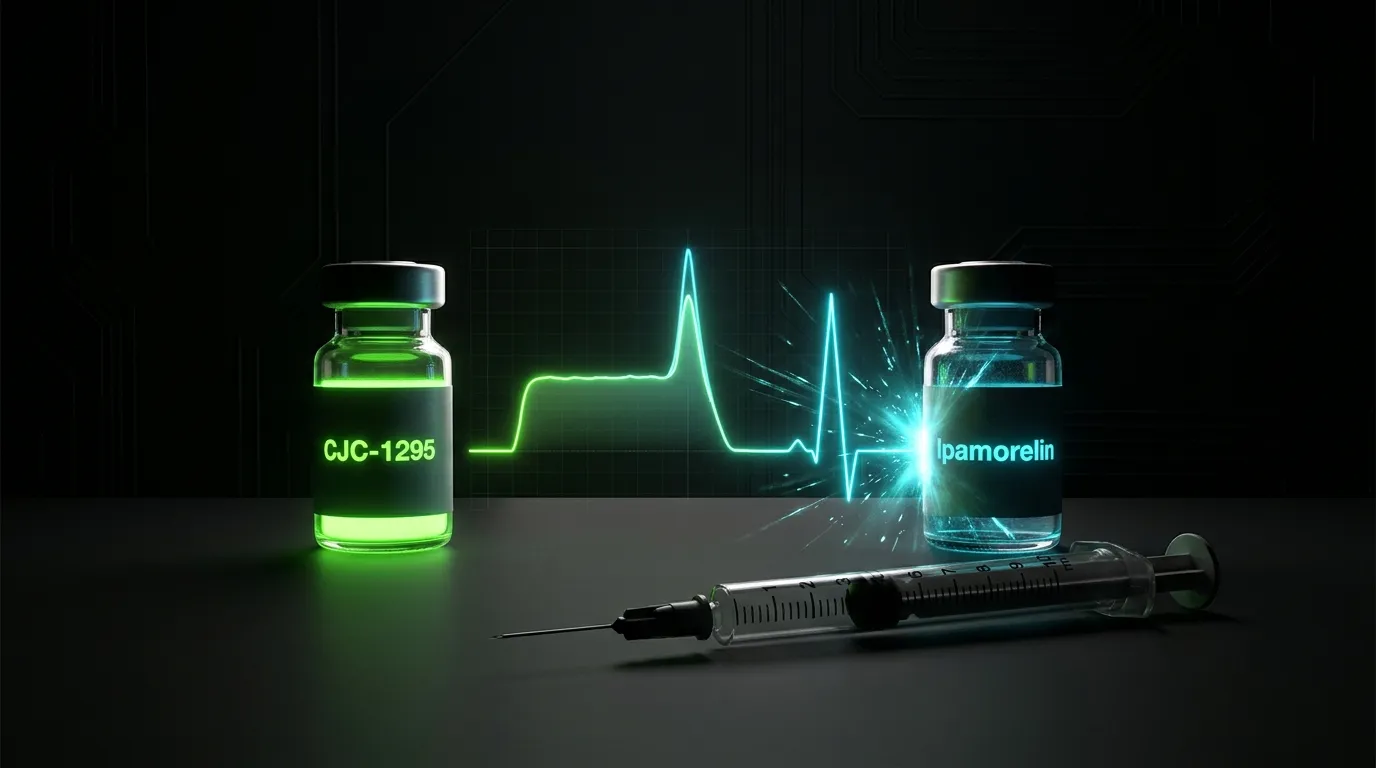
CJC-1295 ipamorelin pairs two peptides that make the pituitary gland under the brain release more growth hormone (GH). Each works through its own receptor, a docking site on the cell. CJC-1295 copies GHRH, the brain's GH signal. Ipamorelin copies ghrelin, a stomach hormone. Switching on both receptors in cells roughly doubled the inner signal. The pair is untested in people.
CJC-1295 and the GHRH Receptor
CJC-1295 is a lab-made form of GHRH, the brain's signal to release GH. GHRH binds its receptor on somatotrophs, the pituitary cells that make GH. That turns on an enzyme called adenylyl cyclase. The enzyme raises cAMP, a messenger inside the cell, and GH release follows (Cunha & Mayo).
The form studied in people carries an add-on called DAC, short for drug affinity complex. DAC lets the peptide latch onto albumin, a protein in the blood. That link is thought to explain its long life in the body. FDA's CJC-1295 review notes that direct proof of this is lacking.
Teichman and colleagues ran two trials in healthy adults aged 21 to 61. Both were randomized, placebo-controlled and double-blind, with rising doses. In each group, chance decided who got the peptide and who got a dummy shot (a placebo). Neither they nor the staff knew who got what. In the first trial, groups got single shots at doses that rose from 30 to 250 micrograms (mcg) per kilogram (kg) of body weight. Those given the peptide got one shot of the DAC form. Their GH in blood plasma rose 2- to 10-fold for 6 days or more, depending on the dose. IGF-1, a marker of GH at work, rose 1.5- to 3-fold for 9 to 11 days. The peptide's half-life, the time the body takes to clear half of it, was 5.8 to 8.1 days (Teichman et al.).
Ipamorelin and the Ghrelin Receptor
Ipamorelin works on a second receptor. It copies ghrelin, which binds the GH secretagogue (GHS) receptor. A secretagogue is anything that makes a gland release a hormone. FDA's ipamorelin review says it releases GH through receptors in two places. One is the hypothalamus, the brain area that controls the pituitary. The other is the GH-making cells of the pituitary. It acts mainly through GHRH-making nerve cells in the hypothalamus.
Older peptides that act on this receptor also raised stress hormones. In a study in pigs, GHRP-6 and GHRP-2 raised cortisol, a stress hormone, and ACTH, the hormone that drives cortisol. Ipamorelin did not, even at doses more than 200 times what it needed to release GH. None of the three changed prolactin, a hormone best known for milk production. In rodent (rat) pituitary cells, ipamorelin released GH about as well as GHRP-6 (Raun et al.).
Two Receptors Working Together
The case for pairing them rests on lab work. The GHS receptor signals through calcium, not cAMP. In cells built to carry both receptors, switching on the GHS receptor alone did not raise cAMP. Switching on both raised it to about twice the level the GHRH receptor reached alone. The study used GHRH itself and a range of GHS compounds (Cunha & Mayo).
The body releases GH in bursts, called pulses. A 2005 computer model of these pulses in rodents (rats) looked at the wider system. It assumed ghrelin acts on the pituitary directly and raises GHRH release in the brain. It also assumed ghrelin blunts the effect of somatostatin, the body's brake on GH. Built that way, the model matched lab findings. One was synergy between GHS and GHRH in live animals, meaning more effect together than the two add up to alone (Farhy and Veldhuis).
A 2001 study of two young adults whose GHRH receptor does not work adds a human clue. Their GH still came in pulses, but they made far less of it. An injection of GHRH did not raise their GH. GHRP-2, which acts on the GHS receptor, did. In the authors' view, a fall in somatostatin mainly sets when a pulse comes. GHRH drives its size (Roelfsema et al.).
That is the logic behind the pairing. CJC-1295 works through the GHRH receptor, and ipamorelin through the GHS receptor. Whether the two together release more GH than either alone has not been tested in people.
Does the CJC-1295 and Ipamorelin Stack Break the Body's Natural GH Rhythm?
Not for CJC-1295 alone, in the one study that checked.
That study sampled GH every 20 minutes overnight in healthy men aged 20 to 40. It did so before and one week after a single shot of the DAC form. GH still came in pulses, and the pulses kept their size and frequency. What changed was the level between pulses, which rose 7.5-fold. Mean GH rose 46% and IGF-1 rose 45% (Ionescu & Frohman).
Ipamorelin's own effect is brief. In healthy men given it by a 15-minute drip into a vein, GH peaked about 40 minutes later. It fell back to very low levels by 6 hours. The drug's half-life was about 2 hours. FDA's ipamorelin review describes this study. No human study has checked the GH rhythm with the two peptides together.
Both peptides work through the body's own pituitary rather than replacing GH. FDA notes that ipamorelin would not be expected to raise GH in people whose pituitary cannot make it. Our breakdown of growth hormone secretagogues vs HGH compares the two approaches.
What Are the CJC-1295 Ipamorelin Stack Benefits for Sleep and Recovery?
None has been measured. No published study has tested sleep, recovery or body composition on this pair in people. The two main human studies of CJC-1295 tracked GH and IGF-1 in healthy adults. Higher GH and IGF-1 are the effects the data show so far. FDA's review found that most websites describe injecting it at night. Neither trial above was set up to test dose timing.
Only one published ipamorelin trial tested a benefit. It looked at recovery of the gut after bowel surgery. Patients got 0.03 milligrams (mg) per kilogram of body weight into a vein twice a day for up to 7 days. Ipamorelin did not beat placebo. A 2020 review quoted by FDA says its development was then stopped.
What's the Standard CJC-1295 + Ipamorelin Stack Dosage Protocol?
There is no standard protocol from research. No trial has given the two peptides together to people. So no study sets a dose for the pair. The table lists the doses the separate human studies used. They are study doses, not a guide for use.
| Study | Peptide | Dose and route | People |
|---|---|---|---|
| Teichman et al., trial 1 | CJC-1295 with DAC | One shot under the skin, four dose levels up to 250 mcg per kg | Healthy adults aged 21 to 61 |
| Teichman et al., trial 2 | CJC-1295 with DAC | Two or three shots of 20 to 60 mcg per kg, one or two weeks apart | Healthy adults aged 21 to 61 |
| Ionescu and Frohman | CJC-1295 with DAC | One shot under the skin of 60 or 90 mcg per kg | Healthy men aged 20 to 40 |
| Gobburu et al. (in FDA's review) | Ipamorelin | A 15-minute drip into a vein at five dose levels | Healthy men |
| Beck et al. (in FDA's review) | Ipamorelin | 0.03 mg per kg into a vein, twice a day, for up to 7 days | Adults after bowel surgery |
| None | CJC-1295 without DAC, or the pair | No published human dose | None |
The Teichman trials found the peptide safe and relatively well tolerated. That held especially at 30 or 60 mcg per kg. FDA's 2024 review also lists the doses that websites give for it. They ranged from 100 mcg a week to 100 to 400 mcg a day. For fitness use, sites described 250 mcg a day. Some gave 100 to 200 mcg two to three times a day. None of these amounts was tested in the published trials, which dosed by body weight.
Neither peptide is an FDA-approved drug. Our guide to whether CJC-1295 ipamorelin is FDA approved covers the legal record. Each peptide also has its own guide: the CJC-1295 complete guide and the ipamorelin complete guide. The maths of mixing a powder vial is in our reconstitution mg/ml chart, where mg/ml means milligrams of peptide per millilitre of liquid. If you buy either one, check our recommended sources first. Skip any listing with no purity paperwork.
No-DAC Versus DAC: What the Data Cover
CJC-1295 is sold in two forms, and the evidence covers only one of them.
| Question | CJC-1295 without DAC | CJC-1295 with DAC |
|---|---|---|
| What the add-on does | No DAC, so no link to albumin | Binds albumin in the blood |
| Half-life in people | No published human data | 5.8 to 8.1 days |
| Effect shown in people | No study found by FDA | GH up 2- to 10-fold for 6 days or more after one shot |
| People dosed in studies | None | FDA counts 63 healthy adults across three studies |
FDA found no study showing that CJC-1295 without DAC is active. It also said the drug profile of the DAC form "cannot be extrapolated", or carried over, to the form without it. That matters for the pair. FDA found CJC-1295 and ipamorelin blends sold online for research use. It lists the CJC-1295 in them as the form without DAC.
How Long Has the CJC-1295 Ipamorelin Stack Been Studied?
As a pair, not at all. The two Teichman trials lasted 28 and 49 days. No one got a dose after day 14. Ipamorelin's longest published human dosing ran up to 7 days. None of the published human studies tested on-and-off schedules or breaks.
Repeat doses built on each other. In the multiple-dose trial, IGF-1 peaked higher after the second and third shots than after the first. It stayed above its starting level for up to 28 days (Teichman et al.). FDA notes one more point from the single-dose trial. IGF-1 went above the normal range for age only at the top dose, 250 mcg per kg.
The Human Safety Record
The record is small. FDA counts 63 healthy adults given the DAC form across three studies. Most were men (87%), and 73% had one shot. No published study has given the two peptides together to people.
No serious adverse reactions were reported in the Teichman trials. FDA's review of the first trial still lists common side effects. Injection site reactions occurred in about 70% of those given the peptide. Headache affected 63%, against 14% on placebo. Flushing, warmth and brief drops in blood pressure affected 30% (Teichman et al.).
One CJC-1295 death is on the record. In 2006, a Phase 2 trial of the peptide in 192 people with HIV was stopped. Phase 2 is the stage that tests whether a drug works, and at what dose, in patients. A participant had a heart attack two hours after an 11th weekly dose and died. The attending physician's most likely explanation was heart artery disease that had caused no symptoms. FDA calls these reports anecdotal: they come from online accounts, not a study record. The trial data were never published.
For ipamorelin, most of the human safety data come from the published bowel surgery trial. FDA's review reports serious medical problems, such as infections or a leak where the bowel was joined, in 17.9% of patients on ipamorelin. The figure was 15.5% on placebo. Most came after dosing had ended. Two patients given ipamorelin died. Both had bowel surgery for colon cancer, then a leak where the bowel was joined. FDA says it is unclear whether ipamorelin played a part. Three problems were more common on ipamorelin than on placebo. Low potassium hit 12.5% against 3.4%. High blood sugar at discharge hit 14.3% against 8.6%. Trouble sleeping hit 10.7% against 5.2%. FDA says the deaths, with the extra cases of low potassium and high blood sugar, raise safety concerns. Its concern is about ipamorelin's use in compounding, where a pharmacy makes its own version of a drug.
In the pig study, ipamorelin did not raise ACTH or cortisol. That held even at more than 200 times the dose it needed to release GH. It did not change prolactin either. These findings come from animals (Raun et al.). Our CJC-1295 side effects and safety guide covers the record in more detail.
See also our tesamorelin guide.
This content is for educational purposes only. These compounds are intended for research use. Nothing here is medical advice. Always work with a qualified clinician before making changes to your health protocol.
Where to buy CJC-1295/Ipamorelin
The hard part with CJC-1295/Ipamorelin isn't the protocol. It's finding a supplier that can prove what's in the vial. We assessed dozens against per-batch, third-party testing. A handful passed.
See the sources that passed →Where to buy CJC-1295/Ipamorelin
The hard part with CJC-1295/Ipamorelin isn't the protocol. It's finding a supplier that can prove what's in the vial. We assessed dozens against per-batch, third-party testing. A handful passed.
See the sources that passed →Share this article
Frequently Asked Questions
Has CJC-1295 with ipamorelin been tested in people?
What doses did the CJC-1295 studies use?
How long does one dose of CJC-1295 with DAC last?
Does ipamorelin raise cortisol?
Is CJC-1295 without DAC proven to work?
Is there a tested schedule for stopping the pair?
Read Next

Disclaimer: This content is for educational purposes only. These compounds are intended for research use. Nothing here is medical advice. Always work with a qualified clinician before making changes to your health protocol.