
Thymosin Alpha 1 Peptide: Benefits, Dosage and Safety

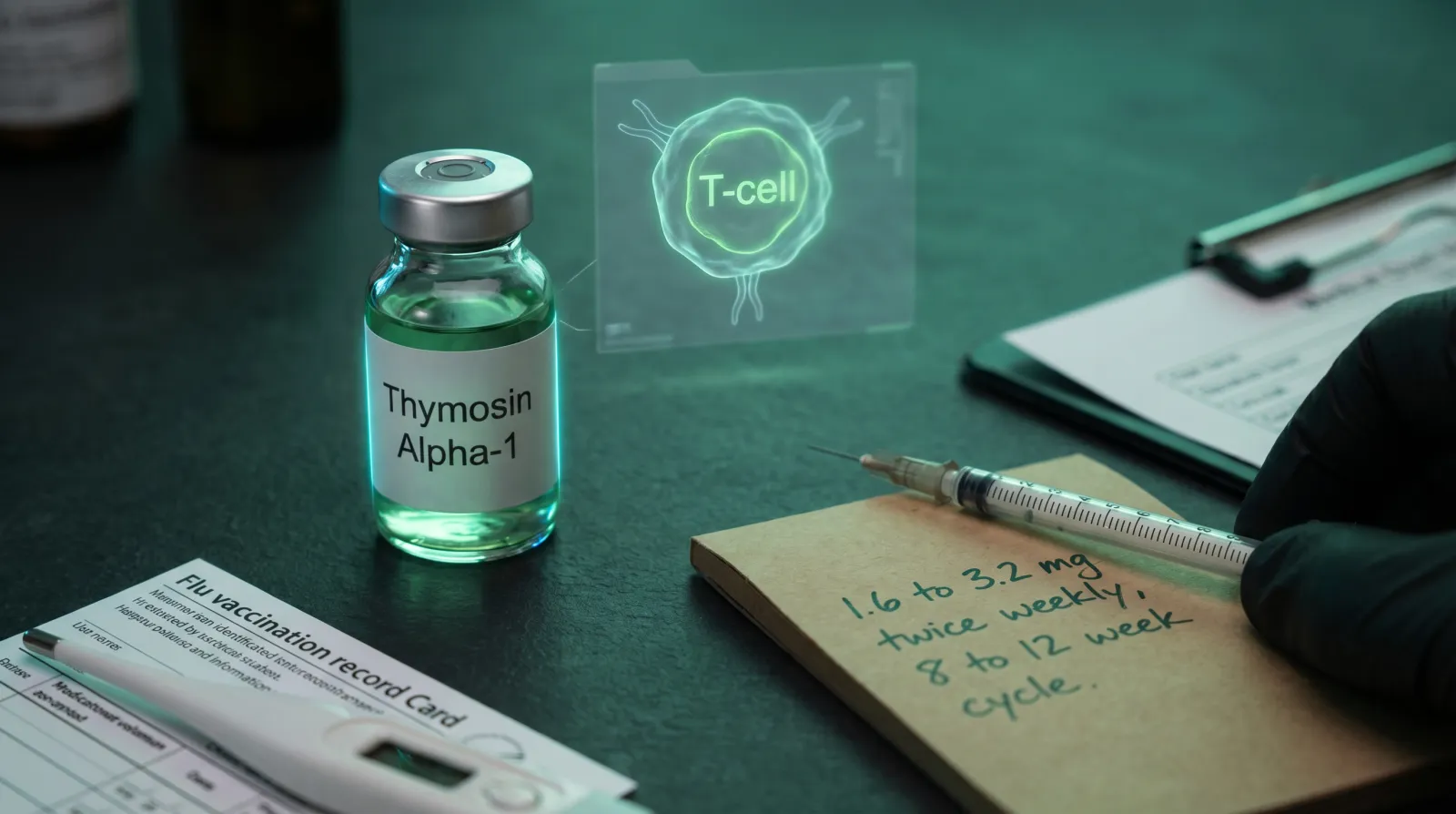
What Is Thymosin Alpha 1, and What Does It Do?
Thymosin alpha 1 peptide is an immune peptide made of 28 amino acids, the building blocks of protein. Its lab-made form, thymalfasin, is sold abroad as Zadaxin. It is thought to boost T-cells, the white blood cells that hunt infected cells. Trials tested it in hepatitis B (a liver infection), sepsis (a runaway response to infection) and vaccine response.
It is an approved prescription medicine in more than 30 countries outside the United States. Its uses there include hepatitis B and C, both liver infections (Goldstein 2009). Chronic hepatitis B, a long-term liver infection, is the use on the Zadaxin label we checked. The United States is different. FDA has approved no drug that contains it, and it has not cleared it for pharmacy compounding, where a pharmacy makes the drug itself. The section on buying it below sets out FDA's record.
The thymus is the gland behind your breastbone where T-cells mature. It shrinks with age. As it does, it puts out fewer new naive T-cells, ones that have not met a target yet. That drop is thought to contribute to the smaller range of T-cells seen in older people (Palmer 2013). The slow weakening of the immune system with age is called immunosenescence. It is also why people look at thymosin alpha-1 for longevity.
Scientists first isolated it in 1977 from thymosin fraction 5, an extract of calf thymus (Goldstein 1977). Tα1 is the short name you'll see in studies.
One thing trips people up. This peptide is not thymosin beta-4, the parent of TB-500. The names look alike. The molecules and the research are different. Our TB-500 guide covers that one.
How Does the Thymosin Alpha 1 Peptide Work in the Body?
Nobody knows the full answer. Zadaxin's own label says the mechanism is not completely understood. It is thought to work mainly by boosting T-cell function.
Most of the mechanism evidence comes from lab dishes and animals. In lab tests, it helped T-cells develop and mature. Cells carrying the markers CD4, CD8 and CD3 all rose. Those markers are tags that sort T-cells into types.
It also raised several cytokines, the chemical signals immune cells use to talk. And it raised the activity of NK cells. NK cells are natural killer cells, immune cells that destroy infected cells.
FDA's 2024 review adds one piece. It says the effects run at least partly through Toll-like receptor 9 (TLR9). TLR9 is a sensor that dendritic cells use to spot germs. A dendritic cell grabs pieces of an invader and shows them to T-cells, like handing over a wanted poster.
In the body, it does not last long. The label reports that in adult volunteers, blood levels peaked about 2 hours after a shot under the skin. They were back to their starting level by 24 hours. Its half-life, the time the body takes to clear half of it, was about 2 hours. For unit conversion, see the thymosin alpha 1 dosage calculator.
It has also been tried in a type of liver cancer, hepatocellular carcinoma. FDA's 2024 review found too little evidence that it works there.
What Are the Thymosin Alpha 1 Benefits in the Trials?
Here's what the trials show, one use at a time. Some early results looked good. The largest, tightest tests found less.
Start with vaccines. The trial's authors note that up to half of older adults may fail to respond to a flu shot. Their trial was randomized, double-blind and placebo-controlled. Chance decided who got the peptide and who got a placebo, a dummy shot. Neither the men nor the staff knew who got what. It ran in 90 men aged 65 to 99 (mean age 77).
Each man got the 1986 seasonal flu vaccine. Alongside it he got Tα1 or placebo, twice a week for eight doses. At 6 weeks, antibody levels rose more with Tα1 than with placebo. Antibodies are the proteins the body makes against a germ. The gain was statistically significant, meaning unlikely to be chance.
The gain came from the older men, aged 77 and up. The younger men showed no difference. Treated older men made about as much antibody as the younger men (Gravenstein 1989).
FDA's 2024 review was cautious here. It found too little evidence to draw any conclusion on vaccines. The studies were exploratory, meaning they did not test a question fixed in advance. Most measured antibodies with a lab test that does not show fewer infections.
Sepsis is a messier story. Sepsis is the body's runaway reaction to an infection, and it can kill. Early work looked promising. The biggest trial then fell flat.
First the good news. A multicenter, randomized, single-blind trial in six Chinese hospitals enrolled 361 severe sepsis patients. Single-blind here means only the patients and the statistician did not know who got what. It compared Tα1, given in combination with conventional medical therapies (usual sepsis care), with a control group. Of the 361, 181 got Tα1 and 180 did not. Deaths within 28 days were 26.0% with Tα1 and 35.0% without. The authors called that gap marginal. It just missed the usual cut-off for statistical significance in one analysis and just met it in another (Wu 2013).
Then came a pooled meta-analysis of 12 trials (1,480 patients in all). A meta-analysis combines the results of several trials. It found a significant mortality reduction (fewer deaths). The pooled risk ratio was 0.68 (a risk ratio below 1 means fewer deaths in the Tα1 group). Its authors warned the trials were small and of poor quality (Li 2015).
Then came a bigger test. It was a 1,106-patient multicenter phase 3 trial, randomized, double-blind and placebo-controlled, published in 2025. Phase 3 is the large, final stage of testing. It ran across 22 Chinese hospitals. Of 1,106 patients, 552 were assigned Tα1 and 554 placebo. Of the 552, 542 got at least one dose. Patients got Tα1 or placebo every 12 hours for seven days. It found no significant difference in 28-day mortality (deaths within 28 days): 23.4% versus 24.1%, hazard ratio 0.99 (Wu 2025). A hazard ratio of 1 means no difference.
The authors also flagged a possible age effect. In a planned subgroup check, patients under 60 fared worse on Tα1, and those 60 and over did not.
I read that 2025 result as the honest one. It doesn't erase the older work. But it is the largest sepsis trial on this page, and it was double-blind. FDA's 2024 review also found the sepsis evidence insufficient.
Chronic hepatitis B is the one use on Zadaxin's label. The label pools three randomized trials with 223 patients. Of those, 113 got 1.6 milligrams (mg) twice a week for six months, and 110 got a placebo or no treatment. A year after treatment ended, 36% of the treated group had no detectable virus DNA and no e-antigen, a marker of active infection. In the other group, 19% did.
A 2008 meta-analysis compared it with interferon, an older injected hepatitis B drug. Interferon looked better at the end of six months of treatment. Tα1 did better six months after treatment stopped (Yang 2008). FDA's 2024 review still found too little evidence that it works in hepatitis B. It found the results mixed and the trials small.
A 2026 Cochrane review pooled 10 randomised trials in chronic hepatitis B. They enrolled 1,349 people and were published between 1991 and 2018. Among the trials that reported age, people were 17 to 75 years old. The peptide may cut deaths from any cause and serious side effects. Even so, the reviewers rated the evidence very low certainty for every outcome except serious side effects, which was low. They said they were not sure of these effects. They cited flaws in the studies, wide margins of error and small numbers of people (Naing 2026).
Then there's the longevity pitch. I want to be clear that it's a pitch. The argument runs like this. An aging thymus puts out fewer naive T-cells, which is thought to shrink T-cell variety. Tα1 acts on T-cells. So a thymic peptide might push back.
That's a stretch from the vaccine work. It isn't a finding. We found no trial of it for lifespan or healthy aging. I'd treat it as an untested idea.
Blood levels do fall early in life, at least in mice. A 1988 rodent (mouse) study measured Tα1 in serum, the liquid part of blood, at five ages. Levels were highest at 3 weeks of age, at about 60 ng/mL. That means 60 nanograms, or billionths of a gram, in each millilitre. They fell sharply to about 20 ng/mL by 2 months. Any fall after 2 months was mild (Weindruch 1988).
Psoriasis and Chronic Fatigue: What the Evidence Shows
This is where I slow down. FDA found compounded Tα1 marketed online for both chronic fatigue and psoriatic arthritis. The evidence behind those uses is thin.
Start with what we know. A case-control study measured Tα1 in serum, the liquid part of blood. Case-control means it compared people who have a disease with people who don't. It tested 200 patients with psoriatic arthritis, rheumatoid arthritis or lupus. All three are autoimmune diseases, where the immune system attacks the body's own tissue. Psoriatic arthritis is a joint disease linked to the skin condition psoriasis. The study found significantly lower circulating Tα1 levels compared to 120 healthy controls, and the lowest in psoriatic arthritis (Pica 2016).
That's an observation. It's not a treatment result. The finding tells us levels differ. It doesn't tell us that topping them up fixes anything. We found no published trial of Tα1 as a psoriasis treatment.
There's a caution too. FDA's 2024 review notes that labels for Tα1 products sold outside the United States carry warnings and contraindications for patients with autoimmune disease. A contraindication is a reason not to use a drug.
Chronic fatigue syndrome (ME/CFS) is a long illness marked by exhaustion that rest does not fix. FDA's 2024 review looked for clinical studies of Tα1 in ME/CFS. It found none. Our article on thymosin alpha-1 in chronic illness goes further into the autoimmune questions.
Long COVID is a different case. A 2023 lab study added Tα1 to immune cells taken from people with long COVID. The authors said it helped restore the cells' normal immune balance. That was a lab study, not a patient trial (Minutolo 2023). On 16 October 2026, ClinicalTrials.gov listed Tα1 trials for acute COVID-19 but none for long COVID.
Who Has Thymosin Alpha 1 Been Tested In?
People who were ill or at risk. Every trial with reported results on this page studied older men getting a flu shot, patients with sepsis, or people with chronic hepatitis B. One hepatitis B review included people as young as 17. On this page, healthy volunteers appear only in the label's studies of how the body handles the drug.
Zadaxin's label covers one group. It is adults 18 and over with chronic hepatitis B whose liver still copes, which doctors call compensated liver disease. The label says safety and effectiveness have not been established under 18.
FDA's 2024 review looked wider. It covered hepatitis C, HIV, COVID-19, three cancers, lung disease (COPD), ME/CFS, and infections after stem cell transplants. It found the evidence insufficient for every use it reviewed.
So the honest answer is narrow. Outside hepatitis B, in the countries that approve it, the trials do not single out any group that clearly gains.
What Are the Thymosin Alpha 1 Side Effects?
Let's talk about the downside, because there is one. Most of what gets reported is mild.
Zadaxin's label draws on over 2,000 treated people. It lists mostly discomfort at the injection site. Rarer effects were redness, brief muscle wasting, joint pain with hand swelling, and rash.
In hepatitis B, the most common reaction was a swing in liver enzymes (markers in a liver blood test). The trial's authors linked it to the immune response (Iino 2005). The label calls these flares: a jump in ALT, a liver enzyme, to more than twice its starting level.
The sepsis trials found no safety signal (a pattern of harm linked to the drug). The 361-patient trial recorded no serious side effect linked to the drug. In the 1,106-patient trial, no safety outcome differed from placebo.
FDA's 2024 review lists other adverse events (unwanted effects) reported in studies. They include abnormal thyroid test (TSH) results in hepatitis C patients. In stem cell transplant patients, they include fatal immune anemia (the immune system destroying red blood cells). They also include graft failure, where a transplant does not take.
FDA's other worry is the product itself. It says compounded Tα1 may pose a significant risk of immunogenicity for certain routes of administration. That means an immune reaction against the peptide itself.
The label and FDA's review single out three groups.
Transplant recipients. Some people are deliberately immunosuppressed: their immune system is turned down on purpose with drugs. The label says Zadaxin appears to work by enhancing the immune system. So it should be considered contraindicated in these patients, for instance transplant patients, unless the potential benefits clearly outweigh the potential risks. FDA adds that it could cause or worsen graft-versus-host disease in stem cell transplant patients. In that disease, transplanted cells attack the body.
Autoimmune disease. Labels for Tα1 sold outside the United States carry warnings and contraindications for patients with autoimmune diseases. FDA's review notes this.
Pregnancy and breastfeeding. The label says it is not known whether Zadaxin can harm an unborn baby. It should be given to a pregnant woman "only if clearly needed". It is not known whether it passes into breast milk, so the label urges caution in nursing women. In the label's reproduction studies in rodents (mice) and rabbits, treated and untreated animals showed no difference in fetal abnormalities (defects in the unborn young).
What Doses Did the Thymosin Alpha 1 Studies Use?
Here are the doses from the label and the trials above, side by side. They are research and label protocols, not advice for you.
The vaccine trial scaled its dose to body size. It gave 900 micrograms (mcg, thousandths of a milligram) per square metre of body surface area.
| Source | Who | Dose | Schedule | Length |
|---|---|---|---|---|
| Zadaxin label | Adults with chronic hepatitis B; in its pooled trials, 113 of 223 got Tα1 | 1.6 mg under the skin | Twice a week, 3 or 4 days apart | Six months (52 doses) |
| Gravenstein 1989 | 90 men aged 65 to 99 enrolled, with a flu shot; the abstract does not say how many got Tα1 | 900 mcg per square metre of body surface | Twice a week | Eight doses |
| Wu 2013 (ETASS) | 361 adults with severe sepsis enrolled; 181 got Tα1 | 1.6 mg under the skin | Twice a day for 5 days, then once a day for 2 days | 7 days |
| Wu 2025 (TESTS) | 1,106 adults with sepsis enrolled; 552 assigned Tα1, 542 of them dosed | 1.6 mg under the skin | Every 12 hours | 7 days |
The label row is the only approved dosing plan. It is for adults with chronic hepatitis B, under a doctor's care. The label says the shot goes under the skin, never into a muscle or a vein.
The label's product is a powder mixed with 1 millilitre (mL) of sterile water just before the shot. It is used straight away. Unmixed vials are stored at 2 to 8 degrees Celsius.
FDA's 2024 review found the most common study dose was 1.6 mg under the skin. For the dosing research in more depth, see our thymosin alpha 1 dosage protocol article.
How Long Does a Thymosin Alpha 1 Cycle Run in the Studies?
In the studies, a course ran as long as the condition called for. None used set on-and-off blocks. The hepatitis B label runs six months without a break. The two sepsis trials ran seven days. The flu vaccine trial gave eight doses over about four weeks.
Across the studies FDA reviewed in 2024, treatment ran from 1 day to 12 months. We found no study that tested on-and-off cycles or seasonal blocks.
The label notes a delayed response in hepatitis B. Some patients responded 12 months or more after treatment ended. So the label's own check-ups run past the last dose. It calls for liver blood tests during treatment. It then calls for virus tests at the end and at 2, 4 and 6 months after.
Where to buy thymosin alpha-1
The hard part with thymosin alpha-1 isn't the protocol. It's finding a supplier that can prove what's in the vial. We assessed dozens against per-batch, third-party testing. A handful passed.
See the sources that passed →Can You Buy Thymosin Alpha 1 Legally in the United States?
Not as an approved medicine. FDA has approved no drug product that contains Tα1 (FDA 2024). It is also not approved in Japan or Europe, except Italy. FDA adds that it cannot independently verify the maker's claims of approval in every other country.
Compounding is not a cleared route either. Compounding is when a pharmacy makes a drug itself from a raw ingredient, called a bulk drug substance. FDA lists thymosin-alpha 1 on its page of bulk drug substances that may present significant safety risks in compounding. It sits in the group whose nominations were withdrawn by the nominators. A nomination is a request to add a substance to FDA's list.
FDA says that group was once in category 2. Category 2 holds substances that may present significant safety risks. FDA's stated concerns are immunogenicity for certain routes of administration, plus peptide impurities and difficulty characterising the substance (confirming exactly what it is). FDA says the safety information it holds is not adequate to understand how big those issues are. That page was current as of 22 April 2026.
FDA also keeps a list of the raw ingredients people have asked it to allow. Its last update was on 14 May 2026. It names Category 1 "Bulk Drug Substances Under Evaluation" (FDA 2026). Tα1 is not in it. It is not in categories 2 or 3 either. So claims that Tα1 returned to Category 1 in 2026, with legal compounding restored, do not match FDA's record. In its 2024 review, FDA also weighed the evidence against adding Tα1 to the 503A bulks list, the list of raw ingredients pharmacies may compound. Our report on the FDA peptide vote explains how these categories work.
FDA also found a website selling compounded Tα1 as "FDA-approved". FDA has approved no such product.
FDA also found key data missing on impurities and aggregates (clumps) in the raw peptide. Our recommended sources page lists the seven tests UB uses to grade research suppliers. The first is a certificate of analysis (COA), a lab report for each batch from a named outside lab. The second is HPLC purity (how pure the batch is). The third is mass spectrometry, a test that confirms the compound in the vial is what the label claims. Our piece on spotting real peptides explains how we read a COA.
Research-supplier prices are tracked on our thymosin alpha-1 library page.
This content is for educational purposes only. These compounds are intended for research use. Nothing here is medical advice.
Where thymalfasin is approved, it is a prescription medicine given under a qualified clinician's care.
Where to buy thymosin alpha-1
The hard part with thymosin alpha-1 isn't the protocol. It's finding a supplier that can prove what's in the vial. We assessed dozens against per-batch, third-party testing. A handful passed.
See the sources that passed →Share this article
Frequently Asked Questions
What dose of thymosin alpha-1 does the Zadaxin label use?
Can you get thymosin alpha-1 legally in the United States?
What does the thymosin alpha-1 label say about transplant patients?
Does thymosin alpha-1 help with psoriasis or chronic fatigue syndrome?
Is thymosin alpha-1 actually proven to reduce sepsis mortality?
How long does a thymosin alpha-1 cycle run in the studies?
Read Next

Disclaimer: This content is for educational purposes only. These compounds are intended for research use. Nothing here is medical advice. Always work with a qualified clinician before making changes to your health protocol.