
Stacking Peptides: When a Stack Beats One Peptide

Does Stacking Peptides Beat One Peptide on Its Own?
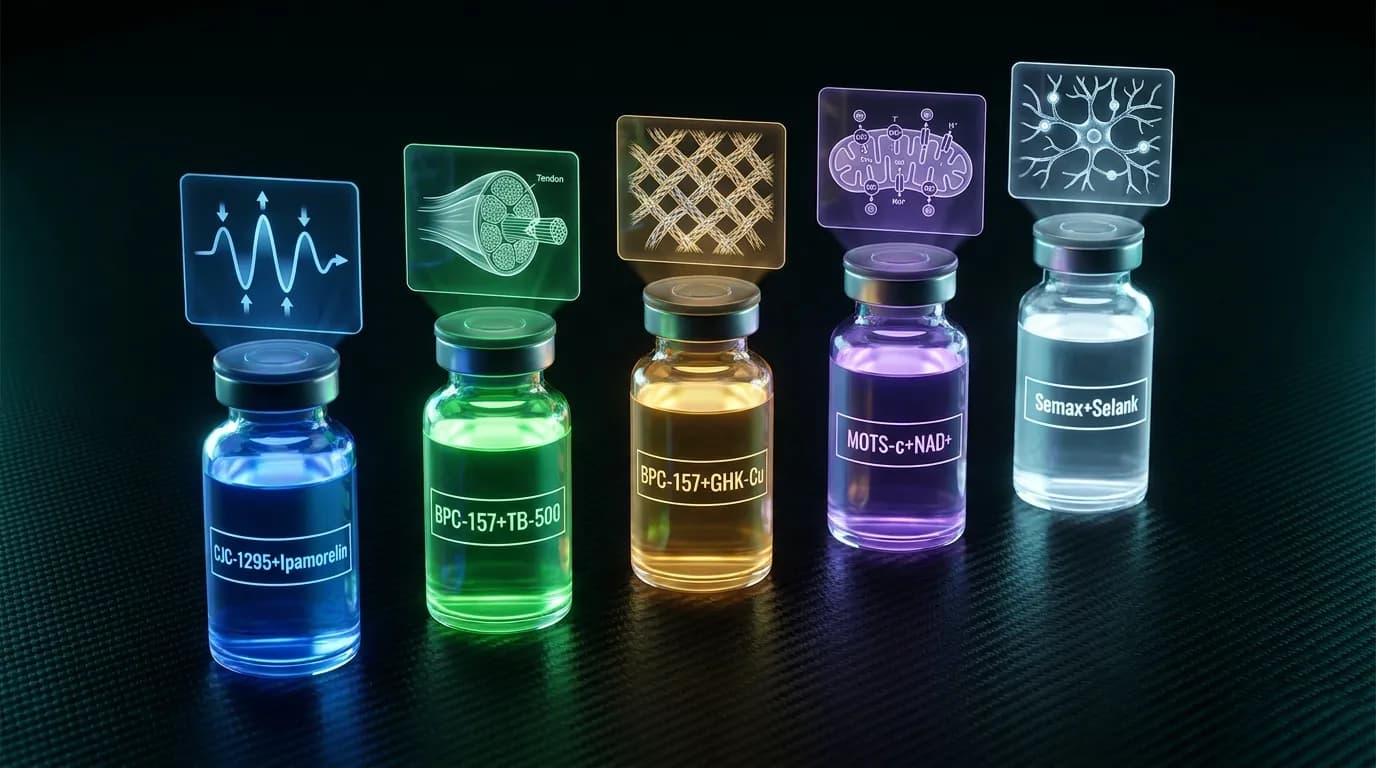
Stacking peptides beats a single peptide only when two conditions hold. The two compounds must hit different pathways that both matter to your goal. Each must carry its own evidence. Five stacks here clear that bar. None has human RCT data proving the pair beats either half.
That is the short answer. The longer one is below, stack by stack, with an honest evidence grade on each.
With BPC-157, the supplier matters as much as the dose. We only list sources that publish an independent, per-batch certificate of analysis. See the ones that clear it.
When Is a Peptide Stack Worth the Cost?
A peptide stack earns its place when both compounds are pulling in useful directions. Not just different directions. Useful ones, for the goal you actually have.
The usual story runs the other way. Single peptides are useful, stacks are better, and any two compounds on different pathways must add up to more. That story fills forum threads, podcasts and a large slice of commercial peptide content.
It gets the pharmacology wrong. "Synergy" has a precise meaning. It is not the same as an additive effect. An additive effect is not the same as both compounds simply doing something.
Why Do So Many Synergy Claims Fall Apart?
True synergy means the pair beats what each dose-response curve predicts. Researchers test that with isobolographic analysis. When they do, real synergy turns out to be rare.
Many synergy claims also rest on animal models with no human RCT replication. Most stacking protocols produce an additive effect at best. At worst they saturate receptors. Or the signals compete and cancel. Or the side effects grow while the result does not.
None of that makes stacking useless. Five combinations below do have mechanistic logic. Several have human or robust preclinical data behind the parts. The premise that a stack always beats one compound is what does not survive.
The "10x GH Release" Claim
The loudest argument for stacking pairs a GHRH analogue with a GHRP. Teichman et al. 2006 showed that CJC-1295 with DAC raised mean IGF-I by 28 to 48 percent across dose groups. That came from a randomised, placebo-controlled, double-blind trial in healthy adults. The data is real and it replicates.
The "10x GH release" figure is a different animal. It comes from acute GH pulse height, not from IGF-I, body composition or any functional measure. Acute spikes do not scale neatly into IGF-I or tissue repair. Somatostatin feedback from the pituitary damps sustained GH however big the pulse was.
Ionescu and Frohman 2006 measured what happens to that rhythm. GH pulses persisted during continuous GHRH stimulation. Pulse frequency and size were unchanged. The authors did not find that pulse height predicted IGF-I.
So a single well-timed GHRH analogue may reach your functional goal on its own. That route skips the cortisol and prolactin risk the GHRP half adds.
BPC-157 With TB-500: Good Logic, No Proof
This pair is the most used injury stack. The logic behind it is sound. BPC-157 works locally. It raises VEGFR2 for angiogenesis. It supports fibroblast activity and collagen organisation at the injury site.
TB-500's active fragment is the Ac-SDKP tetrapeptide sequence from thymosin beta-4. It drives actin polymerisation and cell migration across the body, moving repair cells to the site. The two are complementary, not redundant.
What is missing is human RCT data showing the pair beats either compound alone. That data does not yet exist. You are combining two reasonably supported compounds on mechanistic logic, not on proven stack synergy.
How Is the Evidence for Each Stack Graded Here?
Rather than present five stacks as equally proven, each one gets a grade. The framework is simple and it is applied the same way every time.
| Grade | Criteria | Clinical Weight |
|---|---|---|
| A | Human RCT data for the combined stack or for individual components with direct IGF/functional outcomes | High confidence |
| B | Human pharmacokinetic data for one component, preclinical functional data for the combination | Moderate confidence |
| C | Animal model data only, or human case series without controls | Low confidence; mechanistic rationale only |
| D | In vitro data or theoretical mechanistic reasoning | Hypothesis-generating only |
Where the evidence is a C, the text says so plainly.
What Is the Best Peptide Stack for Growth Hormone?
CJC-1295 without DAC plus ipamorelin. Grade B.
Why Skip the DAC Version
CJC-1295 with DAC carries a Drug Affinity Complex that binds albumin. Its half-life runs about eight days. That gives a flat, non-pulsing rise in GH.
Natural GH release is pulsed. Holding a steady GHRH signal may flatten that pattern over time. Flattening it is linked to the familiar GH complaints at higher doses. Those are water retention, stiff joints and higher fasting glucose.
CJC-1295 without DAC has a half-life of roughly 30 minutes. That keeps the pulsed pattern intact when the two are given together.
Mechanism
CJC-1295 without DAC copies natural GHRH at the pituitary. It triggers GH release through the GHRH receptor. Ipamorelin works at the ghrelin receptor, a separate receptor population on the same somatotroph cells.
Hitting both receptor systems at once produces a larger GH pulse than either alone. Ipamorelin's selectivity is its edge over GHRP-6. At standard doses it does not meaningfully raise cortisol or prolactin. GHRP-6 releases both through non-ghrelin routes at higher doses.
Dosing Protocol
| Compound | Dose | Frequency | Timing |
|---|---|---|---|
| CJC-1295 (no DAC) | 100 mcg | 1-2x daily | Fasted, pre-sleep preferred |
| Ipamorelin | 100-200 mcg | 1-2x daily | Same injection, fasted |
A typical run is 8 to 12 weeks with a structured break. The IGF-I data from Teichman et al. 2006 applies to the CJC-1295 half. The ipamorelin half rests on preclinical and pharmacokinetic evidence. Anyone with insulin resistance should monitor fasting glucose throughout. For the full breakdown, see the ipamorelin dosage protocol guide.
What Is the Best Peptide Stack for Muscle Growth?
Honestly, none of these five. The GH stacks are the closest fit, and their lean mass evidence is weak.
Raised IGF-I from a GHRH analogue is real. Whether it becomes lean mass in a healthy, well-fed adult is another question. The RCTs that show IGF-I rises have not tracked it. They show no consistent, statistically significant change in DXA-measured lean mass. That is in people who are not GH deficient.
So manage expectations. If size is the whole goal, a stack is not the lever you were promised.
Which Peptide Stack Suits Injury Recovery Best?
BPC-157 with TB-500. Grade B for the individual compounds, C for the stack.
Mechanism
BPC-157 is a 15-amino-acid synthetic peptide. It is drawn from a gastric mucosal protein sequence. Its repair routes are among the best characterised in the peptide literature. It raises VEGFR2, which drives angiogenesis. It shifts the nitric oxide system. It pushes fibroblasts to divide. It also has a documented anti-inflammatory effect on TNF-alpha and IL-6 at injury sites.
Yuan et al. 2026 is a recent review of those mechanisms. It covers muscle, tendon, ligament and gut tissue in preclinical models.
Staresinic et al. 2022 reviews healing at the myotendinous junction, where muscle meets tendon. The work covers animal surgery models and reports recovery of muscle function. The review describes a wide effective range, from microgram down to nanogram doses.
TB-500 is the synthesised fragment matching residues 17 to 23 of thymosin beta-4. It acts through actin sequestration and cell migration signalling. There's no verified human cardiac trial data available for TB-500's parent compound, thymosin beta-4. For the full data breakdown, see the TB-500 complete guide.
The rationale is a division of labour. BPC-157 builds the local repair environment. TB-500 moves repair cells in from elsewhere.
Dosing Protocol
| Compound | Dose | Frequency | Route |
|---|---|---|---|
| BPC-157 | 250-500 mcg | Daily or 5x weekly | Subcutaneous, near injury site where possible |
| TB-500 | 2-2.5 mg loading for 4-6 weeks, then 1-1.5 mg maintenance | 1-2x weekly | Subcutaneous |
Where This Stack Falls Short
For gut complaints alone, adding TB-500 to BPC-157 buys no clear mechanistic benefit. The gut evidence for BPC-157 rests on direct mucosal contact when taken orally. Injected, it rests on local peritoneal signalling. TB-500 moves cells around the body. That matters less to mucosal healing.
Single-compound BPC-157 taken orally is the better supported route for gut work. See BPC-157 oral vs injectable for that comparison.
Can You Run Ipamorelin and MK-677 as One Peptide Stack?
Yes, and the case for it is convenience. Grade B. This pairs an injected GHRP with an orally active ghrelin mimetic.
MK-677 (ibutamoren) is not strictly a peptide. It is a small molecule at the ghrelin receptor, with a 24-hour plasma half-life. It raises GH and IGF-I steadily, with no injection. Ipamorelin is added for a pulsed release on top of that steady baseline.
The practical limit is MK-677 itself. Through its ghrelin-mimetic effect it reliably raises appetite and water retention. In some users it raises fasting glucose too. Adding ipamorelin layers a second ghrelin receptor agonist on top. That may amplify the side effects without amplifying the benefit. For the full picture, see the ipamorelin vs MK-677 comparison.
Dosing Protocol
| Compound | Dose | Frequency | Timing |
|---|---|---|---|
| MK-677 | 12.5-25 mg | Once daily | Pre-sleep (to attenuate appetite surge during waking hours) |
| Ipamorelin | 100-200 mcg | Once daily | Morning, fasted, separate from MK-677 timing |
Human data for MK-677 is stronger than for most GH secretagogues. Murphy et al. 1998 ran a double-blind, randomised, placebo-controlled cross-over trial. Eight healthy adult volunteers ate at a calorie deficit across two 14-day periods. Oral MK-677 at 25 mg daily reversed the nitrogen loss that the diet caused. Mean IGF-I also rose by a statistically significant margin against placebo. Fasting glucose monitoring is non-negotiable on this stack, especially with pre-diabetic markers.
Water retention and appetite hit almost everyone on MK-677. Ipamorelin does not soften them. If you are lean and sensitive to carbs, CJC-1295 with ipamorelin is the better bet.
Does a Peptide Stack Help Focus and Stress?
Selank with Semax. Grade C, and the grade is the point.
Both are Russian-developed neuropeptides with a real body of Soviet-era and post-Soviet research behind them. That research base is also why the grade is C rather than B. The primary literature is Russian-language. It sits in journals with limited peer-reviewed review from abroad. Study quality varies a lot. Neither has finished Phase III RCT review by a regulator abroad.
Mechanism
Selank is a synthetic copy of tuftsin, a natural immune-signalling peptide. It calms anxiety and steadies thinking. It acts mainly on the GABAergic system. It also shifts BDNF and serotonin receptor levels.
Semax is an ACTH(4-7) analogue. It raises BDNF and NGF in the brain. Stroke recovery research has documented nootropic and nerve-sparing effects.
The pair targets two different nodes. Selank handles anxiety and stress resilience. Semax handles cognition and neurotrophin support. Whether they truly amplify each other is not established by controlled comparative data. For background on each, see the Selank complete guide and the Semax complete guide.
Dosing Protocol
| Compound | Dose | Frequency | Route |
|---|---|---|---|
| Selank | 250-500 mcg | 1-2x daily | Intranasal or subcutaneous |
| Semax | 300-600 mcg | 1x daily (AM) | Intranasal preferred |
Runs in the research are usually 10 to 14 days. That is far shorter than the 8 to 12-week GH protocols. Data on extended use is very limited. For serious neurological or psychiatric use, involve a qualified clinician who knows peptide pharmacology.
For acute stress alone, Selank on its own has the tighter mechanism. Semax is stimulatory, so in a high-stress week it may work against Selank rather than with it.
Which Peptide Stack Works on Skin and Connective Tissue?
GHK-Cu with BPC-157. Grade B for skin and connective tissue, C for whole-body use.
Mechanism
GHK-Cu is a naturally occurring copper complex with a substantial evidence base of its own. It raises collagen and elastin synthesis, drives angiogenesis and modulates TGF-beta signalling. Gene work in human fibroblast studies has mapped its broad effects on skin repair and inflammation.
Paired with BPC-157, the two overlap on angiogenesis and collagen. They arrive by different routes. GHK-Cu works through TGF-beta and copper-driven LOX enzyme activation. BPC-157 works through VEGFR2 and nitric oxide.
That gives a logical case for wound healing, post-procedure skin recovery and connective tissue remodelling. For the wound-healing evidence, see the GHK-Cu wound healing and recovery guide.
Dosing Protocol
| Compound | Dose | Route | Context |
|---|---|---|---|
| GHK-Cu | 1-2 mg | Subcutaneous or topical (compounded) | Daily or 5x weekly |
| BPC-157 | 250-500 mcg | Subcutaneous | Daily, near target tissue where relevant |
The strongest use is skin, fascia and shallow connective tissue. For deep joint and muscle injuries, BPC-157 with TB-500 is still the better pair. For ageing and long life, see the best peptides for anti-ageing and longevity 2026 overview.
Topical GHK-Cu does not cross intact skin well without a tuned vehicle. If the target is connective tissue deeper down, injectable GHK-Cu is required. The human evidence for injectable GHK-Cu is much thinner than the topical and in vitro data.
Which Stack Fits Your Goal?
| Goal | Best Stack | Single-Compound Alternative | Evidence Grade |
|---|---|---|---|
| GH axis optimisation | CJC-1295 (no DAC) + Ipamorelin | MK-677 alone (oral convenience, more side effects) | B |
| Musculoskeletal injury recovery | BPC-157 + TB-500 | BPC-157 alone for most soft tissue | B/C |
| GH + metabolic convenience | Ipamorelin + MK-677 | MK-677 alone at lower dose | B |
| Cognitive performance / stress resilience | Selank + Semax | Semax alone for pure nootropic effect | C |
| Skin and superficial connective tissue | GHK-Cu + BPC-157 | GHK-Cu alone for surface-level skin | B/C |
| GI repair or gut health | BPC-157 alone (oral or injectable) | Not applicable - single compound is optimal here | B |
When Does One Peptide Beat Stacking Peptides?
Three situations, and most stacking guides skip all three.
1. Pathway specificity beats amplitude. When the target is one well-defined pathway, a second compound on a different route adds nothing to the aim. Gut mucosal repair, acute wound healing and specific receptor work all sit here. It adds cost, injections and off-target risk instead. BPC-157 for gut complaints is the clearest case. Skin and connective tissue is the same story. GHK-Cu alone has a strong base of its own here. It covers collagen synthesis and anti-inflammatory signalling. See our GHK-Cu complete guide for the human wound-healing data.
2. You are new to peptides. Two compounds at once make tolerance and response almost impossible to read. Start with one, establish the response, then layer. That is not caution. It is the only way to learn what is working.
3. The budget will not cover full doses. A stack run at half doses is worse than one compound at its full evidence-based dose. Cutting doses to afford a stack defeats the reason for stacking.
Where to buy BPC-157
The hard part with BPC-157 isn't the protocol. It's finding a supplier that can prove what's in the vial. We assessed dozens against per-batch, third-party testing. A handful passed.
See the sources that passed →How Do You Avoid a Bad Batch When Stacking Peptides?
Quality is the most common single point of failure in any protocol. The grey market has a well-documented contamination and mislabelling problem. Studies of research peptides on sale have found products that are underdosed or mislabelled. Some carry bacterial endotoxin from poor lyophilisation.
With BPC-157, the supplier matters as much as the dose. We only list sources that publish an independent, per-batch certificate of analysis. See the ones that clear it.
What Should a Clinician Check Before You Start?
Five things, in this order.
Start single, then layer. Establish tolerance and baseline response on one compound first. This is basic pharmacological method.
Match the stack to the mechanism, not the marketing. "Complementary pathways" only counts when both pathways matter to your outcome. Two mechanisms that are both irrelevant to your goal add nothing.
Match your hopes to the evidence. A grade-A stack earns more faith. A grade-C one is hypothesis-generating at best. Do not give both the same effort.
Monitor numbers you can measure. For GH stacks, track IGF-I, fasting glucose and body composition at baseline and every 8 weeks. For injury stacks, use functional movement tests and imaging where available. Without monitoring, a protocol is just an anecdote.
Involve a qualified clinician. These peptides sit in a legal grey area that varies by country. A clinician who knows these drugs can oversee the protocol. They can manage adverse events and read your response data. Going it alone with no clinical oversight substantially increases risk. That is true above all for GH axis work.
The Honest Summary
Stacking is not automatically better than one compound. Five pairs are covered here. CJC-1295 with ipamorelin. BPC-157 with TB-500. Ipamorelin with MK-677. Selank with Semax. GHK-Cu with BPC-157. Each has a logic on mechanism. Each has a different grade of support. Human RCT proof that any pair beats its own halves is essentially non-existent.
A stack is justified when both conditions are met. The compounds must target genuinely distinct mechanisms that both matter to your goal. Each must carry enough evidence for its own contribution. Miss either condition and one compound at the right dose is the more defensible choice.
All content in this guide is provided for educational purposes, reflecting research use contexts, and does not substitute for evaluation and oversight by a qualified clinician familiar with your individual health status and goals.
Where to buy BPC-157
The hard part with BPC-157 isn't the protocol. It's finding a supplier that can prove what's in the vial. We assessed dozens against per-batch, third-party testing. A handful passed.
See the sources that passed →Share this article
Frequently Asked Questions
Do peptide stacks actually work better than single peptides?
What is the best peptide stack for injury recovery?
How long should you run a peptide stack before expecting results?
Is BPC-157 better taken orally or by injection when stacking with TB-500?
What are the main risks of stacking peptides?
Can you stack BPC-157 with a GH secretagogue like CJC-1295?
Read Next

Disclaimer: This content is for educational purposes only. These compounds are intended for research use. Nothing here is medical advice. Always work with a qualified clinician before making changes to your health protocol.