
BPC-157 and TB-500: What the Wolverine Stack Research Shows

What Are BPC-157 and TB-500 in the Wolverine Stack?
BPC-157 and TB-500 are two peptides that some websites sell together as the "Wolverine" stack. No published study has tested the two together in people. The FDA found no clinical studies of TB-500 in people at all. So no dose, schedule or cycle for the stack has a study behind it.
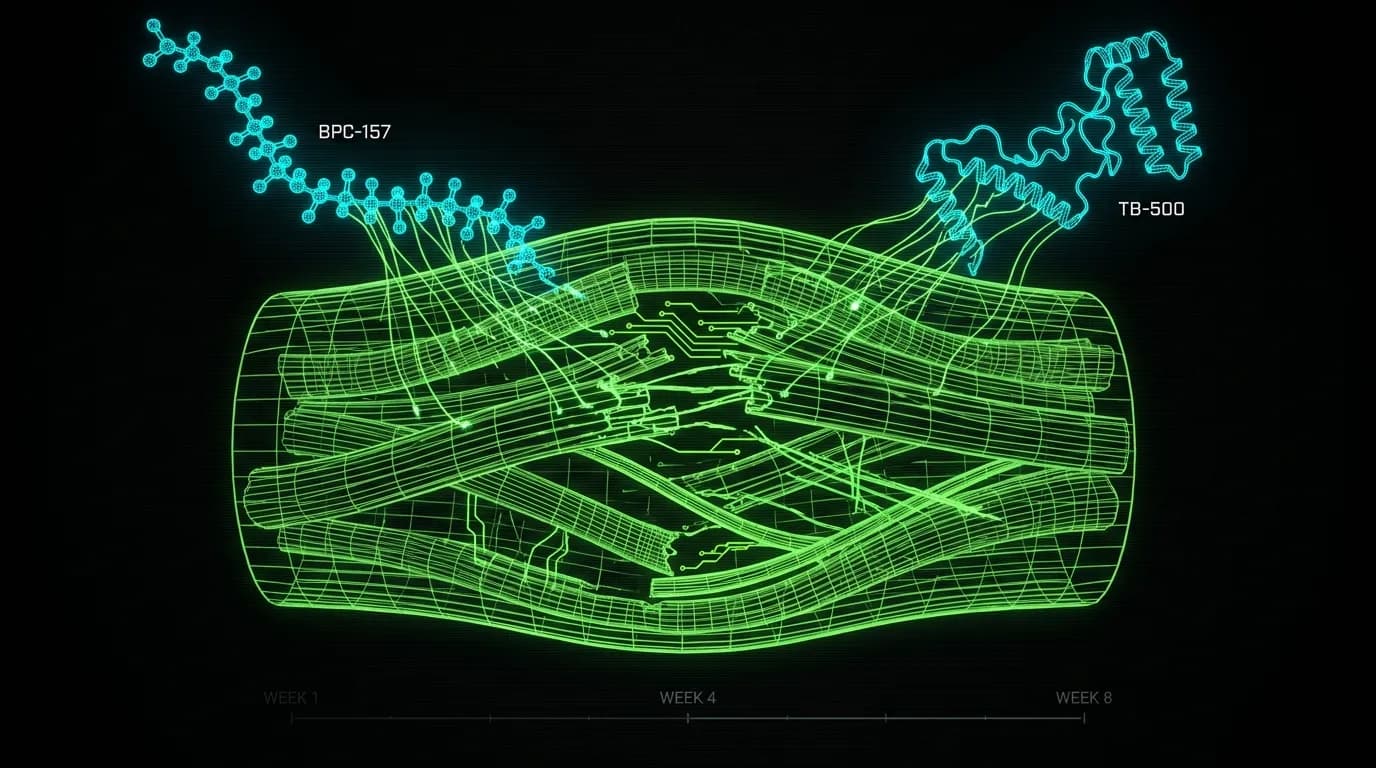
Peptides are short chains of amino acids, the building blocks of proteins. BPC-157 is a chain of 15 amino acids. It is derived from human gastric juice, the fluid in the stomach (Chang et al.). TB-500 is a lab-made chain of seven amino acids. It copies part of thymosin beta-4, a natural protein that is 43 amino acids long. The part it copies is amino acids 17 to 23. It also has a small chemical cap, an acetyl group, at the front.
That is how the FDA's TB-500 briefing document describes it. The FDA also says that thymosin beta-4 and TB-500 are not the same substance. So a result for the full protein does not carry over to the short copy.
The FDA looked at both peptides for a July 2026 meeting of its compounding panel. Compounding means pharmacies custom-making drugs. For TB-500, it found no clinical studies or human exposure data by any route. For BPC-157, it found five small human studies. None of them used TB-500.
This content is for educational purposes only and is not medical advice. Several seller websites the FDA reviewed label these products for research use only. A qualified clinician can advise on any health decision.
Is There a Wolverine Stack BPC-157 TB-500 Dosage Protocol?
No. We found no primary source that gives a dose for the two peptides taken together. Dosing schedules for the stack circulate online. We found no study behind any of them. Our BPC-157 and TB-500 complete guides cover each peptide on its own.
The table lists every dose the FDA's two briefing documents report giving to people. It also lists the two TB-500 animal studies that measured how the body breaks it down. The briefings also report other animal and lab doses, which are not doses for people. Each row gives the source, who got it and the route, in that source's own terms. A placebo is a dummy treatment. An enema is a liquid given into the rectum. A meeting abstract is a short conference summary. Per kg means per kilogram of body weight.
| Peptide | Source | Who | Route | Dose as reported |
|---|---|---|---|---|
| BPC-157 | Veljaca 2002 and 2003, meeting abstracts, per the FDA's BPC-157 briefing | 32 healthy volunteers: 24 got BPC-157, 8 a placebo | Enema | 0.25, 0.5, 1 or 2 mg per kg once. Then, after a week off, once daily for 7 days. |
| BPC-157 | Ruenzi 2005, meeting abstract, per the FDA | 53 people with ulcerative colitis, a bowel disease; 46 finished | Enema | 80 mg or placebo, once daily for 2 weeks |
| BPC-157 | Lee and Padgett 2021, per the FDA | 17 people with knee pain, from clinic records | Into the knee joint | 2 to 4 mg, 1 or 2 doses. Some also got thymosin beta-4. |
| BPC-157 | Lee et al. 2024, per the FDA | 12 women with interstitial cystitis, a bladder pain condition | Into the bladder wall | 10 injections of 1 mg, 10 mg in total, in one procedure |
| BPC-157 | Lee and Burgess 2025, per the FDA | 2 healthy adults | Drip into a vein | 10 mg on day 1, then 20 mg on day 2 |
| TB-500 | The FDA's own search | No people | Any route | None. The FDA found no clinical studies or human exposure data. |
| TB-500 | Ho et al. 2012, per the FDA | Horses | Under the skin | 10 mg, to measure blood levels |
| TB-500 | Rahaman et al. 2024, per the FDA | Rodents (rats), young adult males | Into the belly | 50 mg per kg, to measure breakdown products in urine |
| Both, blended | The FDA's search of its food and supplement complaint system | Two reports | Not given | None. The reports did not include safety assessments. |
The two enema studies are the only human results with a placebo group. Both exist only as meeting abstracts. The FDA said the human studies were short and small. It added that they "evaluated doses that were likely exploratory in nature."
The horse and rat studies measured how the body breaks TB-500 down. Neither tested whether it heals anything. None of the figures in the table is a dose for the stack. Our BPC-157 dosing guide and TB-500 dosage guide cover each one on its own.
Have BPC-157 and TB-500 Been Tested Together?
Not in any trial we found. Three records come closest. None of them tested TB-500 as a treatment.
The first is a look back at the records of a US clinic (Lee and Padgett). It covered 17 people who had BPC-157 put into the knee. Of the 16 reached by phone, 4 had shots of both BPC-157 and thymosin beta-4. The authors say 3 of those 4 had significant improvement in knee pain. There was no group to compare with. The abstract gives no dose for thymosin beta-4. And thymosin beta-4 is not TB-500.
The second is a report in FAERS, the FDA's database of side effect reports. A woman aged 40 used a product with both peptides in it, under the skin. It was labelled for "research purposes only." After a week of use, her skin and gums turned dark. The same thing came back when she used it again. She stopped, and it did not return. The FDA said the product was the likely cause. But with two peptides in it, the FDA said it could not tell which one.
The third is the FDA's search of its food and supplement complaint system. It found two reports about "blended TB-500 and BPC-157." The reports did not include safety assessments.
The FDA's BPC-157 review also lists websites that sell the two as one product. A label that gives only a combined total does not say how much of each peptide is inside.
Wolverine Stack BPC-157 TB-500: What Is It Said to Do?
Websites make broad claims for both. The FDA found TB-500 sold online for tissue repair. The claims include healing damage to tendons, muscles, ligaments and bones. One BPC-157 website says it can "accelerate the healing of injuries and wounds," the FDA reports. A clinic website says it "has been called 'wolverine compound' by many."
The FDA judged TB-500 for wound healing, the use it was put forward for. It found "a lack of evidence to evaluate the effectiveness" of TB-500 for that use. It found no medical paper where TB-500 was given to patients to treat any disease or condition.
The FDA also notes that many websites call TB-500 a synthetic version of thymosin beta-4. They often use the two names as if they were the same. The FDA says they are not.
How Do BPC-157 and TB-500 Each Work in Lab and Animal Studies?
All of the work in this section is preclinical. That means it was done in animals or cells, not people.
In rodent (rat) tendon cells grown in a dish, BPC-157 raised growth hormone receptor levels (Chang et al.). A receptor is the spot on a cell that a hormone binds to. When growth hormone was added, the treated cells grew in number faster. This has not been tested in people.
A sports medicine review searched three medical databases for BPC-157 (Vasireddi et al.). It took in 36 studies. Of these, 35 were preclinical and 1 was in people. It says the studies suggest that BPC-157 raises growth hormone receptor levels. They also suggest it acts on signals for cell growth and angiogenesis, the growth of new blood vessels. The review found no clinical safety data.
TB-500 comes from thymosin beta-4, so the older work is on that parent protein. In 1990, a lab pulled a small peptide from human blood platelets, the cells that help blood clot (Safer et al.). It bound loose actin and stopped it forming strands. Actin is the protein that forms a cell's inner frame. A year later, the same lab showed the peptide was thymosin beta-4 (Safer et al.).
A new scoping review, a broad map of a topic, looked at 80 studies on the protein and TB-500 (McGuire et al.). Most tested thymosin beta-4 rather than TB-500. Direct TB-500 evidence came from just one study.
What Does the BPC-157 and TB-500 Animal Evidence Show?
The tendon and wound results come from animals. Most of the healing work tested the full thymosin beta-4 protein, not TB-500.
In one rodent (rat) study, the Achilles tendon was cut. BPC-157 was injected into the belly, not into the tendon. Treated rats walked better, and their tendons held more load before they failed. They also formed more collagen than controls, the untreated rats, over 14 days (Staresinic et al.). Collagen is the protein that gives tendons their strength.
In another rodent (rat) study, the Achilles tendon was cut away from the heel bone. BPC-157, again given into the belly, helped the tendon heal back onto the bone. Function, strength and the organisation of collagen fibres all improved (Krivic et al.).
In a rodent (rat) wound study, cuts went through every layer of skin. Thymosin beta-4 went on the skin or into the belly. New skin closed over the wound 42% more than with salt water (saline) at day 4. By day 7 it was up to 61% more. The treated wounds also shrank at least 11% more than controls by day 7 (Malinda et al.).
In a rodent (rat) knee study, the medial collateral ligament, a ligament of the knee, was cut. Thymosin beta-4 was placed in the gap. At 4 weeks, the fibre bundles were evenly spaced, and the tissue was stronger than in controls (Xu et al.).
Rodent (rat) surgical cuts treated on the spot with thymosin beta-4 healed with minimal scarring and no loss of wound breaking strength. The treated wounds were also narrower (Ehrlich and Hazard).
The scoping review found that tendon, ligament, muscle, cartilage and spine studies were sparse. Human evidence was mostly in eye and skin wound settings (McGuire et al.). Eyes and skin are not tendons, and a rat is not a person. Our BPC-157 vs TB-500 comparison sets out the record for each one.
What Is Known About BPC-157 and TB-500 Safety?
For TB-500, the FDA found no clinical studies or human exposure data by any route. So it says the safety risks in humans are unknown. It also found no studies of its effects on genes, cancer, or birth and fertility.
For BPC-157, the FDA found "insufficient clinical safety information to characterize the safety profile." The human studies lasted two weeks at most. No serious adverse events, meaning serious health problems, appear to have been reported. But the FDA said the authors gave little safety data. In the healthy volunteer enema study, headache and gas were the most common side effects, at about the same rate as with placebo.
The FDA's side effect database held three reports for BPC-157, all for shots. They were redness and swelling where it went in, shortness of breath, and the dark skin and gums above. The last one came from a product with both peptides. The FDA said it is unclear whether BPC-157 caused any of them.
The FDA also flags immunogenicity for both. That is the risk of an immune reaction to the drug. It says injected TB-500 may pose a significant risk of one.
BPC-157 and thymosin beta-4 have both been linked to new blood vessel growth in lab and animal work. No study we found has tested either peptide in people with cancer. Our TB-500 side effects guide covers that half in more depth.
Where Do BPC-157 and TB-500 Stand With the FDA and WADA?
Neither peptide is an approved medicine in the United States. Both appear on an FDA list of bulk substances that may pose safety risks in compounding. Bulk substances are the raw ingredients pharmacies make drugs from. They sit in the group whose nominations were withdrawn.
In July 2026, an FDA advisory panel looked at both for the list pharmacies may compound from. The FDA's own reviews weighed against adding either one. The trade journal PharmExec reported that the panel voted 8 to 6 in favour of allowing both. PharmExec also noted that the FDA is not bound by the vote.
The FDA's TB-500 review is dated May 15, 2026. The briefing says the FDA will not make a final decision until it has weighed the panel's input. Our guide to getting a BPC-157 and TB-500 prescription tracks what that means in practice.
In sport, both are banned. The FDA's reviews place BPC-157 in the S0 section of the list kept by WADA, the World Anti-Doping Agency. S0 covers drugs with no approval. They place TB-500 in section S2.3, another numbered part of that banned list. See our piece on BPC-157 and WADA for the rules.
Where to buy BPC-157 and TB-500
The hard part with BPC-157 and TB-500 isn't the protocol. It's finding a supplier that can prove what's in the vial. We assessed dozens against per-batch, third-party testing. A handful passed.
See the sources that passed →What Is Known About BPC-157 and TB-500 Product Quality?
The FDA says BPC-157 is not well characterized as a chemical. Its naming is inconsistent, and data on its identity, purity and possible impurities (unwanted extra substances) were missing or inadequate. For TB-500, the FDA says it is not well defined as a chemical. One reason is that its naming is not consistent.
A certificate of analysis, or CoA, is a lab report on one batch. Our walkthrough on how to read a peptide CoA explains each line. We also keep a checklist in how to know if peptides are real. Our sources page sets out how we grade vendors.
Where Can You Read More on BPC-157 and TB-500?
Our tendon and ligament article covers the tendon studies in more detail.
This content is for educational purposes only and is not medical advice. Several seller websites the FDA reviewed label these products for research use only. A qualified clinician can advise on any health decision.
Where to buy BPC-157 and TB-500
The hard part with BPC-157 and TB-500 isn't the protocol. It's finding a supplier that can prove what's in the vial. We assessed dozens against per-batch, third-party testing. A handful passed.
See the sources that passed →Share this article
Frequently Asked Questions
How long do BPC-157 and TB-500 take to work?
Is there a studied dose for BPC-157 and TB-500 together?
Have BPC-157 and TB-500 been given in one product?
Is the Wolverine Stack safe for long-term use?
Does the Wolverine Stack work for muscle strains, not just tendons?
Are BPC-157 and TB-500 banned in competitive sport?
Read Next
Disclaimer: This content is for educational purposes only. These compounds are intended for research use. Nothing here is medical advice. Always work with a qualified clinician before making changes to your health protocol.