
BPC-157 and TB-500 Post-Surgery Recovery: When and How Much

What do BPC-157 and TB-500 do after surgery?
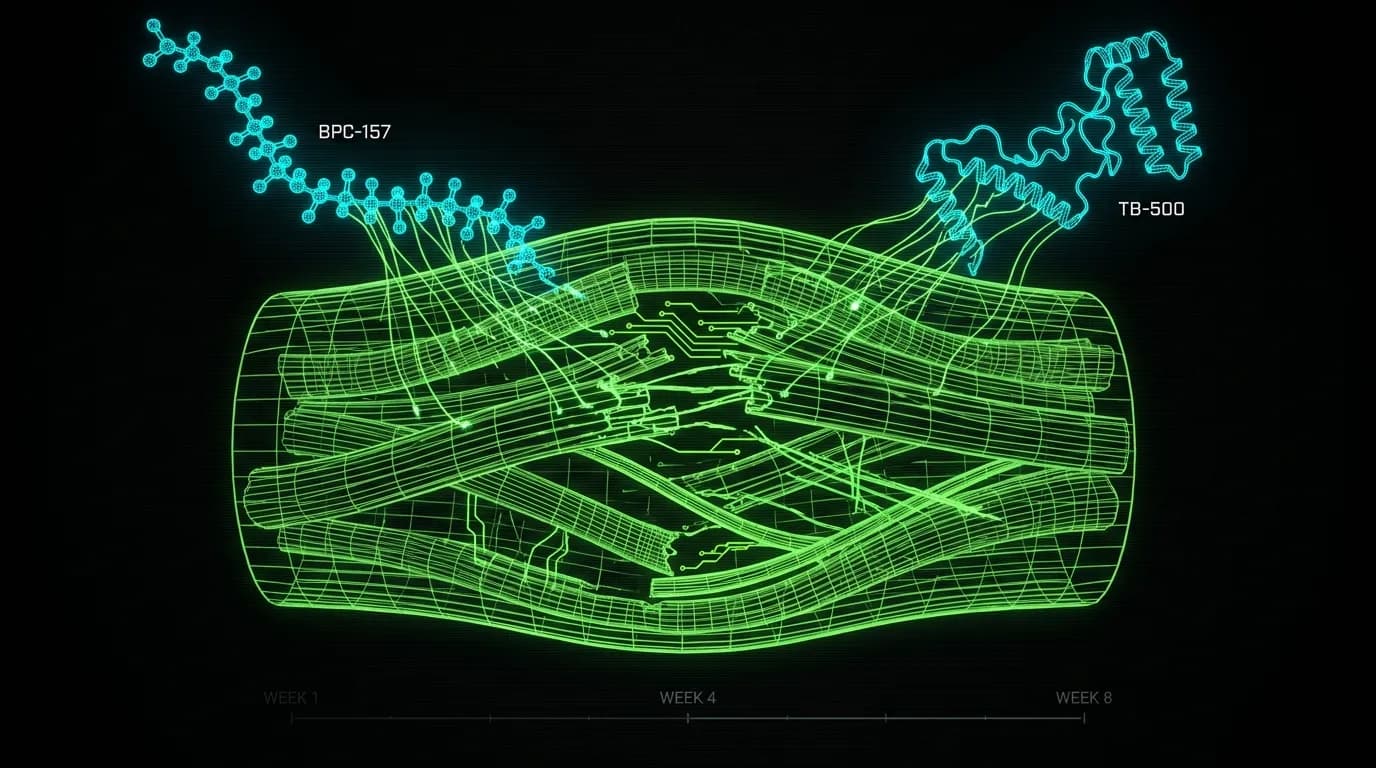
They work on two different parts of the same repair job. BPC-157 supports new blood vessels and gut stability. TB-500 drives cells into the damaged area. Run together for 4 to 8 weeks after surgery, they support faster soft-tissue healing. They sit alongside standard post-op care, never instead of it.
Recovery after surgery runs two jobs at once. Clear the damage, then rebuild the tissue.
The first 72 hours belong to inflammation and clotting. The next two weeks lay down new tissue. The 4 to 8 weeks after that are remodelling, where the new tissue gains its strength. The two peptides hit different parts of that timeline.
What follows is the protocol recovery clinicians actually run. Dosing, timing, cycle length, and the reasons a surgeon might say no.
Why use both peptides instead of just one?
Because their mechanisms barely overlap.
BPC-157 is a 15-amino-acid sequence found in gastric juice. It drives angiogenesis, which is the growth of new blood vessels. That matters after surgery because blood supply is the rate-limiting step in any deep repair. Tissue can't rebuild faster than it can be fed. It also protects tendon and ligament (Staresinic et al. 2022). That covers much of what orthopaedic surgery disturbs.
TB-500 is a synthetic fragment of thymosin beta-4, the most abundant peptide inside human cells. Its main job is switching actin from its loose form to its thread form. That is what pulls cells into a damaged area (Goldstein et al. 2005). It also calms inflammation and limits scarring. That matters, because heavy scarring is the usual bad outcome after muscle or tendon surgery.
So BPC-157 gets the blood there. TB-500 gets the cells there. Reviews of thymosin beta-4 list three separate effects: cell movement, new vessel growth, and cell survival (Crockford et al. 2010). In tendon specifically, BPC-157 sped up fibroblast outgrowth and migration in cultured rat tendon (Chang et al. 2011). A fibroblast is the cell that rebuilds connective tissue.
When should you start, and how soon after surgery?
Between 24 and 72 hours after the operation, once bleeding has settled.
Start before 24 hours and you risk disturbing normal clotting. That matters most with TB-500. It carries mild anti-clotting signals through its effect on the cell skeleton. Start after 72 hours and you miss the window where new vessels form fastest.
Two exceptions. For gut surgery, some clinicians wait at least 48 hours. That gives the join between cut ends time to seal. For major vascular surgery, bleeding risk rules, and the surgical team sets the timing.
For routine orthopaedic work, the 48-hour mark is the usual default. That covers knee arthroscopy, rotator cuff repair and ACL reconstruction. Confirm it with your surgical team. Always.
What is the dosing for the first two weeks after surgery?
High frequency, upper end of the range. This is the loading phase, and it exists to saturate the window when repair is moving fastest.
| Phase | BPC-157 | TB-500 | Route and site |
|---|---|---|---|
| Loading, first two weeks | 500 mcg twice daily | 5 mg twice weekly | Subcutaneous, abdomen, rotating sides |
| Maintenance, weeks 3 to 8 | 250 mcg once daily | 2.5 mg once weekly | Subcutaneous, abdomen |
Inject in the abdomen and rotate sides. Some practitioners inject near the surgical site for tendon and ligament work, on the theory that local concentration helps local repair. Systemic dosing in the abdomen is the more common default, and the evidence supports it.
TB-500 gets larger, less frequent doses. That reflects its longer half-life and slower mechanism. Some protocols front-load with 10 mg on the first dose. I'd skip that. The safety margin is unclear and the extra benefit is small.
Run this for 14 days. Track pain at rest, range of motion, swelling and how the surgical site looks. Track it daily. Most people notice swelling and pain dropping faster during this phase.
How does the dosing change after week two?
Everything halves, roughly.
Once inflammation has passed and rebuilding is underway, the dosing tapers. Maintenance keeps the repair machinery running. It just stops you over-driving new vessel growth. The table above has the exact numbers.
Some protocols drop TB-500 entirely after week 4, if recovery is on a strong line. The thinking is that the cell movement window has mostly closed by then. So more TB-500 gives less back.
Total cycle length depends on what was done to you. Soft-tissue procedures run 4 to 6 weeks. Orthopaedic work runs 6 to 8 weeks. Major reconstructions can extend to 12 weeks, if the surgical team is on board and your markers are still improving.
What else belongs in a post-surgery recovery plan?
The basics, first. They still carry most of the load.
Protein at 1.6 to 2.0 grams per kilogram of bodyweight. Sleep at 8 hours minimum. Gentle movement as soon as you're cleared for it. And full compliance with whatever loading and immobilisation plan your surgeon set.
Three peptides come up often alongside the main pair. GHK-Cu for skin and connective tissue, often topical on visible incisions. Thymosin alpha-1 for immune support during the vulnerable post-op window, especially past 60. And CJC-1295 with ipamorelin for adults whose growth hormone axis is already falling, where the IGF-1 effect on collagen is the point. The CJC-1295 and ipamorelin guide has the protocol detail. The GHK-Cu complete guide covers topical and injectable use.
On supplements: vitamin C at 500 to 1000 mg daily supports collagen synthesis. Magnesium glycinate at bedtime helps sleep and muscle relaxation. A clean omega-3 source helps inflammation resolve.
What are the side effects and contraindications?
Mild, mostly at the injection site.
Both are well tolerated in published preclinical and observational work. The common reactions are transient redness, slight warmth, and the occasional pinpoint bruise. These clear within 48 hours.
BPC-157 draws rare reports of mild dizziness on the first dose. TB-500 draws occasional reports of mild lethargy in the first week, usually at loading doses. That one resolves once maintenance dosing starts.
What you must rule out matters far more than the side effects. Active cancer is a no. Recent cancer surgery is a no too. Both peptides grow new blood vessels, and so do tumours. Pregnancy is a no, on thin data. So is any known allergy to peptide formulations or to bacteriostatic water.
One more. WADA banned BPC-157 in 2022, and TB-500 has been on the prohibited list since 2009. If you are drug tested in sport, neither peptide is an option post-surgery, whatever the medical case for it.
Which surgeries does this protocol suit?
Orthopaedic soft-tissue work, first and foremost.
That means rotator cuff repair, ACL or meniscus work, Achilles repair, hip or shoulder labrum work, and tendon transfers. The case is strongest where three things matter at once: soft tissue, the tendon-to-bone join, and inflammation.
Gut surgery is the second-best fit, though the evidence there is animal work. BPC-157 is an anti-ulcer peptide, stable in human gastric juice. Reviews credit it with defending the stomach lining across the whole gut (Sikiric et al. 2010). In rats, it also improved healing at surgical joins between cut bowel ends (Sikiric et al. 2020). Nobody has shown that in people. TB-500 plays a smaller role there. Its calming effect on inflammation still helps. Defer to the surgical team on timing for anything with a join in it.
It suits purely cosmetic surgery, dental implants and skin-only procedures less well. Not contraindicated, just a weaker fit. GHK-Cu topical alone is often the more sensible choice there. The best peptides for injury recovery guide covers those alternatives.
Where can you source these peptides safely?
A 503A compounding pharmacy, on prescription, wherever you can get one. Post-surgical patients have far less margin for a contaminated vial than anyone else. The 2026 FDA rule change widened legal pharmacy access for both peptides. So this route is more open than it was.
Pharmacy vials come with sterility checks and identity testing. They also come with a prescribing clinician already inside your recovery plan. That last part is worth more than people think.
No pharmacy access? Then use a verified research-grade source with independent third-party certificates of analysis. Check the lot-specific COA before you mix anything. The peptide reconstitution guide covers the technique.
What should you actually take away?
Start it in the 24 to 72 hour window. Dose it properly. Run it for 4 to 8 weeks with a clean taper. Do that, and the pair supports a faster return to function in most soft-tissue and orthopaedic recoveries.
But they are an assist, not a substitute. The basics still win. The peptides multiply what the basics build.
Work with a clinician who knows this territory. Source through a licensed pharmacy. Check the contraindications before the first dose. Then stop reading and start healing.
Bibliography
- Chang CH et al. The promoting effect of pentadecapeptide BPC 157 on tendon healing. Journal of Applied Physiology, 2011.
- Staresinic M et al. Stable Gastric Pentadecapeptide BPC 157 and Striated, Smooth, and Heart Muscle. Staresinic et al., Biomedicines, 2022.
- Sikiric P et al. Revised Robert's cytoprotection and adaptive cytoprotection and stable gastric pentadecapeptide BPC 157. Sikiric et al., Current Pharmaceutical Design, 2010.
- Sikiric P et al. Fistulas Healing. Stable Gastric Pentadecapeptide BPC 157 Therapy. Sikiric et al., Current Pharmaceutical Design, 2020.
- Goldstein AL et al. Thymosin beta4: actin-sequestering protein moonlights to repair injured tissues. Trends in Molecular Medicine, 2005.
- Crockford D et al. Thymosin beta4: structure, function, and biological properties supporting current and future clinical applications. Annals of the New York Academy of Sciences, 2010.
- U.S. Food and Drug Administration. Certain Bulk Drug Substances for Use in Compounding That May Present Significant Safety Risks. FDA, 2024 update.
Where to source it
The hard part with BPC-157 and TB-500 isn't the protocol. It's finding a supplier that can prove what's in the vial. We assessed dozens against per-batch, third-party testing. A handful passed.
See the sources that passed →Disclaimer
This article is for informational and educational purposes only and is not medical advice. Peptide compounds discussed are intended for research use unless prescribed by a qualified clinician through a licensed compounding pharmacy. They are not approved by the FDA as finished drug products and are not approved for use in healthy adults outside of legitimate medical indications. Use of any peptide post-surgery should be coordinated with your surgical team and the prescribing clinician. Individual response varies. The strength of evidence is preclinical and observational for many of the claims discussed. Verify current FDA classifications and your state pharmacy board rules before making decisions about access or use.
Where to source it
The hard part with BPC-157 and TB-500 isn't the protocol. It's finding a supplier that can prove what's in the vial. We assessed dozens against per-batch, third-party testing. A handful passed.
See the sources that passed →Share this article
Frequently Asked Questions
When can I start BPC-157 and TB-500 after surgery?
Can I use BPC-157 and TB-500 together?
How long should the recovery cycle run?
Are there risks to using these peptides during cancer recovery?
Subcutaneous or intramuscular injection?
Can these peptides replace post-op physical therapy?
Read Next
Disclaimer: This content is for educational purposes only. These compounds are intended for research use. Nothing here is medical advice. Always work with a qualified clinician before making changes to your health protocol.