
BPC-157 vs TB-500 Comparison: What the Research Shows

BPC-157 vs TB-500 Comparison: What's the Real Difference?
This BPC-157 vs TB-500 comparison comes down to where the evidence sits. BPC-157's best data is in tendon healing, from rat and lab-dish studies. TB-500 is a small piece of thymosin beta-4, a protein that helps cells move. Its evidence sits mostly in skin and eye healing. Neither has a controlled human trial for injury.
Most comparisons skip straight to a stack. That skips the useful question. These two peptides were studied in different tissues, by different research groups, often in different forms. Knowing which one has what behind it tells you more than any sales page. That matters with two of the most searched healing peptides on the market.
| BPC-157 | TB-500 | |
|---|---|---|
| What it is | A short piece of a protein found in human gastric juice, the fluid in your stomach | A lab-made (synthetic) copy of a short piece of thymosin beta-4 |
| What the research looked at | Tendon cells moving and surviving stress, plus collagen and new blood vessels (angiogenesis) in healing tendon | Actin-sequestering, which helps cells move, plus faster skin wound healing with the parent protein |
| Best studied tissue | Tendon, tendon-to-bone and the myotendinous junction, in rats | Dermal and corneal wound healing (skin and the surface of the eye), mostly with the full protein |
| Strongest evidence | Two rat injury studies and one lab-dish study | A review of the parent protein and animal skin wound work |
| Controlled human trials for injury | None | None |
How Does BPC-157 Help Tendons Heal?
This is the better evidenced half of the pair.
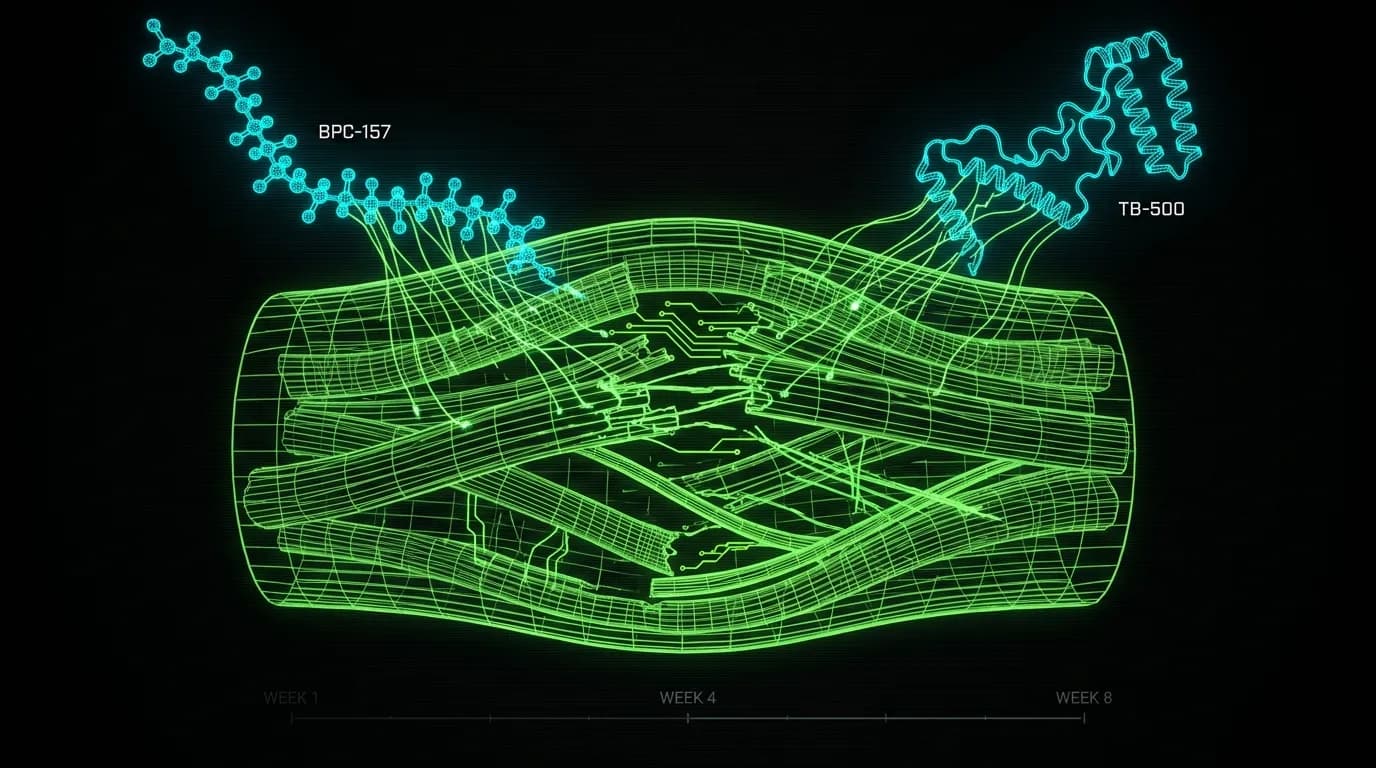
In rats with an Achilles tendon cut away from the heel bone, BPC-157 improved healing on several fronts. The Achilles functional index rose. That's a standard score for how well the leg works. Load-to-failure rose too, meaning the tendon took more force before tearing. Collagen fibres lined up better, and more blood vessels showed. The rats got one shot a day, into the belly cavity. They were checked over 21 days and compared with rats given salt water, or saline (Krivic 2006).
A separate study was lab-dish work, not an injury in a living animal. It took small pieces of rat tendon and tendon fibroblasts, the cells that build tendon. The peptide sped up how fast those cells grew out of the tendon pieces. It helped them survive stress and move faster. It didn't make them multiply faster (Chang 2010). So its main effect here was moving cells, not making more of them.
The third study is the most striking. In rats, a cut where the quadriceps (front thigh muscle) meets its tendon doesn't heal on its own. That spot is the myotendinous junction. With the peptide, function came back fully. The muscle atrophy (wasting) that normally follows was held back too (Japjec 2021). The rats got it as a shot into the belly cavity, or in their drinking water.
Two injury studies in live rats and one cell study, all pointing the same way. One caveat: the two rat studies share authors. So the agreement is less independent than it looks. It's still the strongest tendon case either peptide has.
How Does TB-500 Help Cells Move?
TB-500 is a lab-made (synthetic) copy of a short piece of thymosin beta-4. Doping lab chemists found that same piece in a product sold as TB-500 (Esposito 2012). Thymosin beta-4 itself is a protein your body already makes, found throughout the body.
That protein is actin-sequestering, meaning it holds a building material called actin in reserve. Actin is what a cell uses to build its internal scaffolding. When the signal to move arrives, the material is already waiting.
The foundational review of the parent protein describes this. It also covers its key role in dermal and corneal wound healing (Goldstein 2005). That means skin, and the clear surface of the eye. It's a review of other work, not a new experiment.
One animal study shows what that looks like. In rats with deep skin wounds, thymosin beta-4 sped up new skin cover over the wound. It worked on the skin or injected into the belly cavity. The wounds also shrank more than with saline by day 7, and more new blood vessels showed (Malinda 1999).
Note what that evidence is, and isn't. It's mostly the full natural protein, mostly in skin and eye. It isn't a tendon trial. It isn't a study of the TB-500 piece itself. So TB-500's tendon claims rest on reasoning from the parent protein. They don't rest on tendon studies like the ones above.
TB-500 vs BPC-157 Differences: What's Claimed vs What's Proven?
Here's the short version.
Claimed for both: faster healing of almost any soft tissue, less inflammation, and better recovery between sessions. Proven in animals: what the studies above actually measured. That's tendon for BPC-157, and skin and eye for thymosin beta-4. Proven in humans for injury, for either: nothing controlled.
The two also overlap more than the marketing suggests. BPC-157 moved tendon cells in the lab-dish study. More new blood vessels showed in the thymosin beta-4 skin wounds. So "one builds blood supply, one moves cells" is a tidy story, not a clean split.
They carry serious animal data. Neither has a finished human evidence base.
TB-500 Peptide vs BPC-157: Has Either Been Tested in People?
Barely, and not for injuries.
The Krivic paper notes that BPC-157 went into clinical trials for a gut disease. That was inflammatory bowel disease (long-term gut swelling). A systematic review (a search that gathers every published study) of its use for sports injuries found just one study in people. It was a small retrospective study (a look back at past patients) of knee pain. The review also found no safety data from people (Vasireddi 2025).
The full thymosin beta-4 protein has reached a small randomised trial in people, where chance decides who gets the drug or a dummy. It was tested as eye drops for severe dry eye (Sosne 2015). That's eye surface work. It isn't TB-500, and it isn't tendon or muscle.
So no controlled human trial has tested either peptide for a tendon, ligament or muscle injury. That isn't a scandal, and it isn't a cover-up. It's simply where these two compounds sit today.
What Are the BPC-157 vs TB-500 Differences in How They're Given?
Both peptides get sold as capsules, not just injections.
The live-animal studies above all used shots into the belly cavity. The muscle-tendon study above also gave BPC-157 in drinking water, and that worked too. Drinking water isn't a capsule, though, and a rat isn't a person. The skin wound study also put the protein straight on the skin. The lab-dish study used no route at all. None of the research here tested a capsule. Not one.
Peptides are chains of amino acids (the building blocks of protein), and the stomach is built to break chains like that apart. That's the reason oral vs injection matters here. It's also why we won't give you a conversion number: no study supports one. Our oral vs injectable guide goes deeper on the route question.
TB-500 vs BPC-157: Which One Fits Your Question?
Here's the one-line version. BPC-157 has the stronger tendon evidence, all in animals and cells. TB-500 has the clearer story about how cells move, mostly borrowed from its parent protein. Neither has been tested properly in people for injury.
Some people run the two together, often called the Wolverine stack. The thinking is that one supports blood supply and the other cell movement. That's a fair hypothesis. It isn't a result: nobody has tested the pair against BPC-157 alone. No study has run the stack against either compound alone and measured the difference. Anyone quoting you a percentage gain from stacking has made it up. Our Wolverine stack guide covers what's known about combining them.
If your question is tendon repair, start with our tendon repair guide. We don't ever decide on your behalf, we give you the tools and assistance to determine your direction.
Arguing over which peptide wins is pointless if the vial holds something else. The human evidence is already thin. Check any supplier against our recommended sources before you blame a disappointing result on the compound.
This content is for educational purposes only. Both compounds are sold for research use. Nothing here is medical advice. Speak to a qualified clinician before considering any peptide, especially around a fresh soft-tissue injury.
Treat all of it as early research, not a recovery plan. Treat anyone offering certainty as someone who hasn't read the papers.
Where to buy BPC-157
The hard part with BPC-157 isn't the protocol. It's finding a supplier that can prove what's in the vial. We assessed dozens against per-batch, third-party testing. A handful passed.
See the sources that passed →Where to buy BPC-157
The hard part with BPC-157 isn't the protocol. It's finding a supplier that can prove what's in the vial. We assessed dozens against per-batch, third-party testing. A handful passed.
See the sources that passed →Share this article
Frequently Asked Questions
BPC-157 vs TB-500: which works faster?
TB-500 vs BPC-157: which has better tendon evidence?
Has BPC-157 been tested by mouth?
Is either peptide approved for human use?
Why is the TB-500 peptide linked to cell movement?
Does the research cover muscle injuries too?
Read Next
Disclaimer: This content is for educational purposes only. These compounds are intended for research use. Nothing here is medical advice. Always work with a qualified clinician before making changes to your health protocol.