TB-500 Dosage Protocol: Loading, Maintenance, and Cycle Breakdown (2026 Guide)

TB-500 dosage is the difference between a protocol that works and one that wastes your money. Most guides online give you a single number and move on. That is not how this peptide operates. TB-500 requires a phased approach because of how it interacts with actin at the cellular level. Get the loading wrong, the maintenance wrong, or the cycle length wrong, and you will either undershoot the therapeutic window or burn through vials without meaningful results.
This guide breaks down every variable in the TB-500 dosing equation: loading phase, maintenance phase, injection routes, reconstitution math, timing, use-case adjustments, and the mistakes that trip people up. If you have already read the TB-500 complete guide, this is where the tactical protocol detail lives.
This content is for educational and informational purposes only. These compounds are sold for research use only. Always consult a qualified healthcare professional before considering any protocol.
Why TB-500 Dosage Matters More Than You Think
TB-500 is not like most peptides where you pin a set dose daily and wait. It works through a saturation model. The peptide binds to G-actin monomers in a 1:1 ratio, sequestering them to regulate cytoskeletal dynamics, cell migration, and tissue repair. Research confirms that thymosin beta-4 sequesters 40-50% of the total G-actin pool in most cell types.
What that means practically: you need an initial loading period to saturate those actin-binding sites across your body. Once saturation is reached, a lower maintenance dose keeps the system primed. Skip the loading phase and you never reach the concentration needed for meaningful systemic repair. Overdose the maintenance phase and you waste compound without additional benefit.
The two-phase structure is not marketing from peptide vendors. It reflects the pharmacokinetics of how TB-500 distributes through tissue, binds to its target, and maintains biologically relevant concentrations over time.
Quick Refresher: How TB-500 Works
TB-500 is a synthetic fragment of thymosin beta-4, the 43-amino-acid protein your body naturally produces at wound sites. It drives recovery through four mechanisms that matter for dosing decisions:
Actin regulation controls how repair cells move through tissue toward injury sites. TB-500 binds G-actin monomers and regulates their polymerisation into structural filaments. This is the primary mechanism and the reason the loading phase exists.
Angiogenesis means new blood vessel formation around damaged tissue. Research published in the FASEB Journal showed that the actin-binding site on thymosin beta-4 directly promotes angiogenesis through endothelial cell migration. [Smart et al., 2007]
Stem cell mobilisation activates progenitor cells and directs them to injury sites. This is how TB-500 supports repair across multiple tissue types simultaneously.
Anti-inflammatory signalling downregulates pro-inflammatory cytokines while activating the Akt survival pathway. [Goldstein et al., 2012] Less inflammation means a cleaner healing environment and less secondary tissue damage.
For a deeper dive into the science, read the full TB-500 guide. For dosing purposes, the key takeaway is that TB-500 works systemically. Unlike BPC-157, which targets localised sites, TB-500 travels through the bloodstream and reaches damaged tissue everywhere. That systemic reach is why the loading dose needs to be high enough to saturate tissue body-wide.
The Loading Phase: Building Tissue Saturation
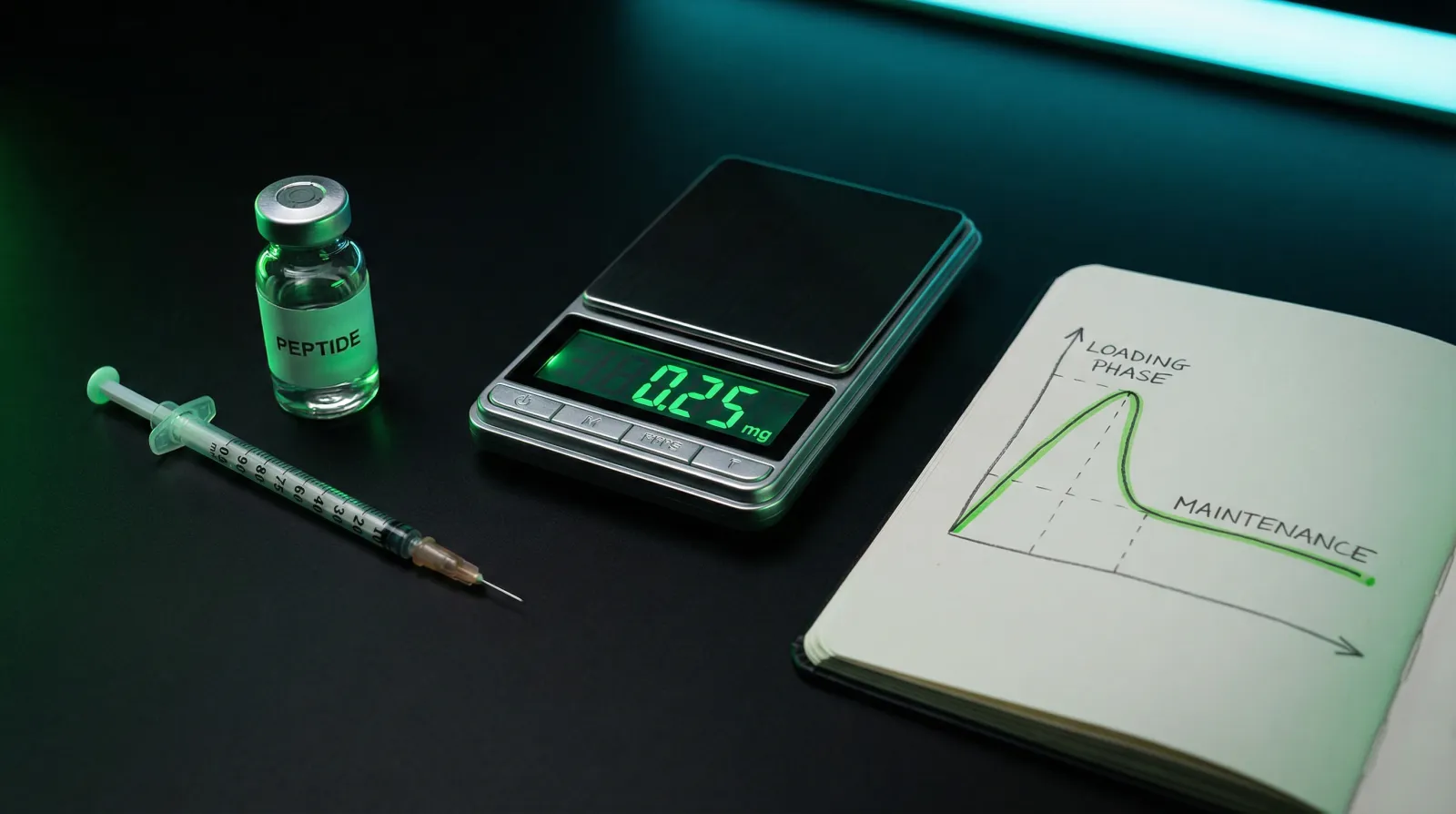
The loading phase is the most important part of a TB-500 protocol. It establishes the tissue concentrations needed for the peptide to exert its effects at actin-binding sites throughout the body. Underdose this phase and the entire cycle underperforms.
Standard Loading Protocol
Dose per injection: 2.0 to 2.5mg
Frequency: Twice weekly, spaced 3-4 days apart
Total weekly dose: 4.0 to 5.0mg
Duration: 4 to 6 weeks
Route: Subcutaneous (preferred) or intramuscular
The twice-weekly schedule is not arbitrary. Spacing injections 3-4 days apart (for example, Monday and Thursday) maintains consistent minimum blood levels while giving tissues time to respond between doses. TB-500 has a longer effective half-life than short-acting peptides like BPC-157, which means daily pinning is unnecessary and potentially wasteful.
Why 4-5mg Per Week?
This range appears consistently across research protocols and practitioner guidelines. It reflects the amount needed to achieve meaningful G-actin sequestration in a typical adult male (70-90kg). Going below 4mg weekly during loading often results in sub-threshold tissue concentrations, particularly for systemic issues. Going above 6mg weekly has not shown proportionally better outcomes in reported protocols and increases cost without clear benefit.
When to Use 4 Weeks vs 6 Weeks
Four weeks is appropriate for acute, well-defined injuries where you are supplementing an already-active healing process. A strained hamstring, mild tendinopathy, or a recently aggravated old injury typically responds within a shorter loading window.
Six weeks is better suited for chronic conditions, multiple simultaneous issues, or situations where the body has been dealing with accumulated training wear over months. The extra two weeks allows deeper tissue saturation and gives slower-healing structures like tendons and ligaments more time to respond.
The Maintenance Phase: Sustaining the Effect
Once loading is complete, the goal shifts from building tissue concentrations to sustaining them. The maintenance phase uses a lower dose to keep actin-binding sites occupied without the cost or volume of the loading phase.
Standard Maintenance Protocol
Dose per injection: 2.0 to 2.5mg
Frequency: Once weekly or once every 10 days
Total weekly dose: 2.0 to 2.5mg (roughly half the loading dose)
Duration: 4 to 6 weeks
Route: Same as loading
The key shift is frequency, not dose size. You are still injecting the same amount per pin. You are just doing it half as often. This approach maintains therapeutic tissue levels because TB-500 has high binding affinity for G-actin and a slow dissociation rate. Once the binding sites are saturated from loading, less frequent dosing is sufficient to keep them occupied.
Tapering vs Hard Stop
Some protocols taper the maintenance dose in the final 1-2 weeks rather than stopping abruptly. A typical taper might look like one injection every 10 days for 2 weeks, then every 14 days for 2 weeks. The rationale is to give the body time to transition back to baseline actin dynamics without a sharp drop-off. This approach is more conservative and may be worth considering for chronic issues where you want to preserve gains. It is not strictly necessary for acute injury protocols.
Full Cycle Structure: Week-by-Week Breakdown
Here is what a complete 10-week TB-500 cycle looks like in practice, using the standard protocol:
| Week | Phase | Dose | Frequency | Weekly Total |
|---|---|---|---|---|
| 1 | Loading | 2.5mg | Mon + Thu | 5.0mg |
| 2 | Loading | 2.5mg | Mon + Thu | 5.0mg |
| 3 | Loading | 2.5mg | Mon + Thu | 5.0mg |
| 4 | Loading | 2.5mg | Mon + Thu | 5.0mg |
| 5 | Loading (optional) | 2.5mg | Mon + Thu | 5.0mg |
| 6 | Loading (optional) | 2.5mg | Mon + Thu | 5.0mg |
| 7 | Maintenance | 2.5mg | Thursday only | 2.5mg |
| 8 | Maintenance | 2.5mg | Thursday only | 2.5mg |
| 9 | Maintenance | 2.5mg | Thursday only | 2.5mg |
| 10 | Maintenance | 2.5mg | Thursday only | 2.5mg |
Total compound used: 30-40mg over a full cycle (depending on whether loading runs 4 or 6 weeks). For most people using 5mg vials, that means 6-8 vials for a complete protocol.
After completing a cycle, a break of 4-8 weeks is standard before repeating. This off-period lets the body return to baseline and prevents potential receptor desensitisation from prolonged use.
SubQ vs Intramuscular: Which Injection Route for TB-500?
Both subcutaneous (SubQ) and intramuscular (IM) injection routes are used in TB-500 protocols. The choice comes down to practicality and preference, not efficacy. TB-500 works systemically regardless of injection site.
Subcutaneous (recommended for most users): Inject into the fatty tissue of the lower abdomen (alternating sides), outer thigh, or flank. Use a 29-31 gauge insulin syringe. Pinch the skin, insert at 45 degrees, inject slowly. This is the easiest route, causes the least discomfort, and allows for self-administration without assistance.
Intramuscular: Inject into the deltoid, vastus lateralis (outer thigh), or gluteus. Use a 25-27 gauge needle, 1-1.5 inches. IM injection may offer marginally faster initial absorption, but for a peptide that works systemically over days rather than minutes, the practical difference is negligible.
The critical factor is rotating injection sites. Do not pin the same spot repeatedly. Rotate between at least 3-4 sites to prevent localised irritation, tissue hardening, or scarring.
Reconstitution and Dosing Calculations
TB-500 arrives as a lyophilised (freeze-dried) powder. Before use, you reconstitute it with bacteriostatic water (BAC water). Getting this right is essential because every dosing calculation depends on the concentration you create. For a full reconstitution walkthrough, see the complete reconstitution guide.
Standard Reconstitution Example
Vial size: 5mg TB-500
BAC water added: 2ml (2cc)
Resulting concentration: 2.5mg per ml
With this concentration:
| Desired Dose | Volume to Draw | Insulin Syringe Units |
|---|---|---|
| 2.0mg | 0.80ml | 80 units |
| 2.5mg | 1.00ml | 100 units (full syringe) |
Alternative Reconstitution for Smaller Doses
If you want more precise dosing control or need to split vials over more injections, add more BAC water:
Vial size: 5mg TB-500
BAC water added: 2.5ml
Resulting concentration: 2.0mg per ml
With this concentration:
| Desired Dose | Volume to Draw | Insulin Syringe Units |
|---|---|---|
| 2.0mg | 1.00ml | 100 units |
| 2.5mg | 1.25ml | N/A (exceeds 1ml syringe) |
Looking for quality TB-500 for research? Real Peptides offers third-party tested TB-500 with verified purity and certificates of analysis. Using this link supports the site.
Key rules: Always use BAC water, not sterile water or saline. BAC water contains 0.9% benzyl alcohol, which prevents bacterial growth and gives you a 28-30 day window after reconstitution. Inject the water slowly down the side of the vial. Never shake. Swirl gently until dissolved. Store reconstituted vials in the fridge at 2-8°C.
Timing Around Training Sessions
TB-500 is not a pre-workout or post-workout compound. Its effects are cumulative over days and weeks, not acute over hours. That said, there are some timing considerations worth noting.
Best practice: Inject on the evening of a rest day or before bed on a training day. This keeps the injection routine consistent and avoids any potential (though rare) lightheadedness during a session. Most users pick their two loading-phase days based on their training split and stick with the same days throughout the cycle.
What does not matter: Whether you inject fasted or fed. Whether it is morning or night. Whether you trained that day or not. These variables affect short-acting peptides like GH secretagogues. They do not meaningfully affect TB-500, which accumulates in tissue over days.
What matters more: Consistency. Pick your schedule and stick to it. The twice-weekly rhythm during loading and the once-weekly rhythm during maintenance should be as consistent as possible to maintain stable tissue concentrations.
Use-Case Specific Protocols
The standard protocol covers most situations, but specific use cases may warrant adjustments. Here are the most common scenarios.
Acute Injury (Muscle Tear, Ligament Sprain)
Loading: 2.5mg twice weekly for 4 weeks
Maintenance: 2.5mg once weekly for 4 weeks
Total cycle: 8 weeks
Notes: Pair with BPC-157 injected locally at the injury site for the Wolverine Stack approach. TB-500 handles systemic healing; BPC-157 handles targeted repair.
Chronic Tendinopathy or Multiple Nagging Injuries
Loading: 2.5mg twice weekly for 6 weeks
Maintenance: 2.5mg once weekly for 6 weeks
Total cycle: 12 weeks
Notes: Longer loading and maintenance for chronic conditions. Tendons and ligaments have poor blood supply and heal slowly. The extended timeline gives these structures adequate exposure.
General Recovery and Training Support
Loading: 2.0mg twice weekly for 4 weeks
Maintenance: 2.0mg once weekly for 4 weeks
Total cycle: 8 weeks
Notes: Slightly lower dosing for general recovery rather than acute repair. Suitable for men over 35 who train consistently and want systemic recovery support without a specific injury target. Read more about peptide options for this demographic in the best peptides for men over 40 guide.
Post-Surgical Recovery
Loading: 2.5mg twice weekly for 6 weeks
Maintenance: 2.5mg once weekly for 6 weeks, with optional 2-week taper
Total cycle: 12-14 weeks
Notes: The most aggressive standard protocol. Post-surgical tissue has significant repair demands across multiple tissue types simultaneously. Always clear any protocol with the treating surgeon or clinician. Do not begin until the immediate post-operative period has passed and initial wound closure is complete.
5 Common TB-500 Dosing Mistakes
1. Skipping the Loading Phase
This is the most frequent error. Some users jump straight to 2.5mg once weekly, thinking they will save money. The result is tissue concentrations that never reach the therapeutic threshold. You end up spending the same amount over a longer period with worse results. The loading phase is not optional.
2. Dosing Too Frequently During Maintenance
If loading is the most skipped step, overdosing maintenance is the most wasteful. Once tissue is saturated from the loading phase, twice-weekly injections during maintenance offer no additional benefit over once-weekly dosing. You are burning through vials for no measurable improvement.
3. Inconsistent Scheduling
Injecting Monday and Tuesday one week, then Wednesday and Saturday the next defeats the purpose of maintaining stable tissue levels. Pick two days for loading (3-4 days apart) and one day for maintenance. Lock them in and do not deviate.
4. Incorrect Reconstitution
Adding the wrong volume of BAC water means every subsequent dose is wrong. A vial reconstituted with 1ml instead of 2ml doubles your concentration, so drawing what you think is 2.5mg actually delivers 5mg. Always measure carefully and record your reconstitution volumes. The reconstitution guide walks through this step by step.
5. Running Cycles Too Long Without Breaks
Continuous use beyond 12 weeks without an off-period increases the risk of diminishing returns. The body needs a reset. Standard practice is 4-8 weeks off between cycles. If the issue is not resolved after one cycle, reassess with a clinician before repeating.
Dosage Adjustments When Stacking
TB-500 is frequently stacked with BPC-157 in the Wolverine Stack. When combining peptides, the TB-500 dosage typically stays the same. There is no need to reduce it because the two peptides work through different mechanisms and do not compete for the same receptors.
Wolverine Stack dosing:
| Peptide | Dose | Frequency | Route |
|---|---|---|---|
| TB-500 | 2.5mg | 2x/week (loading) then 1x/week | SubQ (systemic) |
| BPC-157 | 250-500mcg | Daily | SubQ near injury site |
The two peptides complement each other. TB-500 provides systemic healing through actin regulation and stem cell mobilisation. BPC-157 provides localised healing through growth factor upregulation and nitric oxide modulation. Running both simultaneously covers the full recovery spectrum. For the complete comparison, read BPC-157 vs TB-500.
When to Stop or Extend a Cycle
Signs a cycle is working: Reduced pain at the injury site, improved range of motion, less morning stiffness, faster recovery between training sessions, and reduced swelling. Most users notice initial improvement within 2-4 weeks of loading. Tendon and ligament improvements take longer, often 6-8 weeks.
When to extend: If symptoms are improving but not fully resolved at the end of your planned maintenance phase, extending maintenance by 2-4 weeks is reasonable before taking a break. Do not extend the loading phase beyond 6 weeks.
When to stop early: If you experience unusual side effects (persistent headaches, significant lethargy, or anything beyond mild injection-site irritation), stop the protocol and consult a clinician. For a full breakdown of what to watch for, read the TB-500 side effects and safety guide.
When to reassess entirely: If you complete a full cycle with no noticeable improvement, the issue may not be what you think it is. A persistent tendon issue that does not respond to 12 weeks of TB-500 warrants proper imaging and clinical evaluation. Peptides support recovery. They do not fix structural problems that require surgical intervention.
Frequently Asked Questions
What is the correct TB-500 dose for the loading phase?
2 to 2.5mg injected subcutaneously twice per week is the standard loading phase dose. This is maintained for 4 to 6 weeks to build systemic tissue saturation. Starting below this range during loading is likely underdosing and may fail to achieve the systemic concentration required for meaningful tissue effect. The twice-weekly schedule works because TB-500 has a longer effective half-life than daily-dosed peptides like BPC-157 and does not require daily administration to maintain therapeutic levels.
How does the maintenance phase dose differ from the loading phase?
The maintenance phase drops to 2 to 2.5mg once per week or once every two weeks, depending on injury severity and individual response during loading. The objective is to sustain the repair environment created during the loading phase while the tissue consolidates structural gains. Continuing at loading doses during maintenance offers no additional benefit and unnecessarily increases total exposure. The reduction is deliberate, not a sign the protocol is less effective.
Does TB-500 need to be injected near the injury site?
No. TB-500 works systemically and does not require near-site injection. Unlike BPC-157, where proximity to the injury provides a local concentration advantage, TB-500 operates through systemic cell migration and tissue remodelling. It can be injected subcutaneously at any convenient site such as the abdomen, flank, or thigh, and distributes through circulation to wherever repair is needed. Near-site injection is not harmful but has no documented advantage for TB-500 specifically.
How much bacteriostatic water should I use to reconstitute a 5mg TB-500 vial?
2.5mL of bacteriostatic water gives a working concentration of 2mg/mL, which is the most practical setup for TB-500. A 2.5mg dose requires a 12.5-unit draw on a 100-unit insulin syringe, which is accurate and easy to measure. Some researchers use 2mL to give 2.5mg/mL, which reduces injection volume slightly. Either approach works — the key is using bacteriostatic water rather than sterile water for any vial you will draw from multiple times over several weeks.
Can I run TB-500 and BPC-157 at full individual doses when stacking both?
Generally yes. No evidence indicates that stacking TB-500 with BPC-157 requires dose reduction for either compound. Both are typically run at their standard individual doses simultaneously. On days when both are due, they can be drawn into a single insulin syringe and injected at the same site. BPC-157 is dosed daily while TB-500 is dosed twice weekly, so they will not always be injected on the same days, which is normal and expected within the stack protocol.
How do I know when to stop a TB-500 cycle rather than extending it?
Stop when the target injury has reached functional recovery and training is no longer limited by it, or when the 12-week maximum across loading and maintenance has been reached. Extension may be warranted if significant functional limitation persists with no evidence of progress since week 6, though this more likely indicates the injury pattern or loading needs reassessment rather than simply more dosing. Do not extend cycles indefinitely as a hedge against future injury. Complete the cycle, rest for an equivalent period, and reassess before deciding on a further cycle.
Read Next
Disclaimer: This content is for educational purposes only. These compounds are intended for research use. Nothing here is medical advice. Always work with a qualified clinician before making changes to your health protocol.