BPC-157 Banned by WADA: What Athletes Need to Know

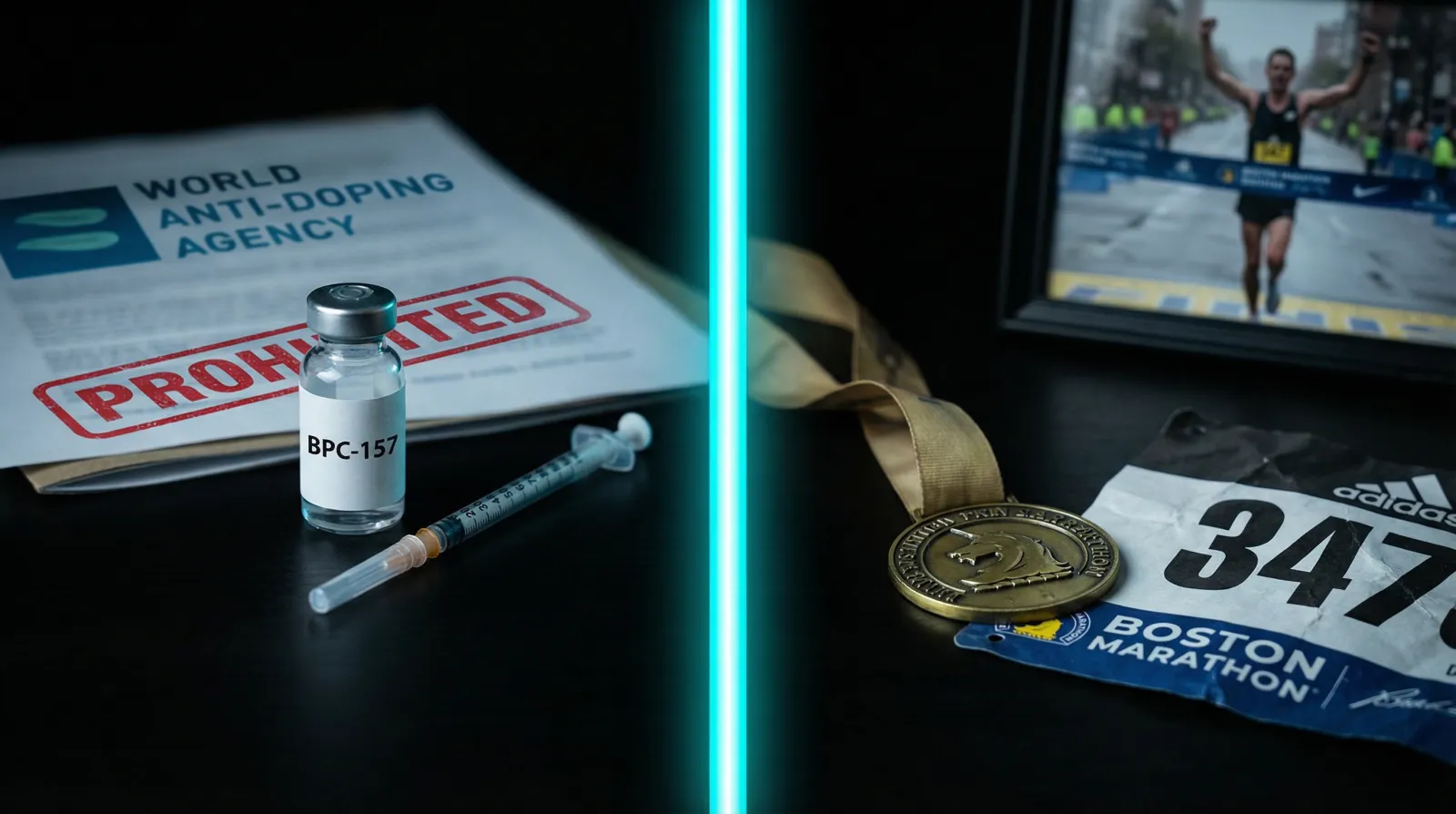
Is BPC-157 banned by WADA?
Yes, BPC-157 is banned by WADA, the World Anti-Doping Agency: it is named on the Prohibited List under section S0, the non-approved substances class. The ban runs all year, in competition and out of it. It covers international and national-level athletes in WADA sports, and others an anti-doping body chooses to test. Own use by non-competitors is outside it.
The ban tells you how WADA sorts BPC-157. It is not a published finding on whether BPC-157 is dangerous. S0 holds substances with no approval for human medical use. BPC-157 isn't approved as a medicine in any country.
The current WADA Prohibited List governs the position. If your sport's governing body has signed the World Anti-Doping Code, that document is the start and the end of it. The biology doesn't change that listing. Nor does your reason for wanting the compound.
Here I'll cover what the ban actually says, who it reaches, what detection looks like now, and what changes if nobody tests you.
This content is for educational purposes only. These compounds are intended for research use. Nothing here is medical advice.
Why was BPC 157 banned, and on what grounds?
WADA can ban a substance partly for health risk. It judges each one against a written test.
Article 4.3 of the World Anti-Doping Code sets that test. WADA considers a substance for the list when it meets any two of three criteria. Those are performance enhancement potential, health risk, and violation of the spirit of sport. Only two of the three are needed.
WADA has not published which criteria BPC-157 met. Its 2022 notice says only that BPC-157 was named "following a recent re-evaluation of its status" (WADA, 2022).
A systematic review of the BPC-157 research for sports medicine weighed the evidence Vasireddi et al. 2025. A systematic review gathers the studies on a question using set search rules. Of its 36 studies, 35 were preclinical, meaning lab and animal work. In those models, BPC-157 improved healing in muscle, tendon, ligament and bone injuries. The studies suggest it also acts on pathways tied to angiogenesis. Angiogenesis means the growth of new blood vessels. The same review notes that its use is banned in professional sports.
So the listing tells you its rule status. It does not rate its safety. USADA, the United States Anti-Doping Agency, says BPC-157 "may lead to adverse health effects" (USADA). The review found "No clinical safety data" (Vasireddi et al. 2025). Read it that way and the rest makes sense.
What the BPC-157 WADA prohibited list 2026 entry says
The Prohibited List is updated at least once a year. WADA publishes it by 1 October and it takes force on 1 January. The 2026 List is the version in force now.
What S0 non-approved substances covers
S0 is the catch-all class. It covers anything no government health body has cleared for human use in medicine. It also has to be a substance no other section names. Drugs still in testing, dropped drugs, designer drugs and animal drugs all land here.
WADA's own list names BPC-157 in that class. The published wording says S0 covers many substances, "including but not limited to BPC-157" (WADA, 2026 Prohibited List). You don't have to infer the status. It's printed.
The list also marks every S0 substance as a Specified Substance. Under the Code, the standard ban for a Specified Substance is two years, unless the anti-doping body shows intent. The Code adds that Specified does not mean less dangerous.
Where S2 sits
S2 is the peptide hormones, growth factors, related substances and mimetics section. Mimetics are substances that copy a hormone's effects. EPO, a hormone that drives red blood cell production, sits there. So do growth hormone, the peptides that release it, and IGF-1. IGF-1 is insulin-like growth factor 1, a signalling protein tied to tissue growth.
Laboratory work does show BPC-157 raising growth hormone receptor levels in tendon cells from a rodent (rat) Chang et al. 2014. WADA's list itself names the compound under S0, not S2. Both S0 and S2 are prohibited at all times. The sanctions differ, though: every S0 substance is Specified, and no S2 substance is.
Detection: what BPC-157 WADA testing can find
The old assumption was that BPC-157 can't be caught. That assumption is out of date.
It's a short peptide, 15 amino acids long. In a study in a rodent (rat) and in dogs, its half-life in the blood was under 30 minutes He et al. 2022. Half-life is the time it takes for the blood level to fall by half.
WADA-accredited labs have moved on. Two of them have published urine tests for BPC-157, using mass spectrometry, a method that sorts molecules by their mass. The Salt Lake City lab's method finds as little as 0.1 ng/mL Cox et al. 2017. That is a tenth of a billionth of a gram in each millilitre of urine. The Shanghai lab's method also looks for five of its breakdown products Tian et al. 2023. Both labs are on WADA's accredited list (WADA Accredited Laboratories).
We found no published detection window for BPC-157 in people. In lab tests on blood plasma, BPC-157 formed a stable metabolite that should show up in urine. A metabolite is what the body breaks a compound down into. Labs can look for it as well as for BPC-157 itself.
The Athlete Biological Passport tracks selected markers in an athlete's own blood or urine over time. It looks for the effects of doping rather than the substance itself. A value outside the athlete's own range can trigger an alert (WADA, Athlete Biological Passport). We found no published source showing the passport detecting BPC-157.
Is BPC 157 banned if you never compete?
No. For their own use, people who don't compete are outside WADA's rules.
The rules bind international and national-level athletes in WADA sports. Olympic and Paralympic athletes are covered. Below national level, an anti-doping body can choose to apply the rules. A positive test then carries the Code's sanctions.
A recreational runner using BPC-157 for injury recovery who enters nothing is breaking no anti-doping rule. A masters runner, one racing in an older age group, is bound by the Code in an event tested under it. Same compound, different rulebook.
Not sure which one you're in? Your national federation can tell you. Not knowing the rules does not stop a violation being found.
| User Type | BPC-157 Status Under WADA | Notes |
|---|---|---|
| Olympic and international-level athletes | PROHIBITED (in and out of competition) | Full WADA code; risk of multi-year ban |
| National-level competitors (WADA sport) | PROHIBITED | Covered at national level |
| Masters / age-group competitors (WADA sport) | PROHIBITED where the code applies | Covered when the federation or anti-doping body applies the code |
| Recreational, non-competitive | Outside WADA rules | Own use is outside WADA rules; local law applies |
| Competitors in non-WADA events | Outside WADA rules unless the athlete is otherwise covered | Event rules vary; local law also applies |
USADA BPC-157 prohibited peptide status in the US
USADA's position is not a separate question from WADA's.
USADA is the official anti-doping agency for the United States. The Prohibited List it uses is the same one WADA puts out. USADA's own page says BPC-157 is prohibited under S0 (USADA). Nothing about BPC-157 changes at the border.
The same holds for every other national anti-doping body that signs the code. One list, many enforcers.
Monitoring is not prohibition
WADA keeps two separate states, and the difference matters.
The Monitoring Program watches substances through anti-doping samples. Labs report how often they turn up, so WADA can spot patterns of misuse. Being on it carries no penalty. The Prohibited List is the one with teeth. A finding there opens a case.
WADA first named BPC-157 in S0 on the 2022 List. It sits on the Prohibited List now. If you're outside WADA's reach, neither state changes much. Your country's law, the safety picture and the research all answer to something else.
BPC-157 WADA banned status: what a positive test costs
For BPC-157, a Specified Substance, the standard ban for a first violation is two years. It rises to four years if the anti-doping body shows it was intentional. It can fall as low as a reprimand where the athlete shows no significant fault. Aggravating circumstances can add up to two more years. A third violation brings a lifetime ban, with some exceptions.
The Code also applies strict liability. You're responsible for what's in your body. How it got there doesn't change the finding. Nor does what you meant to do.
Testing isn't limited to race day either. It runs in and out of competition. A registered testing pool is the group of top-priority athletes an anti-doping body tests most. Athletes in one must file where they will be. Any athlete can be asked for a sample at any time and place by an anti-doping body with testing authority over them.
So the risk isn't "will this specific event screen for it". For a tested athlete, any use carries that risk.
Can you get a TUE for BPC-157?
It is unlikely, though not ruled out.
A Therapeutic Use Exemption, or TUE, lets an athlete use a banned substance for a medical condition. The athlete must show that four conditions are met. The condition must be diagnosed and backed by clinical evidence. The substance must be an indicated treatment, with no reasonable permitted alternative. It must give no boost beyond a return to normal health. And the need must not come from earlier banned use without a TUE.
BPC-157 isn't an approved medicine in any country. The US Food and Drug Administration (FDA) 2026 briefing for its compounding advisers found it marketed in US dietary supplements. Some products carry a label saying they are for research purposes only (FDA, 2026). USADA says a BPC-157 TUE is unlikely because permitted alternatives exist. It adds that it "considers each TUE application on a case-by-case basis".
Compare that with therapeutic testosterone (see our guide on BPC-157 and testosterone cypionate) or certain corticosteroids, drugs that calm inflammation. Both are available as licensed medicines. A TUE for them still has to meet the same four conditions.
This page does not set out an injury plan. A qualified clinician or a sports doctor who knows anti-doping rules can weigh the permitted options. For the research on BPC-157 and a torn meniscus, see our torn meniscus research page.
What matters instead when nobody tests you
The Code's rules on own use bind athletes, not people who never compete. National laws differ.
For people outside those rules, the questions are biological and practical. What's the mechanism. What's the safety picture. How is the protocol designed. Where did the vial come from, and did anyone test it.
Sourcing is the one I'd put first. A Certificate of Analysis from a third-party lab reports what that lab found in a sample. Our guide also sets out how BPC-157 compares with TB-500.
The rules and the research are two different threads. The rules answer is for tested athletes. The research answer is for everyone else. They're separate questions with separate answers.
Where to buy BPC-157
The hard part with BPC-157 isn't the protocol. It's finding a supplier that can prove what's in the vial. We assessed dozens against per-batch, third-party testing. A handful passed.
See the sources that passed →References
- World Anti-Doping Agency. The Prohibited List. Annual update. wada-ama.org/en/prohibited-list
- World Anti-Doping Agency. WADA's 2022 Prohibited List now in force. 1 January 2022. wada-ama.org
- World Anti-Doping Agency. Accredited Laboratories Network. wada-ama.org/en/accredited-laboratories
- World Anti-Doping Agency. Athlete Biological Passport. wada-ama.org/en/athlete-biological-passport
- USADA. BPC-157: What Athletes Should Know About the Prohibited Experimental Peptide. usada.org
- Chang CH, et al. Pentadecapeptide BPC 157 enhances the growth hormone receptor expression in tendon fibroblasts. Molecules. 2014. PMC6271067
- Vasireddi N, et al. Emerging use of BPC-157 in orthopaedic sports medicine: a systematic review. HSS J. 2025. PMC12313605
- He L, et al. Pharmacokinetics, distribution, metabolism, and excretion of body-protective compound 157, a potential drug for treating various wounds, in rats and dogs. Front Pharmacol. 2022. PMC9794587
- Cox HD, Miller GD, Eichner D. Detection and in vitro metabolism of the confiscated peptides BPC 157 and MGF R23H. Drug Test Anal. 2017. PubMed 28035768
- Tian T, et al. Stable isotope labeling-based nontargeted strategy for characterization of the in vitro metabolic profile of a novel doping BPC-157 in doping control by UHPLC-HRMS. Molecules. 2023. PMC10650108
- World Anti-Doping Code. Article 4.3, Criteria for Including Substances and Methods on the Prohibited List. World Anti-Doping Code
- World Anti-Doping Code 2021. Articles 2.1, 4.4, 4.5, 5.2 and 10, and Appendix 1 (Definitions). 2021 World Anti-Doping Code (PDF)
- U.S. Food and Drug Administration. FDA Briefing Document: BPC-157. Pharmacy Compounding Advisory Committee meeting, July 23 to 24, 2026. fda.gov/media/193343
- World Anti-Doping Agency. International Standard for Therapeutic Use Exemptions 2023, Article 4.2. wada-ama.org
This content is for educational purposes only. These compounds are intended for research use. Nothing here is medical advice.
Share this article
Frequently Asked Questions
When was BPC-157 added to the WADA prohibited list?
WADA first named BPC-157 on the 2022 List. It is listed as an example in S0, the class for drugs with no approval. WADA says this came after "a recent re-evaluation of its status". The list is updated each year. WADA publishes it by 1 October, and it takes effect on 1 January. The 2026 list is the one in force now.
Is BPC-157 banned by WADA or USADA?
Both. USADA is the United States Anti-Doping Agency. It is the official anti-doping agency for the United States. Both use the same banned list. So every national anti-doping body that signs the Code bans BPC-157. Athletes under any of them face the same rules on it.
Can BPC-157 be detected in anti-doping tests?
Yes. Two WADA-accredited labs have published urine tests for it. Both use mass spectrometry, which sorts molecules by their mass. The Salt Lake City lab's 2017 test finds as little as 0.1 ng/mL. That is a tenth of a billionth of a gram per millilitre. The Shanghai lab's 2023 test also looks for five of its breakdown products. The idea that BPC-157 cannot be found is out of date.
What happens if an athlete tests positive for BPC-157?
BPC-157 is a Specified Substance. For a first positive test, the standard ban is two years. It is four years if the anti-doping body shows intent. It can be cut where the athlete shows no significant fault. Aggravating factors can add up to two years. Repeat violations can lead to a lifetime ban. The athlete is responsible for any substance found in their body. How it got there does not change that. This is called strict liability.
Can I get a Therapeutic Use Exemption for BPC-157?
It is unlikely. USADA says it would probably not approve one, since other allowed options exist. But it also says it "considers each TUE application on a case-by-case basis". FDA found it marketed in US dietary supplements, and some products are labelled for research purposes only. It is not a licensed medicine in any country.
What should a competitive athlete use instead of BPC-157 for injury recovery?
This page does not recommend a treatment. USADA says other allowed options exist. That is why a TUE for BPC-157 is unlikely. A sports doctor who knows the anti-doping rules can go through those options. USADA's Drug Reference Line also takes questions about specific products.
Read Next

Disclaimer: This content is for educational purposes only. These compounds are intended for research use. Nothing here is medical advice. Always work with a qualified clinician before making changes to your health protocol.