
Wolverine Stack for Torn Meniscus: The Real Evidence

What Is the Wolverine Stack for Torn Meniscus?
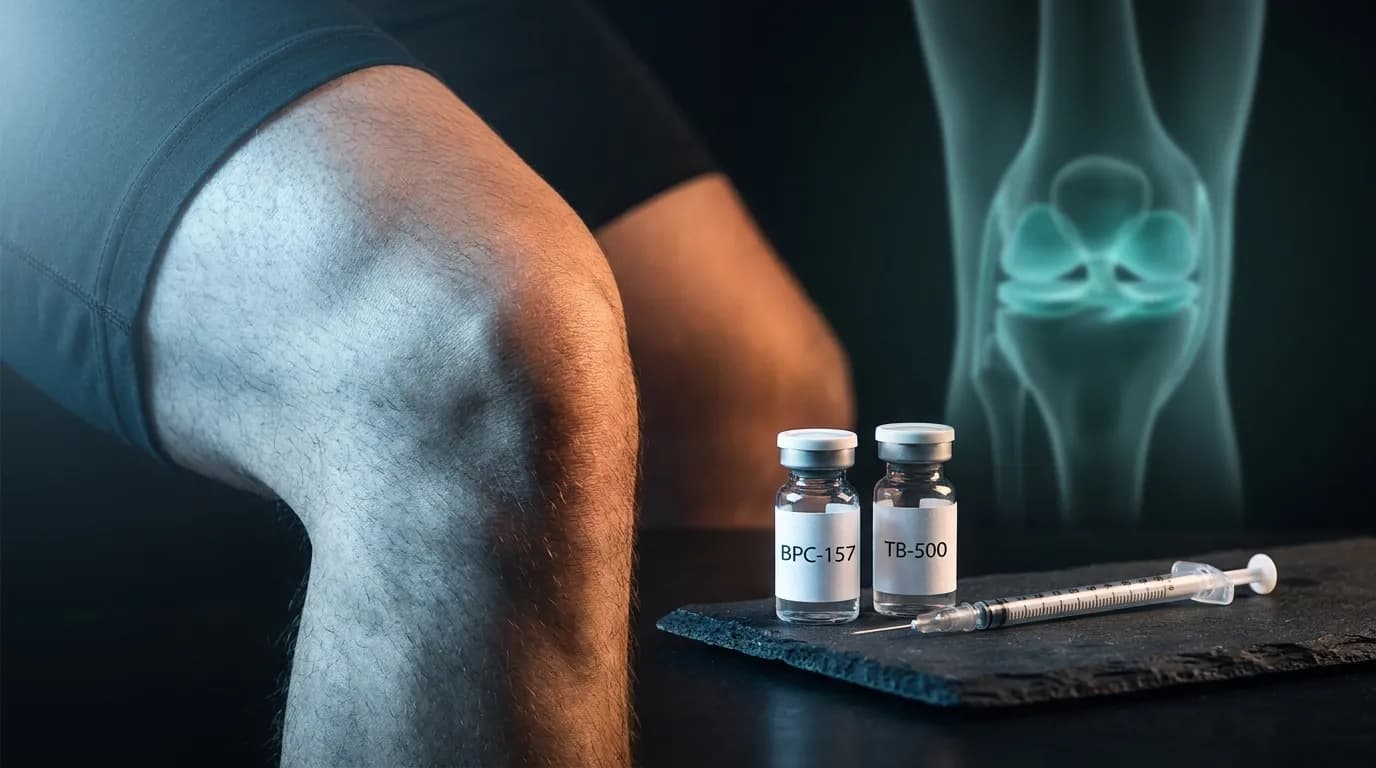
The wolverine stack for torn meniscus is BPC-157 plus TB-500. The only human evidence is one small chart review of mixed knee pain, not a meniscal-tear study. In it 11 of 12 patients (91.6%) given BPC-157 reported significant improvement. Of 4 given BPC-157 plus TB4, 75% did. No trial has tested either peptide in a torn meniscus.
BPC-157 is short for Body Protection Compound 157. It is made in a lab. The chain is 15 amino acids long, so it is called a pentadecapeptide (pentadeca means fifteen). It copies part of a protein found in human gastric juice. That protein guards the gut lining. The formula is C62H98N16O22.
TB-500 copies thymosin beta-4, also written Tb4 or TB4. That one is natural, and its chain runs 43 amino acids. The TMSB4X gene holds the recipe. Nearly every cell with a nucleus makes it. Platelets, the blood's clotting cells, carry 200-500 micromolar of it, a measure of concentration. Most other cells carry 10-100 micromolar. Its day job is to hold G-actin, the free single units of actin. That sets the balance between free actin and actin in filaments.
The pairing is not new. Our wolverine stack guide covers the general case, and the BPC-157 vs TB-500 comparison sets the two side by side. This page asks one narrower question. What does the evidence say about a torn meniscus?
Why Does a Torn Meniscus Not Heal on Its Own?
Because most of it has no blood supply.
The meniscus is a wedge of fibrocartilage, a tough cartilage packed with collagen fibres. Its matrix is mostly type I collagen in circumferential bundles that run around its curve. Smaller amounts of type II collagen sit at the core. That build spreads load across the tibial plateau, the flat top of the shin bone. It carries up to 70% of the knee's contact force when you stand on it.
Vascular anatomy then splits the tissue in two. The outer red-red zone carries synovial vessels, from the joint lining, and keeps some repair capacity. The inner white-white zone is avascular and aneural: it has no blood vessels and no nerves. It feeds by diffusion from synovial fluid alone.
Diffusion keeps that tissue alive. It cannot rebuild it. Repair needs progenitor cells (young cells that can become tissue cells), oxygen and growth factors delivered well above resting levels. Without vessels reaching the tear, none of that arrives.
Physiotherapy, corticosteroid injections and hyaluronic acid do not change this. They work on symptoms. The vascular deficit stays. That is why peptide research here aims at angiogenesis (new blood vessel growth) first. See also our BPC-157 complete guide.
How Does BPC-157 for Meniscus Tear Work?
Three mechanisms, and only the first is really about vessels.
VEGF and New Vessels
VEGF, short for vascular endothelial growth factor, is the main signal that grows new blood vessels. Its main receptor is VEGFR2, also called KDR. Hsieh et al. 2017 found BPC-157 raised VEGFR2 in rats and in human vessel-lining cells. In those cells it did not raise the level of VEGF-A, the growth factor itself, only its receptor. It switched on the VEGFR2-Akt-eNOS relay, a chain of signals that drives vessel growth. In rats with a leg cut off from its blood supply, it sped the return of blood flow.
A second line of work looked at cell movement. Chang et al. 2011 grew rat tendon cells with BPC-157. It switched on the FAK-paxillin pathway in those cells. FAK is focal adhesion kinase, and paxillin is its partner protein. The cells spread and migrated faster. That pathway is how cells read the matrix around them. They answer by pushing out lamellipodia, the flat feet a cell crawls on.
A white-zone tear is short of both vessels and moving repair cells. Vessel signals plus cell movement is the route by which that pocket could theoretically gain vessels. It would move the tear's biology toward red-zone behaviour. That step is unconfirmed in human tissue.
Growth Hormone Receptor Sensitisation
The second mechanism is different in kind. Chang et al. 2014 found BPC-157 raised GH receptor levels in rat tendon cells. That could turn up the build signal from the body's own growth hormone. The idea is that GH in the blood does not change, and the tissue just hears it better. No study cited here shows BPC-157 raising blood IGF-1, the growth factor GH makes the liver release. GH secretagogues, drugs that make the body release more GH, do raise it.
In those tendon cells, added GH then switched on JAK2 and the cells multiplied faster. JAK2 starts the JAK2-STAT5 pathway, a relay that carries the hormone's signal to the genes. GH signalling is proposed to raise collagen output. Chang et al. 2014 measured cell growth, not collagen.
Cerovecki et al. 2010 tested BPC-157 on ligament healing in rats. They cut the medial collateral ligament and followed healing. BPC-157 was given three ways: into the abdominal cavity, in drinking water, and as a thin cream on the wound. Every route improved healing. Healing was better in function, in mechanical strength, by eye and under the microscope.
Two things to be careful about here. The paper is a ligament study, not a meniscus study. Its abstract reports those four categories of improvement, and it does not report collagen typing.
Turning Down Inflammation
BPC-157 is also proposed to damp NF-kB. NF-kB is the master switch for pro-inflammatory cytokines, signals that drive inflammation. It drives IL-6, TNF-alpha and IL-1beta. All three are catabolic to connective tissue, meaning they help break it down. All three hold back fibroblasts, the cells that build connective tissue. Lowering NF-kB lowers that load at the injury site.
A 2025 systematic review found 544 articles. After duplicates were removed, it included 36 studies. Those studies suggest BPC-157 reduces inflammatory cytokines, the chemical signals that drive inflammation. In preclinical models, meaning animal and lab studies, it also improved functional, structural and biomechanical outcomes, meaning how the tissue handled force. That held across muscle, tendon, ligament and bone injuries. (Vasireddi et al. 2025)
The proposal is that this is a softer move than a corticosteroid. A corticosteroid blocks the destructive and the reparative side together. Damping NF-kB would leave enough inflammation to call repair cells in. No cited study has tested that. For dosing background, see our BPC-157 dosing protocol guide.
What Does TB-500 Add That BPC-157 Does Not?
Movement. TB-500 is mostly about getting cells to the tear and keeping them alive once they arrive.
Actin and Cell Migration
Cells crawl on actin. A migrating cell pushes lamellipodia forward and lets go at the back. That needs actin filaments built and taken apart in order. Thymosin beta-4 and TB-500 set that balance by holding G-actin. Shift the ratio of G-actin to F-actin, actin in filaments, and migration runs longer.
Sosne's laboratory showed thymosin beta-4 helps corneal wounds heal by spurring the surface cells to migrate (Qiu et al. 2007). Cornea is not fibrocartilage. The machinery is conserved, though. Fibroblasts, chondrocytes (cartilage cells) and endothelial progenitors (future vessel-lining cells) heading into a meniscal tear all use it.
HIF-1 Alpha and the Low-Oxygen Response
HIF-1α is hypoxia-inducible factor 1-alpha. It is the switch that runs the low-oxygen response. With normal oxygen, prolyl hydroxylase enzymes break it down fast. In tissue with no blood supply it survives and gets to work. It then turns on dozens of genes. VEGF, erythropoietin (the hormone that makes red blood cells) and glucose transporters are among them. So are several matrix metalloproteinases used in remodelling.
In cell studies, thymosin beta-4 kept HIF-1α from breaking down, even at normal oxygen (Ock et al. 2012). In effect it turns up the tissue's own distress call. Smart et al. 2007 worked in the mouse heart. There, thymosin beta-4 woke resting progenitor cells in the heart's outer layer and spurred new vessel growth.
The heart literature is where thymosin beta-4's own evidence is strongest. Bock-Marquette et al. 2004 tied off a heart artery in mice to cause a myocardial infarction, or heart attack. Thymosin beta-4 improved heart function and helped heart muscle cells survive early on. Starved heart muscle and a white-zone meniscus share some features. Both are short of oxygen. Both need neovascularisation, new vessel growth, before repair can start.
This is where the synergy claim comes from. The two peptides are proposed to reach vessel growth by different upstream routes. BPC-157 comes in through the growth factor receptor. TB-500 comes in through the hypoxic transcription programme, the genes low oxygen switches on. That suggests the pair is additive rather than redundant.
Stem Cell Mobilisation
The boldest claim for thymosin beta-4 is stem cell recruitment. The claim is that it mobilises CD34+ progenitors (early blood and vessel cells) and mesenchymal stem cells, or MSCs, out of bone marrow. The proposed route is the SDF-1 and CXCR4 chemokine axis. Chemokines are chemical signals that steer moving cells. Damaged tissue releases SDF-1, and CXCR4-bearing cells follow that gradient in.
TB-500 is also claimed to raise CXCR4 on progenitor cells, so they read the gradient more sharply. For a meniscus it matters because MSCs can become chondrocytes, the cells that lay down fibrocartilage matrix. That would change what the repair tissue is made of, not just how fast it forms.
The Matrix Connection
Both peptides touch integrin signalling, by different doors. Integrins are transmembrane receptors, which span the cell's outer membrane. They link the extracellular matrix outside a cell to its actin skeleton inside. They read matrix stiffness and shape. They then turn that into signals that switch genes on or off, keep the cell alive and steer what kind of cell it becomes.
Thymosin beta-4 carries an actin-binding domain, the LKKTET sequence. It also binds integrin-linked kinase, or ILK. ILK sits at the inner face of integrin adhesion complexes. It coordinates PI3K-Akt signalling, a cell-survival relay, and Wnt signalling, a relay that steers cell growth. Downstream sit GSK-3beta, an enzyme switch, and beta-catenin, a signal carrier. They govern chondrocyte survival and matrix synthesis. In heart cells, Bock-Marquette et al. 2004 found that this ILK link switched on Akt, a survival signal. The same ILK-Akt axis runs in chondrocytes and fibroblasts.
BPC-157's FAK-paxillin action also sits close to integrins. FAK sits on the tails of beta-integrins at focal adhesions, the spots where a cell grips the matrix. So BPC-157 lands where growth factor signalling meets matrix sensing. That could favour organised collagen and not just more of it, though no cited study has measured that. Cells under the right tension lay collagen down along the local force lines.
Our TB-500 complete guide covers these routes in other injuries. The TB-500 dosage guide covers how the body handles it.
Is BPC-157 the Best Peptide for Meniscus Repair?
Nobody has run the head-to-head trial that would answer that. What follows is a mechanistic comparison, not a ranking.
| Mechanism | BPC-157 | TB-500 | Relevance to Meniscal Tear |
|---|---|---|---|
| Angiogenesis initiation | VEGFR2 upregulation, VEGFR2-Akt-eNOS activation | HIF-1α stabilisation, VEGF induction (cell studies) | Critical: avascular white-zone requires new vessel formation |
| Collagen synthesis | Proposed: GH receptor rise and JAK2 activation (collagen not measured) | Proposed: ILK-Akt pathway, MMP/TIMP balance (not measured for collagen) | High: type I collagen is structural backbone of fibrocartilage |
| Cell migration | Fibroblast motility via FAK activation | Actin dynamics (G-actin sequestration); CXCR4 rise claimed, not shown | High: repair cells must migrate to injury site |
| Stem cell recruitment | Limited direct evidence | Claimed: SDF-1/CXCR4 axis, MSC mobilisation from bone marrow | Potentially transformative: MSCs can differentiate to chondrocytes |
| Anti-inflammatory | Proposed NF-kB suppression; studies suggest fewer inflammatory cytokines | Proposed: reduced oxidative stress, ILK-Akt survival signalling | Moderate: excessive inflammation is catabolic to cartilage |
| Collagen remodelling quality | Proposed type I over type III deposition; not reported in the abstracts of the cited rat studies. | Proposed MMP/TIMP balance shift toward controlled remodelling | High: determines mechanical competence of repair tissue |
| Primary receptor targets | VEGFR2, GH receptor, FAK (NF-kB proposed) | ILK, HIF-1α, actin-binding domain (CXCR4 claimed) | Proposed as complementary targets; untested together |
Repair quality has a useful proxy: the ratio of type I to type III collagen. Type I gives tensile strength, resistance to pulling, through thick, tightly packed fibrils, the fine strands collagen is built from. Type III is thinner and stretches more easily, and it marks early scar. A high type III share means immature tissue that is mechanically weaker. As repair matures, the ratio tips toward type I.
Staresinic et al. 2003 cut the Achilles tendon in rats and treated them with BPC-157. Treated animals recovered better on every measure taken. Load to failure, the force needed to break the tendon, rose. So did Young's modulus (a measure of stiffness). Treated rats also scored significantly higher than controls on the Achilles functional index, a score of tendon function. Under the microscope there were more fibroblasts, more reticulin (fine support fibres) and more collagen, and the tendon defect closed. The abstract reports collagen formation without typing it, so read the type I claim as mechanism, not as a measured result in that paper.
TB-500 is proposed to work on the other half of the problem. The idea is that it shifts matrix metalloproteinases, or MMPs, and their inhibitors. MMP-1 and MMP-13 are collagenases, enzymes that cut collagen. TIMP-1 and TIMP-3 hold that cutting in check. In corneal cells, thymosin beta-4 raised MMP-1 (Qiu et al. 2007). The proposal is that tilting that balance gives controlled remodelling instead of runaway breakdown or disorganised build-up.
So the pair covers both phases on paper. BPC-157 leans on synthesis. TB-500 leans on remodelling. That is a mechanistic rationale for stacking them, and it is not the same thing as proof.
Is There Human Evidence for BPC-157 Peptide for Meniscus Tear?
Not for meniscal tears as such. One small study covers knee pain of multiple types.
Lee and Padgett 2021 reviewed charts at a hormone clinic. Patients had received intra-articular BPC-157, injected into the knee joint, for multiple types of knee pain. The abstract does not say how many patients, if any, had a meniscal tear. 16 patients were reached by phone. Of those, 12 had received BPC-157 alone. In that group 11 of 12 (91.6%) reported significant improvement in knee pain. Vasireddi et al. 2025 describe the pain as unspecified chronic knee pain. They report relief lasting more than 6 months in 7 of the 12.
The limits are real and they must be stated. The study is retrospective, meaning it looked back at old records. It is uncontrolled. It has no placebo arm, a group given a dummy treatment for comparison. The review was run at the clinic that gave the injections. With only 16 patients, the study has little power to tell a real effect from chance. Nobody confirmed anything on a repeat scan.
What the number is worth is a judgement call. A 91.6% response in a small, uncontrolled group is a signal worth testing. With no control group, it cannot show how much of that came from the injection itself. That is an argument for a trial, not a substitute for one.
The same chart review also had a small TB4 arm. 4 patients got BPC-157 plus TB4, short for thymosin beta-4, into the knee. Of those, 75% reported significant improvement and 25% had no relief. Four patients with no control group cannot show what the TB4 added. The abstract names it thymosin-beta-4 (TB4) and gives no product or dose. Beyond that, human data for thymosin beta-4 is thin outside the heart and the eye. For a meniscus the case for TB-500 is extrapolated from mechanism and animal work.
A wider evidence base sits behind that one study. The 2025 review included 35 preclinical studies of BPC-157. They cover muscle, tendon, ligament and bone injuries. Vasireddi et al. 2025 searched the literature up to June 2024. It graded what it found as level IV and level V evidence, which is the weak end. That body of animal work is the case for testing any of it in people. For the rules, see our FDA reclassification guide.
How Does the Wolverine Stack for Torn Meniscus Compare With PRP and BMAC?
By proposed mechanism it may reach further. By human evidence it sits last.
| Intervention | Primary Mechanism | Addresses Avascular Deficit | Collagen Quality Effect | Stem Cell Activity | Human Evidence Quality |
|---|---|---|---|---|---|
| PRP (Platelet-Rich Plasma) | Growth factor concentrate delivery (PDGF, TGF-beta, IGF-1) | Partial (PDGF promotes angiogenesis) | Moderate, TGF-beta stimulates collagen synthesis | Limited direct effect | Moderate (multiple randomised controlled trials, or RCTs, mixed results) |
| Bone Marrow Aspirate Concentrate (BMAC) | Direct MSC delivery plus growth factors | Moderate (MSCs secrete VEGF) | Potentially high via MSC chondrogenesis (cartilage formation) | High (direct cell delivery) | Low-moderate (small case series) |
| Hyaluronic Acid Injection | Joint lubrication, receptor-mediated anti-inflammation via CD44 | None directly | No direct collagen effect | None | Moderate (multiple RCTs, symptom-focused) |
| BPC-157 + TB-500 | Proposed: VEGFR2 and HIF-1α vessel signalling, GH receptor rise, SDF-1/CXCR4 MSC mobilisation | Proposed, not tested in a meniscus (VEGFR2 and HIF-1α signalling) | Proposed type I over type III deposition; not reported in the abstracts of the cited rat studies. | Claimed via a TB-500 CXCR4 rise; not measured | Very low (one small uncontrolled chart review in people; otherwise preclinical studies) |
| Prolotherapy (Dextrose) | Osmotic irritant, triggering inflammatory cascade and growth factor release | Limited | Modest via secondary growth factor release | None | Low-moderate (some RCTs in knee osteoarthritis, or OA, limited meniscal data) |
PRP (platelet-rich plasma) delivers growth factors in one bolus, a single large dose. It does not sustain VEGF signalling or call marrow progenitors out. BMAC (bone marrow aspirate concentrate) delivers stem cells directly. It does not build the lasting vessel supply those cells need to survive in avascular tissue. Hyaluronic acid treats symptoms and leaves repair biology alone.
Three things fail at once in an avascular tear. Too little VEGF. Too little cell migration. Too few MSCs called in. The stack is the only row on that table aimed at all three. Breadth of mechanism is not proof of better results. Properly powered human trials decide that, and none has been run.
It does justify one thing. These compounds are a serious research question. Thin human data is a reason to test, not a reason to shrug. Our best peptides for injury recovery 2026 overview sets them beside other classes. The BPC-157 and TB-500 post-surgery recovery guide covers the overlap with surgery.
How Do the Repair Phases Line Up?
This section is educational. It describes how the mechanistic evidence maps onto the phases of wound healing, for research use context. Any use of these compounds belongs with a qualified clinician who knows peptide pharmacology. Nothing here is medical advice.
Wound healing runs in three classical phases. Inflammation covers days 1-7. Proliferation covers days 7-21. Remodelling runs from weeks 3-12 and beyond.
BPC-157 is proposed to lower NF-kB and to lift vessel signalling early. That fits the handover from inflammation to proliferation. TB-500's proposed stem cell and HIF-1α effects would matter later. By then matrix is being laid and vessels must keep growing in. That ordering is a reading of mechanism only. No study has tested it in people.
| Repair Phase | Duration | Dominant Biology | Primary Peptide Mechanism Active | Compound whose proposed mechanism fits (mechanism only, not a protocol) |
|---|---|---|---|---|
| Inflammatory | Days 1-7 | Cytokine signalling, macrophage infiltration | NF-kB suppression (proposed), VEGFR2 signalling | BPC-157 |
| Proliferative (early) | Days 7-14 | Fibroblast migration, early collagen deposition | FAK-paxillin, GH receptor sensitisation, actin dynamics | BPC-157 and TB-500 |
| Proliferative (mid) | Days 14-21 | Angiogenesis, MSC recruitment, matrix synthesis | VEGFR2, FAK-paxillin, HIF-1α, SDF-1/CXCR4, ILK-Akt | BPC-157 and TB-500 |
| Remodelling | Weeks 3-12+ | Collagen maturation, type I/III ratio shift | Proposed: MMP/TIMP modulation, ILK-Akt, JAK2-STAT5 | TB-500 and BPC-157 |
Route may matter as much as timing. No cited study compares injected and oral BPC-157 tissue levels in a knee. That would count when the target sits inside or beside a joint. Our analysis of BPC-157 oral versus injectable delivery covers how much gets in.
With BPC-157 and TB-500, the supplier matters as much as the dose. We only list sources that publish an independent, per-batch certificate of analysis. See the ones that clear it.
Where to buy BPC-157 and TB-500
The hard part with BPC-157 and TB-500 isn't the protocol. It's finding a supplier that can prove what's in the vial. We assessed dozens against per-batch, third-party testing. A handful passed.
See the sources that passed →What Are the Limits and Risks of This Stack?
Four unknowns, and none of them is small.
First, the best delivery route for a meniscus is unresolved. Intra-articular injection puts BPC-157 in the joint space to diffuse toward the tear. Subcutaneous injection, under the skin, relies on the bloodstream instead. Peri-lesional injection, right beside the injury, is used in animal tendon models but is hard in a human knee without ultrasound guidance. Each route carries different safety implications.
Second, no dose-response curve, a map of effect against dose, exists for a meniscus. Staresinic et al. 2003 gave 10 micrograms, 10 nanograms or 10 picograms per kilogram, once daily into the abdomen. Cerovecki et al. 2010 gave 10 micrograms or 10 nanograms per kilogram once daily into the abdomen. It also gave 1.0 microgram per gram of cream on the wound, or 0.16 micrograms per millilitre in drinking water. Scaling a rat dose up to a person is guesswork. The Lee and Padgett abstract states no dose at all.
Third, long-term human safety is not established. The preclinical safety data reads well. The 2025 review reports that preclinical safety studies showed no adverse effects across several organ systems. Long-term human data does not exist. The same review found no clinical safety data at all. TB-500's human record is just as thin outside heart trials.
Fourth, and this one decides most cases, the grade and site of the tear matter. A peripheral red-zone partial tear in a young active knee with good synovial supply is one biological problem. A complete white-zone tear in older, less cellular tissue is another. The mechanistic case is strongest for the first and gets steadily weaker toward the second.
Decisions about these compounds for a torn meniscus belong with a qualified clinician. Imaging is what confirms the grade and the site of a tear. The evidence, not anecdote, is the fair basis for expectations. Loading matters too. Repaired tissue needs a physiotherapy programme to mature.
This content is for educational purposes only. These compounds are intended for research use. Nothing here is medical advice. A qualified clinician can advise on any health decision.
Where to buy BPC-157 and TB-500
The hard part with BPC-157 and TB-500 isn't the protocol. It's finding a supplier that can prove what's in the vial. We assessed dozens against per-batch, third-party testing. A handful passed.
See the sources that passed →Share this article
Frequently Asked Questions
How exactly does BPC-157 help a torn meniscus at the molecular level?
What does TB-500 actually do that BPC-157 does not?
Does the white zone of the meniscus have any real chance of healing with peptides?
Is there any human study showing BPC-157 works for knee injuries?
Why is the combination of BPC-157 and TB-500 considered better than either alone for meniscal repair?
Can I use these peptides without surgery for a grade 3 meniscal tear?
Read Next
Disclaimer: This content is for educational purposes only. These compounds are intended for research use. Nothing here is medical advice. Always work with a qualified clinician before making changes to your health protocol.