
BPC-157 Oral vs Injectable: What the Evidence Shows

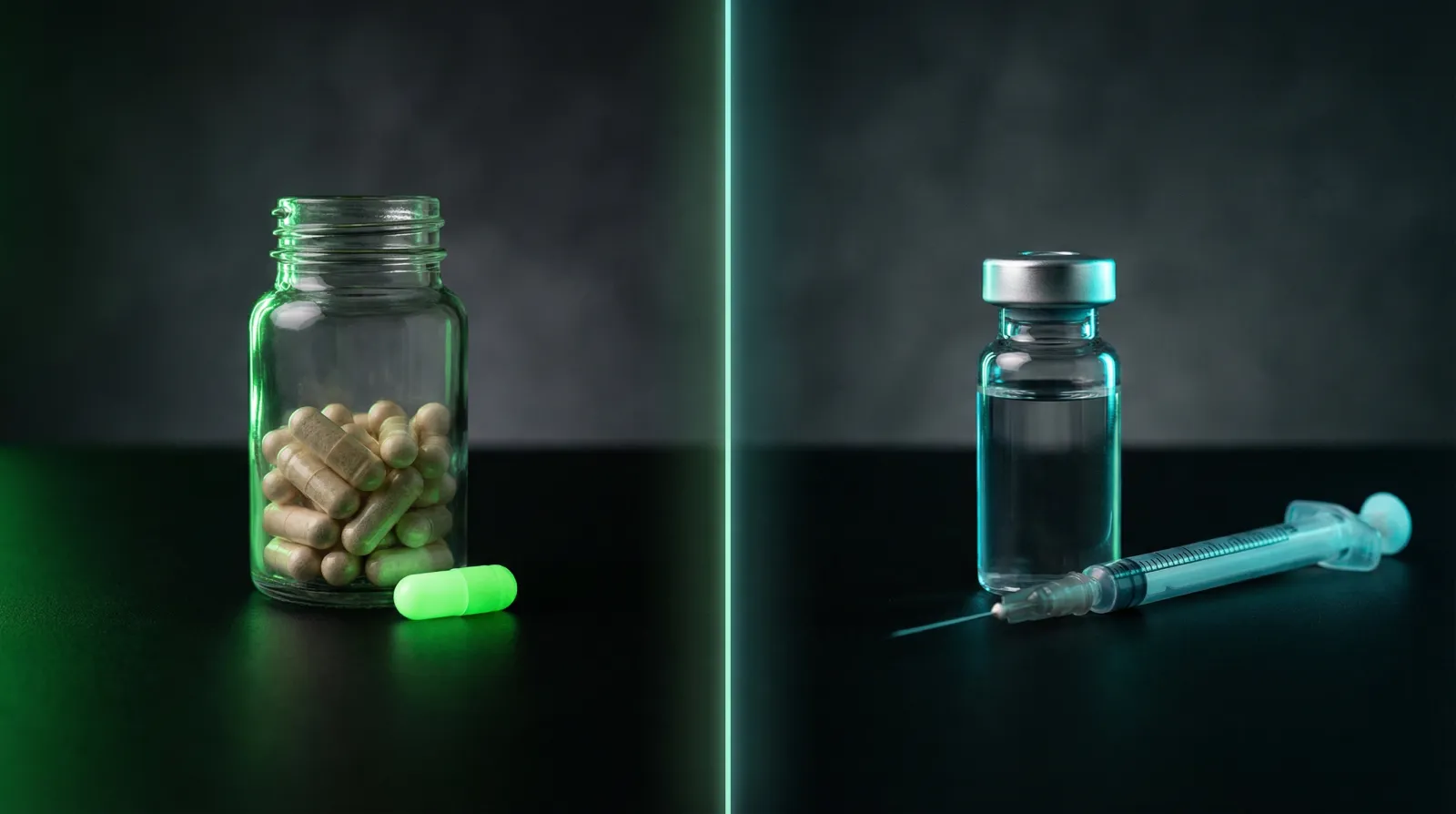
BPC-157 Oral vs Injectable: What Do the Studies Show?
For BPC-157 oral vs injectable use, no published study has compared the two in people. The FDA found no human data on how much gets into the blood by mouth or by a shot under the skin. In rodents (rats), both ways have been tested. Both were reported to help healing.
This page sets out what each named source found, by route. It gives the species, the route and the dose in that source's own terms. It does not turn any of it into advice.
This content is for educational purposes only and is not medical advice. BPC-157 is sold for research use and is not approved by the FDA for human use. A qualified clinician can advise on any health decision.
How Does BPC-157 Oral vs Injectable Bioavailability Compare?
Bioavailability is the share of a dose that reaches the blood. In people, no one has measured it for either route. In 2026, the FDA wrote a briefing document for its advisory panel. It says "there is no information to assess the pharmacokinetics of BPC-157 in humans." Pharmacokinetics is how the body takes in and clears a drug.
The only injected bioavailability figures come from animals. He et al. 2022 gave it into a muscle and compared it with a dose into a vein. About 14-19% reached the blood in rodents (rats). In beagle dogs it was 45-51%. The half-life was under 30 minutes in both. Half-life is the time it takes for half the drug to leave the blood.
For the mouth, the data is about survival, not absorption. Gastric juice is the fluid in the stomach. A 2020 review says BPC-157 is stable in human gastric juice for more than 24 hours (Sikiric 2020). He et al. 2022 also write that it is resistant to gastric juice. Neither finding measures how much enters the blood.
| Route | In people | In animals |
|---|---|---|
| By mouth | No absorption data, per the FDA briefing. One Phase I tablet trial posted no results. | Reported stable in gastric juice. No oral bioavailability figure in the sources we read. |
| Under the skin | No absorption data, per the FDA briefing. | No figure in the sources we read. |
| Into a muscle | No absorption data. | 14-19% in rats, 45-51% in beagle dogs (He et al. 2022) |
| Enema (liquid given into the rectum) | Blood levels were mostly too low to measure, per the FDA briefing | Not covered here |
What Do Animal Studies Show for BPC-157 Oral vs Injectable Effectiveness?
Some rodent (rat) studies gave BPC-157 by mouth and by injection in the same experiment. All of the ones below come from researchers in Zagreb, Croatia. None were done in people.
In one study, the rats had a cut knee ligament, the medial collateral ligament. BPC-157 was given once daily into the belly at 10 mcg or 10 ng per kilogram (kg) of body weight. Another group got it in drinking water at 0.16 mcg per ml. The authors report that both routes improved healing. They measured function, strength and tissue changes (Cerovecki 2010). A nanogram (ng) is one thousandth of a microgram (mcg).
In rats with short bowel syndrome, part of the small bowel was removed. BPC-157 was given in drinking water or into the belly. The authors report weight gain with both routes (Sever 2009). Another study cut the sciatic nerve, the main nerve of the leg, in rats. BPC-157 was given into the belly, by stomach tube or at the nerve. The authors report better nerve healing (Gjurasin 2010).
These are rat results. No study we found has tested whether the same holds in people.
What Lab Studies Show About How BPC-157 Works
The lab work on how BPC-157 acts used cells in a dish. It does not test a route.
BPC-157 is a chain of 15 amino acids, the building blocks of proteins. It is part of a larger protein found in human gastric juice (Chang 2011). Fibroblasts are the cells that rebuild connective tissue. In rodent (rat) tendon fibroblasts, BPC-157 increased cell migration in a dose-dependent way. That means the effect grew with the amount used. It raised the activation of FAK and paxillin, a signal chain that controls how cells move. Total levels of these proteins did not change. The authors say the FAK-paxillin pathway likely drives these effects (Chang 2011).
A second study used the same kind of rat tendon cells. Growth hormone receptor (GHR) was among the most raised genes. It rose at both the mRNA and protein level. mRNA is the working copy a cell makes of a gene. Adding growth hormone made the treated cells multiply more (Chang 2014).
A third study looked at blood vessels. VEGFR2 is a receptor that tells blood vessels to grow. BPC-157 raised VEGFR2 in human cells that line blood vessels. It also switched on Akt and eNOS, the next steps in that signal chain (VEGFR2-Akt-eNOS). That chain is linked to new vessel growth. In rats with poor blood flow to a hind leg, blood flow recovered faster (Hsieh 2017).
We also have guides on BPC-157 for a herniated disc and on peptides for knee cartilage and osteoarthritis. The Wolverine stack guide covers BPC-157 with TB-500.
BPC-157 Oral vs Injectable for Gut Healing: What Is Known?
For the gut, the human studies used neither a pill nor a shot. Two small studies gave BPC-157 by enema, a liquid dose into the rectum. Both compared it with a placebo, a dummy treatment. Per the FDA briefing, both exist only as meeting abstracts. These are short conference summaries.
One gave healthy volunteers 0.25, 0.5, 1 or 2 mg per kg (Veljaca 2002 and 2003). The other gave 80 mg once a day for 2 weeks (Ruenzi 2005). It was tested in 53 people with ulcerative colitis (UC), a bowel disease. The FDA found "a lack of evidence to make a conclusion on the effectiveness of BPC-157 for treating UC."
In rats, gut studies have used both routes. One study gave rats a sore, inflamed food pipe (esophagitis). BPC-157 was given into the belly or in drinking water. The authors report that both healed the damage (Petrovic 2006). A review by the same group covers its use across the gut in animal models (Sikiric 2011).
We cover the gut record in more depth in BPC-157 for gut health. A related guide covers the KPV gut health peptide.
Can TB-500 Be Taken Orally Like BPC-157?
No source we found tested TB-500 by mouth. The FDA wrote a review of TB-500, dated May 15, 2026. It found no human studies or human exposure data for TB-500 by any route. The FDA has made no final decision on it.
TB-500 is a lab-made chain of seven amino acids. It copies amino acids 17 to 23 of thymosin beta-4, a natural repair protein. It also has a small chemical cap added. The FDA says the two are not the same thing. So a thymosin beta-4 result does not carry over to TB-500.
The FDA's review lists two animal doses. Horses got 10 mg under the skin. Rats got 50 mg per kg into the belly. Those studies tracked how the body breaks it down. None tested healing. Our TB-500 complete guide and TB-500 dosage guide set out the full record. The BPC-157 vs TB-500 comparison covers how the two differ.
What Are the BPC-157 Oral vs Injectable Dosage Differences?
No source sets an oral or an injected dose for people. The table lists each dose a named source used or planned, by route. The animal doses are per kilogram (kg) of body weight.
| Route | Source and who | Dose (as reported or planned) |
|---|---|---|
| By mouth (tablets) | NCT02637284, a Phase I plan (a first safety trial in people), healthy adults 18-35 | Planned: tablets of 1 mg; one dose of 1, 3 or 6 tablets, then 3 tablets three times daily for 14 days. No results posted. |
| By mouth (drinking water) | Cerovecki 2010 and Sever 2009, rodents (rats) | 0.16 mcg per ml of water (ligament study); 10 mcg or 10 ng per kg (bowel study) |
| Enema | Veljaca 2002 and 2003 and Ruenzi 2005, per the FDA briefing | 0.25 to 2 mg per kg (healthy volunteers); 80 mg once daily for 2 weeks (ulcerative colitis) |
| Into the knee joint | Lee and Padgett 2021, knee pain chart review (a look back at clinic records) | 2-4 mg (1-2 doses), per the FDA briefing |
| Into the bladder wall | Lee et al. 2024, 12 women with bladder pain | 10 injections of 1 mg, 10 mg total, in one procedure |
| Drip into a vein | Lee and Burgess 2025, 2 adults | 10 mg on day 1, then 20 mg on day 2 |
| Into a muscle | He et al. 2022, rats and beagle dogs | Rats: 20, 100 or 500 mcg per kg. Dogs: 6, 30 or 150 mcg per kg. |
| Into the belly | Cerovecki 2010, rodents (rats) | 10 mcg or 10 ng per kg once daily |
No study has shown that any of these amounts is right for a person. Our BPC-157 dosage guide covers each human study in more detail.
How Strong Is the BPC-157 Oral vs Injectable Effectiveness Evidence?
It is thin by both routes. A 2025 review searched medical databases for BPC-157 in sports medicine. It was a systematic review, which follows set search rules. It found 36 studies. 35 were preclinical, meaning animal or cell work. Just 1 was done in people (Vasireddi et al. 2025).
The FDA's 2026 briefing lists five small human studies. It said no serious harms appear to have been reported. Its conclusion was that "there is insufficient clinical safety information to characterize the safety profile" of BPC-157. None of the five compared a pill with a shot.
USADA, the US anti-doping agency, says BPC-157 is banned in sport by WADA, the World Anti-Doping Agency. It also says it is unknown if there is a safe dose. Our sources page sets out how we grade vendors.
Where to buy BPC-157
The hard part with BPC-157 isn't the protocol. It's finding a supplier that can prove what's in the vial. We assessed dozens against per-batch, third-party testing. A handful passed.
See the sources that passed →Which Route Claims Do the Sources Not Support?
Several common claims about the two routes go further than the record.
- "Oral BPC-157 stays in the gut." No human study has measured where it goes after a dose by mouth, per the FDA briefing.
- "Only a shot reaches a tendon or ligament." In rats, BPC-157 in drinking water was reported to help a cut ligament heal (Cerovecki 2010). No human study has tested either route for this.
- "Stomach survival means absorption." Stability in gastric juice is a lab finding. It does not measure entry into the blood.
- "Using both routes works better." We found no study that gave it by mouth and by shot together.
References
- Chang CH et al. The promoting effect of pentadecapeptide BPC 157 on tendon healing involves tendon outgrowth, cell survival, and cell migration. J Appl Physiol, 2011. PubMed
- Chang CH et al. Pentadecapeptide BPC 157 enhances the growth hormone receptor expression in tendon fibroblasts. Molecules, 2014. PubMed
- Sikiric P et al. Stable gastric pentadecapeptide BPC 157: novel therapy in gastrointestinal tract. Curr Pharm Des, 2011. PubMed
- Sikiric P et al. Fistulas Healing. Stable Gastric Pentadecapeptide BPC 157 Therapy. Curr Pharm Des, 2020. PubMed
- Cerovecki T et al. Pentadecapeptide BPC 157 (PL 14736) improves ligament healing in the rat. J Orthop Res, 2010. PubMed
- Sever M et al. Gastric pentadecapeptide BPC 157 and short bowel syndrome in rats. Dig Dis Sci, 2009. PubMed
- He L et al. Pharmacokinetics, distribution, metabolism, and excretion of body-protective compound 157, a potential drug for treating various wounds, in rats and dogs. Front Pharmacol, 2022. PubMed
- FDA. BPC-157 briefing document, Pharmacy Compounding Advisory Committee, July 2026. FDA
- FDA. TB-500 briefing document, Pharmacy Compounding Advisory Committee, July 2026. FDA
- USADA. BPC-157 peptide prohibited. USADA
Where to buy BPC-157
The hard part with BPC-157 isn't the protocol. It's finding a supplier that can prove what's in the vial. We assessed dozens against per-batch, third-party testing. A handful passed.
See the sources that passed →Share this article
Frequently Asked Questions
Is oral BPC-157 as effective as injectable for joint pain?
Can TB-500 be taken orally like BPC-157?
What oral BPC-157 doses have studies used?
Is there evidence for choosing oral or injectable BPC-157?
Does BPC-157 survive stomach acid?
Has combining oral and injectable BPC-157 been studied?
Read Next
Disclaimer: This content is for educational purposes only. These compounds are intended for research use. Nothing here is medical advice. Always work with a qualified clinician before making changes to your health protocol.