
Best Peptides for Men Over 40: Recovery and Longevity

What Are the Best Peptides for Men Over 40?
No source names the best peptides for men over 40, so this guide covers six of the most studied. Human data are thin for all of them. BPC-157 and TB-500 are studied for tissue repair. CJC-1295 and ipamorelin each raise growth hormone, but no study we read tests the pair. Semax is studied for focus, and GHK-Cu for skin.
After 40, several changes stack up. Growth hormone output falls by about 14% a decade after age 30. Collagen and elastin decline. Healing after an injury takes longer. Memory can start to slip. Mavrych et al. 2026.
Those changes are real and they're measurable.
So what is a peptide? It is a short chain of amino acids. Cushman et al. 2024. Each one acts on a set path in the body. Some build new blood vessels. That is called angiogenesis. Some boost growth hormone signals. Some shift actin, the protein that lets a cell move. Some raise neurotrophins, the proteins that keep nerve cells healthy. Know what a compound does inside a cell and you have a plan. Skip that step and you have an expensive guess.
This guide covers six that are studied for problems after 40. You get how each one works. You get the reported doses and the evidence grades. You get the side effects, the sourcing rules and the stack logic. Every major claim names its source, and most link to it.
Why does the biology after 40 need a different toolkit?
Researchers call the fall in growth hormone (GH) somatopause. It brings less lean muscle and more fat, especially around the organs. It also brings lower bone density, thinner skin and slower recovery from illness or injury. Mavrych et al. 2026.
Healing slows too. Ageing tissue grows fewer new blood vessels, which hurts healing. A chronic low-grade inflammation, called inflammaging, adds to the problem. Mavrych et al. 2026.
The six peptides below are studied against those changes. Between them they target growth signals, new blood vessel growth, cell movement, brain plasticity, and skin and collagen. For a foundation on how peptides work, see my complete introduction to peptides.
This content is for educational purposes only. These compounds are intended for research use. Nothing here is medical advice. They are not FDA-approved therapeutic agents. Talk to a qualified clinician before you begin any peptide protocol.
Which Peptides Are Studied for Tendons, Joints and Muscle?
Two of them are studied most for tissue repair, BPC-157 and TB-500. Both have animal data and almost no human data. Mavrych et al. 2026.
How does BPC-157 work?
BPC-157 is a synthetic pentadecapeptide. That means a short made-to-order chain of amino acids. It comes from human gastric juice. In animal and cell studies it works in three ways. One is switching on VEGFR2, a receptor that tells cells to build blood vessels. One is the FAK-paxillin pathway, a cell-movement signal, in rodent (rat) tendon fibroblasts. Those are the cells that lay down new tendon. And one is more growth hormone receptors on those rodent (rat) cells. One protocol site gives 250-500mcg under the skin each day, for 4-8 weeks. Peptide Guides 2026.
The main blood vessel effect runs through VEGFR2 and the Akt-eNOS axis. That axis is a chain of signals in blood vessel cells that makes nitric oxide. It grows new blood vessels at injury sites. Tendons have a poor blood supply, which slows their healing. Research by Chang et al. (J Appl Physiol, 2011) went further, in rodent (rat) tendon tissue and cells. BPC-157 sped up the outgrowth of tendon fibroblasts. It also sped up their migration and spreading, in a dose-dependent way, meaning higher doses gave bigger effects. Cell survival under oxidative stress, the kind of damage hydrogen peroxide causes, rose significantly too.
There is a structural effect too. In rodent (rat) tendon fibroblasts grown in a dish, BPC-157 upregulated growth hormone receptor expression in a dose-dependent manner. When GH was added, the treated cells multiplied more. GH also switched on JAK2 in them, the signal that carries the GH receptor's message into the cell.
One review pulled the whole picture together. It read 36 studies in all. They ran from 1993 to 2024. It suggests that BPC-157 raises growth hormone receptor expression. It also raises several paths behind cell growth. Angiogenesis is one of them. And it cuts inflammatory cytokines, the proteins cells use to signal inflammation. Preclinical (lab and animal) models showed better outcomes. That covers function, structure and how well the tissue bears load. That held in muscle, tendon, ligament and bone injuries.
A second review adds that it also engages ERK1/2 signalling. ERK1/2 is another signal chain inside cells that helps new blood vessels form. And it helps repair muscle and the cells that line blood vessels. Those effects count most in tissue with poor blood supply. Tendons and the points where muscle meets tendon are exactly that.
How strong is the BPC-157 evidence?
| Domain | Evidence Level | Notes |
|---|---|---|
| Tendon and ligament repair | Preclinical (animal) | Among 35 preclinical studies in one systematic review (Vasireddi 2025) |
| Muscle healing | Preclinical (rodent, rat) | Thigh (quadriceps), calf (gastrocnemius) and Achilles models (Cushman 2024) |
| Gut repair | Preclinical (rodent, rat) | Gastric, colon and liver lesions in rodents (rats) (FDA 2026) |
| Human clinical data | Very limited (3 pilot studies) | Knee pain, interstitial cystitis (a painful bladder condition), and safety and pharmacokinetics (how the body handles a dose) given into a vein (McGuire 2025) |
| Safety profile | No adverse effects in preclinical safety studies | No clinical safety data (Vasireddi 2025) |
What is the BPC-157 dosing protocol?
| Parameter | Reported protocol | Source and notes |
|---|---|---|
| Dose | 250-500mcg a day | Peptide Guides; its starting dose is 250mcg once daily |
| Frequency | Once daily, or split morning and evening | Peptide Guides |
| Route | Under the skin; by mouth for gut problems | Peptide Guides |
| Injection location | Near the injury when practical | Peptide Guides |
| Cycle length | 4-8 weeks on | Peptide Guides; 6-8 weeks for joint pain |
| Rest period | 4-8 weeks off | Peptide Guides |
| Onset | 1-3 weeks, as users report | Peptide Guides (user reports) |
| Tested in people | No dose-finding trial | Mavrych et al. 2026 |
Need the mixing maths? The ratios for bacteriostatic water (sterile water with a preservative) and the storage rules? They are all in my BPC-157 dosing protocol guide. For oral against injected, read BPC-157 oral vs injectable.
What are the BPC-157 side effects and cautions?
BPC-157 has a clean preclinical safety record. Preclinical safety studies found no adverse effects across several organ systems, in work running from 1993 to 2024. But there are no clinical safety data. Vasireddi et al. 2025. The three small human pilot studies reported no adverse effects. McGuire et al. 2025.
On cancer, one review flags a theoretical risk that its blood vessel effect could feed abnormal tissue, though it calls this speculative. Rahman et al. 2026.
One note on the rules. BPC-157 went on the FDA Category 2 bulk substance list on 29 September 2023. That is FDA's list of raw ingredients for pharmacies that may present significant safety risks. FDA's safety page, updated in April 2026, now lists it as a withdrawn nomination. FDA 2026. FDA's advisers met on it in July 2026. FDA's own slides for that meeting proposed that BPC-157 and TB-500 not be added to the list of raw ingredients pharmacies may use. FDA slides 2026. I cover that in my FAQ on FDA reclassification. The peptides legal status update for 2026 has the rest.
What does one protocol site list for route, cycles and rest?
- Route: Peptide Guides lists oral BPC-157 for gut problems, and shots under the skin for tendon, joint and muscle goals.
- Cycle length: Peptide Guides lists 6-8 weeks for joint pain, longer than its 4-6 weeks for tendon and muscle injuries.
- Rest period: Peptide Guides lists 4-8 weeks off after each cycle. A 2026 review notes that such on-off cycles rest on theory about receptors dulling, with no trials behind them. Mavrych et al. 2026.
- Quality checks: independent labs keep finding online peptides that are mislabelled or impure. SDOMG 2026. Check every vial against a certificate of analysis from an independent lab.
I compare the two side by side in BPC-157 vs TB-500.
How does TB-500 work?
TB-500 is a synthetic copy of one part of Thymosin Beta-4, the actin-binding region. Philp et al. 2003. The full protein binds single actin units and keeps a ready pool of them inside the cell. Cushman et al. 2024. In animal work it helps repair cells move to an injury. Mavrych et al. 2026.
TB-500 (Ac-LKKTETQ, its amino acid code) matches amino acids 17-23 of the natural Thymosin Beta-4 protein. Sanders et al. (PNAS, 1992) showed what that protein does. Injected into living cells, it broke down actin filaments in a dose-dependent way. The authors called it a potent regulator of actin assembly. That is the base for its effects on how cells move.
For the full protein, animal work shows stem and repair cells moving in, new blood vessels and less scarring. It also shows more VEGF, a growth factor that builds blood vessels. Cushman et al. 2024.
Philp et al. (Wound Repair Regen, 2003) tested the synthetic actin-binding piece that TB-500 copies. They tested it only in aged rodents (mice), where it helped skin wounds heal about as well as the full protein. The full protein also helped wounds heal in a diabetic rodent (mouse) model. So the effect holds in older animals, at least.
A 2026 review on ageing looked at both of them. It found that the effects of combining peptides are unexplored, and that the safety and benefit of combinations remain unstudied. Mavrych et al. 2026. It also warns that findings on the full protein should not be carried straight over to TB-500.
How does TB-500 differ from BPC-157?
| Property | BPC-157 | TB-500 |
|---|---|---|
| Primary mechanism | VEGFR2, FAK-paxillin, GH receptor upregulation (animal) | Actin binding and cell movement (full protein, animal) |
| Administration | Daily, under the skin, near the injury (Peptide Guides) | Under the skin or into muscle (Rahman et al. 2026) |
| Cycle structure | 4-8 weeks on / 4-8 weeks off (Peptide Guides) | No tested cycle |
| Stack compatibility | No controlled trial; one small chart review with thymosin beta-4 (Lee and Padgett 2021) | No controlled trial; combinations unstudied (Mavrych et al. 2026) |
| Human clinical data | 3 pilot studies (McGuire 2025) | None for TB-500 (FDA); one phase I (first small safety) trial of the full protein (Mavrych 2026) |
What is the TB-500 dosing protocol?
| Source | Dose | Frequency | Duration |
|---|---|---|---|
| Peptide Guides, with BPC-157 | 2.0-2.5mg | Twice weekly | 6-8 weeks |
| Human studies (FDA) | No human exposure data | Not established | Not established |
In research use, TB-500 is usually injected under the skin or into a muscle. Rahman et al. 2026. For the full phase-by-phase breakdown, reconstitution included, see the TB-500 complete guide.
What does TB-500 do for connective tissue after 40?
Ageing tissue heals more slowly, partly because chronic low-grade inflammation gets in the way. In animal work, thymosin beta-4 helps cells move to an injury and releases anti-inflammatory signals. Mavrych et al. 2026. But FDA found no animal wound studies and no human studies of TB-500 itself. FDA slides 2026.
The Wolverine stack is BPC-157 plus TB-500, run at the same time. No controlled trial has tested the pair. In one small retrospective chart review, 4 people with knee pain got BPC-157 with thymosin beta-4, the protein TB-500 comes from. It looked back at one clinic's records. Lee and Padgett 2021. My Wolverine stack guide has the co-administration protocol.
What are the TB-500 side effects?
FDA found no human exposure data and no animal toxicity studies for TB-500. FDA slides 2026. It warns that TB-500 made by a pharmacy may trigger an immune reaction by some routes. FDA 2026. A review adds that thymosin beta-4's role in cancer is unclear, and raised levels turn up in some cancer cell lines. Cushman et al. 2024.
How Do You Raise Growth Hormone After 40?
With two compounds that press two different buttons on the pituitary, the gland under the brain that releases GH.
CJC-1295 is a long-acting modified version of GHRH, the brain's own signal to release growth hormone. Ipamorelin switches on a different target, the ghrelin receptor. Ghrelin is a natural hormone, and switching on its receptor releases GH. The pair is meant to drive GH release through two receptor systems at once, but no trial has tested it in people. Websites FDA reviewed give CJC-1295 doses from 100 mcg a week to 100-400 mcg a day. FDA 2024. One clinic lists ipamorelin at 150 mcg a day. FDA 2024.
Why does the pair matter after 40?
Somatopause, the fall in GH that starts around age 30, is covered above. A 2026 review says CJC-1295 can restore a more youthful GH pattern. Mavrych et al. 2026.
These two tell the pituitary to make more of your own GH. CJC-1295 is a modified, lab-made version of GHRH. It binds the GHRH receptor and signals the pituitary to raise GH output. A chemical add-on called a drug affinity complex (DAC) stretches its half-life to 5.8 to 8.1 days. Half-life is the time the body takes to clear half a dose. Teichman et al. 2006. Your own GHRH lasts minutes. Mavrych et al. 2026. A randomised, placebo-controlled, double-blind trial tested a single injection of CJC-1295. In such a trial, neither the volunteers nor the staff know who gets the drug or a dummy shot. Average GH in the blood rose 2 to 10-fold, in a dose-dependent way. The rise lasted 6 days or more. IGF-1, a growth factor that rises with GH, went up 1.5 to 3-fold for 9 to 11 days. Teichman et al. 2006.
Ipamorelin uses a different receptor. That is the ghrelin receptor. It releases GH on a path that doesn't need GHRH at all. A 2026 review says ipamorelin complements CJC-1295 because it works through the ghrelin receptor. But the study it cites tested ipamorelin alone, in rodents (rats) and pigs (swine).
Ipamorelin also stands out for how selective it is, at least in pigs (swine). It did not raise ACTH, the pituitary hormone that drives cortisol, or cortisol itself, beyond what GHRH did. That held even at doses over 200 times what released GH. Older GH-releasing peptides, GHRP-6 and GHRP-2, raised both. None of them changed prolactin, a pituitary hormone best known for milk production. Raun et al. 1998.
What do men over 40 get downstream?
- Body composition: in a GH-deficient rodent (mouse) model, daily CJC-1295 brought growth, body composition and metabolism back to normal. Mavrych et al. 2026.
- Sleep, recovery and bone: the sources we read report no studies of these in older men taking CJC-1295 or ipamorelin.
What is the CJC-1295 and ipamorelin dosing protocol?
| Compound | Reported dose | Where it comes from |
|---|---|---|
| CJC-1295 in trials | 30-250 mcg per kg, up to four shots; most had one | Healthy adults; FDA's review of the trials |
| CJC-1295 on websites | 100 mcg a week to 100-400 mcg a day | Websites FDA reviewed |
| CJC-1295 on fitness sites | 250 mcg a day to 100-200 mcg, 2-3 times a day | Websites FDA reviewed |
| Timing on websites | A shot at night; some 5 of 7 nights; one once a week | Websites FDA reviewed |
| Ipamorelin | 150 mcg a day, under the skin | One clinic FDA reviewed |
| The pair together | Not tested in people | Mavrych et al. 2026 |
On timing, websites FDA reviewed describe a CJC-1295 shot at night, some on 5 of 7 nights. One describes a single weekly shot. FDA 2024. A 2026 review adds that such protocols rest only on animal work, anecdote and single-dose studies. Mavrych et al. 2026.
Need more? The DAC call is in my CJC-1295 and ipamorelin stack protocol. Doses sit in the ipamorelin dosage guide. The CJC-1295 complete guide has the rest. To weigh these against a shot of the hormone itself, read secretagogues vs synthetic HGH.
What are the side effects and cautions?
In the CJC-1295 trials, the most common side effect was a reaction at the injection site. FDA 2024. The trial authors called it safe and fairly well tolerated, especially at the lower doses. Teichman et al. 2006.
FDA has flagged more serious risks. It has identified serious adverse events linked to CJC-1295, including a raised heart rate and a body-wide widening of blood vessels. It adds that clinical data are limited. For ipamorelin, it cites a published study with serious adverse events, including death. There, the drug was given into a vein to speed up the gut. FDA 2026.
FDA's 2024 review of CJC-1295 also cites anecdotal reports of a Phase 2 trial. It enrolled 192 people with HIV lipodystrophy, a shift in where the body stores fat. Two hours after an 11th weekly dose, one participant had a heart attack and died about an hour later. The attending physician's most likely explanation was silent disease of the heart's arteries, with a plaque that burst and blocked one. The trial was stopped, and its data were never published. FDA 2024.
FDA also says it cannot rule out overgrowth or tumours of the pituitary with long-term CJC-1295 use. It found no long-term animal cancer studies. In a rodent (mouse) model bred to overproduce GHRH, the pituitary overgrew and formed tumours. FDA 2024. For the full safety picture, see my CJC-1295 side effects and safety guide.
Which Peptides Are Studied for the Brain and Skin?
Semax is studied for the brain. GHK-Cu is studied for skin and collagen. Mavrych et al. 2026.
How does Semax work?
Semax is a synthetic heptapeptide, a chain of seven amino acids. It is based on a piece of ACTH, amino acids 4 to 10. Small studies in healthy adults gave it in the nose at 0.25 to 1.2 mg. FDA 2026. BDNF, short for brain-derived neurotrophic factor, is a protein that helps nerve cells survive and grow. In a rodent (rat) study, one dose raised BDNF in the hippocampus, a brain area key to memory, by up to 1.4-fold. It lifted BDNF mRNA 3-fold. That mRNA is the message a cell reads to make the protein. It also switched on TrkB, the receptor BDNF acts through. That path keeps neurons alive. It supports synaptic plasticity too, the way links between nerve cells grow stronger or weaker.
Why does focus slip after 40?
Memory can slip with age, starting with mild age-related memory problems. BDNF is the master regulator of neuroplasticity, the brain's ability to rewire itself, and it declines with age. It supports nerve cell survival, synaptic plasticity and new nerve cell growth, which decline with age too. Mavrych et al. 2026.
Semax speaks to that directly, in rodent (rat) studies. Semax produced 1.4-fold increases in hippocampal BDNF protein levels. BDNF mRNA expression rose 3-fold. The BDNF receptor TrkB fired more strongly.
There is more than BDNF here, and some of it is worrying. In a rodent (mouse) study, Semax boosted the dopamine release that amphetamine sets off in the striatum, a brain reward area. FDA called that concerning, since drugs of abuse such as cocaine do the same. FDA's review also describes Semax as free of ACTH's hormone effects, while keeping its effects on behaviour. FDA 2026. In animal studies of low blood flow to the brain, it shifted gene activity in nerve-signal and inflammation pathways. Earlier studies describe antioxidant and anti-inflammatory effects. Mavrych et al. 2026.
What is the Semax dosing protocol?
| Group studied | Dose | Source |
|---|---|---|
| Healthy adult men | 1 mg in the nose a day for 2 days, or 0.25 mg once | Kaplan et al. 1996, as FDA lists it |
| Healthy adults | 1.2 mg in the nose | Two small studies, as FDA lists them |
| Russian registered product | 0.1% and 1% nasal drops | FDA 2026 |
| Rodents (rats), BDNF study | 50 mcg per kg, once | Dolotov et al. 2006 |
Semax is sold as nasal drops or spray, and as a shot. FDA 2026.
Want the full profile? The Semax complete guide covers the N-acetyl Semax variant and the stack options. For how it sits next to other nootropic peptides, Selank included, read best nootropic peptides for focus and memory.
What are the Semax side effects and cautions?
Most human Semax studies FDA reviewed did not report on side effects. FDA also found no published animal toxicity studies. FDA 2026.
As with every compound here, it is intended for research use and is not FDA-approved. It is registered as a drug in Russia, as 0.1% and 1% nasal drops. FDA 2026.
How does GHK-Cu fit after 40?
GHK-Cu is a natural tripeptide, a chain of three amino acids, that binds copper. It is found in human plasma, the liquid part of the blood. Cushman et al. 2024. It turns at least 4,000 human genes up or down. Pickart et al. 2015. Those genes cover tissue remodelling, anti-inflammatory signalling and antioxidant defence. In lab studies it raises collagen and elastin production. Pickart and Margolina 2018. It also speeds wound healing in animals. Cushman et al. 2024.
Plasma GHK-Cu falls a long way with age. It runs near 200ng/mL at age 20. That unit means nanograms, or billionths of a gram, in each millilitre. By age 60 it is around 80ng/mL. That drop tracks with weaker skin repair. In cell studies, GHK-Cu shifted gene activity towards a younger pattern, but whether that matters in the body is not yet known. Mavrych et al. 2026.
It works by turning genes up or down. It raises decorin, a small protein in the collagen matrix. It drives fibroblasts to make collagen and glycosaminoglycans, long sugar chains in tissue. Pickart et al. 2015. In a rodent (mouse) model of lung injury, it raised superoxide dismutase, an antioxidant enzyme. Pickart and Margolina 2018. And in human skin cells in the lab, it cut the release of IL-6, an inflammatory signal that feeds the inflammaging state. Pickart et al. 2015.
Another note on the rules. Injectable GHK-Cu went on the FDA Category 2 bulk substance list on 29 September 2023 too. FDA now lists it as a withdrawn nomination, and warns that injected GHK-Cu made by a pharmacy may trigger an immune reaction. FDA 2026. For where it stands now, see my GHK-Cu complete guide and GHK-Cu for wound healing and recovery.
How Do You Stack the Best Peptides for Men Over 40?
The compounds above act on different targets. Only the recovery stack below comes from a protocol site.
What does the recovery stack look like?
| Compound | Reported dose | Frequency | Primary Role |
|---|---|---|---|
| BPC-157 | 250-500mcg | Daily, in one protocol site's stack | Angiogenesis, GH receptors (animal studies) |
| TB-500 | 2.0-2.5mg | Twice weekly, in the same stack | Cell movement (full protein, animal studies) |
This is the Wolverine stack as Peptide Guides lists it. No controlled trial has tested the combination. For a knee plan, see my peptide protocol for knee cartilage and osteoarthritis.
What does the GH and body composition stack look like?
No study or source we read gives a combined protocol for this goal. The table above lists what the trials, websites and one clinic report for each peptide on its own.
What does the focus stack look like?
No study or source we read gives a Semax and Selank protocol. FDA found websites selling Semax on its own and mixed with Selank, as a shot or a nasal spray. FDA 2026.
Want the full designs with timing diagrams? They are in my peptide stacks that work guide. For a wider view, read best peptides for injury recovery in 2026.
How Do You Source the Best Peptides for Men Over 40 Safely?
Quality swings wildly across the research supply chain. An independent third-party CoA is the floor. It has to show purity by high-performance liquid chromatography, or HPLC. It has to show mass spectrometry identity too, a test that confirms the molecule by its weight. Never buy on price alone. Mislabelled, impure and contaminated product turns up often. SDOMG 2026.
Research-grade sellers do not follow pharmaceutical manufacturing standards. A vial could hold the wrong sequence, broken fragments or a different peptide entirely. SDOMG 2026. The only real protection is third-party lab testing, batch by batch. That means HPLC for purity. It also means mass spectrometry, or MS. That check confirms the molecular weight is right.
Ask any supplier these four questions before you buy:
- Do you provide a certificate of analysis (CoA) for each batch?
- Is the CoA from an independent third-party lab, or an in-house test?
- Does the CoA show HPLC purity above 98% and mass spectrometry identity?
- Can you give me the lot number that matches the vial I am buying?
For vetted sources that meet this bar, see my recommended sources. To read and check a CoA, see how to read a peptide CoA and how to know if peptides are real. To vet a supplier beyond the CoA, see how to vet a peptide supplier.
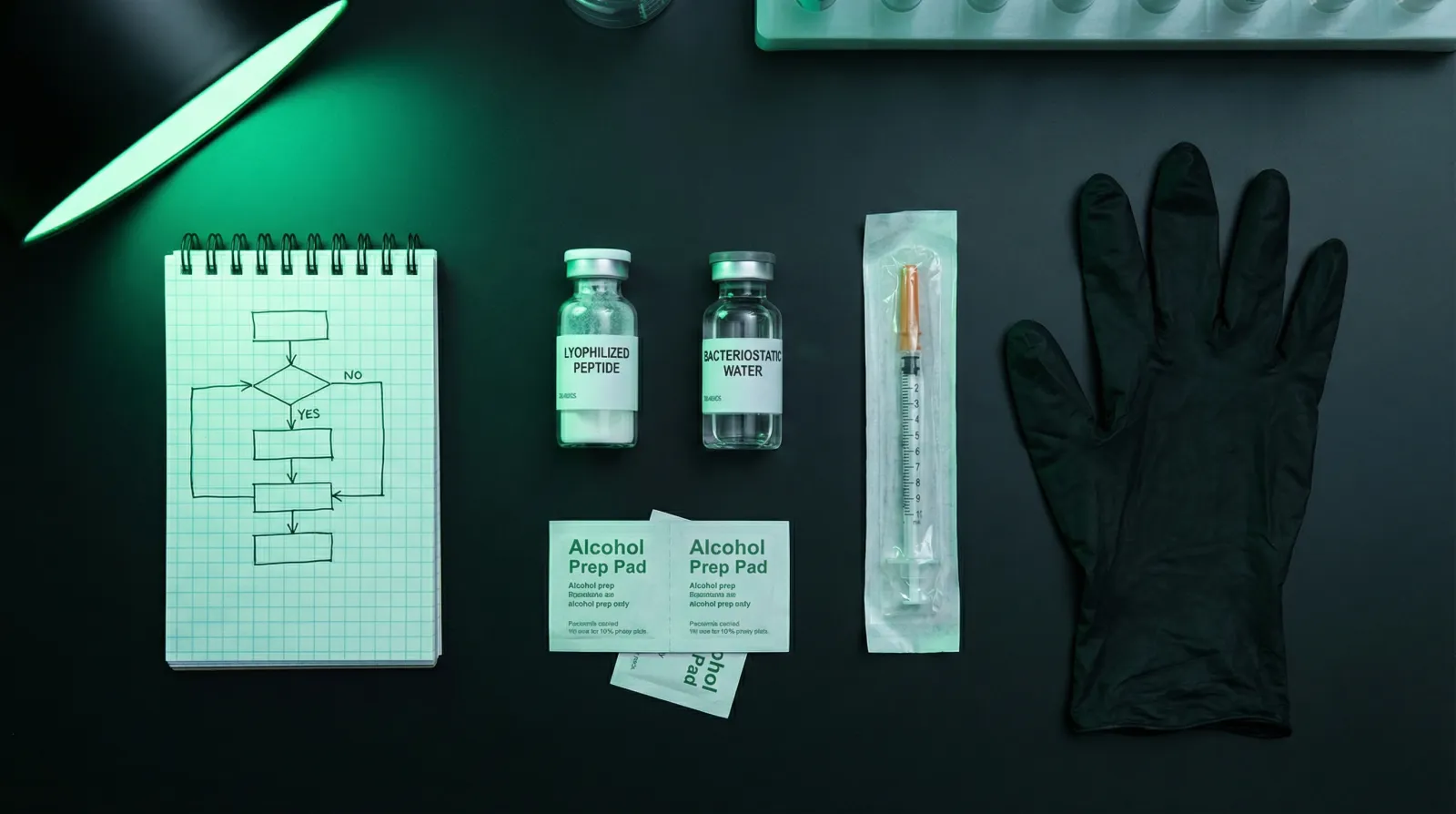
Peptides sold as powder need mixing with bacteriostatic water before a shot. Peptide Guides 2026. My guide to reconstituting peptides has the steps.
Who should not use these compounds?
The sources we read flag these cautions across the group:
- Active cancer: one review flags a theoretical tumour risk from BPC-157's blood vessel effect. Rahman et al. 2026. Thymosin beta-4's role in cancer is unclear. Cushman et al. 2024.
- Pregnancy and breastfeeding: the sources we read report no safety data in pregnancy.
- Raising GH long term: a 2026 review says its safety in older people is not fully known. It names possible heart effects, blood sugar problems and cancer risk. Mavrych et al. 2026.
Where to buy research peptides
The hard part with research peptides isn't the protocol. It's finding a supplier that can prove what's in the vial. We assessed dozens against per-batch, third-party testing. A handful passed.
See the sources that passed →What Is the Evidence for the Best Peptides for Men Over 40?
Honest evidence grading matters more here than in most fields. The marketing claims run well ahead of the research. Here is where each compound actually stands.
| Compound | Preclinical Evidence | Human Clinical Evidence | Honest Assessment |
|---|---|---|---|
| BPC-157 | 35 preclinical studies in one review (Vasireddi 2025) | Very limited; 3 pilot human studies as of a 2025 narrative review | Human data needed |
| TB-500 / Thymosin Beta-4 | One wound study of the fragment in aged rodents (mice) (Philp 2003); FDA found no animal wound studies of TB-500 | None for TB-500 (FDA); one phase I trial of the full protein | Full-protein findings should not be uncritically carried over to TB-500 (Mavrych 2026) |
| CJC-1295 | Growth and body composition normalised in a GH-deficient rodent (mouse) model (Mavrych 2026) | Two randomised placebo-controlled trials in healthy adults; 2-10x GH rise (Teichman 2006) | Published trials in healthy adults only. FDA cites reports of an unpublished Phase 2 in 192 people with HIV lipodystrophy, terminated after a death. Never tested with ipamorelin. |
| Ipamorelin | Rodent (rat) and pig (swine) studies (Raun 1998) | A randomised, placebo-controlled dose-escalation study in healthy men; 30 got ipamorelin by IV infusion (FDA 2024); one IV trial after bowel surgery (FDA 2024) | More selective than older GH-releasing peptides (GHRPs) in pigs (swine) |
| Semax | BDNF rise in rodent (rat) studies (Dolotov 2006) | Decades of use in Russia; independent Western validation is lacking | Western validation lacking (Mavrych 2026) |
| GHK-Cu | Gene expression and collagen in lab studies; animal wound studies | Placebo-controlled skin studies (Pickart 2015); no injectable human data found | Skin data only; FDA warns on injectables |
The anti-ageing side of this field keeps moving. I track it in best peptides for anti-ageing and longevity in 2026.
Every compound in this guide is a research peptide. None is an FDA-approved drug for any use. Semax is registered as a drug in Russia. This information is provided for educational purposes only, and these compounds are intended for research use. Always talk to a qualified clinician before you begin any peptide protocol, especially if you have a health condition or take prescription medication.
Share this article
Frequently Asked Questions
What is the best starting peptide for a man over 40 who has never used peptides before?
What is the correct dose of CJC-1295 and ipamorelin for men over 40?
How long does BPC-157 take to work on a tendon injury?
Can I run BPC-157 and TB-500 at the same time?
Are peptides legal to buy in the US in 2026?
How do I know if the peptides I am buying are real and not underdosed?
Read Next
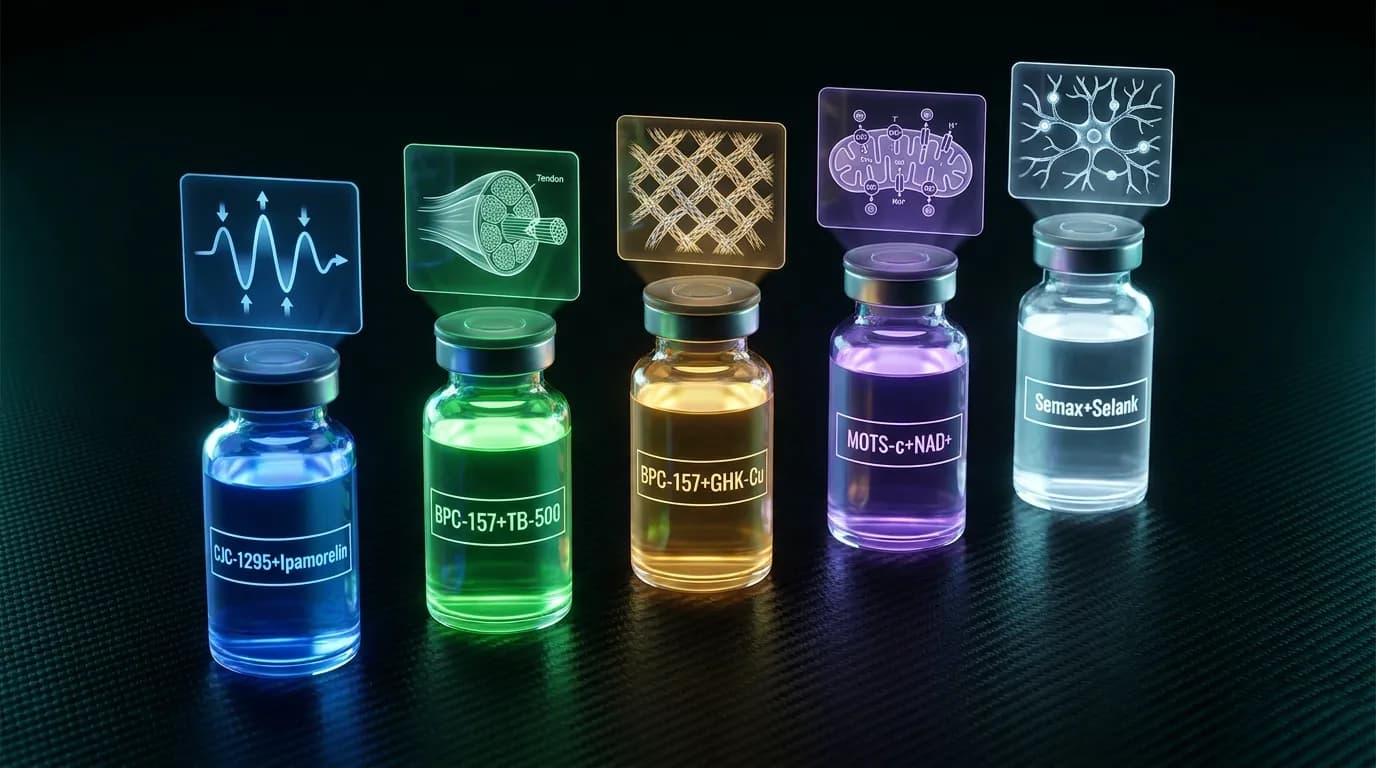

Disclaimer: This content is for educational purposes only. These compounds are intended for research use. Nothing here is medical advice. Always work with a qualified clinician before making changes to your health protocol.