
GHK-Cu Wound Healing: What Research Shows and Hasn't Tested

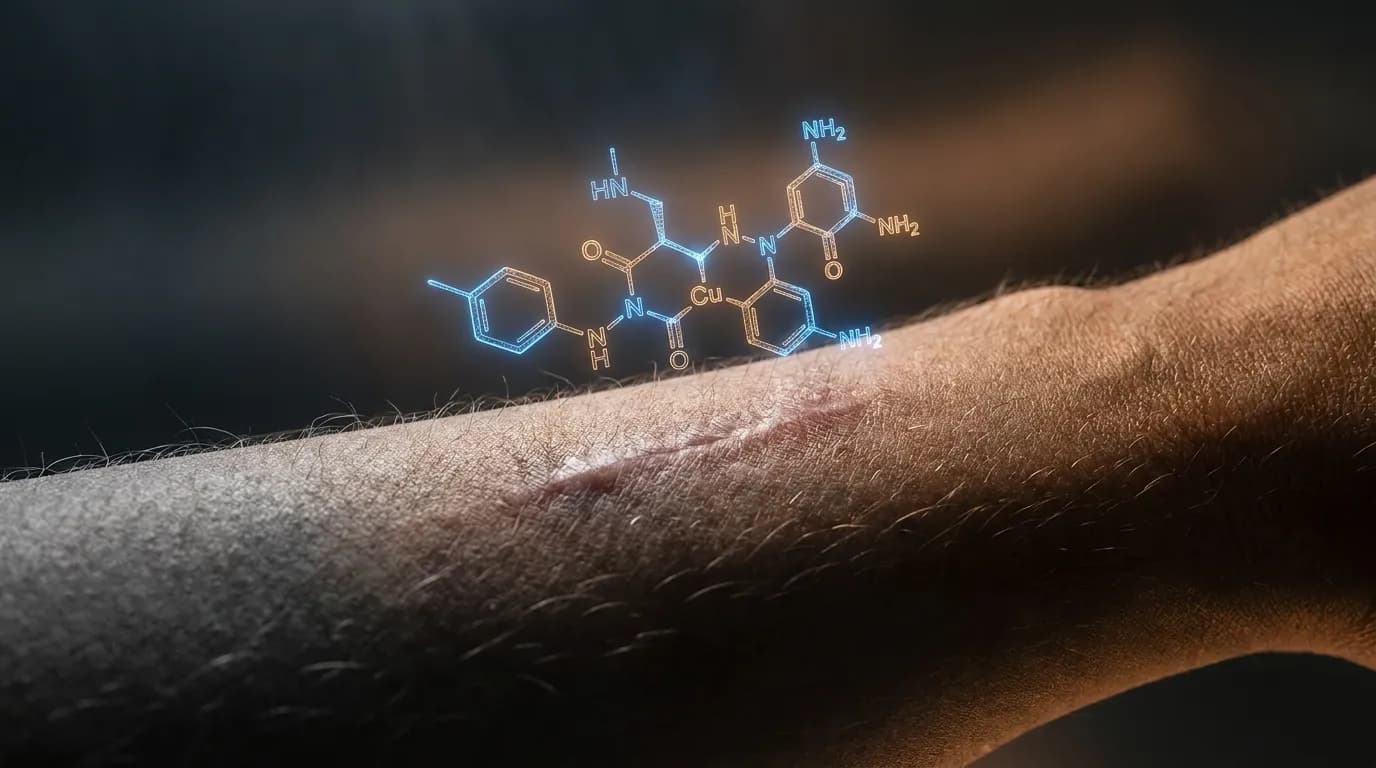
How solid is the GHK-Cu peptide evidence: skin, wound healing, safety?
GHK-Cu wound healing evidence is mostly lab and animal work. We found one wound trial in people. It compared a copper peptide cream with a dummy cream on leg ulcers, and the copper cream did no better. We found no published study of injected GHK-Cu in people, and FDA says human data are limited.
GHK-Cu is a natural three-part peptide, glycyl-histidyl-lysine, bound to copper. A peptide is a short chain of amino acids, the building blocks of proteins. This page sets out what each study tested, in what species and by what route. For topical use on skin, see our GHK Cu topical guide.
This content is for educational purposes only and is not medical advice. Nothing here is a guide to research use or to treatment. A qualified clinician can advise on any health decision.
What the evidence is actually made of
Three tiers, and it helps to keep them apart.
Cell-culture work is the first layer. That means cells grown in a dish. It is where the potency figures come from. Animal work comes next. The animal studies below used rabbits and pigs.
Human work is the thinnest layer. The skin trials a 2018 review lists tested creams and serums on ageing skin, not on wounds (Pickart and Margolina 2018). The one wound trial we found, in leg ulcers, found no benefit over a dummy cream (Bishop et al. 1992). We found no published human trial of injected GHK-Cu.
Safety, side effects and what FDA says
FDA keeps a page of bulk drug substances that may present significant safety risks in compounding. Compounding is when a pharmacy makes a drug to order. GHK-Cu for injectable routes sits in the group whose nominations were withdrawn by the nominators.
On that page, FDA says injected compounded GHK-Cu may pose a risk of immunogenicity (FDA). That is the risk of an immune reaction. FDA links it to possible clumping and peptide-related impurities. It adds that there are limited data in humans to inform safety.
Non-injectable GHK-Cu has a different status. FDA's 503A list covers substances nominated for pharmacies that make drugs for individual patients. Its update of 14 May 2026 puts GHK-Cu (except for injectable routes) in Category 1, "Bulk Drug Substances Under Evaluation" (FDA 503A list). FDA says it intends to consult its compounding advisory committee before the end of February 2027.
The skin-entry study below used pig and cell models to check safety. It saw no obvious signs of skin irritation after microneedle pretreatment, which uses tiny needles to open small channels in the skin (Li et al. 2015). A 2012 review names GHK-Cu's toxic action as a lowering of blood pressure (Pickart et al. 2012). The figures from that review are in the next section.
Quality is a separate question from the peptide itself. See how to know if peptides are real. Our sources page sets out how UB grades vendors.
GHK-Cu copper peptide skin wound healing review: what the studies found
Each study answers a different question. It matters which claim comes from where. The table gives the species and route for each one.
| Study | Who or what | How it was given | What it found |
|---|---|---|---|
| Maquart et al. 1988 | Fibroblast cultures (cells in a dish) | Added to the culture | More collagen made, starting between 10⁻¹² and 10⁻¹¹ M, highest at 10⁻⁹ M |
| Li et al. 2015 | Human skin in a lab chamber | On the skin, with or without microneedles | 134 nanomoles crossed microneedle-treated skin in 9 hours; almost none crossed intact skin |
| Cangul et al. 2006 | 18 rabbits with open skin wounds, in three groups | A tripeptide-copper complex on the wound, daily for 21 days | Smaller unhealed area than untreated wounds on days 7, 14 and 21 |
| Pickart et al. 2012 (review) | Pigs | Not stated in the review | Strong systemic wound healing at about 1.1 mg per kg of body weight |
| Bishop et al. 1992 | 86 people with venous leg ulcers | A 0.4% tripeptide copper complex cream on the ulcer | No better than a dummy cream |
Collagen switches on at tiny concentrations in cells
The foundational fibroblast study found something important. Fibroblasts are the cells that build connective tissue. Collagen synthesis stimulation started at very low concentrations, between 10⁻¹² and 10⁻¹¹ M. It peaked at 10⁻⁹ M. This happened without any change in cell number (Maquart et al. 1988). M here means molar, a measure of concentration.
The same paper notes that the GHK sequence sits inside type I collagen. The authors suggest wound enzymes may release it at the site of an injury. That is their proposal, not a tested result.
In one lab study, almost none crossed intact skin
One study tested microneedles, tiny needles that make small channels in the skin. It used human skin in a lab chamber, outside the body. Skin treated this way let through 134 nanomoles of peptide over 9 hours. A nanomole is a billionth of a mole, a chemist's unit for counting molecules. Almost none crossed intact human skin (Li et al. 2015).
What happened in rabbit wounds?
One rabbit study cut an open, full-thickness wound on each side of the back. A tripeptide-copper complex went on daily for 21 days. Treated wounds had a smaller unhealed area than untreated ones on days 7, 14 and 21. Granulation tissue covered the wound bed sooner (Cangul et al. 2006). Granulation tissue is the new tissue that fills a wound. The abstract does not name the peptide as GHK.
What does the pig dose prove?
Less than you'd think. A review reports what it calls strong systemic wound healing in pigs at about 1.1 mg GHK-Cu per kilogram of body weight. The authors convert that to about 75 mg for a person. They put it about 300-fold below GHK-Cu's toxic action, which they describe as a lowering of blood pressure (Pickart et al. 2012).
Read that carefully. The review does not say how the pigs got the peptide. The 75 mg figure is the authors' own arithmetic, not a dose any human study tested.
Did GHK-Cu heal wounds in people?
Not in the one wound trial we found. It was randomised, meaning patients were assigned by chance. The people judging the ulcers did not know who got what. 86 people with venous leg ulcers finished it. Venous leg ulcers are sores caused by poor blood flow in the veins (Bishop et al. 1992).
A 0.4% tripeptide copper complex cream did no better than an inert dummy cream. A silver sulfadiazine cream shrank the ulcers more than either. The authors note its antibacterial action was not a factor here. The abstract does not name the peptide as GHK.
The human skin trials in the 2018 review were cosmetic. In one, 71 women with signs of sun-related skin ageing used a GHK-Cu cream for 12 weeks. The review reports thicker, denser skin and fewer fine lines (Pickart and Margolina 2018). That is ageing skin, not a wound.
What the gene work adds
A later review pulled the gene-expression data together. It reports that GHK stimulates blood vessel and nerve outgrowth. It raises collagen, elastin and glycosaminoglycan synthesis, and supports dermal fibroblasts. Elastin lets skin stretch, and glycosaminoglycans are sugar chains that help it hold water. It also credits the peptide with antioxidant and anti-inflammatory actions. The authors suggest the gene data may explain why one molecule does so many things (Pickart and Margolina 2018).
The same review flags a problem in chronic wounds. GHK-Cu is easily broken down by enzymes called carboxypeptidases. The review says the "wound serum" in sores such as diabetic ulcers rapidly breaks it down. Both review authors list R&D Skin Biology, in Bellevue, Washington, as their affiliation.
Where do BPC-157 and TB-500 fit?
This GHK-Cu peptide evidence (skin, wound healing, safety) does not cover BPC-157 or TB-500. They are different peptides, and the GHK-Cu studies above say nothing about them. FDA reviewed both for its July 2026 compounding advisory committee. GHK-Cu was not on that agenda (FDA meeting page).
TB-500 was put to the committee for wound healing. FDA found no study where TB-500 was given to patients for any condition. It found no animal study of TB-500 for wound healing. In one lab study, TB-500 did not speed the closing of scratch wounds in fibroblasts (FDA TB-500 review).
BPC-157 was put to the committee for ulcerative colitis, a bowel disease. FDA found five small human studies. It concluded there is insufficient clinical safety information to characterise its safety profile (FDA BPC-157 review).
No primary source we found gives a dose for GHK-Cu combined with either peptide. See what studies tested in our BPC-157 dosing protocol guide and our TB-500 dosage guide. For skin and hair, see GHK-Cu for skin and hair.
None of this replaces a large randomised human trial of GHK-Cu on wounds. We found no published large randomised trial of GHK-Cu on wounds in people.
Where to buy GHK-Cu
The hard part with GHK-Cu isn't the protocol. It's finding a supplier that can prove what's in the vial. We assessed dozens against per-batch, third-party testing. A handful passed.
See the sources that passed →References
- Maquart FX, Pickart L, Laurent M, Gillery P, Monboisse JC, Borel JP. Stimulation of collagen synthesis in fibroblast cultures by the tripeptide-copper complex glycyl-L-histidyl-L-lysine-Cu2+. FEBS Lett. 1988. PubMed
- Li H, et al. Microneedle-mediated delivery of copper peptide through skin. Pharm Res. 2015. PubMed
- Pickart L, Vasquez-Soltero JM, Margolina A. The human tripeptide GHK-Cu in prevention of oxidative stress and degenerative conditions of aging: implications for cognitive health. Oxid Med Cell Longev. 2012. PubMed
- Pickart L, Margolina A. Regenerative and protective actions of the GHK-Cu peptide in the light of the new gene data. Int J Mol Sci. 2018. PubMed
- Cangul IT, Gul NY, Topal A, Yilmaz R. Evaluation of the effects of topical tripeptide-copper complex and zinc oxide on open-wound healing in rabbits. Vet Dermatol. 2006. PubMed
- Bishop JB, Phillips LG, Mustoe TA, et al. A prospective randomized evaluator-blinded trial of two potential wound healing agents for the treatment of venous stasis ulcers. J Vasc Surg. 1992. PubMed
- FDA. Certain bulk drug substances for use in compounding that may present significant safety risks. FDA
- FDA. Bulk drug substances nominated for use in compounding under section 503A. Updated 14 May 2026. FDA
- FDA. Briefing documents, Pharmacy Compounding Advisory Committee, 23-24 July 2026: TB-500 and BPC-157.
Where to buy GHK-Cu
The hard part with GHK-Cu isn't the protocol. It's finding a supplier that can prove what's in the vial. We assessed dozens against per-batch, third-party testing. A handful passed.
See the sources that passed →Share this article
Frequently Asked Questions
Is there evidence that GHK-Cu helps wounds heal in people?
Has injected GHK-Cu been tested in people?
Can GHK-Cu get through the skin?
What is GHK-Cu's FDA status in 2026?
How is GHK-Cu different from BPC-157 and TB-500 for wound healing?
Read Next
Disclaimer: This content is for educational purposes only. These compounds are intended for research use. Nothing here is medical advice. Always work with a qualified clinician before making changes to your health protocol.