
Peptides for Knee Cartilage Repair: What the Evidence Shows

What Do Peptides for Knee Cartilage Repair Actually Do?
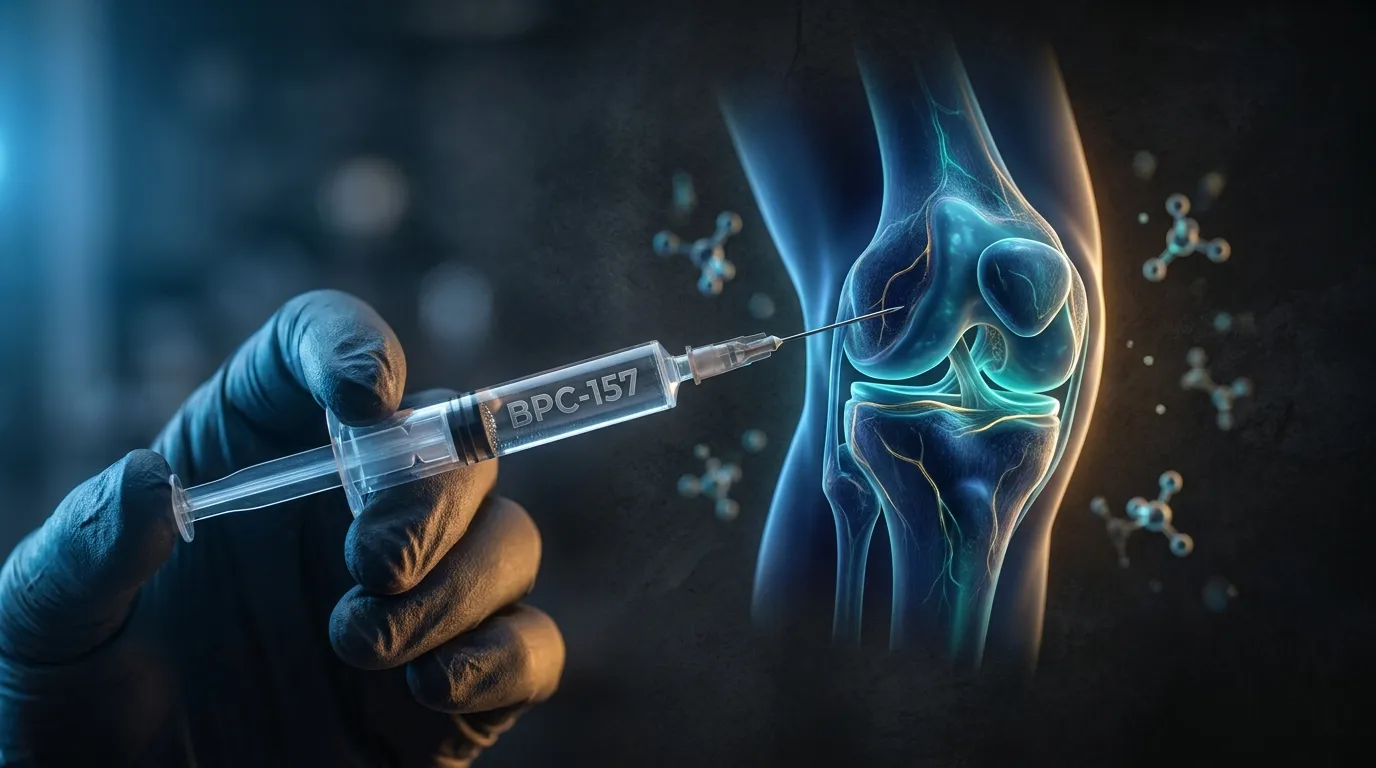
Peptides for knee cartilage repair are injected signalling molecules that act on repair. In the one human case series, 14 of 16 knee pain patients got relief after BPC-157 shots into the knee. Four also had thymosin beta-4, the protein TB-500 comes from. That is 87.5%, uncontrolled, and far short of proof. No study has set a knee dose.
Knee osteoarthritis (OA) is a condition that wears the joint down over time, and no drug yet slows the disease itself. Liao et al. 2024. Cartilage has no blood supply of its own. That is the whole of the problem in one line.
The usual toolkit has limits. Common OA medicines carry safety concerns. Liao et al. 2024. Repeated corticosteroid shots speed up cartilage loss. McAlindon et al. 2017. In one trial, shots of hyaluronic acid (a natural part of the cartilage matrix) and platelet-rich plasma (PRP) improved pain and function for three months. In the hyaluronic acid group, the drop in pain at rest did not last to three months. Kesiktas et al. 2020.
Peptide therapy is not a cure. It draws interest for what it does in lab and animal work. BPC-157, TB-500 and GHK-Cu each act on parts of repair. Those parts are new blood vessel growth, the activation of fibroblasts (the cells that make collagen) and remodelling of the extracellular matrix (ECM). The ECM is the scaffolding that holds cells in place. Rahman et al. 2026.
This guide covers how they work, the doses sites report, the risks, the rules as of September 2026, and the honest limits of the evidence. None of this is medical advice. These compounds are intended for research use. Always work with a qualified clinician before making changes to your health protocol.
Why Is Knee Cartilage So Hard to Repair?
Joint cartilage is avascular. It has no blood vessels at all. That one word sets up the rest of this page.
The synovium, the joint's lining, has a rich blood supply and brings it nutrients instead. Synovial fluid, the slippery fluid inside the joint, keeps it moving smoothly and carries nutrients. Hakim et al. 2026. Chondrocytes, the only cells living in cartilage, are sparse and sit deep in a dense matrix.
In OA, signals that inflame and break down tissue rise while repair signals fall. So the cartilage matrix breaks down and chondrocytes stop working well. The inflamed synovium drives pain. The bone beneath the cartilage and other parts of the joint play a part too. Hakim et al. 2026 call OA a whole-joint disease, driven by several tissues at once. They argue that treatments should reach cartilage, synovium and the bone beneath it.
That is why a shot into the joint is worth a look.
How the three compounds work
BPC-157 (Body Protection Compound-157) is a lab-made chain of 15 amino acids, the building blocks of protein. Its sequence comes from human gastric juice. Its animal record covers tendon, ligament, muscle, gut and bone.
In animal studies it works four ways. It raises vascular endothelial growth factor (VEGF), which grows new blood vessels. It switches on fibroblasts and the making of collagen, the base of matrix repair. It raises growth hormone receptor levels. And it shifts nitric oxide pathways. Nitric oxide is a small gas molecule that cells use as a signal. Cushman et al. 2024. Yuan et al. 2026 review the vessel, collagen and nitric oxide effects. They call the animal safety data favourable and the human research limited to small pilot studies, early tests in a handful of people.
A narrative review backs three of those routes: blood vessel growth, fibroblast activity and nitric oxide. It found only three small human pilot studies, with no adverse effects reported. McGuire et al. 2025.
TB-500 is a synthetic piece of thymosin beta-4. That protein steers actin, the protein a cell uses to move, and drives tissue repair. Its active piece helps build actin strands and helps cells move. It also draws in progenitor cells, early cells that can turn into tissue cells. Rahman et al. 2026. After an injury, thymosin beta-4 promotes new blood vessel growth, calms inflammation and blocks cell death (apoptosis). Peng 2026.
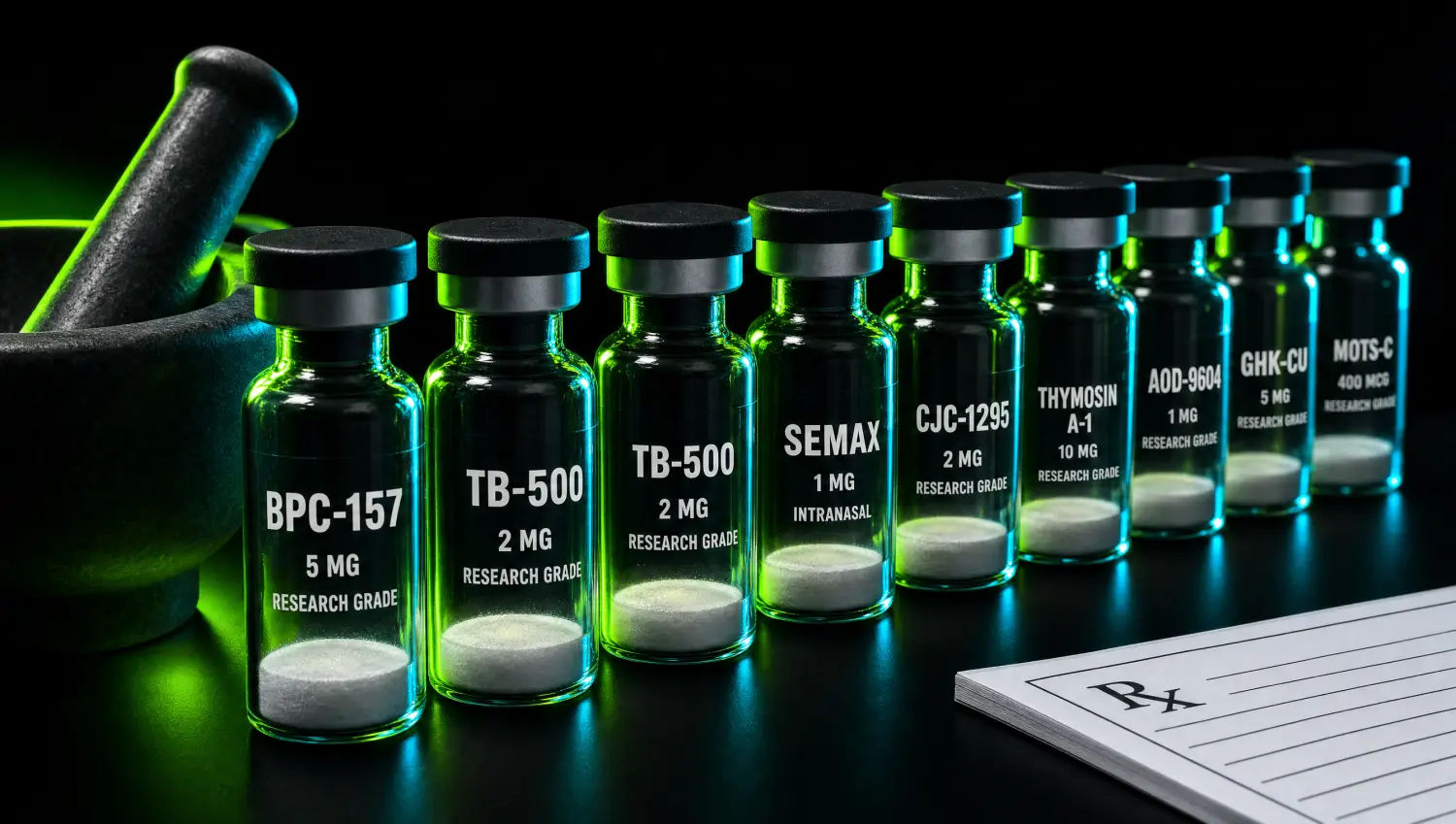
Clinics sell the pair as the "Wolverine stack", named after the Marvel character who heals fast. Perfectb 2024. No controlled trial has tested the two together. Mavrych et al. 2026. Our guide to the stack walks through the pairing.
GHK-Cu (glycyl-L-histidyl-L-lysine copper complex) is a tripeptide, a chain of just three amino acids, bound to copper. Its level in the body falls a lot with age. The cited review puts its level in serum, the clear liquid part of the blood, at about 200 ng/mL at age 20. That unit means nanograms, or billionths of a gram, in each millilitre. They fall to around 80 ng/mL by age 60. Cushman et al. 2024. That fall tracks with a weaker ability to repair many tissues.
The same peptide grows blood vessels and nerves. It raises the making of collagen, elastin and glycosaminoglycans (long sugar chains in the tissue matrix). It helps fibroblasts in the skin do their work. Pickart and Margolina 2018. It also adjusts matrix metalloproteinases (MMPs), the enzymes that break down the matrix, and their blockers. So it drives both the build-up and the breakdown of collagen. It raises two of those long sugar chains, dermatan sulphate and chondroitin sulphate. It also raises decorin, a small protein with sugar chains attached. Pickart et al. 2015. A review of tripeptides in wound healing agrees on the matrix point. Adnan et al. 2025. More sits in our GHK-Cu guide.
What Human Evidence Supports Peptides for Knee Cartilage Repair?
Less than the internet suggests. Here is all of it. Read it and judge for yourself.
The best knee data is a case series from 2021, a report on one group of treated patients. It followed 16 patients with knee pain of several kinds. Twelve had BPC-157 shots into the knee, and 11 of them got relief. The other 4 also had thymosin beta-4 (TB4). Three of those 4 got relief. In all, 14 of 16 patients (87.5%) got relief. Lee and Padgett 2021.
The honest read is less flattering. This was small and retrospective, meaning it looked back at past records. It was also uncontrolled, with no comparison group. Pain was rated by phone, with no standard scoring tool. Lee and Padgett 2021. A 2026 review says its flaws and lack of controls limit how far it can be trusted. Mayfield et al. 2026.
One randomised study is stronger. It tested a peptide shot into the knee against hyaluronic acid and PRP, in 54 patients with knee OA. The peptide product, Prostrolane, is 1.5% sodium hyaluronate (a form of hyaluronic acid) plus five short peptides. So the peptide group also got hyaluronic acid. WOMAC pain scores were significantly better in the peptide group at three months. WOMAC is a standard questionnaire on knee pain, stiffness and function. Kesiktas et al. 2020. Prostrolane is made of different ingredients from BPC-157, so its result does not carry over.
TB-500 has no human safety or outcome data. FDA says it has not found any human exposure data for TB-500. FDA 2026. A phase I study is a first small safety test in people. One tested a different molecule, the full protein thymosin beta-4, made in the lab and given into a vein. It ran in 84 healthy volunteers and found no side effects bad enough to stop raising the dose, and no serious adverse events. Wang et al. 2021, Peng 2026. Good tolerance is not proof it works, and it tells us little about TB-500. No published study has tested TB-500 in human bones, joints or tendons as of this writing. Our TB-500 guide covers what the animal work does show.
GHK-Cu sits further back again. On the skin, reviews by the scientist who first described it report no safety problems in cosmetic use or in human wound healing studies. Pickart et al. 2015. Shots into the joint have only been tested in animals so far. The review cites one study of shots into the joint, in a rodent (mouse) model after ACL (knee ligament) surgery. GHK-Cu shots made the graft stiffer and the knee less loose than saline (salt water). The gains faded once the shots stopped, and graft strength and the way the mice walked did not improve. No published study has tested it in human joints with OA. Cushman et al. 2024.
One thing does count in favour. Researchers are designing lab-made peptides to help cartilage regrow, and testing them in the lab and in animals. Liao et al. 2024. That is early-stage work, and a reason to keep looking.
Do Collagen Peptides for Knee Cartilage Work?
Collagen peptides for knee cartilage are a different product. You take them by mouth. Know which one you are being sold.
Cushman et al. reviewed oral collagen next to the injected peptides. Native collagen-2 is an unprocessed form of type 2 collagen. In one osteoarthritis trial, taking it by mouth with paracetamol improved pain, function and quality of life from the start. It did not lower urine markers of cartilage breakdown. So the only proven benefit is symptom relief. Oral peptides also struggle to reach the joint, because cartilage has no blood supply. Cushman et al. 2024.
Treat the two as separate choices.
What Doses Are Reported for Peptides for Knee Cartilage Repair?
The figures below come from dose-protocol sites, a clinic and one animal study. No trial has set a dose. A 2026 review for orthopaedic doctors says the dose, how often and for how long are still unknown. Mayfield et al. 2026. It is not a prescription. Dosing must be individualised by a qualified clinician, based on your diagnosis, OA grade, imaging and health history. Always work with a qualified clinician before making changes to your health protocol.
Under the skin, at home, physician supervised
Peptide Guides gives a BPC-157 starting dose of 250 mcg (micrograms) once a day. Its range is 250 to 500 mcg a day. Peptide Guides 2026. Alpha Rejuvenation, a clinic, puts tissue repair doses at 250 to 300 mcg a day, and up to 500 mcg a day for acute injuries. Alpha Rejuvenation 2025.
The clinic's standard cycle is 6 to 8 weeks on, then 2 to 4 weeks off. Alpha Rejuvenation 2025. No study has tested a TB-500 dose in people. GHK-Cu can go on the skin over the joint as a cream, which has a clean safety record on skin. Pickart et al. 2015. But no clinical data support it for joint problems. Mayfield et al. 2026. Injected GHK-Cu is another matter. FDA lists it with the withdrawn Category 2 nominations and warns it may trigger an immune reaction. FDA 2026.
Into the joint
A shot into the joint puts more of the dose where the problem is. It also means less exposure for the rest of the body. Hakim et al. 2026. The knee case series used BPC-157, with thymosin beta-4 as well in 4 of its 16 patients, and its published summary gives no doses. Lee and Padgett 2021.
Any injection carries a risk of infection, and getting the needle in the right place matters. Cushman et al. 2024.
The table below is a general reference framework only. Dosing must be individualised by a qualified clinician.
| Compound | Route | Reported dose range | Frequency | Evidence grade |
|---|---|---|---|---|
| BPC-157 | Under the skin | 250 to 500 mcg a day | Once daily | Protocol sites and a clinic; no trial |
| BPC-157 | Into the joint | Not reported | Not established | Case series, 16 patients |
| TB-500 | Under the skin | No tested dose | Not established | No human exposure data (FDA) |
| Thymosin beta-4 (TB4) | Into the joint | Not reported | With BPC-157 | Case series, 4 of 16 patients |
| GHK-Cu | On the skin | Skincare products | Not established | Skin and wound healing only; no joint data |
| GHK-Cu | Into the joint | Animal study only | Not established | One rodent (mouse) study |
| AOD-9604 | Into the joint | 0.25 mg plus hyaluronic acid, in rabbits | Weekly, rabbit model | Animal study only |
Who Should Not Have These Injections, and Where Do They Come From?
This is not a protocol for everyone. No guideline yet says who should avoid these shots, because what they should be used for, and at what dose, is still unknown. Mayfield et al. 2026. A clinician must weigh your case before any injection is considered.
What the sources flag
- Infection. Any injection carries a risk of infection. Cushman et al. 2024.
- Tumour growth, in theory. BPC-157 helps grow new blood vessels. One review flags a theoretical risk that pentadecapeptide arginate, a stabilised form of BPC-157, could feed abnormal (dysplastic) tissue this way. It calls the risk speculative, since the compound also slowed tumour growth in some cell studies. Rahman et al. 2026.
- Immune reactions. FDA warns that BPC-157, TB-500, AOD-9604 and injected GHK-Cu made by a pharmacy may trigger an immune reaction by some routes. FDA 2026.
Rules and sourcing in 2026
The rules moved this year. Here is where they stand now. BPC-157, TB-500, injectable GHK-Cu and AOD-9604 sat under FDA Category 2, its list of ingredients that may carry serious safety risks. That limited what compounding pharmacies, which make up medicines to order, could do. FDA now lists all four as withdrawn nominations, meaning the requests to add them were pulled. It calls them previously in Category 2. FDA 2026. Leaving that list does not make a peptide lawful to compound. Under section 503A of US drug law, a pharmacy may use a raw drug ingredient only if it meets one of three tests. It has a USP monograph (an official quality standard), it is part of an FDA-approved drug, or it is on FDA's 503A bulks list. 21 USC 353a. BPC-157 and TB-500 have no such monograph and are part of no approved drug. FDA slides 2026. Neither is on the bulks list. 21 CFR 216.23. So no US pharmacy may lawfully make BPC-157 or TB-500. FDA's advisers reviewed both for that list in July 2026, but advisers only make recommendations that FDA does not have to follow. FDA meeting 2026.
Adding either peptide to that list would take a formal FDA rule (a regulation). 21 USC 353a. None of these compounds is an FDA-approved drug for any use. Physician evaluation, appropriate diagnostics and ongoing monitoring remain firm requirements.
Sourcing is the bigger worry. Gray-market vendors trading under "research use only" labels do not meet drug manufacturing standards. The risks are toxic solvent residues, mislabelling, bacterial contamination and sterility failures. SDOMG 2026. A prescription does not change that, because no US pharmacy may lawfully make BPC-157 or TB-500.
The supplier matters as much as the dose here. We only list sources that publish an independent, per-batch certificate of analysis. See the ones that clear it.
What Does the Evidence Not Support?
Everything above has a ceiling. Here it is, stated plainly. None of it is a reason to stop reading.
No high-quality randomised controlled trial has tested BPC-157 or TB-500 specifically for knee OA in humans. The one case series had no control group and used no standard scoring tool. Mayfield et al. 2026.
BPC-157 does not appear on any current FDA-approved drug list for any indication. Any use outside a physician-supervised research setting carries regulatory and safety risk. Our BPC-157 guide sets out the full compound picture.
AOD-9604 gets added to knee OA protocols to protect cartilage. A clinic blog pitches it that way, and notes that clinical data are still thin. Refresh Dubai 2026. The main study was in 32 rabbits, with knee damage set off by an enzyme. Weekly AOD-9604 shots into the knee, with or without hyaluronic acid, left less cartilage damage than saline. The pair worked best. Kwon and Park 2015. No study shows it rebuilds a human knee that has already lost its cartilage.
Standard treatments have randomised trials behind them, and these peptides mostly do not. Two examples follow. Repeated corticosteroid shots speed up cartilage loss. A 2017 trial gave 40 mg of triamcinolone, a corticosteroid, into the knee every 12 weeks for two years. It found significantly greater cartilage loss than saline, and no difference in knee pain. McAlindon et al. 2017. In the randomised trial above, the hyaluronic acid and PRP groups also improved on WOMAC scores, and the gains held at three months. Pain on movement stayed lower in both groups, while pain at rest held only with PRP. Kesiktas et al. 2020.
If you are still considering this
Here is what the sources above report on doing this well, point by point.
First, imaging. The case series authors call for future studies with follow-up MRI scans to show any benefit. Lee and Padgett 2021. Second, the doctor. A 2026 review tells orthopaedic doctors that what to use them for, the doses and the length of treatment are still unknown. Mayfield et al. 2026.
Third, placement. In the rabbit study of AOD-9604, ultrasound guided each shot into the knee. Kwon and Park 2015. Fourth, supply. No US pharmacy may lawfully make BPC-157 or TB-500. Fifth, measuring results. The randomised trial scored pain with WOMAC and with VAS, a line on which patients mark how bad the pain is. It checked at one week, one month and three months. Kesiktas et al. 2020. The case series used no standard scoring tool. Lee and Padgett 2021.
Bibliography
- Yuan C, Demers A, et al. From Regeneration to Analgesia: The Role of BPC-157 in Tissue Repair and Pain Management. Int J Mol Sci. 2026.
- Lee E, Padgett B. Intra-Articular Injection of BPC 157 for Multiple Types of Knee Pain. Altern Ther Health Med. 2021.
- Liao HJ, Chen HT, Chang CH. Peptides for Targeting Chondrogenic Induction and Cartilage Regeneration in Osteoarthritis. Cartilage. 2024.
- Rahman OF, Lee SJ, Seeds WA. Therapeutic Peptides in Orthopaedics: Applications, Challenges, and Future Directions. J Am Acad Orthop Surg Glob Res Rev. 2026.
- Pickart L, Margolina A. Regenerative and Protective Actions of the GHK-Cu Peptide in the Light of the New Gene Data. Int J Mol Sci. 2018.
- Pickart L, Vasquez-Soltero JM, Margolina A. GHK Peptide as a Natural Modulator of Multiple Cellular Pathways in Skin Regeneration. Biomed Res Int. 2015.
- Adnan SB, et al. Exploring the Role of Tripeptides in Wound Healing and Skin Regeneration. Int J Med Sci. 2025.
- Kwon DR, Park GY. Effect of Intra-articular Injection of AOD9604 with or without Hyaluronic Acid in Rabbit Osteoarthritis Model. Ann Clin Lab Sci. 2015.
- Cushman CJ, Ibrahim AF, et al. Local and Systemic Peptide Therapies for Soft Tissue Regeneration. Yale J Biol Med. 2024.
- Mavrych V, Shypilova I, et al. Therapeutic peptides in gerontology: mechanisms and applications for healthy aging. Front Aging. 2026.
- FDA. Certain Bulk Drug Substances for Use in Compounding that May Present Significant Safety Risks. 2026.
- 21 USC 353a. Pharmacy compounding. Federal Food, Drug, and Cosmetic Act, section 503A.
- FDA. July 23, 2026 Meeting of the Pharmacy Compounding Advisory Committee: FDA Presentations. 2026.
- 21 CFR 216.23. Bulk drug substances that can be used to compound drug products in accordance with section 503A of the Federal Food, Drug, and Cosmetic Act.
- FDA. July 23-24, 2026: Meeting of the Pharmacy Compounding Advisory Committee. 2026.
- Mayfield CK, Bolia IK, et al. Injectable Peptide Therapy: A Primer for Orthopaedic and Sports Medicine Physicians. Am J Sports Med. 2026.
- Kesiktas FN, Dernek B, et al. Comparison of the short-term results of single-dose intra-articular peptide with hyaluronic acid and platelet-rich plasma injections in knee osteoarthritis: a randomized study. Clin Rheumatol. 2020.
- McGuire FP, Martinez R, et al. Regeneration or Risk? A Narrative Review of BPC-157 for Musculoskeletal Healing. Curr Rev Musculoskelet Med. 2025.
- Hakim B, Zhang H, et al. Peptide-based targeted drug delivery strategies for osteoarthritis treatment. npj Biomed Innov. 2026.
- Wang X, Liu L, et al. A first-in-human, randomized, double-blind, single- and multiple-dose, phase I study of recombinant human thymosin β4 in healthy Chinese volunteers. J Cell Mol Med. 2021.
- McAlindon TE, LaValley MP, et al. Effect of Intra-articular Triamcinolone vs Saline on Knee Cartilage Volume and Pain in Patients With Knee Osteoarthritis: A Randomized Clinical Trial. JAMA. 2017.
- SDOMG. BPC-157: What It Is, What We Know, and Why Its Use for Arthritis Remains Unproven. 2026.
- Peng J. TB-500 for Injury Recovery: What the Research Actually Shows. 2026.
- Perfectb. Wolverine Peptide: BPC-157 and TB-500. 2024.
- Peptide Guides. BPC-157 Protocol. 2026.
- Alpha Rejuvenation. BPC-157 Dosage Guide. 2025.
- Refresh Dubai. AOD-9604 and Osteoarthritis: What Modern Experimental Studies Show. 2026.
This content is for educational purposes only. These compounds are intended for research use. Nothing here is medical advice. Always work with a qualified clinician before making changes to your health protocol.
Where to buy BPC-157 and TB-500
The hard part with BPC-157 and TB-500 isn't the protocol. It's finding a supplier that can prove what's in the vial. We assessed dozens against per-batch, third-party testing. A handful passed.
See the sources that passed →Where to buy BPC-157 and TB-500
The hard part with BPC-157 and TB-500 isn't the protocol. It's finding a supplier that can prove what's in the vial. We assessed dozens against per-batch, third-party testing. A handful passed.
See the sources that passed →Share this article
Frequently Asked Questions
What is the mechanism of action for BPC-157 in cartilage repair?
How does TB-500 differ from BPC-157 for knee cartilage repair?
What is the documented dosing for peptide knee injections?
What are the contraindications for peptide injections into the knee?
Is GHK-Cu safe and evidence-based for injection into the knee?
What is the regulatory status of BPC-157 and TB-500 for knee osteoarthritis?
Read Next

Disclaimer: This content is for educational purposes only. These compounds are intended for research use. Nothing here is medical advice. Always work with a qualified clinician before making changes to your health protocol.