
Peptide Dosage Chart: Why Most Advice Gets It Wrong

What Determines Your Peptide Dosage?
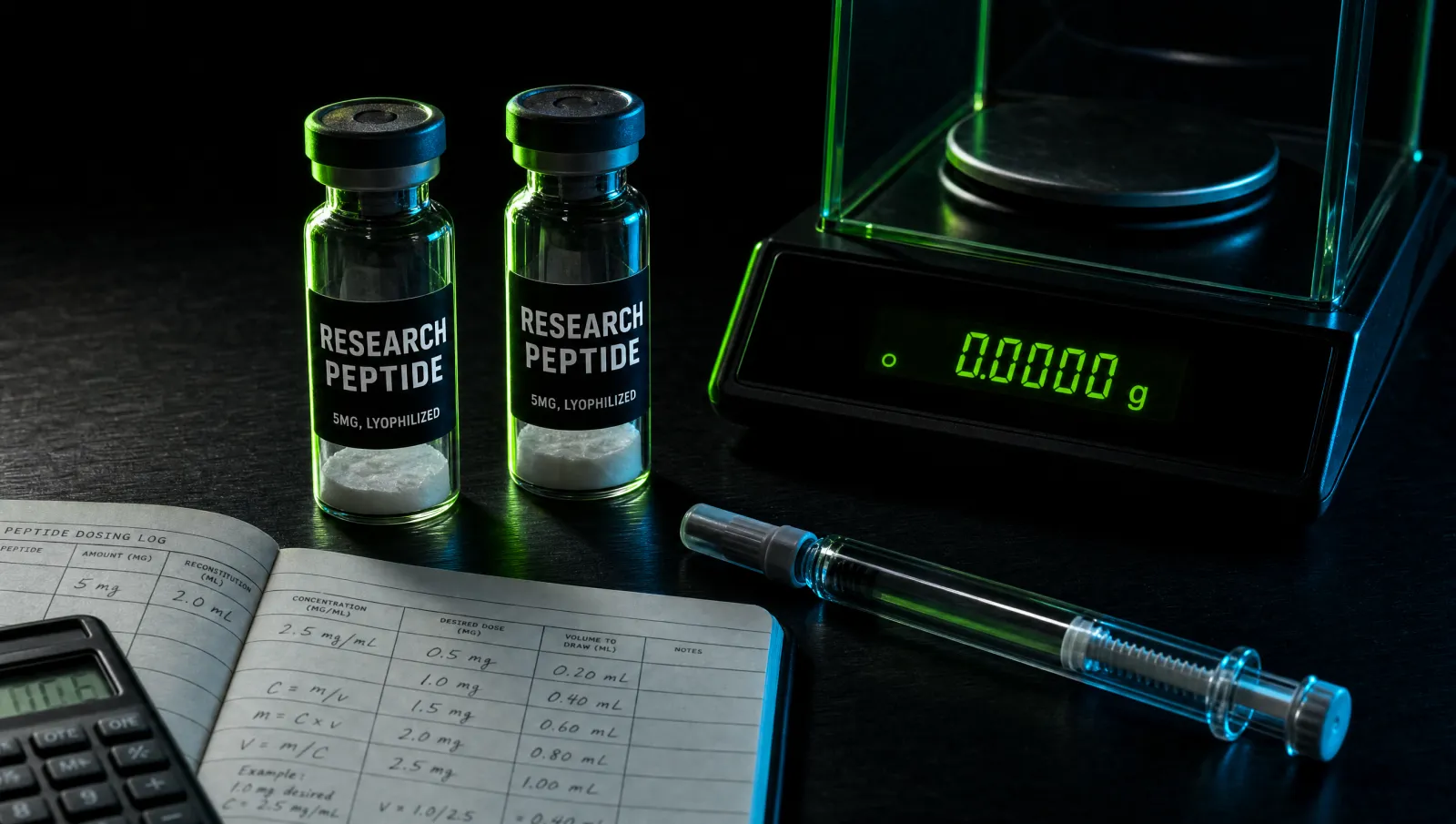
A peptide dosage chart starts with four things, in order. The compound, since doses range from micrograms to milligrams. Its half-life, which sets how often you dose, not how much. How you mixed it, which sets what each draw contains. And whether the vial matches its label, which decides if the rest matters.
Most dosing advice skips straight to a number. That number is the last step, not the first. A chart with no arithmetic behind it is asking you to trust a stranger's guesswork.
This content is for educational purposes only. These compounds are intended for research use. Nothing here is medical advice, and any decision about a protocol should involve a qualified clinician.
What Does This Peptide Dosage Chart Show You?
Here is every compound we publish, with its commonly cited dose.
| Compound | Commonly cited dose | Route |
|---|---|---|
| BPC-157 | 250-500mcg per day, split into 1-2 doses | Subcutaneous, oral capsules |
| TB-500 | 2-2.5mg twice weekly loading, 2-2.5mg once weekly maintenance | Subcutaneous or intramuscular |
| GHK-Cu | 1-2mg per injection, 2-3 times per week | Subcutaneous, topical serum |
| CJC-1295 | 100-300mcg per injection, 1-3 times weekly with DAC, daily without | Subcutaneous |
| Ipamorelin | 200-300mcg per injection, 2-3 times per day | Subcutaneous |
| MOTS-c | 5-10mg per injection, 2-3 times per week | Subcutaneous or intramuscular |
| KPV | 200-500mcg per dose, 1-2 times daily | Oral capsules, subcutaneous |
| Thymosin Alpha-1 | 1.6mg twice weekly clinically, 800mcg-1.6mg 2-3 times weekly in research | Subcutaneous |
| Semax | 200-600mcg per day, split into 2-3 doses | Intranasal |
| Selank | 250-500mcg per day | Intranasal |
| DSIP | 100-300mcg per dose, 30 minutes before sleep | Subcutaneous, intranasal |
| AOD-9604 | 300mcg once daily | Subcutaneous |
| Kisspeptin-10 | 25-100mcg per injection, 1-3 times per week | Subcutaneous |
| Dihexa | 8-15mg per day, limited human protocols | Oral capsules, transdermal cream |
Read this as a starting point, not a prescription. Each compound has its own page with the evidence behind its figure. These protocol articles go further still: BPC-157 dosing, TB-500 dosage, MOTS-c, ipamorelin, CJC-1295 with and without DAC, thymosin alpha-1, tesamorelin, retatrutide titration and AOD-9604.
Why Isn't There a Peptide Dosage Calculator?
There is no calculator here. That is deliberate.
A calculator hides the one step that goes wrong. Your dose is not a property of the vial. It is a property of how much water you added. Get that wrong, and every number after it is wrong too.
Do the maths in two lines. Divide the milligrams in the vial by the millilitres of bacteriostatic water (the sterile mixing water) you added. That gives milligrams per millilitre. Then divide your target dose by that figure to get the volume to draw.
Add 2ml to a 5mg vial and each millilitre holds 2.5mg. Add 3ml to the same vial and each millilitre holds about 1.67mg. Same powder. Different dose in the same syringe marking.
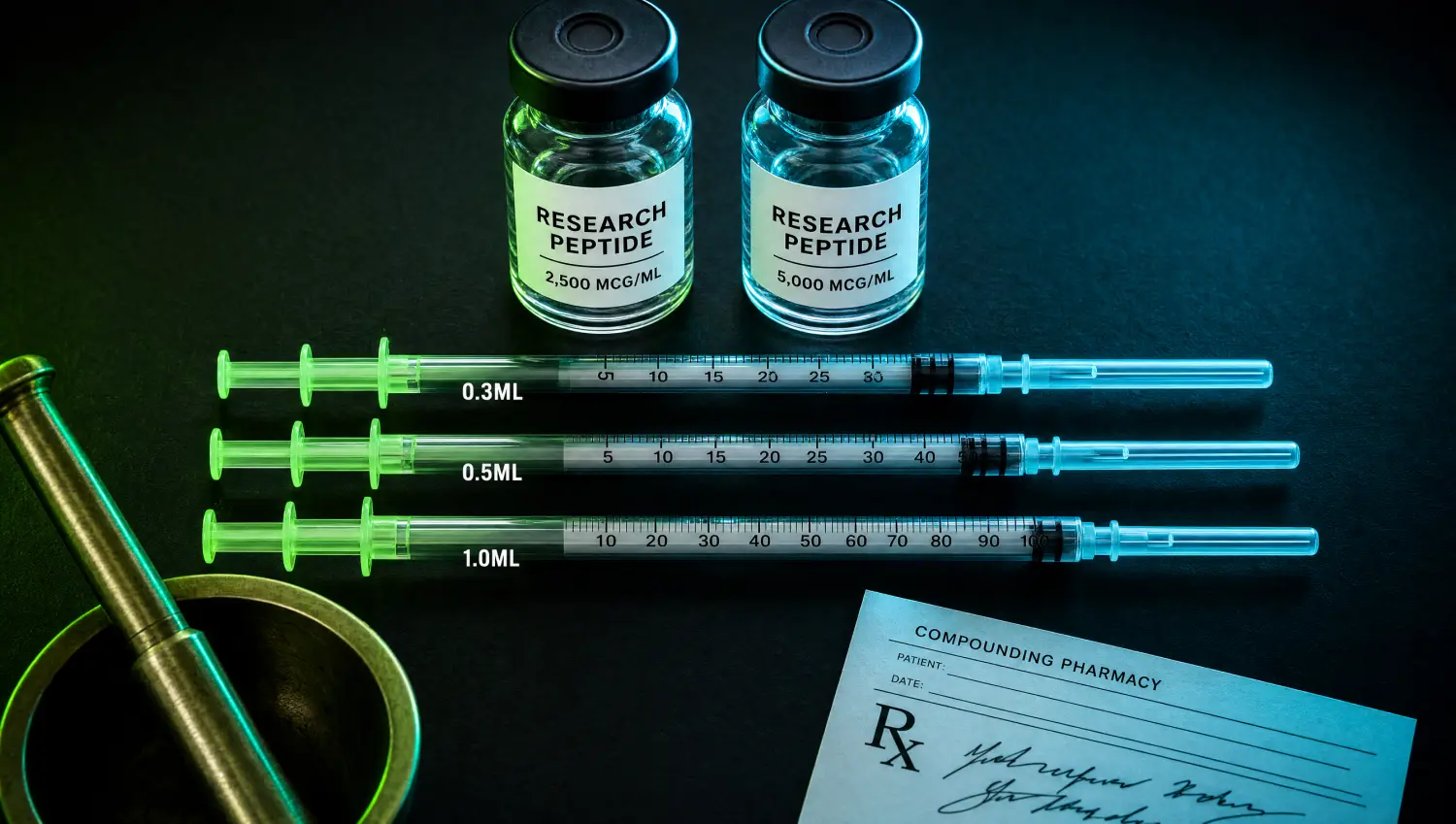
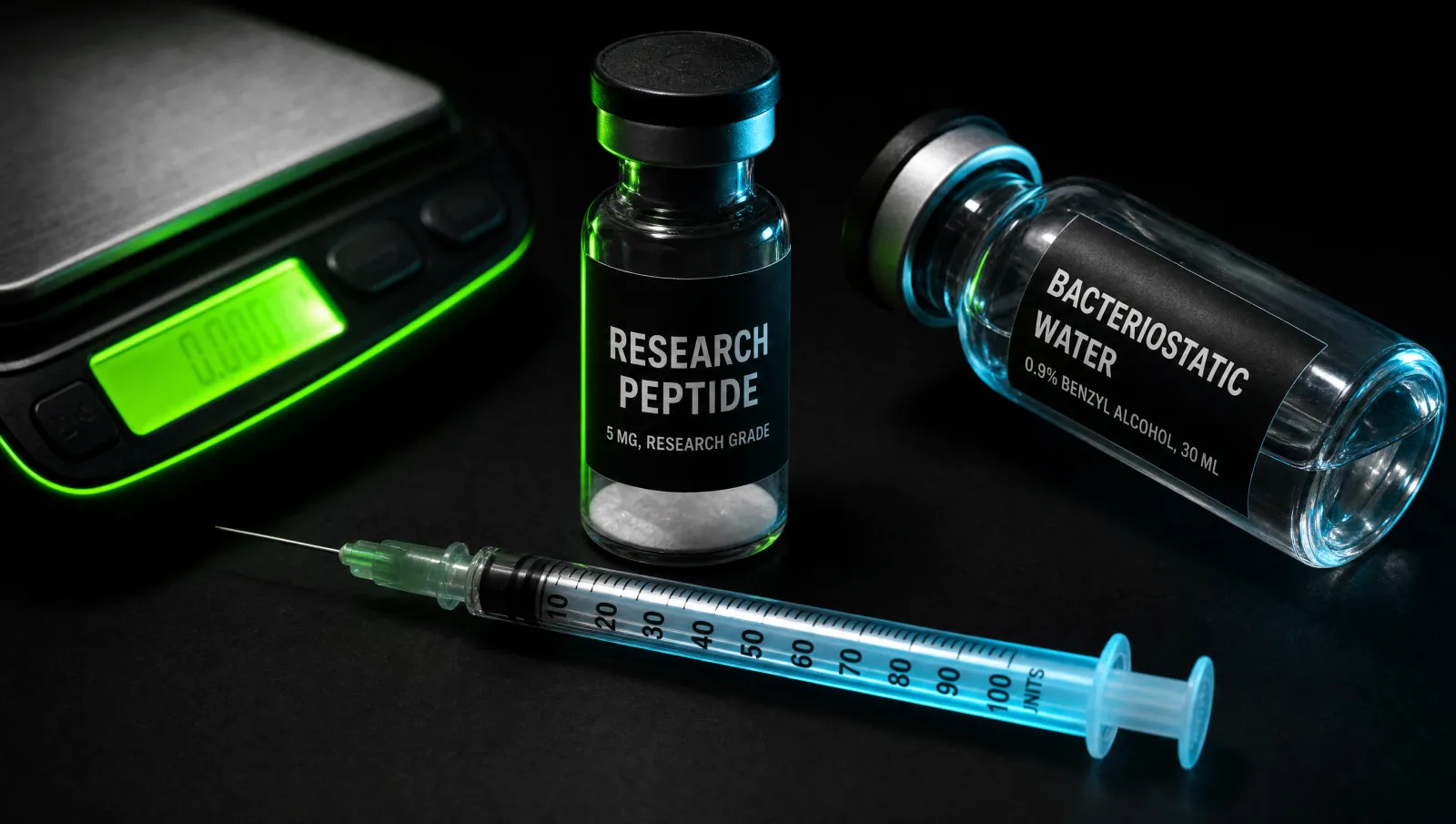
Our reconstitution chart lays out the common combinations. The microgram to syringe units chart converts your result into the marks on an insulin syringe. The full reconstitution walkthrough covers water choice, storage and stability.
What's on This Peptide Dosage Cheat Sheet?
Six rules are worth remembering before you dose anything.
- Frequency follows half-life. Size does not.
- Micrograms and milligrams are a thousand apart. Most serious dosing errors are a decimal place, not a judgement call.
- Reconstitution volume sets your dose. Write it on the vial.
- More is rarely better. Higher doses have not produced proportionally bigger effects in most of the animal work.
- A dose is only as real as the vial. Purity and content are different measurements.
- If a chart cites no source, it is someone's habit, not evidence.
Why Does the Vial Matter More Than the Chart?
Because it assumes the vial matches the label. A dosing schedule built on 5mg of BPC-157 does nothing useful if the vial holds 3mg of something else. Purity and net peptide content are measured differently, and a generic certificate usually reports only one.
A vial can show 99% purity and still be underdosed by a third. Purity describes how clean the peptide is, relative to itself. It says nothing about how much peptide is in there, against water, salts and counterions.
That gap is real, not theoretical. No production method yields only the target peptide. Chemical synthesis leaves truncated fragments and deletion sequences behind, from steps that did not fully complete. That is why preparative liquid chromatography is a standard purification step (De Luca et al. 2021). It separates the peptide you want from these production leftovers.
What's left over matters in your body, not just on paper. Regulatory researchers built a risk framework for exactly this question. It compares how impurities differ from the intended peptide, and how likely each difference is to trigger an immune response (Mattei 2025). Older work on therapeutic peptides reached a similar conclusion from a different angle. Unwanted immune responses are shaped heavily by what else is in the preparation (Wadhwa 2003).
So before you trust any number, ask for three things. A batch-specific certificate with HPLC purity above 98%. A mass spectrometry identity report. And a named lab you can check for ISO/IEC 17025 accreditation. Our guide to reading a peptide COA covers what a real one contains. Independent purity testing covers who does the testing.
How Does Half-Life Change Your Dosing Frequency?
This is the part most charts leave out.
Two products can carry nearly identical names and behave completely differently in your body. Chemical modification is why. A 2022 systematic review measured half-life extension across conjugation methods. It ranged from roughly 0.1 hours up to 33.57 hours, depending on the modification (Wijesinghe 2022).
That is a three hundred fold spread hiding behind a label. It is the difference between injecting twice a day and injecting twice a week. Fatty-acid conjugated and PEGylated versions need that modification confirmed by mass spectrometry, not assumed from the name on the vial. If you are copying a frequency from a forum post, you are assuming their vial and yours were modified the same way.
Where to source it
If you're researching how peptide dosing actually gets validated, I've linked a trusted source below. It supports the channel.
See the sources that passed →How Do You Verify a Peptide Before You Dose It?
Treat verification as step one, not an afterthought.
Confirm the compound is what the label says, at the purity claimed, from a lab you can check independently. Two people running an identical schedule can get different outcomes. The reason often has nothing to do with pharmacokinetics (how your body processes the compound). One person is dosing a verified compound. The other is not. Our recommended sources page lists vendors who publish batch-level documentation, and the peptide purity crisis article covers the structural side of the problem.
Share this article
Frequently Asked Questions
What purity percentage should a peptide COA show?
Can you tell a fake or underdosed peptide just by looking at it?
What is the difference between purity and net peptide content?
How do I know if a testing lab on a COA is legitimate?
Why does sourcing matter more than dosing calculations?
Read Next
Disclaimer: This content is for educational purposes only. These compounds are intended for research use. Nothing here is medical advice. Always work with a qualified clinician before making changes to your health protocol.