
The Peptide Purity Crisis Nobody Talks About

What Is the Peptide Purity Crisis?
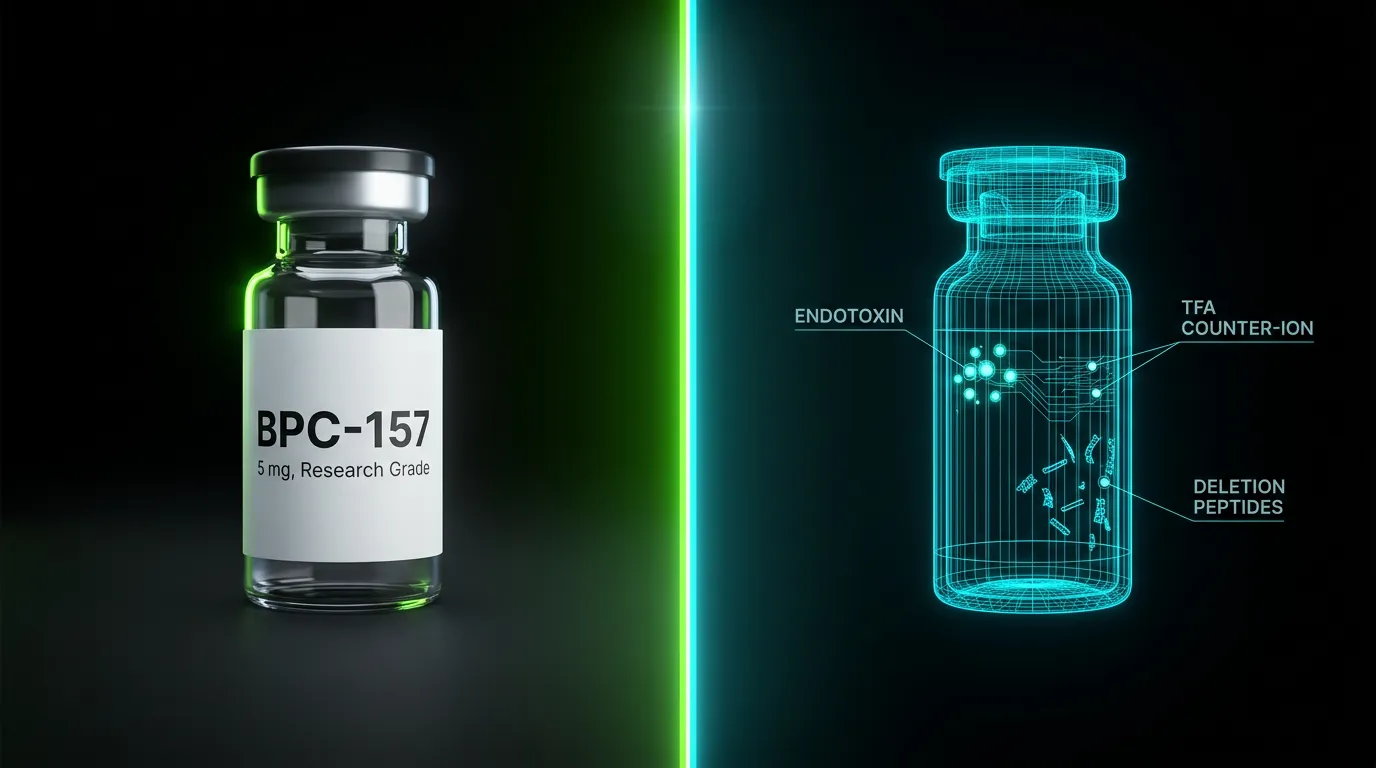
The peptide purity crisis is systemic. Most research vials pass 98% HPLC purity and still carry undetected endotoxins, TFA counter-ions and synthesis byproducts. Fewer than 1 in 10 suppliers publish a batch LAL endotoxin result. That leaves the checking to the researcher placing the order.
The number on a Certificate of Analysis is not the whole story. HPLC purity tells you one thing. It says what share of the material it can see matches the target sequence. It says nothing about bacterial endotoxins. It says nothing about TFA counter-ions, truncated deletion sequences, or the room the batch was made in.
This is not a fringe worry. It is built into how the peptide supply chain works. Men source BPC-157, TB-500, GHK-Cu or CJC-1295 for serious research. They are routinely buying material that would fail a drug release test. This piece is about why that matters, and what to do about it.
This post is for educational purposes. These compounds are intended for research use. Nothing here is medical advice.
Why Does an HPLC Purity Number Not Tell the Full Story?
HPLC cannot see everything in the vial.
High-performance liquid chromatography splits a sample into its parts. It then measures the UV light each part absorbs. It is good at one job. It reports how much of the sample is the peptide you asked for. Here is what it cannot do.
- See endotoxins, which barely absorb UV at the usual wavelengths.
- Spot counter-ions such as trifluoroacetate, which leave the column with the parent peak.
- Tell the target sequence from a deletion peptide missing one amino acid.
- Confirm sterility, or rule out microbial contamination.
Work catalogued by USP says the same. McCarthy et al. 2023 treat three things as separate questions. They are primary sequence, oligomer and aggregation state, and impurity profile. Each one needs its own test. A single HPLC trace folds all of that into one number.
So "98% purity" on a COA describes one slice of quality. The parts that matter most for dirt in the vial are not reported at all.
What Is Actually in the Vial Besides the Peptide?
Solid-phase peptide synthesis makes a known family of byproducts. It makes them at every coupling step. The lower the purity, the messier that mix becomes.
A peptide is built one amino acid at a time. Each residue is coupled, deprotected and checked before the next goes on. Coupling that does not finish leaves deletion peptides. Deprotection that does not finish leaves changed residues. Racemisation at weak spots makes mirror-image twins, called diastereomers, that behave differently in the body.
D'Hondt et al. 2014 set out a full list of these synthesis impurities in peptide medicines.
- Deletion peptides: sequences missing one or more inner amino acids.
- Truncated peptides: chains that stopped growing early.
- Insertion peptides: sequences with a spare residue from a double coupling.
- Diketopiperazine (DKP): a small ring byproduct formed at some N-terminal sequences.
- Beta-elimination products: from serine, threonine and cysteine under basic deprotection.
- Succinimide formation: an aspartate and asparagine reshuffle that can alter receptor binding.
The same review notes something that matters in practice. Unrelated peptides were seen in the intended product. The authors read that as a lack of proper GMP, or good making practice. That is not one bad batch. It is what happens when peptides are made outside a checked system.
For a researcher this becomes a repeatability problem. Take two vials both labelled 80% pure. Same supplier, six months apart. They can carry quite different junk. The other 20% is not a fixed recipe. This is why serious groups refuse to work below 98% HPLC. They also ask for mass spectrometry proof of the sequence.
What Is the TFA Counter-Ion Problem Nobody Labels?
Trifluoroacetic acid, or TFA, is a standard reagent in solid-phase synthesis. It is used again in reverse-phase clean-up. Left-over TFA binds tightly to the peptide as a counter-ion. Standard lyophilisation, meaning freeze-drying, does not fully remove it. Some peptides carry a positive charge and no basic residue at the N-terminus. In those, the bound mass is not trivial. It bears on dosing in a tight dose-response window.
This is one of the least discussed quality issues in the research peptide space. Part of a vial's stated weight may be bound TFA, not active peptide. The real peptide content is then lower than the label states.
Roux et al. 2008 tested three ways to swap that counter-ion out. They used reverse-phase HPLC, an ion-exchange resin, and a deprotonation and reprotonation cycle. They ran the work for a reason. Bound TFA gets in the way of physical and chemical read-outs. It might also affect in vivo studies, meaning work in living animals. Their conclusion: TFA does not leave on its own, so a swap is often needed. That holds for reference-grade material too.
Some suppliers run an acetic acid swap, an ammonium bicarbonate swap, or an HCl swap. They usually say so on the COA. If the counter-ion is not listed, TFA is almost certainly there. Ask before you order.
Why Can HPLC Not See Endotoxin?
Endotoxins are fragments from the outer wall of gram-negative bacteria. They are lipopolysaccharides, or LPS. HPLC cannot see them. They are potent at nanogram amounts.
The LAL assay is short for Limulus Amebocyte Lysate. It uses a clotting protein from horseshoe crab blood. It reacts to endotoxin down to roughly 10^-12 grams per millilitre. That sensitivity exists for a reason. Nanogram amounts are enough to set off a body-wide inflammatory cascade.
Yu et al. 2019 call the LAL assay the golden method for drug quality control. They also name its limits. They describe newer nanomaterial sensors built for tighter checks. The point for researchers stands. This test is its own test. A clean 98% HPLC peak says nothing about whether the vial holds 10 EU/mg of LPS.
USP's own peptide standards page sets out written standards with proven test methods and pass marks. It also offers well-described impurity reference standards. USP says these tools help makers keep contaminants down.
So a supplier who cannot hand you a batch LAL result is telling you something. The test was never run. A COA with no endotoxin figure is an incomplete COA, whatever the HPLC number says.
How Does Research Grade Differ From Pharmaceutical Grade?
| Attribute | Research-Grade | Pharmaceutical-Grade |
|---|---|---|
| Facility registration | Not required | FDA-registered facility |
| Endotoxin testing | Rarely performed | LAL assay, batch-specific |
| Counter-ion documentation | Rarely disclosed | Documented on COA |
| Batch traceability | Inconsistent | Full batch records |
Both columns can print the same HPLC number. That is exactly the problem.
What is a reference standard for? McCarthy et al. say it settles identity, purity and strength. They name four traits as the ones that matter most. Those are primary sequence, secondary structure, oligomer and aggregation state, and impurities and breakdown products. Each calls for a proper test plan and real batch records.
Research-grade plants in China, India and Eastern Europe can hit impressive purity on the HPLC trace. What can be absent is all of the rest. No FDA site registration. No proven methods. No checks on the room for microbes. No staff qualification records. No batch release rules. The HPLC number is real. The setting that gives it meaning is not.
Some researchers source compounds such as Semax, MOTS-c or KPV. The biology there is sensitive and the dosing window can be narrow. This split matters. A deletion peptide at 2% may do nothing at all. An endotoxin load of 5 EU/mg will not.
What Is Light Contamination, and Why Does It Skew an Assay?
Light contamination is a quieter version of the same problem.
Labs use isotopically-labelled peptides as internal standards in proteomics. "Light" means the plain unlabelled version of the same sequence. A labelled standard may carry some of its own light twin. The calibration is then biased from the start. A few parts per million is enough to introduce systematic error.
Salek et al. 2022 report that this light contamination is frequent. It shows up in heavy labelled peptides of high isotopic enrichment. They tested peptides from several established commercial suppliers. Even analytical-grade material carried enough to spoil the numbers.
The mechanism is simple and often missed. Ong et al. 2002 introduced SILAC, the labelling method that made these standards routine. The standard may carry unlabelled cognates. If so, the error rides quietly through every figure drawn from it.
So chemical purity is not the same as fitness for an assay. A peptide that is 98% pure by HPLC can still bias a quantitative assay. This is why testing more than one way matters.
How Do You Evaluate a Peptide COA?
Here is what to look for, and what should make you pause.
What a legitimate COA contains:
- A unique batch or lot number traceable to one production run.
- A make date, plus an expiry or retest date.
- Amino acid sequence proof, not just molecular weight.
- An HPLC chromatogram with its integration data, not only a summary percentage.
- A mass spectrometry result matching the expected molecular weight.
- An LAL endotoxin result in EU/mg, with the method named.
- The counter-ion named, whether TFA content or a swapped ion type.
- A third-party lab signature or accreditation number where testing was external.
Red flags on a COA:
- No lot number, or one lot number across several compounds.
- Purity given as a percentage with no chromatogram behind it.
- No endotoxin result.
- No make date or test date.
- A mass spectrometry result with molecular weight but no isotope pattern.
- A certificate in one format across compounds from different makers.
Who did the testing matters too. A supplier testing its own product has an obvious conflict of interest. Third-party testing by an accredited lab is a real mark of quality. Better still if the raw data is there on request. Some suppliers add a QR-code to the vial that opens the outside lab report. That is the standard the serious end of the market is moving to. For a step-by-step walkthrough, see our guide on how to read a peptide COA and our roundup of reliable peptide sources.
What Should This Change in Your Research Protocol?
The answer is not to stop sourcing peptides. It is to source with proof.
A workable floor for serious research looks like this. 98% HPLC purity. Mass spectrometry proof of the sequence. A batch LAL endotoxin result. And a supplier who will talk openly about how the material is made.
Think of the compounds people order most. BPC-157, TB-500, GHK-Cu and CJC-1295 are all sold by suppliers who meet that floor. The price premium over unverified sources usually runs 20 to 40 percent. Set that against dosing an unknown mix of byproducts and possible endotoxin. On research integrity alone, the premium pays for itself. Want to see what a good protocol looks like once sourcing is sorted? Our BPC-157 dosing protocol breakdown is a useful next stop.
With BPC-157, the supplier matters as much as the dose. We only recommend sources that publish an independent, per-batch certificate of analysis. See our recommended sources for the vetting criteria we use.
Always work with a qualified clinician before making changes to your health protocol.
Why Does This Problem Persist?
The peptide research market sits in a gap in the rules.
Compounds sold for research use fall outside the FDA rules for making drugs. A seller can operate with no site registration, no cGMP compliance, and no proven quality system. Until the rules catch up, checking quality falls almost entirely to the researcher.
USP has been building reference standards for synthetic peptides for exactly this reason. McCarthy and colleagues describe how those standards are made and described. That gives a lab something trusted to test against. They exist because the market was shipping material without them.
The cross-border side makes it worse. Some peptides are made where drug oversight is light. They are then sold on through US or European channels as research compounds. Nobody at the making end carries a duty for that. The researcher is the last quality check in a chain that may have had none. For more on how the rules are shifting, see our coverage of the case for peptide regulation and what FDA reclassification actually means.
None of this argues against the research use of peptides. It argues for eyes-open sourcing and COA literacy. The number on the certificate begins the quality conversation. It does not end it.
Where to buy BPC-157
Research-grade BPC-157 verified by third-party HPLC testing. See our recommended sources for suppliers publishing current certificates of analysis.
See the sources that passed →References
- D'Hondt M et al. (2014). Related impurities in peptide medicines. Journal of Pharmaceutical and Biomedical Analysis.
- Salek M et al. (2022). Light contamination in stable isotope-labelled internal peptide standards is frequent and a potential source of false discovery and quantitation error in proteomics. Analytical and Bioanalytical Chemistry.
- McCarthy D et al. (2023). Reference Standards to Support Quality of Synthetic Peptide Therapeutics. Pharmaceutical Research.
- Yu N et al. (2019). Highly Sensitive Endotoxin Assay Combining Peptide/Graphene Oxide and DNA-Modified Gold Nanoparticles. ACS Omega.
- USP (2026). Peptide Standards | Biologics. United States Pharmacopeia.
- Ong SE et al. (2002). Stable isotope labeling by amino acids in cell culture (SILAC). Molecular and Cellular Proteomics.
- Roux S et al. (2008). Elimination and exchange of trifluoroacetate counter-ion from cationic peptides. Journal of Peptide Science.
Share this article
Frequently Asked Questions
Does a 98% HPLC purity number mean a peptide is safe to use in research?
How do I know if a peptide supplier tests for endotoxins?
What is the difference between research-grade and pharmaceutical-grade peptides?
Is TFA contamination in research peptides something to worry about?
Why do two vials of the same peptide from the same supplier sometimes behave differently?
What should a complete peptide COA show?
Read Next
Disclaimer: This content is for educational purposes only. These compounds are intended for research use. Nothing here is medical advice. Always work with a qualified clinician before making changes to your health protocol.