
Reliable Peptide Sources: How We Choose Who Makes the List


How Do You Find Reliable Peptide Sources in 2026?
To find reliable peptide sources, start with the law, then the lab. None of the restricted peptides on this page can be lawfully compounded (pharmacy-made) today. So every source you find sits outside the pharmacy system. That makes independent batch testing your only real check. Read the certificate, read the vendor's enforcement record, and doubt any legal claim.
Reliability is not a feeling about a brand. It is a short list of published criteria, and you can check every one of them from your side of the transaction. Batch testing data. Enforcement history. Honest language about what the compound is, and about who is banned from touching it. Nothing here is regulated the way a pharmacy shelf is, so those criteria are all you get. Applied properly, they are enough.
The rest of this page builds that standard in order. What the law actually says after the July vote. What independent testing has measured in real vials. And what a source has to publish before it earns your money.
This page is for educational purposes only. Nothing here is medical or legal advice. Check the current rules with a qualified clinician before you use any peptide.
The July FDA Vote Moved the Headlines, Not the Law
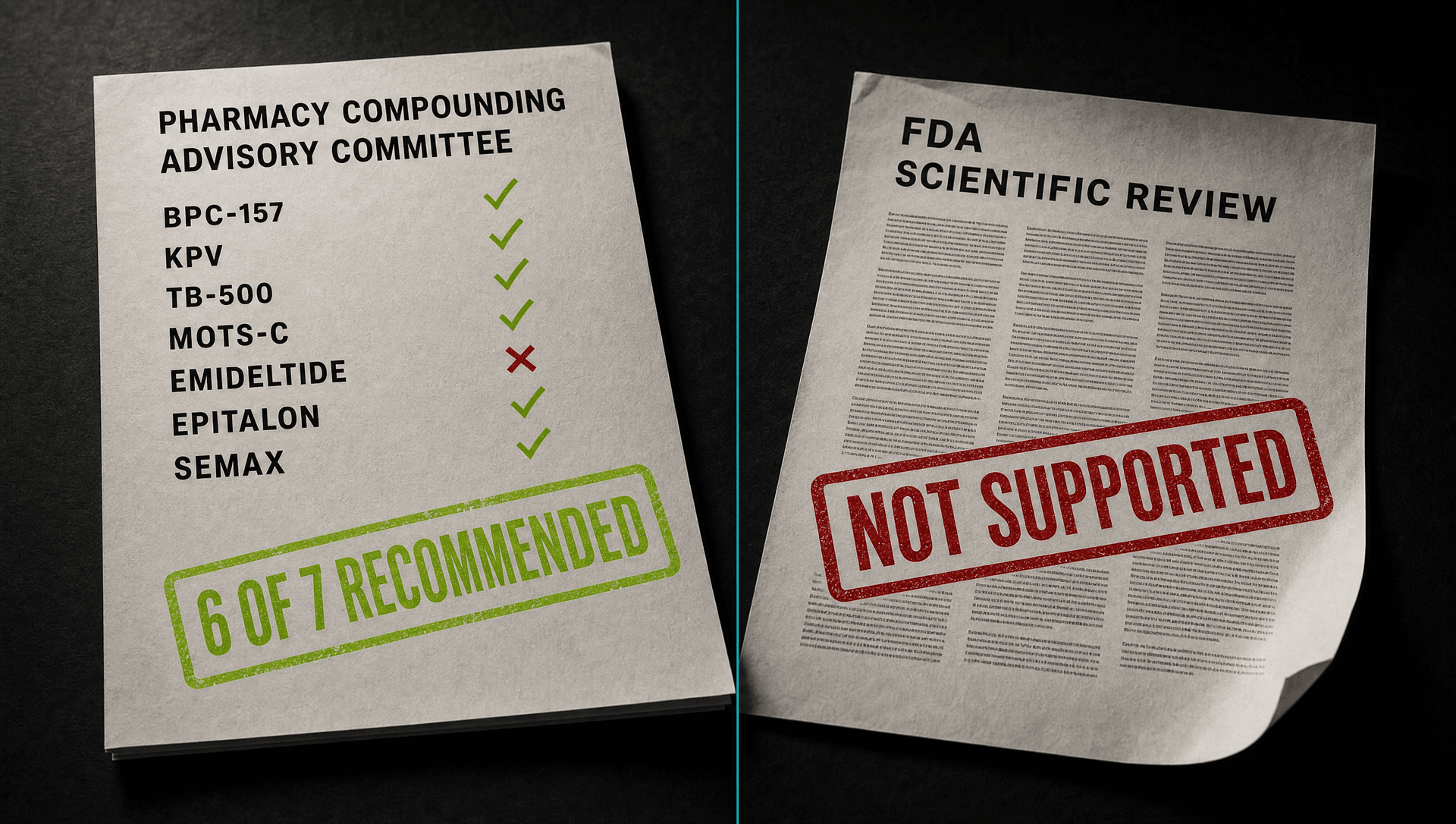
Six recommended, one rejected, nothing legalised.
FDA's Pharmacy Compounding Advisory Committee, a panel of outside experts, met over two days at the FDA's White Oak campus. It voted on seven peptides for that list, which names the ingredients a compounding pharmacy may lawfully build a preparation from. The seven were BPC-157, KPV, TB-500, MOTS-c, emideltide (DSIP, a peptide studied for sleep), epitalon and Semax. Six were recommended. By LumaLex Law's count, only emideltide was rejected, by 6 votes to 7 with 1 abstention. BPC-157, KPV and TB-500 each passed 8 to 6, again with 1 abstention.
Read the rest of the record before you read the tally as progress. FDA's own scientific staff had recommended against all seven. Every nomination had already been withdrawn, and FDA evaluated the seven at its own discretion anyway.
Nothing reaches the bulks list without formal notice-and-comment rulemaking (a rule FDA must publish for public comment before it is final). The law firm Orrick says that rulemaking typically takes 12 to 24 months. As of late September 2026, the Federal Register (the government's daily rule journal) shows no proposed rule. Orrick also expects a second advisory meeting on five more peptides before the end of February 2027.
Two older votes still stand. In October 2024 the committee voted against compounding for Ipamorelin and MK-677 (ibutamoren). In December 2024 it did the same for CJC-1295 and AOD-9604. None of those four were part of the July vote. Our comparison of ipamorelin versus MK-677 covers where each one sits. For the wider picture, see what FDA's compounding rules mean for peptide users and our companion piece on the peptide legal landscape now. Our report on the FDA peptide vote covers the two-day meeting in full.
The Category System That Decides What a Pharmacy May Build
To see why a recommendation changes so little, look at the rule underneath it. Section 503A of the Federal Food, Drug, and Cosmetic Act lets a pharmacy prepare a medicine for one named patient. It may only do that if the bulk substance (the raw ingredient) qualifies. FDA sorted the candidates into three interim buckets while it worked through them.
| Category | What it means | Compounding allowed? |
|---|---|---|
| Category 1 | Substances nominated with sufficient supporting information for FDA to evaluate them, which may be eligible for the 503A bulks list | FDA does not intend to take action while it reviews them, if its conditions are met. FDA describes them as substances that cannot otherwise be used under section 503A |
| Category 2 | Substances where FDA identified a potential safety concern | No. FDA said it would not use enforcement discretion (its choice not to act during review) |
| Category 3 | Substances with too little information to judge | No. Cannot be compounded as active ingredients |
Almost every headline missed the same fact. There are only three lawful routes onto a 503A preparation. The substance is a component of an FDA-approved drug. Or it has a USP or NF monograph. That is an official quality standard in the US drug standard books. Or it sits on the 503A bulks list. None of the seven peptides in the July vote qualifies by any of the three routes today. FDA's briefing on each one found no USP or NF monograph and no approved drug that contains it. The bulks list itself, 21 CFR 216.23, names none of them.
These categories govern pharmacies, not personal possession or research use. The grey-market problem with legal peptide access starts in that gap. Category 2 placement did not make possession criminal. It meant FDA would consider taking action against a pharmacy that compounds with those substances.
On 29 September 2023, FDA added 19 substances to Category 2 for pharmacy compounding, most of them peptides. The best known were BPC-157, TB-500 and CJC-1295. FDA cited thin safety data, poor characterisation (too little known about exactly what the molecule is), impurity concerns and possible immune reactions. It set out those concerns again at meetings in 2024.
The science backs the worry about impurities. A review in Regulatory Toxicology and Pharmacology found that quality rules written for peptides are still limited. It flagged impurity analysis and toxicology (the study of harm from chemicals) as the weak points. That gap is why the certificate on the vial carries the weight a monograph would otherwise carry. Our guide to reading a peptide certificate of analysis shows what HPLC (purity), mass spectrometry (identity) and endotoxin (bacterial toxin) results should look like. It also shows how to spot a certificate that does not meet the standard.
Are Reliable Peptide Sources Safe for Tested Athletes?
Not for the banned peptides. FDA status and WADA (World Anti-Doping Agency) status are separate systems, and mixing them up has ended careers. A peptide can be recommended for the bulks list and still be banned in sport. Six of the seven peptides in the table below are on the 2026 List. Thymosin alpha-1 is not on the List.
BPC-157 is the clearest case. No global regulator has approved it for standard medicine. Human research is too thin to confirm either safety or benefit. The 2026 WADA Prohibited List puts BPC-157 in category S0: Non-Approved Substances. It is a Specified Substance, a class where a shorter ban is possible. TB-500 is a non-Specified Substance, WADA's stricter class, in S2.3, growth factors. Both are banned in and out of competition.
The penalty is heavy. A Canadian athlete received a four-year sanction in April 2025 after using BPC-157 and TB-500. It was a non-analytical positive (a violation proven without a positive drug test). For BPC-157, the WADA Code allows a shorter ban if an athlete shows no significant fault. A therapeutic use exemption (TUE, medical permission to use a banned substance) for BPC-157 is unlikely. The US Anti-Doping Agency (USADA) says permitted alternatives exist, though it judges each TUE request case by case.
| Peptide | WADA status (2026 List) | TUE available? | FDA position (FDA records to July 2026) |
|---|---|---|---|
| BPC-157 | S0: Non-Approved Substance. Banned in and out of competition | Unlikely, but USADA judges each request case by case | Advisory committee recommended for the 503A list in July 2026 (FDA had proposed against). Advisory only, rulemaking pending, not lawfully compoundable today |
| TB-500 | S2.3: growth factor. Banned in and out of competition | Case by case | Advisory committee recommended for the 503A list in July 2026 (FDA had proposed against). Advisory only, rulemaking pending, not lawfully compoundable today |
| CJC-1295 | S2.2.4: GHRH analogue (a copy of the brain signal that releases growth hormone) | Case by case | Not part of the July 2026 vote. The December 2024 vote against compounding stands |
| Ipamorelin | S2.2.4: growth hormone secretagogue (a compound that makes the body release growth hormone) | Case by case | Not part of the July 2026 vote. The October 2024 vote against compounding stands |
| Thymosin Alpha-1 | Not named on the 2026 List. S0 covers only substances with no current government approval, and FDA's 2024 review found it licensed in many countries | Not needed, as it is not on the List | Not part of the July 2026 vote. The December 2024 vote against compounding stands |
| Tesamorelin | S2: Peptide Hormone (GHRH analogue, a copy of the brain signal that releases growth hormone) | Potentially, with FDA-approved indication | FDA-approved (Egrifta) for HIV-associated lipodystrophy (abnormal fat changes in people with HIV) |
| Sermorelin | S2: GHRH analogue | Potentially with clinical indication | FDA's 503B list (March 2025) has sermorelin acetate in category 1, as part of an FDA-approved drug, Geref. Geref was withdrawn from sale, but not for safety or effectiveness reasons. Sermorelin is in no category on FDA's 503A list (May 2026) |
The US Department of Defense bars service members from using any ingredient on its prohibited list in dietary supplements. That list includes substances in WADA sections S0 to S5. If you compete or serve, treat WADA status as a separate question from FDA status, and ask a clinician with anti-doping experience first. Our analysis of BPC-157's WADA ban sets out what S0 means in practice.
What the FDA Enforcement Record Shows
A vendor tells you what it wants you to believe. FDA's record tells you what the regulator does.
| When | What happened |
|---|---|
| September 2023 | FDA added 19 substances to Category 2 for pharmacy compounding. Most were peptides, among them BPC-157, TB-500, CJC-1295, Ipamorelin, Thymosin Alpha-1, AOD-9604, Selank, Semax, injectable GHK-Cu and MOTS-c. FDA said it would consider taking action against a pharmacy that compounds with them |
| October 2024 | The advisory committee voted against compounding for Ipamorelin and MK-677 (ibutamoren) |
| December 2024 | FDA issued warning letters to Prime Peptides, Xcel Peptides, SwissChems and Summit Research Peptides. The Summit letter, dated December 10, 2024, warned that seizure and injunction (court orders to take goods or stop sales) could follow |
| December 2024 | The advisory committee voted against compounding for CJC-1295, AOD-9604 and thymosin alpha-1 |
| January 2025 | FDA stopped placing newly nominated substances into the categories. Substances already placed stayed where they were |
| February 2025 | FDA found the semaglutide shortage resolved. Its grace period for shortage-based compounding ran to April 2025 for pharmacies and May 2025 for outsourcing facilities |
| September 2025 | FDA launched a crackdown on misleading drug ads, including warning letters to telehealth firms selling compounded GLP-1 drugs (the class that includes semaglutide). A second group of 30 such letters followed in March 2026 |
| February 2026 | Health and Human Services (HHS) Secretary Robert F. Kennedy Jr. spoke about peptides on the Joe Rogan Experience podcast. It was episode 2461, released on February 27. No FDA record shows any of them moving to Category 1. FDA's category 2 page, updated in April 2026, lists BPC-157, TB-500 and others as withdrawn nominations |
| April 2026 | FDA's category 2 page moved BPC-157, TB-500 and others to its list of substances whose nominations were withdrawn by the nominators |
| July 2026 | The advisory committee voted on 23 and 24 July. Six of seven peptides were recommended, by LumaLex Law's account. The votes are non-binding recommendations |
The 2024 warning letters are the ones to read for yourself. FDA said plainly that a "research use only" label does not exempt a seller from the rules on unapproved new drugs. The letters warned of seizures and injunctions if nothing changed. A name in that database is a live signal about a business you are about to trust with an injectable. The database is public and free to search.
Do Reliable Peptide Sources Publish Independent Testing?
The good ones do. Independent testing shows why it matters.
Here is what one peer-reviewed test purchase found.
| What was tested | What came back |
|---|---|
| Three semaglutide vials bought from illegal online pharmacies (PMID: 39509151) | Purity of 7.7% to 14.37% against a label claim of 99% |
Purity is only half the risk. A peptide can sit close to its label and still carry bacterial endotoxin from a dirty process, and that risk is real for anything injected. The same review (PMID: 39243929) found the rules on impurity testing and toxicology still limited. Without pharmaceutical controls, the impurity profile of a grey-market vial is simply unknown.
Small impurities are not cosmetic either. A study in the Journal of Peptide Science (DOI: 10.1002/psc.70090) notes that even minor impurities can change how a peptide behaves. It notes they can skew test results too. So the certificate is a document to read line by line, not a badge to glance at. Our walkthrough on how to vet a peptide supplier covers what one does and does not tell you.
Three Ways to Buy, and Only One Is Clean
Testing tells you about the vial. The route you buy through sets your legal exposure. Only one of the three routes is clean on both counts.
| Pathway | Legal status | Quality oversight | Prescription needed? | WADA risk for athletes? |
|---|---|---|---|---|
| FDA-approved peptide drugs (semaglutide, tesamorelin, liraglutide) | Fully legal. Approved under NDA or BLA (FDA's two drug approval routes) | Pharmaceutical grade. FDA-inspected manufacturing | Yes | Depends on indication; TUE potentially available |
| Compounded preparations from a licensed 503A or 503B pharmacy | Under 503A, legal only where the substance meets one of the three lawful routes, and none of the restricted peptides on this page does. 503B outsourcing facilities need the substance on FDA's 503B bulks list or its drug shortage list | State pharmacy board regulated. 503B outsourcing facilities (larger FDA-registered compounders) follow FDA Current Good Manufacturing Practice (CGMP), its quality rules for drug makers | Yes for 503A. 503B outsourcing facilities may also fill a provider's order for office stock, with no patient named | Yes for most growth hormone secretagogues and S0 compounds |
| Grey-market research vendors ("research use only" labelling) | Legally ambiguous at best. FDA warning letters confirm the label is no exemption | No pharmaceutical oversight. One peer-reviewed test purchase, from illegal online pharmacies, found three semaglutide vials 7.7% to 14.37% pure against 99% claimed | No, and that is a legal weakness, not a feature | Yes. WADA status ignores vendor marketing |
The middle route is the one people want. It is not open for these compounds today. A rule would have to be proposed, opened for comment and finalised first. Watch the Federal Register for that proposed rule. Until it lands, nothing has moved.
Which leaves most readers in the third row, buying from vendors with nothing above them. That is the market the rest of this page is written for. Our guides on ipamorelin protocols, CJC-1295 and ipamorelin together and Thymosin Alpha-1 are written with this context in mind.
What Standard Do Reliable Peptide Sources Have to Clear?
Two halves, testing and compliance. On the testing side, a source publishes a certificate for each batch from a named independent lab. On the compliance side, it carries no active FDA warning letter and tells no stories. No claim that these peptides are now legal to compound, and no soft talk about WADA.
The analytical half has not changed. Those certificates should show HPLC purity, mass spectrometry identity and, for injectables, endotoxin below FDA limits.
The compliance half is the part the July vote sharpened. Alongside the certificate, look for:
- No active FDA warning letters. The warning letter database is public and searchable. A vendor with a 2024 letter on file is under live scrutiny. Treat that as a material risk, not a footnote.
- No claims that these peptides are now legal to compound. They are not. A vendor selling that story is either confused or hoping you are.
- Honest research-use framing. The lawful use for a research peptide is research. A vendor that avoids human therapeutic claims is a vendor further from FDA's crosshairs.
- Straight talk about WADA. Calling a banned compound safe for athletes is materially misleading. It tells you what the rest of the site is worth.
Put both halves together and you get the bar a source has to clear before it appears here.
- Publish a certificate for each batch from a named outside lab. It covers HPLC purity, mass spectrometry identity and, for injectables, endotoxin.
- Carry no active FDA warning letter and no documented enforcement action.
- Make no human therapeutic claims for research compounds, and no misleading claims about WADA status.
- Trade with real business details, a working returns policy and clear payment terms.
- Hold up when independent testers buy and grade their products.
Our shortlist of sources that meet both standards sits on our recommended sources page. As enforcement and rulemaking move, we update those assessments on compliance grounds, not analytical results alone.
So what changes for you this month? Nothing. No new lawful route opened in July, and no rule has even been proposed, so a recommendation is not permission. The Prohibited List is untouched too. An athlete who reads a headline as clearance is risking a career on a misread.
In a market this unregulated, the per-batch certificate is the only quality evidence you will ever hold. Our guide on how to know if your peptides are real walks through the checks that separate a real document from a decorative one.
Then watch the Federal Register rather than the headlines. A proposed rule is the first real signal, and it has not appeared. Watch whether it follows the panel or FDA's own scientists, whether any entry limits route or use, and how fast state boards move behind it.
Everything on this site is presented for education and research use only. Work with a qualified clinician who knows the current rules before acting on any of it.
This content is for educational purposes only. These compounds are intended for research use. Nothing here is medical advice.
Where to buy research peptides
The hard part with research peptides isn't the protocol. It's finding a supplier that can prove what's in the vial. We assessed dozens against per-batch, third-party testing. A handful passed.
See the sources that passed →Where to buy research peptides
The hard part with research peptides isn't the protocol. It's finding a supplier that can prove what's in the vial. We assessed dozens against per-batch, third-party testing. A handful passed.
See the sources that passed →Share this article
Frequently Asked Questions
Are peptides legal again in 2026 after RFK Jr.'s announcement?
Is BPC-157 banned by WADA even if the FDA reclassifies it?
What does 'research use only' labelling actually mean legally for peptide vendors?
Which peptides are still banned from compounding after the July 2026 FDA vote?
How do I know if a peptide source has an FDA warning letter against it?
What is the difference between Category 1 and Category 2 in the FDA's compounding framework?
Read Next
Disclaimer: This content is for educational purposes only. These compounds are intended for research use. Nothing here is medical advice. Always work with a qualified clinician before making changes to your health protocol.