
Retatrutide Dosage and Titration: What the Trials Used

What Retatrutide Dosage Did the Phase 2 Trial Use?
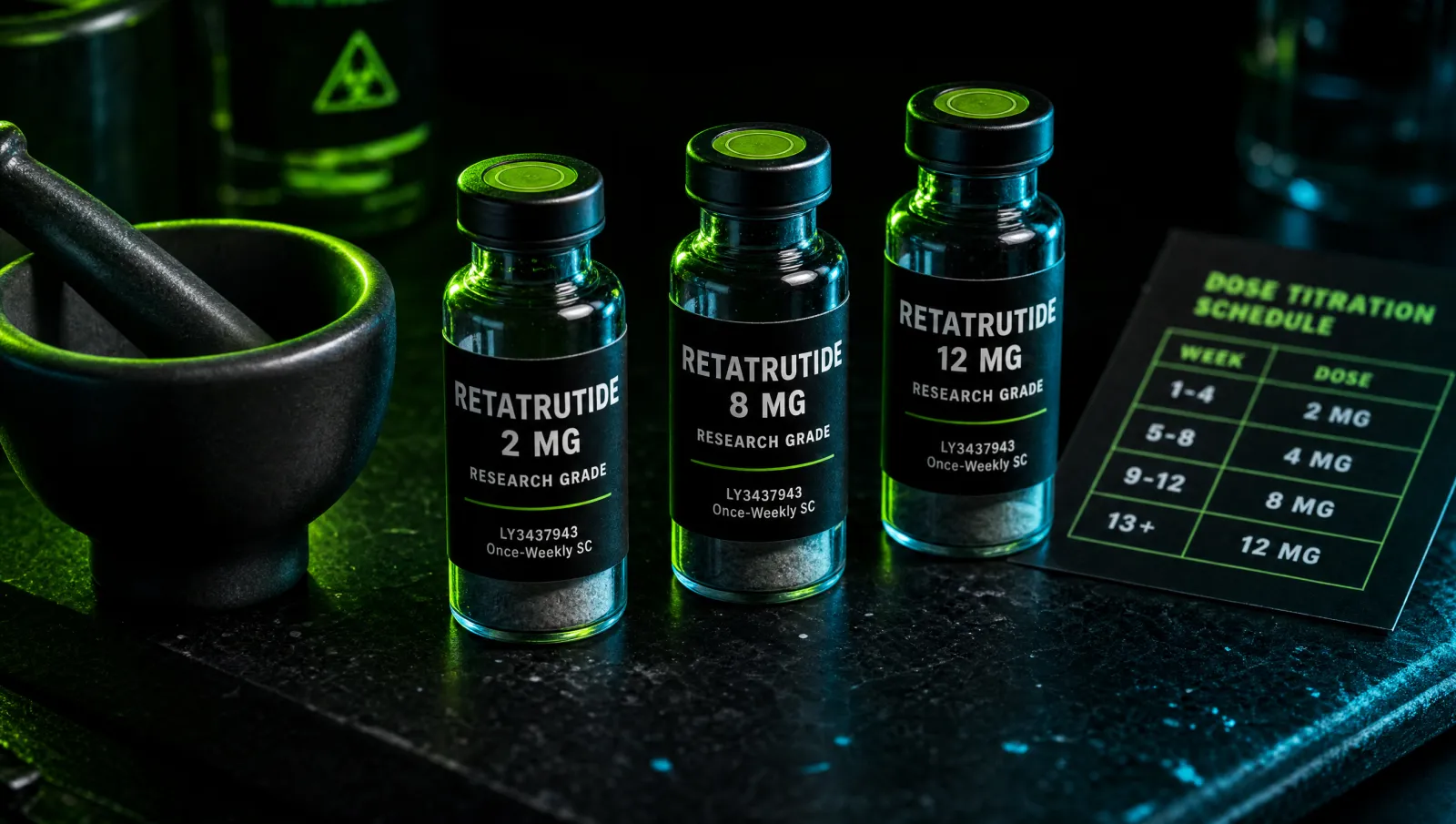
Retatrutide dosage in the Phase 2 obesity trial ran from 1 mg to 12 mg, once a week, by injection under the skin. Some groups started at 2 mg and some at 4 mg. At 12 mg, body weight fell by 24.2% on average over 48 weeks. (Jastreboff 2023)
Retatrutide (LY3437943) is a trial drug. Its main Phase 3 obesity programme, called TRIUMPH, is meant to support a bid for approval for obesity and two related conditions. (Giblin 2025) This page reports the doses used in trials and what they found. It is not prescribing guidance. For a head-to-head view, read our retatrutide vs tirzepatide comparison.
For sourcing research peptides, see our recommended sources page.
Why Does Retatrutide Dosing Start Low?
The short answer is the gut. In Phase 2, the most common side effects hit the stomach and bowel. They rose with dose and were mostly mild to moderate. A lower first dose of 2 mg, not 4 mg, partly cut them. (Jastreboff 2023)
In a liver fat study run inside the same trial, these gut events came mainly while the dose was being raised. (Sanyal 2024)
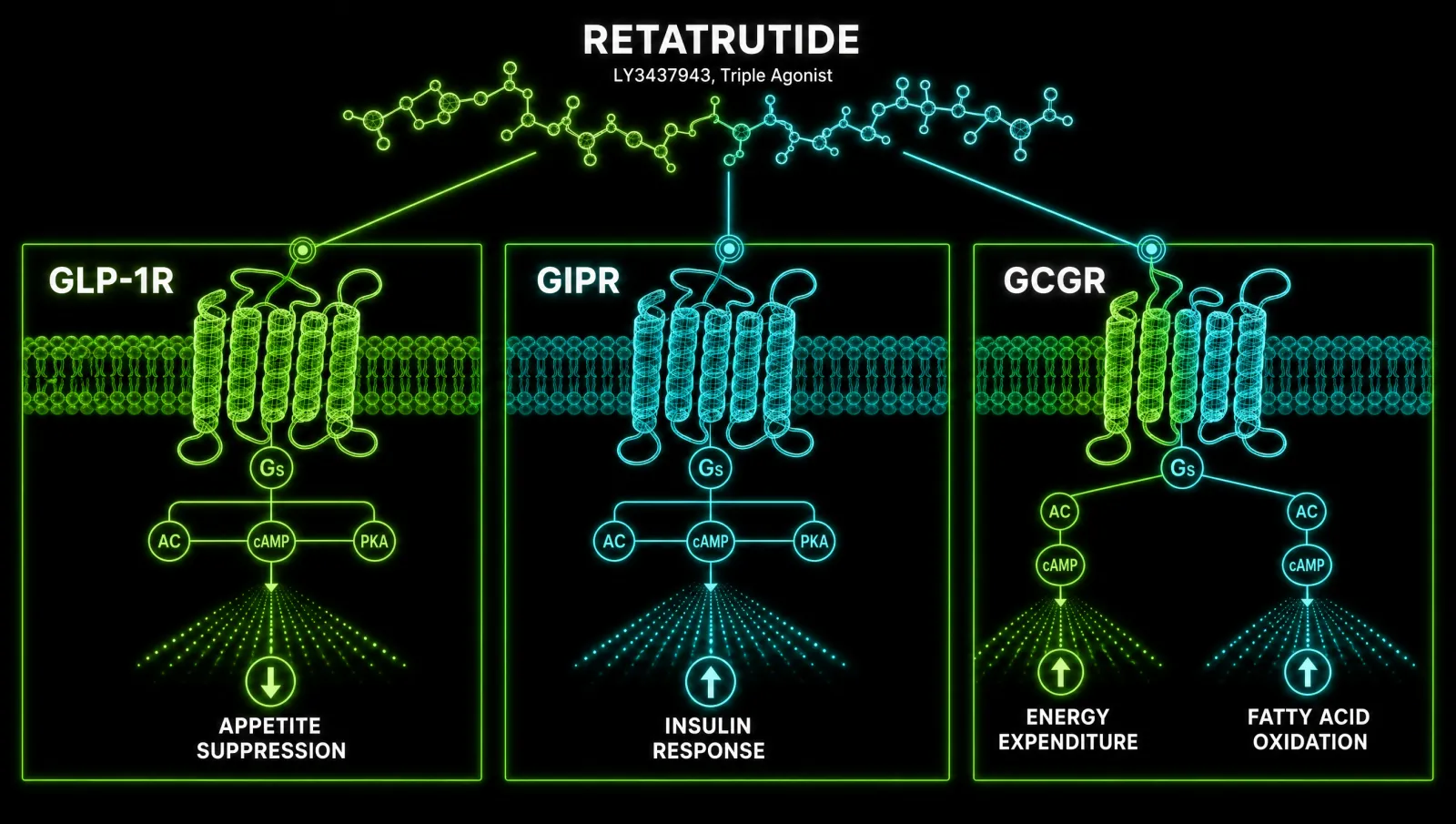
The drug's design helps explain this. It switches on three hormone receptors at once. A receptor is the docking point a hormone uses to signal a cell. The three are the GIP, GLP-1 and glucagon receptors. All three are linked to hunger, blood sugar and fat use. A 2025 review describes it as a first-of-its-class triple receptor agonist. An agonist is a drug that switches a receptor on. (Katsi 2025)
Retatrutide is one peptide joined to a fatty diacid chain, a fat-like tail. Its strength at each receptor is uneven. In cell studies, it was 8.9 times as strong as the body's own GIP at the GIP receptor. It was 0.4 times as active at the GLP-1 receptor. At the glucagon receptor it was 0.3 times as active. (Sanyal 2024)
In obese mice, the glucagon signal added extra energy burn. The other two receptors cut how much the mice ate. (Coskun 2022) Whether that makes it better than tirzepatide is not settled. A 2023 review said the two still needed a direct test against each other. (Doggrell 2023) A Phase 3 head-to-head trial against tirzepatide is now under way (NCT06662383).
What Was the Retatrutide Starting Dose?
It depended on the group. The groups aiming for 4 mg or 8 mg started at either 2 mg or 4 mg. The 12 mg group started at 2 mg. The trial lists no separate first dose for the 1 mg group. (Jastreboff 2023)
The trial compared a 2 mg start with a 4 mg start for the 4 mg and 8 mg doses. The authors report that the 2 mg start partly cut the gut side effects, next to a 4 mg start.
What Does a Retatrutide Dosing Chart Show for Phase 2?
The Phase 2 trial took in 338 adults. Each had obesity, or was overweight with at least one weight-related health problem. Each was put at random into one of six drug groups or a placebo group. A placebo is a dummy shot. The trial was double-blind, so neither volunteers nor staff knew who got what. Treatment lasted 48 weeks. (Jastreboff 2023)
| Group | Starting dose | Target dose, once weekly | Share of places |
|---|---|---|---|
| 1 mg | Not listed separately | 1 mg | 2 of 10 |
| 4 mg, low start | 2 mg | 4 mg | 1 of 10 |
| 4 mg, high start | 4 mg | 4 mg | 1 of 10 |
| 8 mg, low start | 2 mg | 8 mg | 1 of 10 |
| 8 mg, high start | 4 mg | 8 mg | 1 of 10 |
| 12 mg | 2 mg | 12 mg | 2 of 10 |
| Placebo | None | None | 2 of 10 |
The shares come from the trial's 2:1:1:1:1:2:2 split. Drug and placebo came in matching single-use vials. The liver study paper shows the step-up plan in a figure, not in its text. So this page gives no week-by-week steps for Phase 2. (Sanyal 2024) Our retatrutide dosage calculator turns a dose in mg into syringe units, from the vial and water you enter.
An earlier Phase 1b trial in people with type 2 diabetes did give its steps. Its top group went from 3 mg to 12 mg over 12 weeks. (Urva 2022) A 2025 review gives the weeks for each step. (Katsi 2025)
| Weeks | Dose, once weekly (Phase 1b, 3/6/9/12 mg group) |
|---|---|
| 1 to 2 | 3 mg |
| 3 to 4 | 6 mg |
| 5 to 8 | 9 mg |
| 9 to 12 | 12 mg |
What Is the Retatrutide Dosage Schedule in Phase 3?
The Phase 3 obesity registration programme is called TRIUMPH. It is four trials with over 5,800 people. Each tests weekly shots of the drug against placebo, along with diet and exercise advice. (Giblin 2025) Other Phase 3 trials, such as TRANSCEND-T2D in type 2 diabetes, are not covered here. (NCT06354660)
Each person reaches their set dose through a fixed step-up plan. For the 80-week trials, the design paper describes 16 weeks of dose steps, then 64 weeks at the final dose. Its text does not list each step, so none is given here. (Giblin 2025)
| Trial | Who takes part | Weekly doses tested | Treatment length |
|---|---|---|---|
| TRIUMPH-1 | BMI 27 or more, no type 2 diabetes, with knee osteoarthritis and sleep apnoea subsets | 4, 9 and 12 mg | 80 weeks |
| TRIUMPH-2 | BMI 27 or more with type 2 diabetes, with a sleep apnoea subset | 4, 9 and 12 mg | 80 weeks |
| TRIUMPH-3 | BMI 35 or more with established heart and blood vessel disease | 9 and 12 mg | 80 weeks |
| TRIUMPH-4 | BMI 27 or more with knee osteoarthritis, no type 2 diabetes | 9 and 12 mg | 68 weeks |
BMI is body mass index: weight in kilograms divided by height in metres squared. TRIUMPH-1 holds smaller trials for sleep apnoea and knee arthritis. TRIUMPH-2 holds one for sleep apnoea. TRIUMPH-4 is a knee arthritis trial on its own. (Giblin 2025)
The US trial registry lists TRIUMPH-1 as completed. It enrolled 2,335 people. Data for its main outcome were complete in April 2026. (NCT05929066)
What Did Each Retatrutide Dosage Per Week Do?
Weight loss rose with dose. At 48 weeks, 4 mg gave a mean fall of 17.1%, 8 mg gave 22.8% and 12 mg gave 24.2%. Placebo gave 2.1%.
| Weekly dose | Mean weight change at 24 weeks | Mean weight change at 48 weeks | Lost 15% or more by 48 weeks |
|---|---|---|---|
| 1 mg | -7.2% | -8.7% | Not reported in the abstract |
| 4 mg (both starts) | -12.9% | -17.1% | 60% |
| 8 mg (both starts) | -17.3% | -22.8% | 75% |
| 12 mg | -17.5% | -24.2% | 83% |
| Placebo | -1.6% | -2.1% | 2% |
At 48 weeks, the gap between 8 mg and 12 mg was 1.4 percentage points. Heart rate also rose with dose. It peaked at 24 weeks and fell after that. (Jastreboff 2023)
A 2025 review pooled four randomised trials. It found the effect grew with dose, with the largest drops at 12 mg. It found side effects similar to the control groups. (Tewari 2025)
What Is the Retatrutide Half Life?
About 6 days.
Half-life is the time it takes for half of a dose to clear from the blood. In the Phase 1b trial, the half-life was about 6 days. Blood levels rose in step with the dose. (Urva 2022) A 2024 review says this half-life suits a once-a-week dose. (Tetelbaun 2024)
| Measure | What studies report |
|---|---|
| Half-life | About 6 days |
| Exposure | Rises in proportion to dose |
| Peak level after a single dose | 12 to 72 hours after dosing (Phase 1, healthy people) |
| Breakdown | Mostly in the liver; no interaction with cytochrome P450 enzymes |
| Effect after one dose | Weight reduction lasted up to day 43 |
(Urva 2022, Katsi 2025, Coskun 2022)
Cytochrome P450 enzymes are a main drug-handling system in the liver.
What Is the Retatrutide Dosage in ml?
The trial papers cited here give each dose in milligrams (mg). A volume in ml depends on how much powder and water a vial holds. Our retatrutide reconstitution calculator turns the vial and water amounts you enter into a volume to draw.
How to Take Retatrutide: What Did the Trials Do?
In the Phase 1b, Phase 2 and Phase 3 trials cited here, the drug was given once a week as a subcutaneous shot. That means a shot into the fat just under the skin. (Jastreboff 2023) Phase 2 volunteers had to be willing to learn to inject themselves. Those with sight problems or physical limits could have a trained person give the shot instead. (NCT04881760)
Everyone in Phase 2 also got diet and exercise advice. (Sanyal 2024) In TRIUMPH, the advice stresses healthy food rather than cutting calories. It also asks for at least 150 minutes of moderate activity a week. (Giblin 2025)
TRIUMPH is a registration programme. That means its trials are meant to support a bid for approval. Its authors say official guidance shaped its size. That includes at least two well-run trials for each use studied. (Giblin 2025) Eli Lilly, the maker, paid for the Phase 2 trial. (Jastreboff 2023)
How Much Retatrutide Should I Take?
The trials cannot answer that for any one person. Each volunteer's dose was set at random. So the results show what each dose did on average across a group. (Jastreboff 2023) A qualified clinician can advise on any health decision.
What the trials do show is how side effects were handled. Nausea, diarrhoea, vomiting and constipation were the most common. They were clearly worse at higher doses. (Katsi 2025)
| Trial | What the protocol allowed |
|---|---|
| TRIUMPH | A permanent dose reduction for gut side effects or poor food intake that other steps had not fixed |
| TRIUMPH | Those other steps include a prior attempt to step the dose down and back up |
| TRIUMPH | A dose reduction if BMI reaches 22 or less, or if a volunteer feels the weight loss is excessive |
What Does a Retatrutide Dosage Chart Show for Liver Fat?
Liver fat fell by a far larger share than body weight did. (Sanyal 2024)
That was about 82% for liver fat against about 18% for body weight at 12 mg, 24 weeks. (Sanyal 2024)
A Phase 2a study inside the trial followed 98 people with fatty liver disease. Its formal name is metabolic dysfunction-associated steatotic liver disease (MASLD). It means fat build-up in the liver, linked to problems such as obesity. Each person had at least 10% liver fat at the start. Liver fat was checked at 24 weeks.
| Weekly dose | Relative change in liver fat at 24 weeks | Reached normal liver fat (under 5%) |
|---|---|---|
| 1 mg | -42.9% | 27% |
| 4 mg | -57.0% | 52% |
| 8 mg | -81.4% | 79% |
| 12 mg | -82.4% | 86% |
| Placebo | +0.3% | 0% |
The 8 mg and 12 mg results were close, at 81.4% against 82.4%. The authors found close to the most liver fat loss at about a 20% fall in body weight. They suggest the liver gives up its fat before other fat stores do. The liver fat fall was larger than seen with GLP-1 drugs and tirzepatide. The authors say this may come from the larger weight loss, from glucagon acting on the liver, or both. The authors say these results raise ideas to test, and are not final. (Sanyal 2024)
References
- Jastreboff AM, et al. Triple-Hormone-Receptor Agonist Retatrutide for Obesity: A Phase 2 Trial. N Engl J Med. 2023;389:514-526. doi:10.1056/NEJMoa2301972
- Tetelbaun L, et al. The First Triple Agonist for Antiobesity: Retatrutide. Cardiol Rev. 2024. PMID 39724554
- Sanyal AJ, et al. Triple hormone receptor agonist retatrutide for metabolic dysfunction-associated steatotic liver disease: a randomized phase 2a trial. Nat Med. 2024;30:2037-2048. PMC11271400; doi:10.1038/s41591-024-03018-2
- Giblin K, et al. Retatrutide for the treatment of obesity, obstructive sleep apnea and knee osteoarthritis: Rationale and design of the TRIUMPH registrational clinical trials. Diabetes Obes Metab. 2025. PMID 41090431
- Tewari J, et al. Efficacy and safety of triple hormone receptor agonist retatrutide for the management of obesity: a systematic review and meta-analysis. Expert Rev Clin Pharmacol. 2025. PMID 39817343
- Katsi V, et al. Retatrutide: A Game Changer in Obesity Pharmacotherapy. Biomolecules. 2025. PMC12190491
- Doggrell SA. Is retatrutide (LY3437943), a GLP-1, GIP, and glucagon receptor agonist a step forward in the treatment of diabetes and obesity? Expert Opin Investig Drugs. 2023. PMID 37086147
- Urva S, et al. LY3437943, a novel triple GIP, GLP-1, and glucagon receptor agonist in people with type 2 diabetes: a phase 1b, multiple-ascending dose trial. Lancet. 2022;400:1869-1881. PMID 36354040
- Coskun T, et al. LY3437943, a novel triple glucagon, GIP, and GLP-1 receptor agonist for glycemic control and weight loss: From discovery to clinical proof of concept. Cell Metab. 2022. PMID 35985340
- ClinicalTrials.gov. A Phase 2 Study of Once-Weekly LY3437943 Compared With Placebo in Participants Who Have Obesity or Are Overweight With Weight-Related Comorbidities. NCT04881760
- ClinicalTrials.gov. A Study of Retatrutide (LY3437943) in Participants Who Have Obesity or Overweight (TRIUMPH-1). NCT05929066
- ClinicalTrials.gov. Effect of Retatrutide Compared With Placebo in Adult Participants With Type 2 Diabetes and Inadequate Glycemic Control With Diet and Exercise Alone (TRANSCEND-T2D-1). NCT06354660
- ClinicalTrials.gov. A Study of Retatrutide (LY3437943) Compared to Tirzepatide (LY3298176) in Adults Who Have Obesity. NCT06662383
This content is for educational purposes only and is not medical advice. It reports research use of retatrutide in clinical trials. A qualified clinician can advise on any health decision.
Where to buy Retatrutide
Research-grade retatrutide is available from verified suppliers. Always verify purity certificates before use.
See the sources that passed →Where to buy Retatrutide
Research-grade retatrutide is available from verified suppliers. Always verify purity certificates before use.
See the sources that passed →Share this article
Frequently Asked Questions
What was the retatrutide starting dose in trials?
What retatrutide doses have trials tested?
What is the highest retatrutide dose tested in trials?
How fast was the retatrutide dose raised in trials?
What is the half-life of retatrutide?
Did trials show a benefit below 12 mg of retatrutide?
Read Next
Disclaimer: This content is for educational purposes only. These compounds are intended for research use. Nothing here is medical advice. Always work with a qualified clinician before making changes to your health protocol.