
FDA Peptide Vote 2026: 6 of 7 Backed for the 503A Bulks List

What happened at the FDA peptide vote on 23 and 24 July 2026?
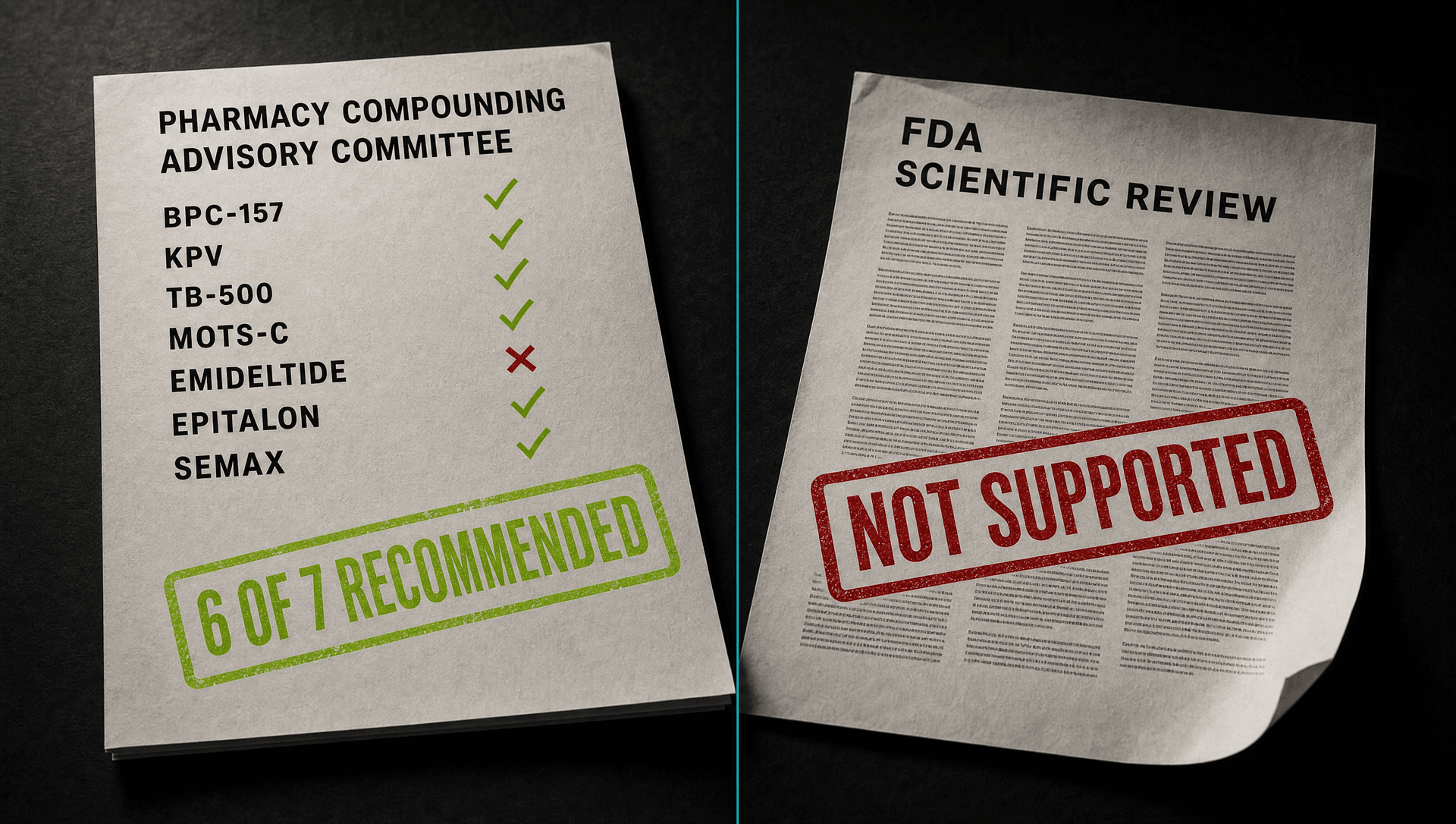
The FDA peptide advisory committee voted on 23 and 24 July 2026 to recommend six of seven peptides for the Section 503A bulks list, rejecting only emideltide. The vote is advisory and non-binding. Nothing about your legal position changed, because none of these seven can lawfully be compounded today.
Meeting held 23 and 24 July 2026 at FDA's White Oak campus in Silver Spring, chaired by Brian Serumaga of the United States Pharmacopeia. This article reflects the public record as of 25 July 2026.
The question in front of the Pharmacy Compounding Advisory Committee was narrow: should seven peptides go on the Section 503A Bulk Drug Substances List, the register of ingredients a compounding pharmacy may lawfully build a preparation from. Voting was electronic, followed by a spoken roll call where each member gave a name and a vote. Stating a reason was optional. At the Semax free-base roll call the chair put it as "would be helpful, but it's not necessary."
Enough members took the option that the roll call became the most revealing part of the two days. Everything below comes from FDA's own record, with news reporting attributed.
Did the FDA approve or legalise these peptides?
No. FDA approved nothing and legalised nothing on 24 July 2026. An FDA official told the committee that none of these substances since 1997, when the statute was passed, could ever be legally compounded, and that none of them were ever in Category 1. A recommendation is not an approval.
That came from FDA staff in the room, not a law firm's summary afterwards. The full quote: "In 2023, the substances were placed in category 2, meaning that we said specifically we weren't going to be exercising enforcement discretion... Those are still documented on our website. None of these substances were ever in category 1. I know there's been some discussion of that today and I will be the first one to admit this is extremely confusing."
FDA defined the buckets in the room. Category 1 was "substances for which we found that there were no safety concerns identified for the substance and therefore we were going to exercise enforcement discretion while those substances waited in line." Category 2 was substances where "we have identified a potential safety concern and therefore we are not going to exercise enforcement discretion". Category 3 was "substances for which there wasn't enough information to make a determination." These seven have never been in the first bucket. For the wider legal picture, our overview of what is and isn't legal in 2026 is the reference.
The position today is what it was on 22 July. Anyone telling you this week's vote opened a door is confused or selling something.
How did each peptide vote go? The full 14-vote matrix
The committee cast 14 votes, not seven, because each peptide was voted on twice, once as the free base and once as the acetate salt. Both forms carried identically every time. BPC-157, KPV and TB-500 each passed 8 yes, 6 no, 1 abstention.
Every tally I've cross-checked against PharmExec, STAT, TIME, AP and RAPS matches on the headline numbers. None reported the salt-form split or the abstentions. Those come from the transcript.
| Substance | Free base | Acetate salt | Outcome |
|---|---|---|---|
| BPC-157 | 8 / 6 / 1 | 8 / 6 / 1 | Recommended |
| KPV | 8 / 6 / 1 | 8 / 6 / 1 | Recommended |
| TB-500 | 8 / 6 / 1 | 8 / 6 / 1 | Recommended |
| MOTS-c | 7 / 5 / 2 | 7 / 5 / 2 | Recommended |
| Emideltide (DSIP) | 6 / 7 / 1 | 6 / 7 / 1 | Rejected |
| Epitalon | 7 / 4 / 1 | 7 / 4 / 1 | Recommended |
| Semax | 8 / 5 / 1 | 8 / 5 / 1 | Recommended |
Chemical identity was the entire fight in that room, which is why the salt-form split matters. A free base and an acetate salt aren't interchangeable: they differ in solubility, stability, and what a lab has to do to confirm what it's holding. My reading, and nobody said this on the record: splitting the vote amounts to FDA treating "BPC-157" as more than one thing, and both forms then carrying identically, every time, suggests the panel wasn't drawing the distinction those separate votes existed to capture. If you've read how to read a peptide certificate of analysis, you know salt form is the first line on the document, not a footnote.
The denominators move too: 15 votes cast on BPC-157, 12 on epitalon. Composition rotated by topic, members were seated for specific substances, and new members were introduced on day two. The chair named three members, Dr Elizabeth Rebello, Danette Stas and Bill Zamboni, as not participating in the Semax topic.
The recurring single abstention is Tim Fensky, pharmacist and liaison from the National Association of Boards of Pharmacy, who abstained on every vote by policy: "as liaison to this committee from the National Association Boards of Pharmacy in order to stay consistent with the position of we do not support or oppose the inclusion of any peptide in the 503A bulks list. I abstained."
What four criteria did FDA ask the panel to weigh?
FDA asked the panel to balance four criteria: physical and chemical characterisation, safety in compounded use, available evidence of effectiveness or lack of it, and historical use in compounding. It's a balancing exercise, not an approval standard, and one yes-voter, Dr Melissa Loski, said plainly she wasn't applying a burden of proof.
Dr Melissa Loski, a family medicine physician, voted yes and put her reasoning on the record: "the criteria for which this appointed position is asking me to weigh my decisions against were met. I am not required and the ask is not burden of proof from an FDA perspective." Dr Asare Christian, a pain physician, told STAT: "We're talking about dosing and efficacy and safety, and it doesn't look like that's what we've been asked to do."
Take that seriously. A 503A listing is a decision about whether a pharmacist may compound an ingredient against an individual prescription. It isn't a marketing authorisation. My reading, offered as analysis and not as legal advice: demanding trial-grade efficacy data imports a standard the statute didn't write.
The dissent is equally coherent and, for me, lands harder. Josh Mailman, patient representative from the Neuroendocrine Tumor Research Foundation, per PharmExec: "I'm voting on something here, but I don't know what that something is. It's kind of like a black box to me." Zamboni, a pharmacologist at UPMC Hillman Cancer Center, voted no repeatedly citing "a lack of fundamental information to evaluate the drug and even to know how to use it." Dr Elizabeth Rebello told TIME that FDA would be "responding to market-induced demand rather than solid science." Serumaga voted no for USP citing "concerns about the physical chemical characterization."
Balance the four criteria and you can reach yes. Ask what the substance is and you stall at criterion one.
What did FDA find on each peptide?
FDA's own scientific staff recommended against adding all seven peptides. BPC-157's effectiveness case rested on a single meeting abstract in 53 subjects, and of the BPC-157 free base and acetate FDA said these substances are not well characterized from a physiochemical perspective. FDA identified no human administration studies of MOTS-c at all.
Every nomination had been withdrawn. FDA evaluated the seven at its own discretion anyway.
BPC-157
Evaluated for ulcerative colitis only. It was also nominated for Crohn's disease, coeliac disease and tendonitis, none of which FDA assessed, because the nomination lacked sufficient information and FDA found no clinical studies in those populations. The indications driving most of the interest went unexamined. Proposed products spanned oral capsule, subcutaneous injection, nasal spray, rectal suppository and transdermal cream.
FDA on mechanism: "dose response relationships to mitigate GI injuries have not been established. Pharmacological studies have been limited to rodent models and the molecular targets for BPC 157 have not been identified." The effectiveness case rested on one meeting abstract describing a randomised double-blind placebo-controlled study in 53 subjects with mild-to-moderate ulcerative colitis given an 80 mg rectal enema, which FDA said was "limited by the lack of details provided in the meeting abstract and the exploratory nature of the study." FDA put the estimated between-group difference at 1.6 points and said it "was not statistically significant". No studies at all via the oral, subcutaneous, nasal or transdermal routes in that population. On identity, covering both the free base and the acetate: "these substances are not well characterized from a physiochemical perspective."
FDA discussed three FAERS reports: a 55-year-old woman with an injection-site reaction, a 28-year-old man with shortness of breath resulting in an emergency room visit after subcutaneous BPC-157 acetate, and a 40-year-old woman with diffuse hyperpigmentation and gingival darkening, reproducible on rechallenge, after BPC-157 plus TB-500. FDA's caveat, immediately after: "It's unclear if these AEs were attributable to BPC 157 as FDA's ability to interpret FAERS reports is [limited]." My analysis, not FDA's: the rechallenge detail is the one worth remembering, because reproducibility on re-exposure is the strongest thing a spontaneous report can offer. None of this contradicts our BPC-157 guide, it sharpens where the uncertainty lives.
KPV
Nominated for wound healing and inflammatory conditions as a 0.1% topical cream and gel, topical only. FDA noted the nominator never specified which wounds or which conditions. No human clinical pharmacokinetic studies were submitted or identified. In an in-vitro human cadaver skin study KPV "does not permeate well through skin," which FDA said could limit systemic toxicity but "could also limit the potential effectiveness of KPV as a topical therapeutic agent." Our KPV guide goes deeper on the mechanism.
TB-500
Nominated for wound healing as a 3 mg/mL lyophilised powder for subcutaneous or intramuscular injection. Seven amino acids, injected. FDA flagged immunogenicity risk "potentially amplified by aggregation." Human safety is unknown. That's the whole file. For a compound with TB-500's reputation, read that again, then read the TB-500 guide with the aggregation point in mind.
MOTS-c
Nominated for insulin resistance, obesity, osteoporosis, vascular calcification, muscle or fat metabolism and longevity, as 5 mg and 10 mg subcutaneous injection. The nominator provided no clinical evidence for any of them, and FDA identified no publicly available clinical studies of MOTS-c administration to humans at all. Not weak studies. None. It passed 7 yes, 5 no, 2 abstentions. Our MOTS-c guide sets out what the preclinical work does and doesn't establish.
Emideltide (DSIP)
Nominated for sleep disorders including chronic insomnia and narcolepsy, and for opioid withdrawal, as a 1,000 mcg/mL subcutaneous injection. FDA reported that two later studies "reached different conclusion than previous studies... authors reported that there were no significant differences in sleep measures compared to baseline measures or placebo. Both authors also stated that short-term treatment of chronic insomnia with [emideltide] had little therapeutic benefit." Note whose verdict that last phrase is: the study authors', as FDA relayed it. FDA's own conclusion was narrower, and worth quoting exactly, because it's absence of evidence rather than a finding of no effect: "insufficient evidence to show that [emideltide] reliably induced or maintained sleep."
Two details widely reported as FDA's were not. The 1992 trial specifics, 16 participants with chronic insomnia, half on DSIP and half on glucose across three consecutive nights, came from Public Citizen in the open public hearing, as did a possible mechanism by which DSIP releases enkephalins that bind the opioid receptor and therefore an unknown addiction potential. The line about the compound being isolated in 1977 from the cerebral venous blood of rabbits came from Dr Matt Cook, an open-hearing speaker who identified himself as co-founder of several peptide-sector businesses.
Epitalon and Semax
Epitalon was evaluated for insomnia, with 10 mg/mL and 3,000 mcg/mL subcutaneous injection proposed in the nomination. FDA noted human studies published from 2002 and still found a lack of evidence for insomnia. Twelve votes were cast, 7 yes, 4 no, 1 abstention, the narrowest panel of the two days. Danette Stas, VP Regulatory Strategy at Jazz Pharmaceuticals, was the non-voting industry representative on that topic.
Semax was evaluated for cerebral ischaemia, migraine and trigeminal neuralgia, with an intranasal spray and subcutaneous injection at 7,500 mcg/mL or 1,000 mcg/mL proposed in the nomination. FDA flagged increased striatal dopaminergic tone as "concerning because it is a response typically induced by drugs of abuse such as cocaine." One small uncontrolled open-label study found it "was not effective in resolving headache pain for the majority of subjects with migraine and was not effective in resolving pain for the majority of subjects with trigeminal neuralgia in the study." It still passed 8 yes, 5 no, 1 abstention. Our Semax guide sets out the nootropic case, which is not the case FDA was asked to weigh.
The characterisation problem underneath all seven
The real obstacle wasn't efficacy, it was identity. FDA's Associate Director for Regulatory Affairs in the Office of Pharmaceutical Quality asked the room, plainly, "What is BPC-157?" He went on: "We can't create quality standards until we actually know what it is," and "we've never faced a problem of what is it and how do we put it on the list." Quality standards are what let a pharmacy verify that the powder it received is the substance on the label, at the purity on the certificate. Without a monograph, every batch is a trust exercise. Same problem as the peptide purity crisis, and it's why our recommended sources page exists: verification is the only lever you actually hold.
Why did emideltide fail when MOTS-c passed?
Emideltide lost 6 to 7 on both salt forms. It was the only one of the seven judged on multiple controlled sleep trials, and the only one carrying a nominated opioid-withdrawal indication. On those trials FDA found the evidence did not show it works. MOTS-c, with no human studies, passed 7 to 5.
Two things set emideltide apart on the record, and both are narrow. It was the only substance assessed against multiple controlled sleep trials, and it was the only one whose nomination carried an opioid-withdrawal indication alongside the sleep ones.
What emideltide was not is the only substance where FDA reported negative human findings. Semax had a study FDA described as not effective for the majority in both migraine and trigeminal neuralgia, and Semax passed 8 yes, 5 no, 1 abstention. On BPC-157, FDA put the estimated between-group difference at 1.6 points and said it was not statistically significant, and BPC-157 passed 8 yes, 6 no, 1 abstention. FDA noted human epitalon studies published from 2002 and still found a lack of evidence for insomnia, and epitalon passed as well.
Be precise about what FDA actually said on emideltide, because the shorthand doing the rounds is wrong. FDA did not conclude the compound doesn't work. It said there was "insufficient evidence to show that [emideltide] reliably induced or maintained sleep." That's absence of evidence, not evidence of absence, and the two are not interchangeable.
So what separated the one rejection? My read, offered as a read and not a finding: the vote pattern doesn't map cleanly onto evidence strength in either direction, because negative human findings sat under three of the six substances that passed. Whatever distinguished emideltide, it wasn't simply that its data looked worse than everyone else's.
Three structural facts that matter more than the tally
Three facts from the record matter more to your safety than the tally does. Compounders operating under 503A aren't required to report adverse events to FDA. A listing without limitations permits any route and any use. And FDA told the room repeatedly that it has no authority to impose those guardrails itself.
One: no adverse-event reporting requirement. FDA staff said it plainly. Compounders operating under 503A "are not required to report adverse events associated with compound drug products... they don't have to report them to the FDA." The signal that would tell anyone whether a listing was working never gets collected.
Two: an unrestricted listing is an open door. Also from FDA staff: "unless specific limitations are included on the entry, the bulk drug substance can be compounded for any use or via any route of administration or dosage form." Follow that through. KPV was nominated as a topical cream, and FDA's own finding was that it barely permeates skin. On an unrestricted listing, nothing stops it being compounded as an injection for an indication nobody assessed. The panel saw this. Loski asked for a topical-only restriction on KPV, and Sen. Bobby Harshbarger asked whether route restrictions could be amended into the vote itself.
Three: FDA says it can't build the guardrails. Members raised adverse-event reporting, monitoring and route restrictions repeatedly across two days. FDA's answer every time was that it lacks the power, and that only legislators can supply it. Scott Brunner, CEO of the Alliance for Pharmacy Compounding, told the committee his organisation "is very much in favor of mandatory adverse serious adverse events reporting... by 503A compounding [pharmacies]", and his own ask of FDA was procedural: "FDA should therefore consider a substance specific implementation period tied to supply chain readiness."
Put those three together and my read is that a listing with no route limits and no adverse-event reporting is a wider opening than the vote count suggests, with no feedback loop attached.
Were there conflicts of interest on the panel?
AP, PBS and STAT all reported that eight panel members were appointed on 29 June 2026. AP alone reported that six of those eight operate practices administering peptides and that all eight voted yes on BPC-157, KPV and TB-500. Motive is not something I'll assign.
AP, PBS and Healio named several of the new appointees: Dr Haleem Mohammed, associated with the Gameday Men's Health clinic chain; Dr Gabriel Alizaidy, who charges $500 for peptide and hormone consultations and promotes BPC-157 and GHK-Cu on social media; and Bobby Harshbarger, PharmD, a Tennessee state senator and pharmacist at family business Premiere Pharmacy, which sells compounded peptides, and whose mother Rep. Diana Harshbarger wrote to Secretary Kennedy asking that peptide restrictions be relaxed. The named members did not respond to AP's requests for comment, and I found no FDA or HHS response to the conflict questions in any source.
STAT characterised the split as yes-voters with industry ties and HHS appointments against dissenters who were largely academic physicians and patient representatives, and STAT, TIME and AP all framed the outcome as a win for HHS Secretary Robert F. Kennedy Jr., who has publicly backed easing peptide restrictions.
The counter-argument deserves a hearing. If a 503A listing decision belongs with practising clinicians and pharmacists rather than academic pharmacologists, then people who work with these compounds are the qualified voters, not the compromised ones. Clinical experience is either relevant expertise or disqualifying interest, and reasonable people put that line in different places. What I won't do is tell you why any individual voted as they did.
When will peptides be legal?
Nobody can give you a date. Nothing reaches the 503A bulks list without formal notice-and-comment rulemaking, outside counsel estimates run from eight to twelve months up to 12 to 24 months, and FDA said on the record it has no deadline for entering rulemaking at all.
Rulemaking is mandatory. FDA decides through a proposed rule, a comment period, then a final rule. Orrick's read is that formal rulemaking cannot be bypassed entirely.
The estimates don't agree. Dustin Robinson, via PharmExec, says eight to twelve months. Orrick says formal rulemaking typically takes 12 to 24 months. Both are outside counsel reading the same process, so treat any single quoted figure as a guess. And FDA gave itself nothing to work to: "we don't have a deadline for entering into that rulemaking." The clock hasn't started.
The vote usually sticks, but FDA's own scientists dissented. FDA said the vote is "one factor in the final decision... it's an advisory vote," and "usually consistent with the final decision." Asked whether a vote has ever been overruled, FDA confirmed at least one instance where the final decision differed and called that "very rare." Normally that settles it. This time FDA's scientific staff recommended against all seven and the panel went the other way on six. My read, not FDA's: that makes divergence risk higher here than the base rate implies.
Leadership could go either way, and the record never closes. STAT names Kyle Diamantas as Acting FDA Commissioner and notes that Kennedy or Diamantas could overrule career staff recommendations. FDA's Office of Pharmaceutical Quality also described a substance it recommended against, that the committee rejected, that went out in a preliminary rule, and that FDA reopened when new information surfaced. A rejection isn't permanent and a recommendation isn't a guarantee.
More is coming. Orrick expects a second advisory committee meeting on five more peptides before the end of February 2027. Comment deadlines for this meeting were 9 July 2026 for material the committee saw and 22 July 2026 for material FDA considered. A post-vote comment period hasn't opened yet.
And the bottleneck a vote can't clear. FDA cannot write quality standards for a substance it can't define. Even on the most favourable political path, somebody has to do the analytical chemistry that establishes what these molecules are, batch to batch and salt form to salt form. Fourteen votes in a conference room didn't advance that work by a day. That's why I keep pointing at the case for proper peptide regulation rather than at access timelines.
What to do in the meantime
Nothing different. There is no lawful compounded route to any of these seven today, no approval, and no timeline you can bank on. Nothing in this vote created a prescription pathway that didn't exist on 22 July, so if a clinic tells you otherwise, that's a claim about the clinic, not about the law.
The temptation is to read momentum as permission. Resist it. Every argument against unverified supply that held on 22 July holds today, and FDA's own presentations made several stronger: immunogenicity risk amplified by aggregation, a dopaminergic signal FDA compared to drugs of abuse, and an emideltide record where FDA found insufficient evidence that it reliably induced or maintained sleep. Dr Mary Thanh Hai, director of FDA's Office of New Drugs, put it sharpest to STAT: "In the grey market, that's not a requirement to be sent to us. Even getting on to the 503A compounding list, that isn't a requirement." Listing doesn't buy you a safety net.
Watch three things: a proposed rule in the Federal Register, which is the first real signal and hasn't happened; whether that rule follows the panel or FDA's own scientists; and whether any entry carries route and use limitations, because an unrestricted listing and a topical-only listing are completely different animals.
Always work with a qualified clinician before making changes to your health protocol. The grey market's core problem is untouched by this vote. Two days of headlines moved the politics. They moved your position not one inch.
Where to buy BPC-157
If you are sourcing BPC-157 for research, our recommended sources page at /sources lists suppliers that publish current third-party certificates of analysis.
See the sources that passed →Sources
- FDA Pharmacy Compounding Advisory Committee, day one livestream, 23 July 2026
- FDA Pharmacy Compounding Advisory Committee, day two livestream, 24 July 2026
- FDA meeting page, Pharmacy Compounding Advisory Committee, 23-24 July 2026
- Federal Register notice of meeting and public docket, 16 April 2026
- Reporting and analysis referenced above: STAT, TIME, Associated Press, PBS, Healio, PharmExec, RAPS and Orrick.
This content is for educational purposes only. These compounds are intended for research use. Nothing here is medical advice.
Share this article
Frequently Asked Questions
Did the FDA approve peptides on 24 July 2026?
Is BPC-157 FDA approved?
When will peptides be legal?
What is the 503A bulks list?
Is peptide therapy FDA approved?
Which peptide did the committee reject, and why does that matter?
Read Next


Disclaimer: This content is for educational purposes only. These compounds are intended for research use. Nothing here is medical advice. Always work with a qualified clinician before making changes to your health protocol.