
Insulin Syringe Units for Peptide Dosing: mcg to Units Chart

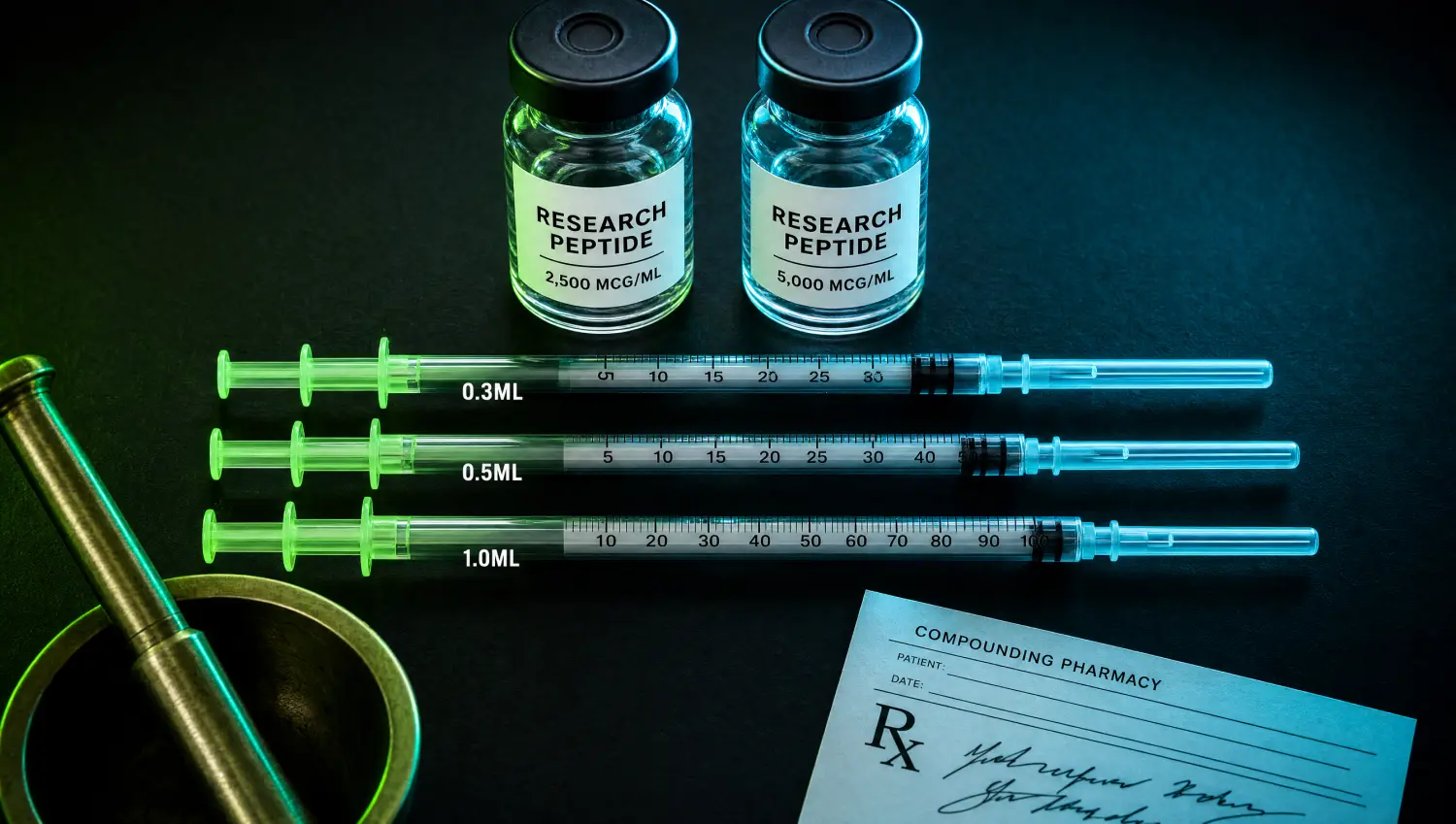
How do insulin syringe units, peptide dosing and mcg fit together?
Insulin syringe units for peptide dosing come from one sum. On a U-100 insulin syringe, 100 units fill 1 mL, so one unit holds 0.01 mL. Divide your dose in mcg by the vial's mcg per mL, then multiply by 100. The charts below have already done it for you.
A unit is not a dose. It is a mark on a barrel. The same 10 units can mean 100 mcg or 500 mcg. What decides it is how much water went into the vial. Get that part right and the rest is arithmetic.
What does a U-100 insulin syringe actually measure?
U-100 names a strength, not a size. The approved label for Humulin R gives that strength as "100 units/mL (U-100)". It also tells the patient to "use only with a U-100 syringe" (DailyMed label, Eli Lilly). The barrel is calibrated for that insulin. It was never calibrated for your peptide.
So the scale measures volume, dressed up as units. One mark is 0.01 mL. Ten marks are 0.1 mL. Fifty marks are half a millilitre. The word carries no strength of its own. That is the whole trap. It is also why the FDA has warned about doses drawn in the wrong measure (FDA safety alert, July 2024).
How do you turn a mcg dose into syringe units?
One formula covers every vial and every dose:
units = (dose in mcg / concentration in mcg per mL) x 100.
Concentration is the only part you have to work out. It comes from two numbers on your bench. One is the milligram figure printed on the vial. The other is the millilitres of bacteriostatic water you added. Multiply the milligrams by 1,000 for micrograms, then divide by that water volume. The mg to mL step has its own reference in our peptide reconstitution chart. Mixing technique belongs to how to reconstitute peptides, so I will not repeat it here.
Which concentration does your vial and water volume give?
| Vial size | BAC water added | Concentration (mcg/mL) | Each unit holds |
|---|---|---|---|
| 2 mg | 1 mL | 2,000 | 20 mcg |
| 2 mg | 2 mL | 1,000 | 10 mcg |
| 2 mg | 3 mL | 667 | 6.7 mcg |
| 5 mg | 1 mL | 5,000 | 50 mcg |
| 5 mg | 2 mL | 2,500 | 25 mcg |
| 5 mg | 3 mL | 1,667 | 16.7 mcg |
| 10 mg | 1 mL | 10,000 | 100 mcg |
| 10 mg | 2 mL | 5,000 | 50 mcg |
| 10 mg | 3 mL | 3,333 | 33.3 mcg |
Read the last column first. It is the number that turns a dose into a plunger position. More water means a weaker solution and more units per dose. Less water means the opposite, and smaller doses get harder to draw accurately.
Which insulin syringe, peptide dosing units apply at each dose?
| Dose | At 10 mcg/unit | At 20 mcg/unit | At 25 mcg/unit | At 50 mcg/unit |
|---|---|---|---|---|
| 100 mcg | 10 units | 5 units | 4 units | 2 units |
| 250 mcg | 25 units | 12.5 units | 10 units | 5 units |
| 500 mcg | 50 units | 25 units | 20 units | 10 units |
| 1,000 mcg | 100 units | 50 units | 40 units | 20 units |
Find your concentration in the column head, then read across from your dose. A half-unit answer, like the 12.5 above, is a signal. Either use a barrel marked in half units, or add more water next time so the dose lands on a whole mark.
What insulin syringe, peptide dosing units and needle size do you need?
Match the barrel to the dose, not to habit. A 30-unit barrel spreads the same fluid over a longer scale, so each mark is further apart and easier to hit.
| Barrel | Holds | Smallest mark | Best for |
|---|---|---|---|
| 0.3 mL | 30 units | Half unit | Doses under 30 units |
| 0.5 mL | 50 units | Whole unit | Doses of 30 to 50 units |
| 1.0 mL | 100 units | Whole unit | Doses above 50 units |
Embecta lists three barrels: 1 mL, 0.5 mL and 0.3 mL. Needles come at 6 mm, 8 mm and 12.7 mm. The half-unit scale sits on the 0.3 mL barrel alone (embecta product specification). Its 6 mm needle is 31 gauge, which is thin enough that most men barely register it. On length, the expert consensus is settled. The FITTER panel concluded that the shortest needles are safe, effective and less painful, and belong first in line (Frid and colleagues). Precision at tiny doses is a genuine constraint, which is why finer increments were built at all (Aanstoot and colleagues).
What do insulin syringe units, peptide dosing and a real vial look like?
Take a 5 mg vial and 2 mL of bacteriostatic water. That is 2,500 mcg per mL, so each unit holds 25 mcg. A 250 mcg dose is 250 divided by 25, which is 10 units. On the barrel that is the 10 mark, and it is 0.1 mL of fluid. Nothing else needs calculating.
Now a 10 mg vial and 3 mL of water. That gives 3,333 mcg per mL, so a unit holds 33.3 mcg. A 500 mcg dose is 15 units. Notice that the second vial is stronger but the second dose takes more units, because the water volume changed too. Always redo the sum when you open a new vial.
What insulin syringe units, peptide dosing mistakes cost people most?
The common failure is never exotic. It is arithmetic done once, in a hurry, at night. One American poison centre reviewed nine years of glucagon-like peptide-1 exposures. Unintentional therapeutic errors accounted for 69% of them, not deliberate overdoses (Muschler and colleagues). The FDA alert above describes the same pattern, including people told to give 5 units who gave 50.
- Reading units as millilitres. Ten units is 0.1 mL, not 10 mL.
- Reusing yesterday's unit count after changing the water volume.
- Squinting at a half-unit line on a barrel that has none.
- Assuming the mark is the dose, when the vial strength decides it.
- Forgetting dead space, the fluid left in the needle and hub after the plunger bottoms out.
That last one earns its own line. A permanently attached needle traps less fluid after use than a detachable one. That is exactly why fixed-needle insulin syringes count as the low dead space design (Zule and colleagues). Pick one, and do not chase the residue with an extra push.
Where should you check your maths before you draw?
Do the sum twice, on paper and on a calculator, before the needle goes anywhere near the vial. Our reconstitution calculator turns vial size and water volume into a concentration, and the dosing calculator turns that concentration into units. Still choosing a supplier? The criteria live on our recommended sources page. Dose-by-bodyweight figures for one common compound sit in the BPC-157 dosage chart.
This content is for educational purposes only. These compounds are intended for research use. Nothing here is medical advice, and any decision involving your health should involve a qualified clinician.
Where to buy research peptides
If you are sourcing peptides to reconstitute and dose using this math, work only with a supplier that publishes independent third-party COAs.
See the sources that passed →References
- Eli Lilly and Company. HUMULIN R (insulin human) injection, solution: prescribing information. DailyMed, US National Library of Medicine.
- US Food and Drug Administration. FDA alerts health care providers, compounders and patients of dosing errors associated with compounded injectable semaglutide products. FDA, 26 July 2024.
- embecta. Insulin Syringes with Ultra-Fine needle: product specification. embecta.
- Frid AH, Kreugel G, Grassi G, et al. New Insulin Delivery Recommendations. Mayo Clin Proc. PubMed record.
- Aanstoot HJ, Rodriguez H, Weinzimer S, et al. Precision Dosing of Rapid-Acting Insulin Matters. Diabetes Technol Ther. PubMed record.
- Muschler K, Muschalek R, Hoyte C. Characterization of glucagon-like peptide-1 agonist exposures reported to a single United States poison center. Clin Toxicol. PubMed record.
- Zule WA, Latypov A, Otiashvili D, et al. Factors that influence the characteristics of needles and syringes used by people who inject drugs in Tajikistan. Harm Reduct J. PubMed record.
Share this article
Frequently Asked Questions
How many units is 250 mcg on an insulin syringe?
How many mL is one unit on a U-100 insulin syringe?
What is the formula for mcg to insulin syringe units?
Which insulin syringe size should I use for peptides?
Does more bacteriostatic water mean a bigger dose?
What if my dose lands on half a unit?
Read Next

Disclaimer: This content is for educational purposes only. These compounds are intended for research use. Nothing here is medical advice. Always work with a qualified clinician before making changes to your health protocol.