
AOD 9604 Dosage: Protocol, Timing and Cycling

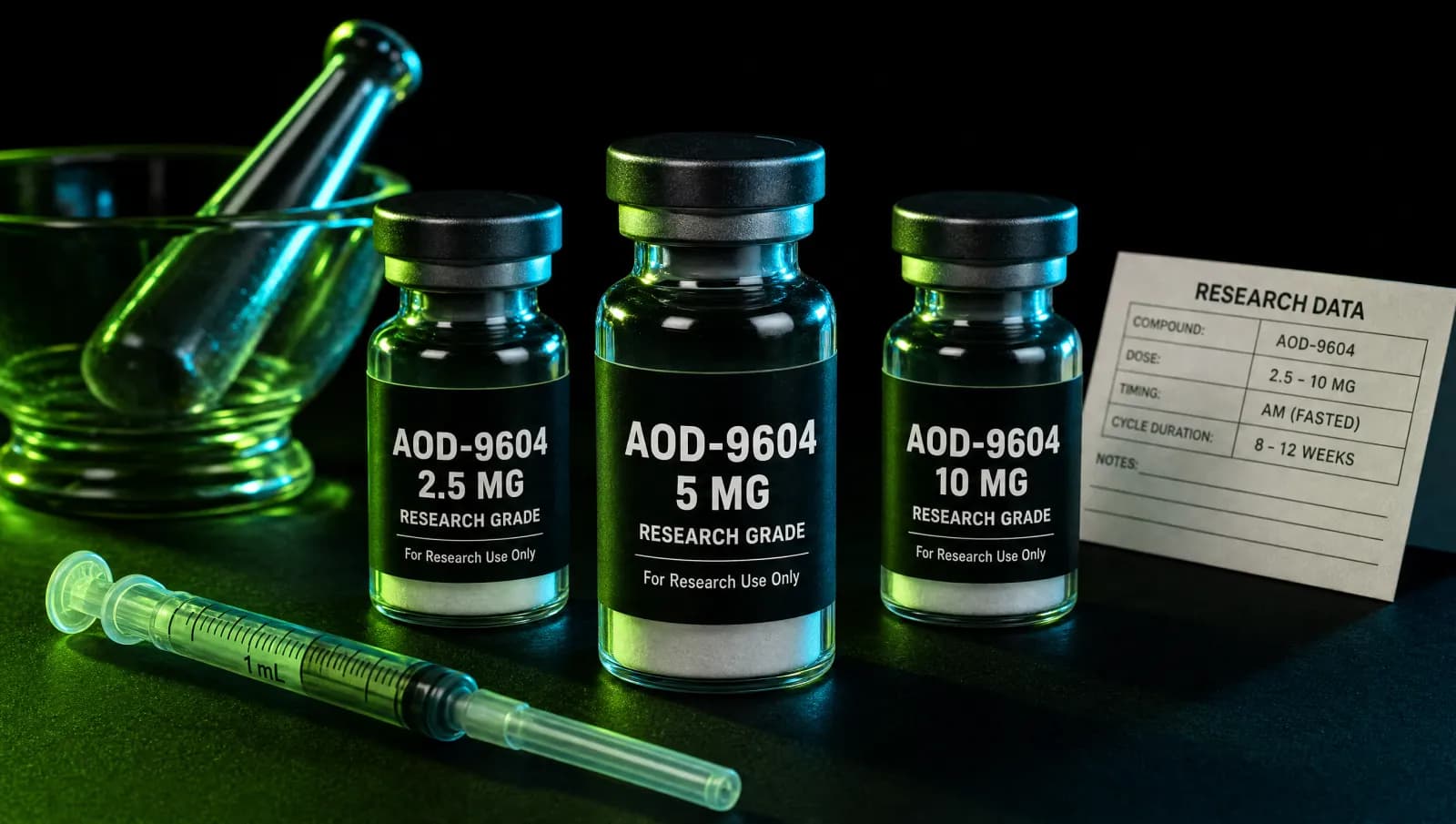
What Is the Standard AOD 9604 Dosage?
The AOD 9604 dosage used in research is 250 to 500 mcg a day, injected under the skin. Human trials tested 1 mg to 10 mg daily by mouth. The 1 mg arm did best: 2.6 kg lost over 12 weeks, against 0.8 kg on placebo.
AOD 9604 is also catalogued as hGH Fragment 176 to 191, or Tyr-hGH 177 to 191. It is a 16-amino-acid synthetic peptide. It copies the C-terminal end of human growth hormone.
The idea behind it is metabolic selectivity. It turns on the fat-burning machinery of fat tissue. It does not bind the growth hormone receptor. It does not raise IGF-1. That split is clear in the trial record. It is why the molecule is still studied, even though the company stopped its work in 2007.
This guide covers the dose, the timing, the fasted cardio logic, and how long a run lasts. Every figure below comes from published data or preclinical evidence, cited inline. Anything practitioner-derived is labelled as such.
Affiliate disclosure: This post contains links to a recommended research compound supplier. We earn a commission if you purchase via those links. This does not influence the clinical analysis. See our recommended sources page for vendor-neutral sourcing guidance.
How Does AOD 9604 Work on Fat Cells?
The biology drives every dosing choice, so it is worth a minute.
Full-length human growth hormone binds the GH receptor and lifts IGF-1. AOD 9604 does neither. It works through a diacylglycerol second-messenger path inside the fat cell. It drives lipolysis, the breakdown of stored fat. It also blocks lipogenesis, the laying down of new fat. The first patent sets this out. It says the peptide acts through beta-3 adrenergic signalling. The doses needed are far below those that switch on growth. Ng 2002.
Animal work backs that up. In obese Zucker rats, 500 mcg/kg/day by intraperitoneal injection for 18 days preserved insulin sensitivity. Intact hGH did not. Heffernan 2001a. Mouse studies used a chronic osmotic pump. AOD 9604 raised fat oxidation and plasma glycerol, a marker of lipolysis. That rise was on a par with full-length hGH. Blood sugar did not climb. Insulin release did not fall. Heffernan 2001b The earlier work on the same fragment found the same split. Ng et al. 2000.
That has a direct effect on dosing. Once the beta-3 receptors in fat tissue are full, more peptide does not push the signal higher. The human trials showed just that.
What Did the Trials Show at Each AOD 9604 Daily Dosage?
The human data is small but clear. The Phase II programme tested 1 mg a day up to 10 mg a day. The 1 mg group lost 2.6 kg over 12 weeks. Placebo lost 0.8 kg. The 10 mg group lost less than the 1 mg group, not more.
| Daily dose | Weight loss over 12 weeks | What it tells you |
|---|---|---|
| Placebo | 0.8 kg | The comparison arm |
| 1 mg | 2.6 kg | The best documented result |
| 10 mg | Less than the 1 mg arm | No extra benefit from a bigger dose |
In that 12-week randomised controlled trial, the 1 mg group beat placebo by a clear margin. The missing dose-response climb is normal for peptides that work by filling receptors. It is not normal for drugs that act through the blood as a hormone.
The later Phase IIb OPTIONS trial enrolled 536 subjects over 24 weeks. Its primary endpoint was weight loss against placebo. That endpoint was not met. The firm ended commercial work in 2007. In 2023 the FDA briefed its Pharmacy Compounding Advisory Committee on it. The briefing cited a lack of clinical evidence for compounding approval. FDA PCAC 2023.
Three points follow for anyone reading the dose data:
- Doses above 1 mg a day are not backed by the trial data. They appear to give less, not more.
- The 250 to 500 mcg range for injection sits below the 1 mg trial dose. Part of the reason is that uptake through the skin differs from the oral route some trial arms used.
- Six trials covering roughly 900 participants found no serious adverse events tied to the drug. There was no IGF-1 rise, no heart event, and no immune response. Walker 2020.
Why Does Every AOD 9604 Dosage Chart Stop at 1 mg?
Because the trial data stops working above it.
A dose-response curve normally climbs. More drug, more effect, up to a ceiling. AOD 9604 did not do that. The 10 mg arm gave a smaller result than the 1 mg arm. The likely reason is that the receptors fill up. Beta-3 receptors in fat tissue are a fixed target. Fill them and the extra peptide has nowhere to act.
So a chart that runs up to 10 mg is not showing a stronger plan. It is showing the arm that worked less well. Our complete AOD 9604 guide sets out the full trial history behind that finding.
What Is a Sensible AOD 9604 Dosage Per Day to Start?
For subcutaneous research use, 250 to 500 mcg once a day is the standard range. Most beginners start at the bottom of it.
The usual pattern is 250 mcg at first. If that is well tolerated, it is raised to 500 mcg after 2 weeks. Nothing in the published record backs a higher daily dose.
Some practitioners drop to 250 mcg every other day in a maintenance phase. The thinking is that a smaller dose keeps a low lipolytic tone without filling the receptors daily. This is anecdotal and practitioner-derived. It is not clinically validated.
Always work with a qualified clinician before making changes to your health protocol.
How Do You Run an AOD 9604 Dosage Protocol by Injection?
Morning, fasted, into the abdomen. That is the shape of it, and the detail matters.
The fasted morning window is favoured for two reasons. First, insulin is at its low point after an overnight fast. Insulin puts a brake on lipolysis through the PI3K pathway. Inject into a low-insulin state and that brake is off. Second, catecholamine levels and nerve traffic run high in the early morning. That is a helpful backdrop for beta-3 activation. This timing case is practitioner-derived and anecdotal. No randomised trial has tested fasted morning dosing against other windows for the injected form.
The practical protocol:
- Dose: 250 mcg to start. Titrate to 500 mcg if well tolerated after 2 weeks.
- Timing: On waking, 30 to 60 minutes before food or exercise. Anecdotal reports suggest a morning shot before fasted cardio may widen the lipolytic window.
- Site: Under the skin of the belly. Move the spot at least 1 inch each time. That avoids lipohypertrophy, a lumpy build-up of fat.
- Split dosing: Some practitioners split the day into 250 mcg on waking and 250 mcg before sleep. The thinking is that two smaller pulses hold a steadier level. This is anecdotal and not clinically validated.
- Reconstitution: Standard bacteriostatic water applies. Refrigerate once mixed. Discard after 28 days.
Our guide to injecting peptides covers the technique itself.
Is There an AOD 9604 Dosage Calculator?
There is no need for one, and that is a useful thing to know.
Human research doses are flat. They do not scale with body weight. The 250 to 500 mcg range is the same for a big man and a small one. The per-kilogram numbers people find online come from the animal work, where rats were given 500 mcg/kg/day. No published human data backs reading a rat dose across by body weight.
Does AOD Cardio in a Fasted State Help?
The AOD cardio idea rests on the same low-insulin, high-catecholamine state that suits morning dosing. The thinking runs like this. AOD 9604 frees fatty acids into the blood. Fasted steady cardio then burns them, before insulin puts them back into store. The case for that pairing is mechanistic and anecdotal. It does not come from controlled human trials.
The version most often described in research communities:
- Wake fasted, 8 to 12 hours after the last meal.
- Inject AOD 9604, 250 to 500 mcg under the skin.
- Wait 20 to 30 minutes.
- Do 30 to 45 minutes of steady cardio, at 60 to 70% of your top heart rate. Easy aerobic work at that level burns fat rather than glucose.
- Break the fast with a high-protein meal afterwards.
Intensity is the part people get wrong. Hard interval work in a fasted state pushes fuel use towards glucose. It may not use the lipolytic window at all. Zone 2 work is the choice that fits.
Pairing AOD 9604 with peptides that act elsewhere may add up, in theory. GH secretagogues, for one, work through the GHRH axis rather than on the fat cell. Multi-compound plans remain unvalidated in human trials. Our look at AOD 9604 and fat loss covers what the outcome data does and does not show.
How Long Should an AOD Cycle Run Before a Break?
An AOD cycle in research use usually runs 12 to 24 weeks. That mirrors the trials that produced the outcome data. Breaks after that window are advised on the theory that constant beta-3 signalling dulls the receptors.
That theory is mechanistic, not directly evidenced. Beta-3 adrenergic receptors can lose sensitivity under constant agonist exposure. It is on record for other beta-adrenergic agonists. Whether AOD 9604 does it at research doses in people is unknown. So the advice to take breaks is a precaution, anecdotal and not evidence-based.
Frameworks cited in research communities:
- 12 weeks on, 4 weeks off: matches the shorter Phase II run. Used for harder fat-loss phases.
- 16 weeks on, 4 weeks off: reaches the Phase IIb length, with a recovery window built in.
- 24 weeks continuous: mirrors the longest human trial. Phase IIb ran to 24 weeks with no reported safety signal.
There is no published human safety data past 24 weeks. That is a real gap, not a technicality.
Is AOD 9604 Safe at These Doses?
The safety record is the strongest part of the file. Across six trials and roughly 900 participants, no serious adverse events were tied to the drug. There was no immune response, no IGF-1 rise, and no bad heart or metabolic signal. On every measure it looked like placebo.
The benefit data did not survive the Phase IIb endpoint. The safety data did. A dataset that size is rare for a research peptide. That is why interest in it went on. Walker 2020.
How that differs from full-length hGH:
- No IGF-1 rise, confirmed across trials. That sets it apart from the cancer-risk worry tied to very high IGF-1.
- No upset to glucose handling. Clamp data in animals showed insulin sensitivity held at therapeutic doses. Heffernan 2001a.
- No high blood sugar in animals, even at doses that drove real fat oxidation. Heffernan 2001b.
- No antibody formation detected across the trials.
What is missing is long-term human safety past 24 weeks. The trial programme ended in 2007. Anyone running longer is working in an evidence gap.
Can AOD 9604 Help Cartilage and Joints?
One rabbit study says maybe.
A 2015 rabbit osteoarthritis model put AOD 9604 into the joint at 0.25 mg weekly, over 4 to 7 weeks. Cartilage regeneration improved. Adding hyaluronic acid at 6 mg improved it further, beyond either one alone. Kwon et al. 2015. That has led some practitioners to look at the peptide for joints.
This is early data from a single animal model. No human trial on AOD 9604 for joint health has been published. It is an area of interest, not a proven use.
Where to source it
Research AOD-9604 from a verified third-party tested supplier. See our recommended sources for CoA-verified options.
See the sources that passed →Is AOD 9604 Legal, and Where Do You Get It?
AOD 9604 is not FDA-approved for any therapeutic use. Work on it stopped in 2007, when the Phase IIb trial missed its primary endpoint. It is sold for research purposes only. The 2023 FDA briefing to the same committee cited too little clinical evidence for compounding approval. FDA PCAC 2023.
The legal position is not in doubt. The compound sits in a research setting, not a clinic. The mechanism is interesting. The benefit case did not survive its own Phase IIb test.
On sourcing, the supplier matters as much as the dose. A third-party certificate of analysis from an accredited lab is the least you should accept. See our recommended sources page for how we check vendors.
For a look at growth hormone-adjacent peptides used in body composition research, our tesamorelin versus ipamorelin breakdown covers two GHRH-axis secretagogues. They work by a different route from AOD 9604.
References
- Rodgers RJ et al. (2012). Obesity Pharmacotherapy: Current Perspectives and Future Directions. Current Pharmaceutical Design.
- Cooke DW, Divall SA, Radovick S. (2011). Central and Peripheral Molecular Targets for Anti-Obesity Pharmacotherapy. Endocrine Reviews.
- Ng FM et al. (2000). Metabolic Studies of a Synthetic Lipolytic Domain (AOD9604) of Human Growth Hormone. Horm Res.
- Heffernan MA et al. (2001). Increase of Fat Oxidation and Weight Loss in Obese Mice Caused by Chronic Treatment with Human Growth Hormone or a Modified C-terminal Fragment. Journal of Endocrinology.
- FDA. (2023). Briefing Document: Pharmacy Compounding Advisory Committee (PCAC) Meeting.
- Gunel G et al. (2015). Effect of Intra-articular Injection of AOD9604 with or without Hyaluronic Acid in Rabbit Osteoarthritis Model. Acta Orthopaedica et Traumatologica Turcica.
- Ng FM. (2002). Treatment of Obesity. U.S. Patent 6,335,319.
- Walker J et al. (2020). Use of Growth Hormone Fragments. U.S. Patent 10,758,593.
This content is for educational purposes only. These compounds are intended for research use. Nothing here is medical advice. Always work with a qualified clinician before making changes to your health protocol.
Where to source it
Research AOD-9604 from a verified third-party tested supplier. See our recommended sources for CoA-verified options.
See the sources that passed →Share this article
Frequently Asked Questions
What is AOD 9604, and how does it work for fat loss?
What AOD 9604 dosage do research protocols use?
When should AOD 9604 be injected?
Does AOD 9604 raise IGF-1 or upset blood sugar the way growth hormone does?
How long should an AOD 9604 protocol run?
What weight loss did the human trials show?
Read Next
Disclaimer: This content is for educational purposes only. These compounds are intended for research use. Nothing here is medical advice. Always work with a qualified clinician before making changes to your health protocol.