
Peptide Reconstitution Chart: mg/mL by Vial Size and Water

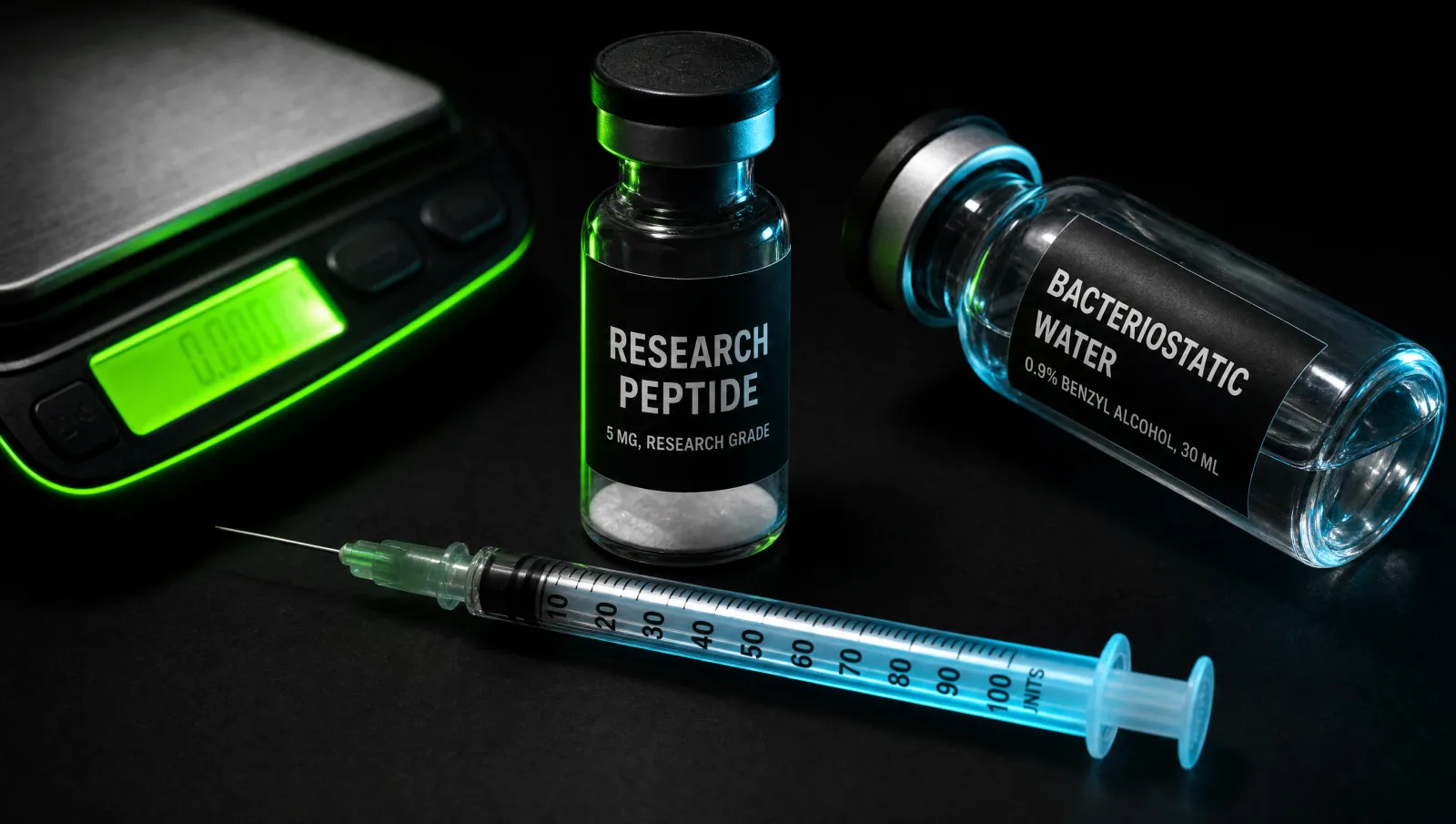
What Does a Peptide Reconstitution Chart Tell You?
A peptide reconstitution chart answers one question. How strong is the vial once the water goes in? That strength is written in micrograms per millilitre. Every dose you draw afterwards is measured against it. Settle that figure once and everything downstream becomes arithmetic.
Two quantities decide it. The powder weight stamped on the label, in milligrams. The bacteriostatic water you push in, in millilitres. One divided by the other is the whole of peptide reconstitution. No compound behaves differently, and no brand of glassware changes the sum.
How Do You Work Out Peptide Reconstitution Concentration?
Convert milligrams to micrograms first. Multiply by 1,000. Divide that by the diluent volume. What you get is potency per millilitre, and it belongs on the label in marker pen before the vial goes anywhere near a fridge.
Work an example. A 5mg vial, 2mL of water. That is 5,000mcg shared across 2mL, so 2,500mcg/mL. Now convert a dose into something a barrel can show. Divide the dose by the strength, then multiply by 100. A 250mcg dose lands on 10 units. A 500mcg dose lands on 20. The 100 appears because a U-100 barrel holds exactly 100 gradations per millilitre.
Peptide Reconstitution Chart: mg/mL by Vial Size
| Vial size | Water added | Concentration | Units for a 250mcg dose |
|---|---|---|---|
| 2mg | 1mL | 2,000mcg/mL | 12.5u |
| 2mg | 2mL | 1,000mcg/mL | 25u |
| 5mg | 1mL | 5,000mcg/mL | 5u |
| 5mg | 2mL | 2,500mcg/mL | 10u |
| 10mg | 1mL | 10,000mcg/mL | 2.5u |
| 10mg | 2mL | 5,000mcg/mL | 5u |
Read the pattern, not the rows. Twice the diluent gives half the potency, every time. This is division, never a curve, so any table that breaks the rule was copied badly from a forum. Your own combination may be missing above, which matters less than it looks. Feed the real figures into the peptide reconstitution calculator and it returns both the strength and the gradation to pull.
Which Water Volume Should You Use for Peptide Reconstitution?
Start at the syringe and reason backwards. Decide where a routine dose should sit on the barrel. Anywhere between 10 and 50 gradations is comfortable to read under ordinary lighting. Only then choose a diluent volume, because picking a tidy 2mL first is how people end up squinting at a mark near zero.
The reverse sum is short. Volume in mL equals vial weight in mg, times 10, times your wanted gradation, divided by the dose in mcg. Suppose a 300mcg dose should sit on 20 units, drawn from a 5mg vial. Five times ten times twenty, over three hundred, gives 3.3mL. Round to whatever your syringe can measure honestly, usually the nearest 0.5mL, then recheck before committing.
Getting the volume wrong will not destroy the powder. It ruins legibility instead. Flood the vial and a single dose needs more liquid than the barrel holds. Starve it and every wobble of your thumb translates into a big swing in micrograms. A 0.3mL barrel carries finer marks and suits anything under 30 units. Our companion piece on converting mcg into syringe units takes that reading problem apart properly.
Does Peptide Reconstitution Change for Retatrutide or Tirzepatide?
Not at all. The division is identical for every lyophilised compound on the market.
Retatrutide, tirzepatide, tesamorelin, GHK-Cu and AOD-9604 obey the same formula. What separates them is the target dose and the frequency behind it. Both come out of the published literature for that molecule, not the mixing bench. A 10mg retatrutide vial and a 10mg copper peptide vial, each in 2mL, both sit at 5,000mcg/mL.
Technique carries across too. Let the water run down the inner wall of the glass, slowly, rather than jetting it straight onto the cake. Then swirl gently and leave it alone. Shaking shears delicate chains and helps nothing. Bacteriostatic water carries a mild preservative, which is exactly why one vial can serve repeated draws instead of a single sitting. Our walkthrough on how to reconstitute peptides covers the bench routine, and how to inject peptides picks up after the draw.
What Ruins a Vial After Peptide Reconstitution?
Heat, light, time and bad labelling. In roughly that order.
Refrigeration slows degradation but never pauses it, so treat a mixed vial as perishable stock with a written date on it. Keep it upright, shaded, and away from the door shelf where temperature swings hardest. Freezing a solution that already contains preservative is generally discouraged, because thawing can wreck the fragile structure you paid for.
Labelling failures cause more wrong doses than any calculation error. Two identical vials, mixed at different volumes, look precisely the same after a week. Write the strength and the date on both. If you cannot remember which vial holds what, the honest move is to bin it rather than guess.
When Should You Let the Calculator Do the Maths?
Whenever your numbers stop being tidy. A chart is fast for popular combinations and useless outside them, and stuffing extra rows onto a page nobody reads solves nothing.
Use this guide to understand where the strength figure comes from and what it governs. Hand the actual sum to the reconstitution calculator, print the single row you rely on, and stick it near the fridge. One caveat outranks all the arithmetic here. Everything assumes the milligram figure on that label is true. An underfilled vial quietly corrupts every result on this page. Buy only from suppliers who publish independent third-party certificates of analysis.
Where to source it
If you are sourcing peptides to reconstitute using this math, work only with a supplier that publishes independent third-party COAs. Check our vetted list before you buy.
See the sources that passed →References
- Vasireddi et al. 2025, "Emerging Use of BPC-157 in Orthopaedic Sports Medicine: A Systematic Review," HSS J. PubMed
- Seiwerth et al. 2021, "Stable Gastric Pentadecapeptide BPC 157 and Wound Healing," Front Pharmacol. PubMed
- Goldstein et al. 2011, "Thymosin β4: a multi-functional regenerative peptide," Expert Opin Biol Ther. PubMed
- Pickart et al. 2018, "Regenerative and Protective Actions of the GHK-Cu Peptide in the Light of the New Gene Data," Int J Mol Sci. PubMed
This content is for educational purposes only. These compounds are intended for research use. Nothing here is medical advice. Always work with a qualified clinician before making changes to your health protocol.
Share this article
Frequently Asked Questions
Does the type of peptide change the reconstitution formula?
What is bacteriostatic water and why not use sterile water?
How long does a reconstituted peptide vial stay usable?
Can I use a different water volume than a chart recommends?
Why do my units not match a chart I found elsewhere?
Does temperature affect the concentration once reconstituted?
Read Next
Disclaimer: This content is for educational purposes only. These compounds are intended for research use. Nothing here is medical advice. Always work with a qualified clinician before making changes to your health protocol.