
Ipamorelin Dosage: mcg Amounts, Timing and Cycle Length

What Is the Standard Ipamorelin Dosage Per Day?
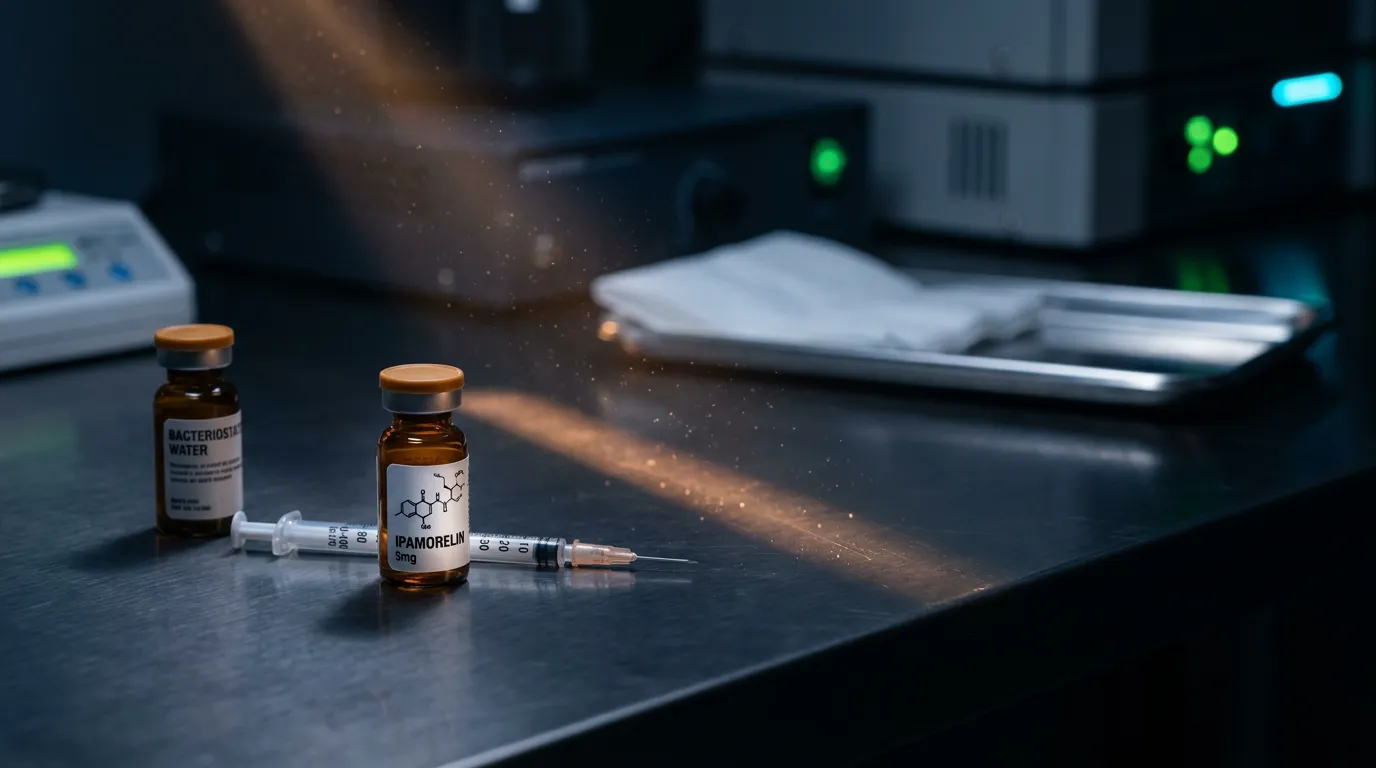
The standard ipamorelin dosage is 200 to 300 mcg per injection, once a day. Inject it under the skin before sleep, on an empty stomach, five days on and two days off. Mix the vial with bacteriostatic water and inject into abdominal fat. Hold that dose for 8 to 12 weeks, then reassess with a qualified clinician.
This page is a manual, not a primer. It assumes you know what a growth hormone secretagogue is. Want the receptor biology and the selectivity data first? Read our guide to growth hormone secretagogues vs HGH. The rest of this page is schedule, technique and math.
What Does the Ipamorelin Dosage Chart Look Like Week by Week?
Protocols converge on a rhythm, not just a number. Ipamorelin clears fast, so most schedules dose it daily. Where they differ is how long you stay on.
| Phase | Duration | Dose | Frequency |
|---|---|---|---|
| Weeks 1 to 2 | 14 days | 100 mcg | Once daily, pre-sleep |
| Weeks 3 to 8 | 6 weeks | 200 to 300 mcg | Once daily, 5 days on / 2 days off |
| Weeks 9 to 12 | 4 weeks | 200 to 300 mcg | Hold steady, reassess at week 12 |
| Between cycles | 4 weeks minimum | None | Off-cycle washout |
The 5-on, 2-off pattern is not arbitrary. Many compounding pharmacy protocols dose this way. It avoids constant receptor occupancy and still gives a pulse most nights. Running for months with no break is common in forum reports. But no published human trial has run it past 12 weeks for body composition or recovery. Treat anything past 12 weeks as unverified. Check in with a qualified clinician before you extend.
How Do You Run an Ipamorelin Injection Protocol Step by Step?
Ipamorelin goes under the skin, not into muscle. The method is simple. Small errors in needle depth and site rotation cause most of the bruising people report.
- Wash your hands and clean the site. Swab the area with alcohol and let it dry fully before you go on.
- Draw the dose. Use an insulin syringe, typically 29 to 31 gauge with a 0.5 inch needle. Draw the volume your concentration calls for.
- Pinch a fold of skin. Abdominal fat 2 inches from the navel is the most common site. Pinch to lift the tissue away from muscle.
- Insert at 45 to 90 degrees. Use 90 degrees for most abdominal fat. Use 45 degrees if you are lean and the fold is thin.
- Inject slowly. Push the plunger over 5 to 10 seconds. A fast injection stings more.
- Withdraw and rotate. Never use the same exact spot two nights running. Rotate between left abdomen, right abdomen and upper thigh.
Rotation matters more on a daily schedule than on a weekly one. Repeated trauma to one pocket of fat is what produces the small hard lumps some users report.
What Is the Ipamorelin Dosage in mL After Reconstitution?
Ipamorelin arrives as a dry powder, usually in a 2mg or 5mg vial. Mixing it wrong is the most common dosing error here. It trips people up more than the shot itself. The table below turns each mix into a volume you can draw.
| Vial size | Bacteriostatic water added | Resulting concentration | Volume for a 200 mcg dose |
|---|---|---|---|
| 2 mg | 2 mL | 1000 mcg/mL (1 mcg per mcL) | 0.2 mL (20 units) |
| 5 mg | 2 mL | 2500 mcg/mL | 0.08 mL (8 units) |
| 5 mg | 5 mL | 1000 mcg/mL | 0.2 mL (20 units) |
Once it is mixed, chill it at 2 to 8°C and use it within 20 to 30 days. Mixed ipamorelin left at room temperature loses potency well before the dry powder would. Our peptide reconstitution guide covers diluent ratios, syringe unit markings and shelf life in more depth.
What Is the Best Ipamorelin Dosage and Timing Window?
Two timing rules show up in almost every protocol. Both come from how the ghrelin receptor pathway behaves.
Fasted. Glucose and insulin in the blood blunt the signal at the pituitary. Inject after a meal, especially a carb or protein heavy one, and the growth hormone pulse measurably drops. The usual advice is a clear 20 to 30 minute window either side of the shot. That means no food for roughly 2 hours before.
Pre-sleep. Your largest natural growth hormone pulse lands in the first hours of deep sleep. A shot 30 to 60 minutes before bed stacks the peptide pulse on top of that surge. Blood growth hormone peaks around 30 to 40 minutes after a shot under the skin. It is back to baseline within 2 to 3 hours. Johansen et al. 1998 That window lines up cleanly with falling asleep.
Some protocols add a second shot straight after training. Hard lifting raises growth hormone on its own, so the two signals stack. That is common practice, not something a trial has tested.
How Does the CJC-1295 Stack Change the Schedule?
This pairing is the most common one out there, and it changes the injection window. CJC-1295 without DAC, sometimes labeled Mod GRF 1-29, binds the GHRH receptor and tells the pituitary to make growth hormone. Ipamorelin binds the ghrelin receptor, GHS-R1a, and tells the pituitary to release it. Two signals, one cell.
| Compound | Typical dose | Timing | Injection site |
|---|---|---|---|
| Ipamorelin | 200 to 300 mcg | Immediately before bed, fasted | Abdominal subcutaneous fat |
| CJC-1295 (no DAC) | 100 mcg | Same injection window as ipamorelin | Same site or adjacent, separate syringe |
Draw the two into separate syringes and inject them within minutes of each other. Their half-lives are close enough that dosing together keeps the pulse pattern. It does not flatten it. Ipamorelin runs roughly 2 hours; CJC-1295 without DAC runs 30 minutes to 2 hours. A 2006 human trial gave one CJC-1295 shot. It raised blood growth hormone 2 to 10-fold, in a dose-dependent way, for 6 days or more. IGF-1 stayed up 1.5 to 3-fold for 9 to 11 days. Teichman et al. 2006 A follow-up found steady GHRH signalling kept the pulses at the same rate and size. It lifted the trough between them 7.5-fold. Ionescu and Frohman 2006 Neither trial gave CJC-1295 with ipamorelin. So the case for the pair rests on mechanism, not a head-to-head study. For the full build-out of this pairing, see our CJC-1295 and ipamorelin stack protocol. If you are weighing its tolerability against running ipamorelin alone, our CJC-1295 side effects and safety guide covers that ground.
Is a Tesamorelin Ipamorelin Blend Dosage Different?
The ipamorelin half does not change. It is the same amount per shot, the same pre-sleep window and the same fasted rule as the schedule above. What changes is the other peptide in the vial. It runs on its own schedule, for its own reasons. Our tesamorelin dosage protocol runs this same operator-manual format for that side of the blend. Read the two together rather than assuming a blend collapses into one rule.
What Does the Ipamorelin Peptide Dosage Evidence Actually Show?
Before you run any of this, be clear about what has been shown in people. The plan above rests mostly on animal work and blood-level data, not big outcome trials.
A landmark 1998 study called ipamorelin the first selective growth hormone secretagogue. Even at doses 200-fold above the ED50 for growth hormone release, it did not raise ACTH or cortisol more than GHRH alone. That set it apart from older GHRPs such as GHRP-6. Raun et al. 1998 Human modeling put the terminal half-life near 2 hours. Growth hormone release tracked the dose, and peaked at roughly 40 minutes. Johansen et al. 1998 In rats, ipamorelin three times daily for 15 days raised the rate of bone lengthening. Bigger doses did more. IGF-1 and bone breakdown markers did not shift. Johansen et al. 1999
The only randomized, placebo-controlled human trial used a drip line at 0.03 mg/kg twice daily. It ran in patients recovering from bowel surgery, not in people chasing body composition. Ipamorelin was well tolerated with no serious adverse events. But it did not meet its primary efficacy endpoint. Beck et al. 2014 That gap is the honest limit under every table on this page. One drip-line trial in surgical patients sits behind the daily shots people actually run. Treat these numbers as a research-informed framework, not a validated prescription.
What Side Effects Show Up Across an Ipamorelin Cycle?
Being selective makes the list shorter than it is for older GHRPs. It does not make it empty. These come up most often during a cycle.
| Side effect | Frequency | Typical management |
|---|---|---|
| Injection site redness or bruising | Common | Rotate sites, slow injection speed |
| Mild headache | Occasional | Often resolves in first week, hydrate |
| Water retention / mild bloating | Occasional | Usually transient, reduce dose if persistent |
| Increased appetite (ghrelin pathway) | Occasional | Expected mechanism, plan meal timing around it |
| Numbness or tingling in extremities | Rare | Stop and reassess with a clinician |
Numbness, tingling or joint pain that will not settle means you stop. Speak to a qualified clinician. Do not wait them out. None of these belong in a well-run protocol.
Which Ipamorelin Dosage Mistakes Do People Make Most?
- Injecting after eating. This blunts the pulse the whole protocol is built around.
- Escalating too fast. Jumping to 300 mcg in week one removes your ability to spot a tolerance issue.
- Skipping the off-cycle window. Running for months with no break has no trial data behind it at any duration.
- Putting CJC-1295 with DAC into a nightly stack. The DAC form has a multi-day half-life and is built for infrequent dosing. Nightly co-injection with ipamorelin flattens the pulse instead of keeping it.
- Storing mixed peptide at room temperature. Once bacteriostatic water goes in, the fridge is not optional.
Where to buy Ipamorelin
The hard part with Ipamorelin isn't the protocol. It's finding a supplier that can prove what's in the vial. We assessed dozens against per-batch, third-party testing. A handful passed.
See the sources that passed →When Should You Stop or Reassess the Protocol?
At the 8 to 12 week mark, most protocols call for a real check-in rather than rolling on. Bloodwork for IGF-1, fasting glucose and HbA1c gives you a hard read. It shows whether you are getting the signal you wanted. It also shows whether your metabolic markers are moving the wrong way. If IGF-1 has not moved after 8 weeks at a steady 200 to 300 mcg, going higher is unlikely to help. Animal work shows the dose-response curve flattens out. The better move is to revisit the stack or the timing, not the milligram figure.
Users report the clearest signal in recovery and sleep depth inside the first 3 to 4 weeks. Body composition changes, where they happen at all, take longer. This content is for educational purposes only. These compounds are intended for research use, and nothing here is medical advice. Work with a qualified clinician before you start, adjust or stack any peptide protocol. Buy only from vendors who publish third-party certificates of analysis. Our recommended sources page lists vendor-neutral options for anyone who wants verified purity first.
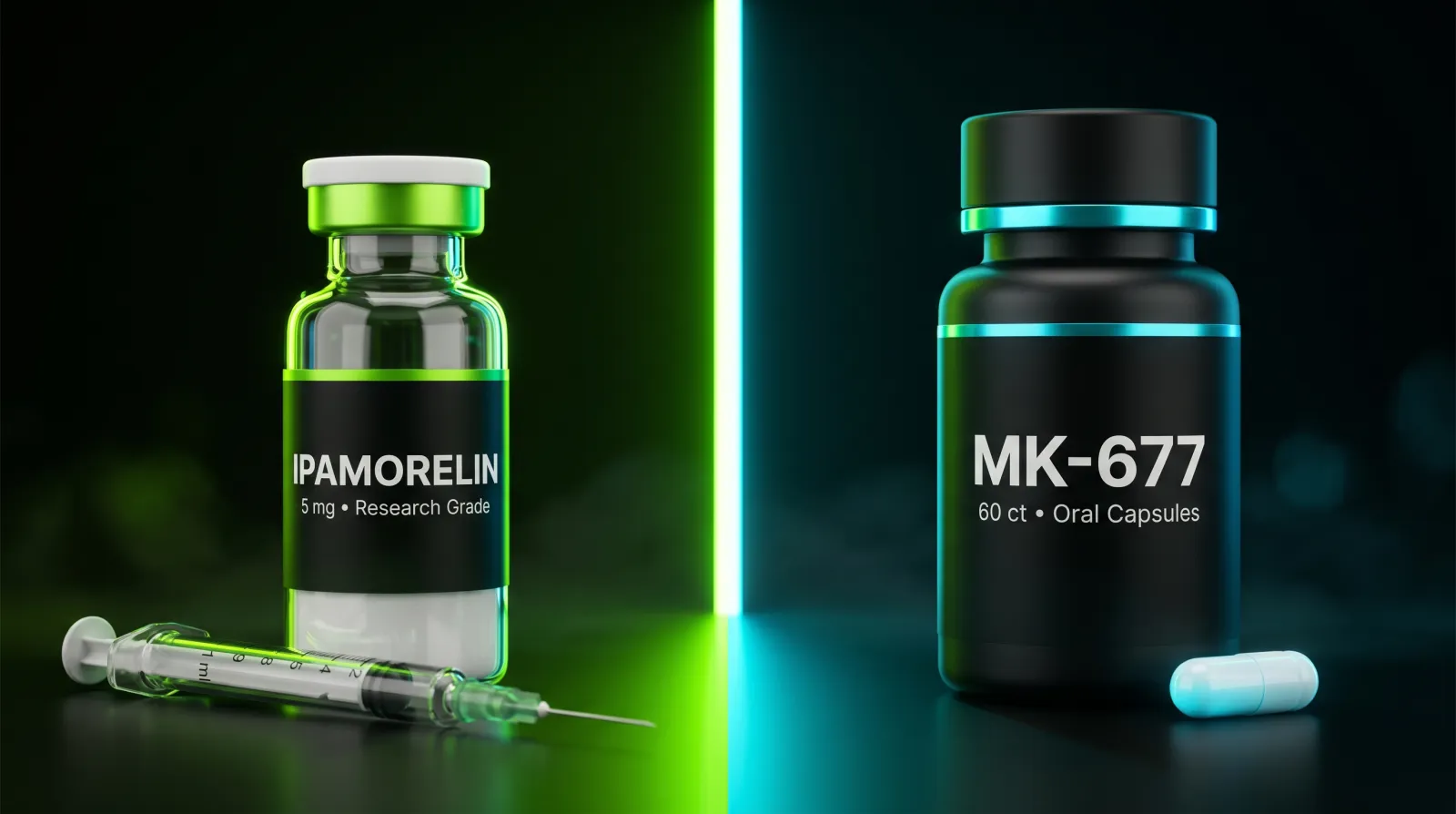
MK-677 hits the same ghrelin receptor pathway, but you swallow it. Our ipamorelin vs MK-677 comparison breaks down the real differences in half-life and daily burden.
Where to buy Ipamorelin
The hard part with Ipamorelin isn't the protocol. It's finding a supplier that can prove what's in the vial. We assessed dozens against per-batch, third-party testing. A handful passed.
See the sources that passed →Share this article
Frequently Asked Questions
What is the standard ipamorelin dosage per injection?
When is the best time to inject ipamorelin?
How long should an ipamorelin cycle run?
Can ipamorelin be stacked with CJC-1295 in the same injection window?
How do you reconstitute ipamorelin for injection?
What are the most common side effects of an ipamorelin protocol?
Read Next

Disclaimer: This content is for educational purposes only. These compounds are intended for research use. Nothing here is medical advice. Always work with a qualified clinician before making changes to your health protocol.