
The Case for Peptide Regulation: An Unpopular Opinion

Why Does the Case for Peptide Regulation Matter Now?
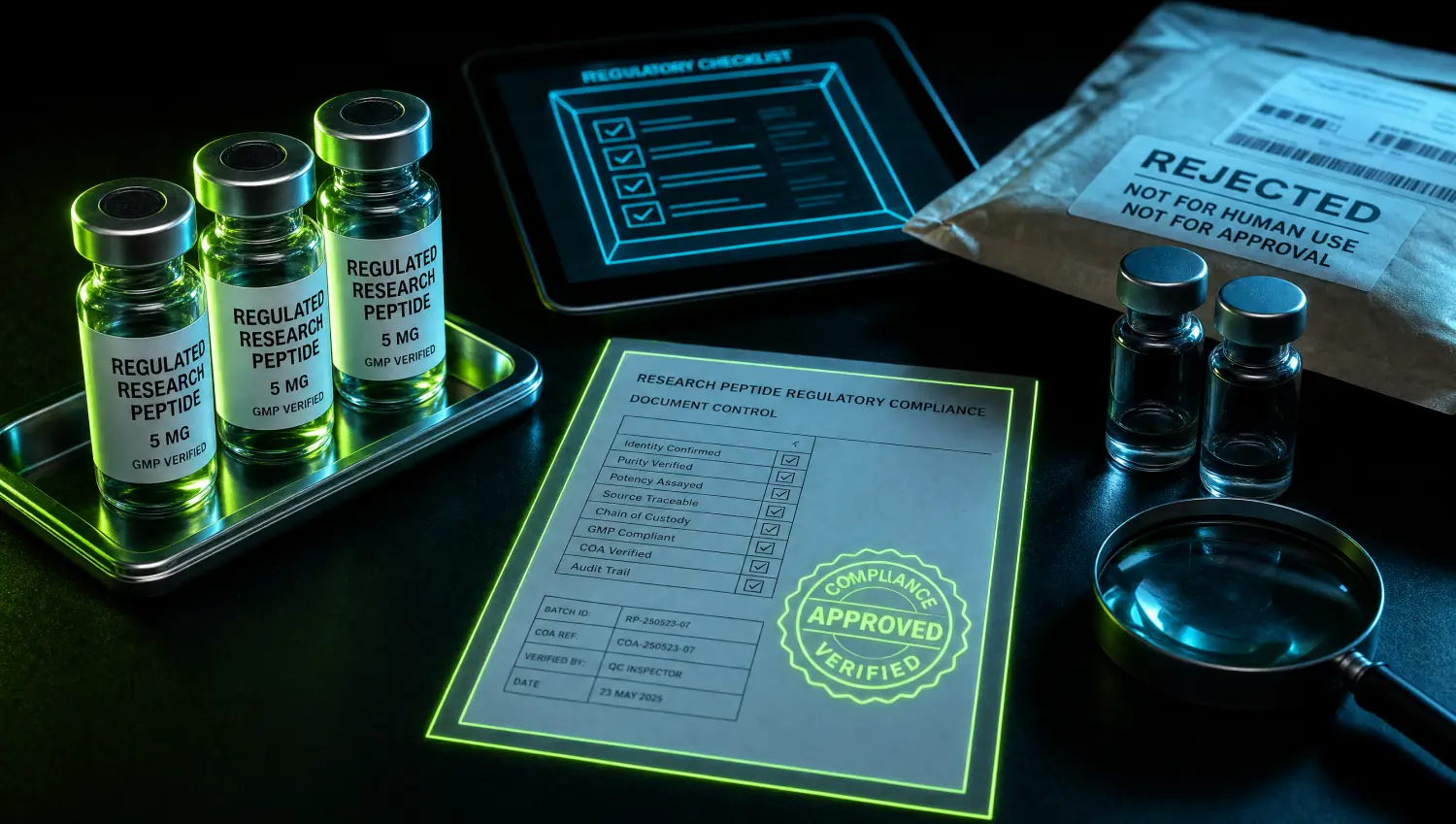
The case for peptide regulation rests on one split. The FDA approved 34 peptides between 2016 and 2024. Vials sold outside that system fail basic quality checks in about 30% of samples. That gap between proven medicine and unverified product is the whole argument. It is worth reading before you decide where you stand.
This is an unpopular opinion in parts of the biohacking world. Regulation gets framed there as the enemy of access. But you've trained long enough to know a shortcut from a structure. Regulation isn't the opposite of performance. It's the scaffolding that makes performance repeatable.
What Do FDA-Approved Peptides Actually Look Like?
An approved peptide has a fixed identity and a fixed purity spec. It earns that the slow way. Alshaer 2026 counts 34 FDA peptide approvals between 2016 and 2024. They cover cancer, antimicrobial and neurological uses, and every one ran through Phase I to III trials first.
The 2024 class held two peptides. They were palopegteriparatide and pegulicianine, and both carry a large PEG chain, per de la Torre and Albericio 2025. That chain slows how fast the body clears the drug.
Approval buys you the rest of it: a set dose, a set way of making it, and a batch that matches its label every time.
Now compare that with a vial shipped with no batch testing and no paper trail. Same class of molecule, and a completely different risk.
Where Is the Regulatory Gap in Peptide Medicine?
The gap isn't that oversight is missing. It is that almost none of it was written for peptides. Regulators still borrow rules made for small molecules and rules made for biologics. Neither was built for a chain of amino acids.
Mitra 2020 built a data set of 47 peptides approved in the United States from 1998 onwards. The paper found no peptide rule book at all. Industry leaned on small-molecule rules on one side and biologic rules on the other.
Elsayed 2025 finds the same pattern in current FDA, EMA and ICH guidance. That guidance covers quality control and stability testing, and it is patched together rather than built for peptides. The same review puts peptide and protein drugs at about 25% of the world drug market (PMC11806371).
So the field grew fast while its rule book stayed thin.
What Is Actually in Gray-Market Peptide Vials?
A 2026 review by BSCG finds a problem in about 30% of gray-market peptide samples. The fault is mislabelling, the wrong dose, or contamination. BSCG tests and certifies products for a living, so read that as an industry count, not a trial. The same review gives the reason it lasts: no GMP rules apply here at all.
Testing has turned up endotoxins, heavy metals and truncated peptide sequences in these vials. Solvent residues, microbial growth and broken-down product show up too.
Hailu 2026 looked at this market as a public health problem. The risk isn't only what is missing from a vial. Digital promotion, self-injection, stacking and casual dosing all add risk on top of it.
The review flags sterility, mixing technique and dose accuracy as risks that come with the needle. It calls for better clinician awareness and proper adverse-event reporting. It lists injection-site infections, allergic reactions and endocrine upset among the harms that still need proper study.
What Did the July 2026 Compounding Vote Change?
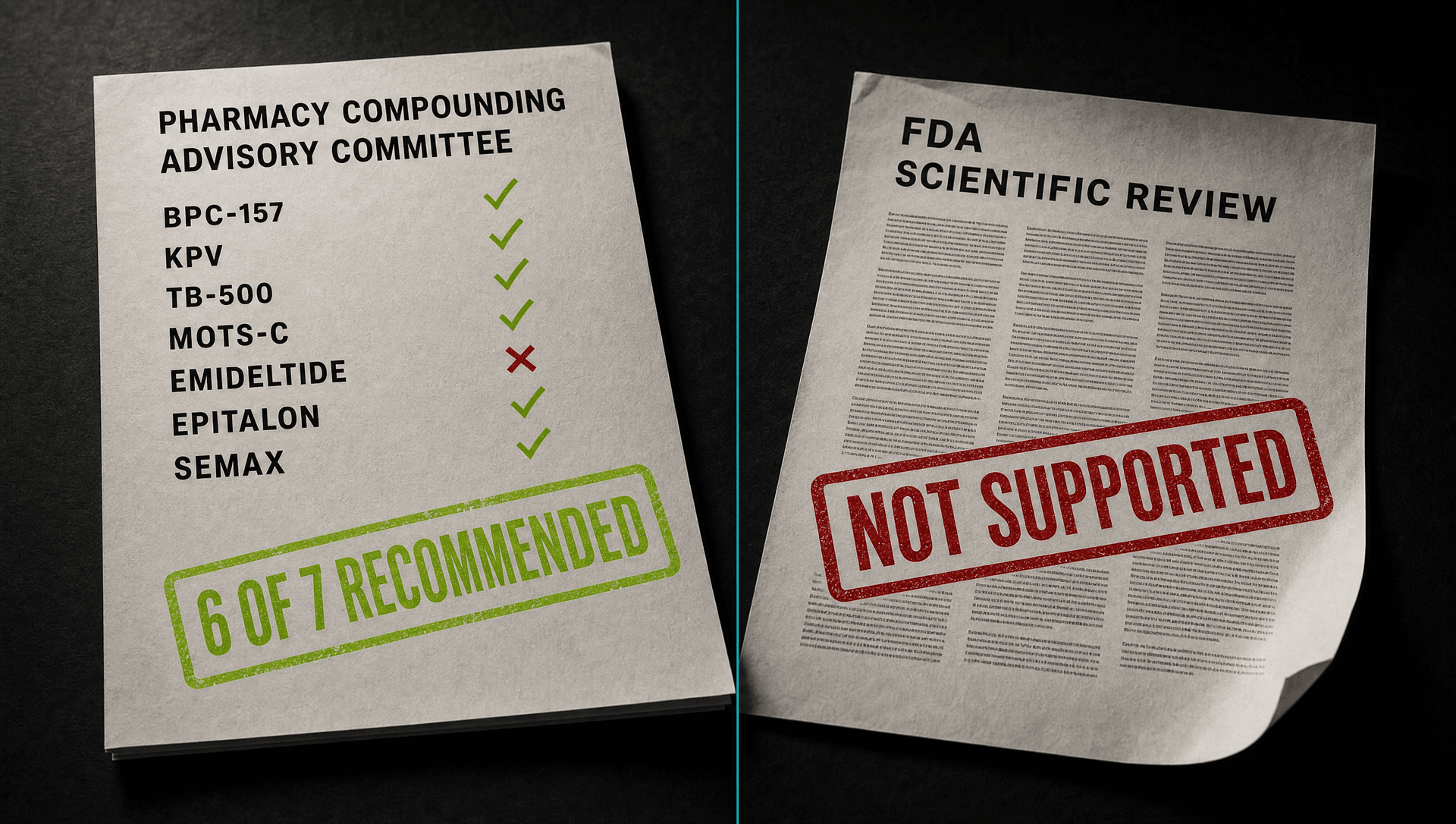
In late 2023 the FDA put a group of peptides into Category 2, BPC-157 and TB-500 among them. That meant the agency would not look the other way while a pharmacy made them. In July 2026 its advisory committee backed six of seven peptides for the bulks list that compounding pharmacies draw from. That was advice, not a rule change. Our breakdown of the FDA compounding rules for peptides sets out what each step allows.
Here is the part worth holding onto. Category 2 never banned a peptide outright. It withdrew the tolerance that let a pharmacy make one. Demand didn't fall with it. Demand moved to the gray market those same regulators warn about, as our piece on the grey market problem traces.
So the rule and the outcome pull in opposite directions. That tension is the whole fight.
Would Harmonised Standards Fix the Quality Gap?
Yes, and the problem is old.
Vergote 2009 found that the rule books for peptide quality were barely lined up. The European Pharmacopoeia and the United States Pharmacopeia set different pass marks for the same molecule. Makers had to run the same test two different ways.
That gap is what lets weaker product slip through. One global standard for identity, purity and shelf life would remove the reward for making peptides wherever the fewest questions get asked.
What Does This Mean for How You Source?
Regulation is what lets you trust a compound without testing every batch yourself. The unpopular part of this opinion isn't that regulation is good. It's that the system we have is too thin, too patchy and too slow for a market this size.
| What you are buying | FDA-approved route | Gray-market vial |
|---|---|---|
| Identity and purity spec | Fixed and published | Set by the seller, if at all |
| Batch testing | Required under GMP | No GMP rules apply |
| Sterility and endotoxin checks | Part of release testing | Rarely evidenced |
| Quality failure rate | Not applicable | About 30% of samples |
| Oversight after sale | Post-market surveillance | None |
None of this means avoid peptides. It means buying with the same care you'd bring to any other training input. You want to know what is in the vial, how pure it is, and that the seller can show their work. Ours sits on the recommended sources page.
For the checks themselves, our guide on how to know if peptides are real walks through them. Our breakdown of peptide testing labs and purity verification covers what a certificate of analysis should show you.
Where to buy peptide regulation
If you're researching sourcing standards for peptides, we've linked a trusted breakdown of vetted sources below. It supports the channel.
See the sources that passed →Bibliography
Alshaer et al. 2025 FDA TIDES (Peptides and Oligonucleotides) Harvest. PMC12943124
Mitra et al. Development of peptide therapeutics: A nonclinical safety assessment perspective. PubMed 32827570
Elsayed et al. Regulatory Guidelines for the Analysis of Therapeutic Peptides and Proteins. DOI 10.1002/psc.70001, PMC11806371
De, Albericio. The Pharmaceutical Industry in 2024: An Analysis of the FDA Drug Approvals from the Perspective of Molecules. PMC11820978
Vergote et al. Quality specifications for peptide drugs: a regulatory-pharmaceutical approach. DOI 10.1002/psc.1167
Hailu et al. Unregulated Peptide Use in the Age of Biohacking: Digital Promotion, Gray-Market Access, and Emerging Public Health Risks. PMC13355462
BSCG. What's Changing With Peptide Regulation in 2026. bscg.org
This content is for educational purposes only. These compounds are intended for research use. Nothing here is medical advice. Always work with a qualified clinician before making changes to your health protocol.
Share this article
Frequently Asked Questions
Why do peptides need regulation?
What are the quality differences between regulated and unregulated peptides?
Are all peptides FDA-approved?
What happened to compounding regulations for peptides?
Why is regulatory harmonisation important for peptides?
Is buying unregulated peptides ever worth the risk?
Read Next
Disclaimer: This content is for educational purposes only. These compounds are intended for research use. Nothing here is medical advice. Always work with a qualified clinician before making changes to your health protocol.