
Ipamorelin vs MK 677: Which One Fits Your Goal

Ipamorelin vs MK 677: Which One Should You Run?
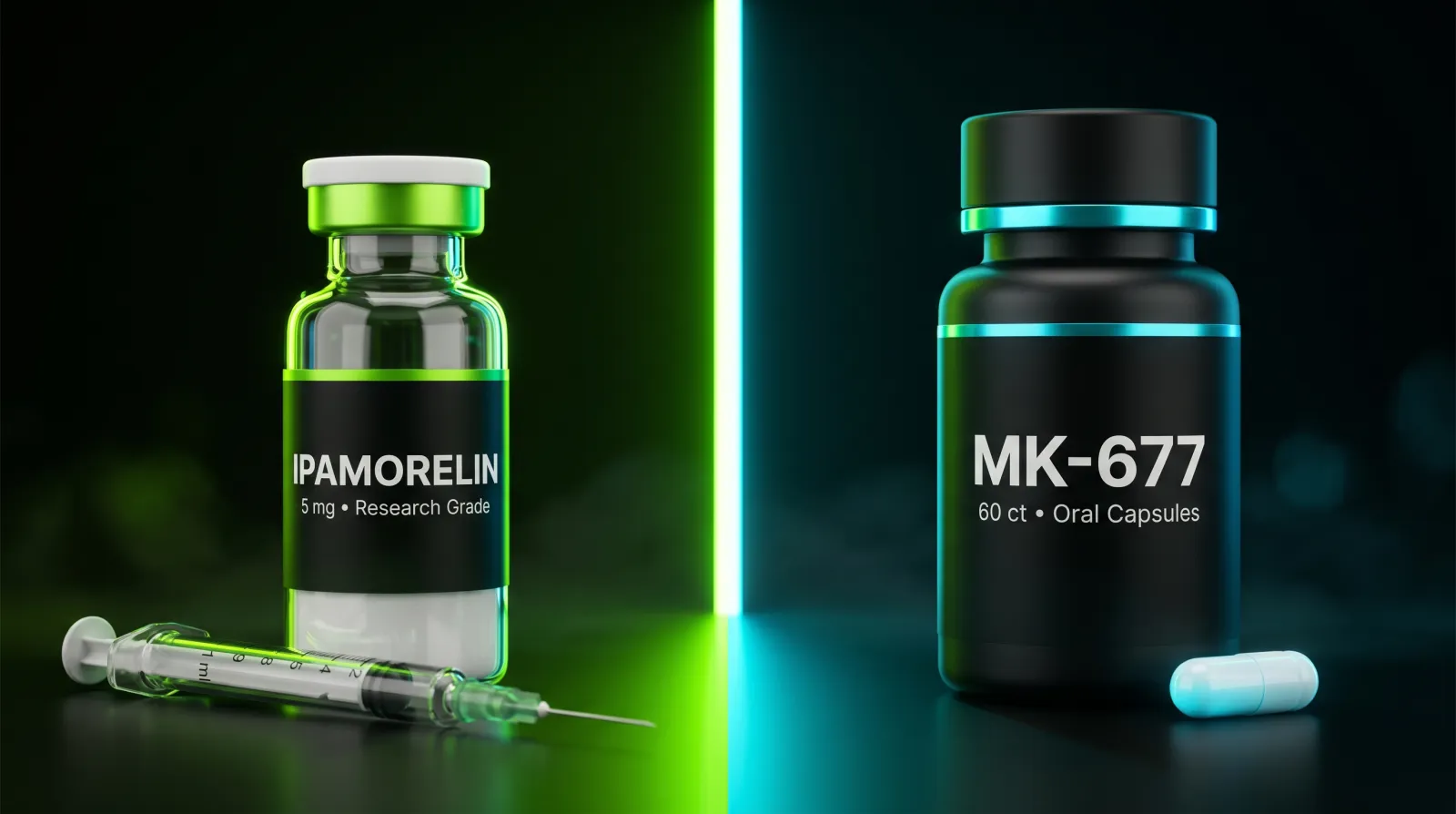
Ipamorelin vs MK 677 comes down to one trade-off. Ipamorelin is an injected peptide that gives a short burst of growth hormone. MK-677 is a once-daily pill. It raises 24-hour GH and IGF-1, a growth factor GH drives, but it raises fasting glucose and hunger. The ipamorelin studies cited here did not measure glucose. MK-677 skips the needle.
Is Ipamorelin MK677 Under Another Name?
No. They are two molecules that hit one shared target. Ipamorelin (NNC 26-0161) is a synthetic pentapeptide, a made-up chain of five amino acids. You inject it. MK-677, sold as ibutamoren, is a small molecule, a compact drug not built from amino acids. You swallow it. Both are potent agonists, drugs that switch a receptor on, at the receptor for ghrelin, a hormone that drives hunger. That receptor is called GHS-R1a. That shared target is why the two get mixed up. Almost everything past it differs.
Ipamorelin vs MK677: How Does Each One Release GH?
Ipamorelin was built to be selective, which means picky. It releases GH and leaves cortisol, ACTH and prolactin alone. Prolactin is the hormone behind milk production. ACTH is the hormone that tells the body to make cortisol. In pigs, ACTH and cortisol after ipamorelin were no different from after GHRH, the body's own GH-releasing hormone. That held even at doses more than 200-fold above the ED50, the dose that gives half the peak GH release. Raun et al. 1998. The older drugs GHRP-6 and GHRP-2 push up both ACTH and cortisol.
In healthy men given ipamorelin as a 15-minute infusion, a slow drip into a vein, GH rose in a single burst. It peaked at 0.67 hours, about 40 minutes, then fell away to almost nothing. The drug's half-life, the time for half of it to clear, was about 2 hours. Gobburu et al. 1999. Ishida & Saitoh 2020 review this whole drug family, the GH secretagogues, drugs that make the body release GH. In rats, roughly 20% gets in by the intranasal route, through the nose. Most leaves the body in urine. Johansen et al. 1998 found its plasma clearance, the rate the blood is cleaned of it, was 5-fold lower than GHRP-6's.
MK-677 is a non-peptide small molecule, a drug that is not a chain of amino acids. It docks in the receptor's main binding site, the orthosteric pocket, where ghrelin itself sits. Liu et al. 2021 imaged MK-677 there with cryo-EM, a way of picturing frozen molecules. Wang et al. 2021 mapped the same pocket with ghrelin and GHRP-6. The pill form is the selling point. At 25 mg a day, average GH over 24 hours rose 1.8-fold and IGF-1 rose 1.5-fold, through bigger GH pulses (Nass et al. 2008). It does more than raise GH. In its two-year trial, appetite and fasting glucose rose as well.
MK-677 vs Ipamorelin Research Comparison: What Do the Trials Show?
Human data is lopsided.
MK-677 has a two-year randomised, placebo-controlled trial in 65 healthy older adults. Placebo-controlled means one group took a dummy pill. Fat-free mass, body weight minus fat, rose about 1.1 kg. The placebo group lost 0.5 kg. GH and IGF-1 climbed to young-adult levels. Fasting glucose rose and insulin sensitivity, how well insulin works, fell. Nass et al. 2008. Strength and function did not improve, despite the lean mass gain. Eight weeks at 25 mg a day in obese men also lifted markers of bone resorption, or breakdown, and bone formation. CTX, a blood marker of bone breakdown, rose 26% and the urine hydroxyproline to creatinine ratio, another bone breakdown marker, rose 23%. IGFBP-5, a protein that carries IGF-1 in the blood, rose 43 to 44%. Svensson et al. 1998.
Ipamorelin has nothing of that size. Most of its evidence is preclinical, meaning animal work. Jiménez-Reina et al. 2002 dosed young female rats for three weeks. The pituitary is the gland under the brain that makes GH. Its GH-making cells are called somatotrophs. Their secretion granules, tiny stores of hormone, took up more of each cell. At rest, the share of somatotrophs did not change. Those cells also held less GH than in rats given salt water. When stimulated again in a dish, they held more GH, and their share rose. Andersen et al. 2001 dosed adult rats at 100 µg/kg three times a day for three months. It counteracted the drop in bone formation caused by a glucocorticoid, a cortisol-like drug. Periosteal bone formation rate, at the outer bone surface, rose 4-fold against glucocorticoid alone. Venkova et al. 2009 gave repeat doses to male rats with postoperative ileus, a stalled gut after surgery. Stool output, food intake and body weight gain all rose significantly.
Ibutamoren vs Ipamorelin: Which One Raises Blood Sugar?
MK-677 does. The ipamorelin studies cited here did not measure blood sugar. In MK-677's two-year trial, fasting glucose rose by about 0.3 mmol/L. That is roughly 5 mg/dL. Insulin sensitivity fell too. Ipamorelin was built to be selective. In pigs, its ACTH and cortisol response did not differ from GHRH's. Repeated doses into a vein still raised food intake in rats after surgery (Venkova et al. 2009). Are you a man of 35 or over who tracks fasting glucose, HbA1c or insulin? HbA1c is a three-month average of blood sugar. For that reader, this is the deciding line.
MK 677 Versus Ipamorelin: How Do You Dose Each One?
| Parameter | Ipamorelin | MK-677 |
|---|---|---|
| Route | Injection: under the skin in Andersen et al. 2001, by infusion in Gobburu et al. 1999 | By mouth (Nass et al. 2008) |
| Dose in the cited studies | 100 µg/kg three times daily, in adult rats (Andersen et al. 2001) | 25 mg once daily, in older adults (Nass et al. 2008) |
| GH pattern | One burst, peak at 0.67 hours after a 15-minute infusion, in healthy men (Gobburu et al. 1999) | 24-hour average GH up 1.8-fold, through bigger pulses (Nass et al. 2008) |
Fasting glucose and blood pressure are the two numbers to have on record before either compound, and at set points after. This is educational information about research use protocols, not a prescription. A qualified clinician can advise on any health decision, and that advice belongs before starting, above all where there is metabolic risk.
Which Side Effects Separate Ipamorelin vs Ibutamoren?
The ipamorelin studies cited here do not report side effects in people.
MK-677 has a side-effect record in people. In its two-year trial, the most frequent were a rise in appetite and mild, passing swelling of the lower legs. Muscle pain was another. The appetite rise eased within a few months (Nass et al. 2008). Then there are the blood sugar effects above. A trial in elderly patients recovering from hip fracture was stopped early. It was stopped over a safety signal of congestive heart failure in a limited number of patients. In heart failure, a weak heart lets fluid build up. Adunsky et al. 2011. The authors judged MK-677's safety profile unfavourable in that group. That group was elderly and recovering from a broken hip. The signal still belongs in any honest comparison.
MK-677 is a poor fit for anyone with diabetes, prediabetes or insulin resistance, or with any of these in the family. Insulin resistance means insulin works less well. That diabetogenic signal, the push towards diabetes, is well documented. The same goes for anyone with a heart history. Ipamorelin is a poor fit for anyone not ready for subcutaneous injection, into the fat under the skin, and cold-chain storage. Cold-chain means the drug is kept cold the whole way. It is also a poor fit alongside any medication that interacts with growth hormone axis modulation, meaning drugs that change the GH system. Neither compound belongs in a protocol without physician oversight if you have active or historical cancer. Raised IGF-1 carries theoretical concerns about how tumours grow. The literature has not settled them.
What Do People Get Wrong in an Ipamorelin vs MK-677 Comparison?
Four mistakes come up again and again.
The first is picking MK-677 to skip the needle. If your glucose already sits near the line, that swap is not worth it. The second is expecting a shot to cover 24 hours. A drug that gives short bursts does not work that way. The third is skipping baseline bloodwork. Fasting glucose, HbA1c and a lipid panel, a blood fat test, are your only early warning. They count before and during. The fourth is buying from a vendor nobody has checked. Purity and dose accuracy are common problems here. Reading how to read a peptide COA first takes five minutes.
Where to buy Ipamorelin
The hard part with Ipamorelin isn't the protocol. It's finding a supplier that can prove what's in the vial. We assessed dozens against per-batch, third-party testing. A handful passed.
See the sources that passed →Where Should You Buy Either Compound?
Both sell widely as research chemicals. Quality swings hard between vendors. The guide on how to know if peptides are real covers the checks before a purchase. A batch can then be matched against its certificate of analysis. We keep our recommended sources for vendors that publish third-party COAs, lab reports from an outside lab. That is not a promise of outcome. It does cut the odds of a weak or dirty product. New to needles? How to inject peptides and how to reconstitute peptides cover the handling steps most guides skip.
What Should You Stack It With?
The CJC-1295 ipamorelin stack protocol pairs a drug that acts like the body's GH-releasing hormone with one that acts on the ghrelin receptor. No human trial of the pair has been published. Want broader anti-ageing and body work? Tesamorelin vs sermorelin and growth hormone secretagogues vs HGH map the wider field. Recovery stacks outside the GH system are covered in peptide stacks that work.
This content is for educational purposes only. These compounds are intended for research use. Nothing here is medical advice. A qualified clinician can advise on any health decision. That advice belongs before starting, most of all where there is metabolic or heart risk.
Where to buy Ipamorelin
The hard part with Ipamorelin isn't the protocol. It's finding a supplier that can prove what's in the vial. We assessed dozens against per-batch, third-party testing. A handful passed.
See the sources that passed →Share this article
Frequently Asked Questions
Can I take MK-677 instead of injecting CJC-1295 and ipamorelin to get similar GH-axis benefits?
What is the typical research dose for ipamorelin versus MK-677?
Does ipamorelin raise cortisol or prolactin like older GHRPs?
Why does MK-677 cause water retention and increased appetite?
Is MK-677 safe for someone with prediabetes or a family history of diabetes?
Can ipamorelin and MK-677 be stacked together?
Read Next

Disclaimer: This content is for educational purposes only. These compounds are intended for research use. Nothing here is medical advice. Always work with a qualified clinician before making changes to your health protocol.