
What Are Peptides? A Beginner's Guide to How They Work


What are peptides?
What are peptides? Peptides are short chains of 2 to 50 amino acids, joined by peptide bonds. Your body makes hundreds of them already. They work as signals, not building blocks: each one binds a receptor on a cell and tells it to do something. Think message, not material.
If you met peptides through a podcast or a longevity forum, you met the noise too. Hype on one side, blanket dismissal on the other. Neither helps.
This guide is for men 35 and over who want a clear foundation first. No bro-science, no promises. Just the biology, the categories, the regulatory picture, and where a beginner should start.
Proteins are the obvious comparison. Both are amino acid chains, but size and job separate them. Peptides run roughly 2 to 50 residues, meaning amino acid units, and stay loosely structured. Proteins run 50 to thousands and fold into fixed 3D shapes. Peptides carry signals. Proteins build structure or drive reactions.
The NIH StatPearls biochemistry reference defines a peptide as a short string of 2 to 50 amino acids formed by condensation. Condensation is a reaction that joins two molecules and gives off water. Each one is joined to the next by a covalent bond, a strong link made of shared electrons. The University of Queensland puts it the same way: most peptides in the human body run around 20 amino acids.
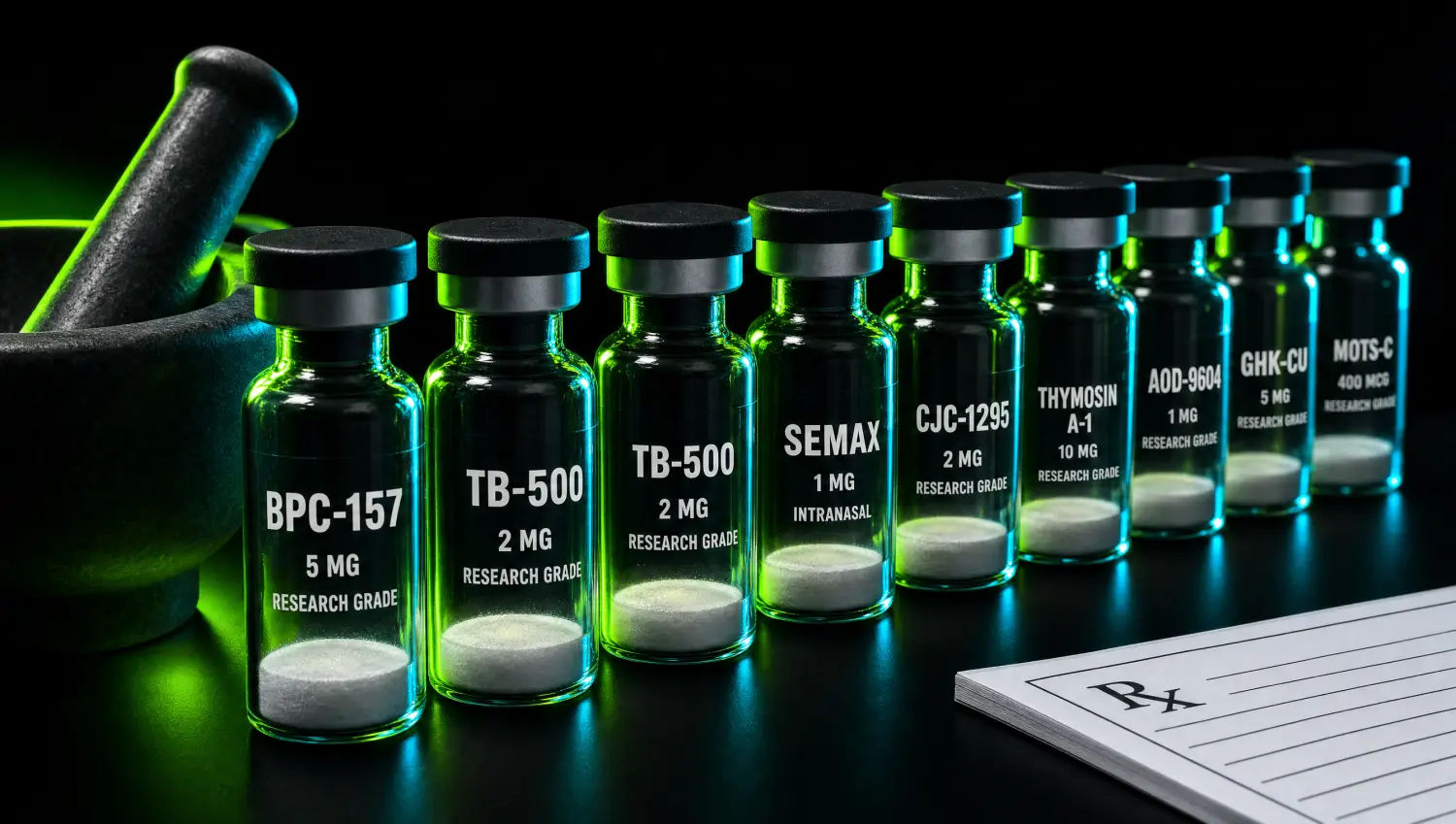
Here is the mental model that matters. Collagen or keratin is material, the scaffolding your tissue is built from. A peptide like BPC-157 or CJC-1295 is a message, a short instruction to a specific receptor. You don't take a peptide to become bigger. You take one to tell your body to do something it already knows how to do.
This content is for educational purposes only. Peptides discussed here are intended for research use, and nothing here is medical advice. Affiliate disclosure: this post may include a referral link, and we keep a vendor-neutral recommended sources page so you can compare independently.
What are peptides and how do they work?
Mostly by binding a receptor.
A peptide attaches to a specific receptor on a target cell's surface. That binding starts a signalling cascade inside the cell, a chain of steps where each one triggers the next. The cascade can switch on gene expression, raise protein synthesis, regulate hormone output, or shift immune activity. Gene expression means a gene being read to make a protein. Which pathway fires depends entirely on which receptor matched.
A foundational PubMed review on peptide hormones and growth factors describes it directly. Peptide hormones and growth factors start signalling by binding and activating cell surface receptors. Those receptors then modulate surface enzymes and adaptor proteins, setting off a chain reaction with metabolic and proliferative effects. Enzymes are proteins that speed up chemical reactions. Adaptor proteins link a receptor to the next step in the chain. Metabolic effects change the chemical processes that keep cells running. Proliferative effects drive cells to grow and divide. A separate review notes that peptides bind G-coupled surface receptors to initiate a signal transduced into the cell through layers of phosphorylating enzymes. G-coupled receptors are a large family of receptors on the cell surface. Transduced means relayed from outside the cell to inside. Phosphorylating enzymes switch other proteins on or off by adding a phosphate group.
Picture a lock and key at cellular scale. Each peptide has a shape. Only certain receptors match it. When the peptide binds, the receptor changes shape, and that change triggers the cascade. The response only happens where the matching receptor is actually expressed.
So the practical takeaway is this. Peptides are not a nutrient your body burns for fuel. The value is in the instruction, not the mass. That is also why microgram dosing errors matter far more here than they would with a protein powder. A microgram is a millionth of a gram.
What are peptides used for?
Research peptides sort into four functional clusters. Each targets a different mechanism, and each carries a different weight of evidence.
Recovery and tissue repair
BPC-157 and TB-500 anchor this group, both with large preclinical datasets. Preclinical means tested in cells or animals, not in people. A 2025 study looked at BPC-157 in a rat model of quadriceps muscle-to-bone detachment. The quadriceps is the large muscle at the front of the thigh. Healing effects held at every time point from day 1 through day 90. The sciatic nerve runs down the back of the leg. Earlier work on sciatic nerve injury found faster axonal regeneration and improved functional recovery measured by EMG and walking tests. Axonal regeneration is the regrowth of nerve fibres. EMG records the electrical signal in a muscle. These are animal studies. Translation to humans has not been confirmed in randomised controlled trials, and that caveat belongs in the frame every time. In those trials, chance decides which people get the treatment being tested. For dosing and delivery, see our breakdowns of BPC-157 oral versus injectable administration and the TB-500 dosage protocol.
Growth hormone axis modulation
Growth hormone-releasing peptides and GHRH analogues act at different points on the GH axis. The GH axis is the chain of brain and gland signals that controls growth hormone (GH). An analogue is a man-made copy of a natural molecule. GHRH is growth hormone-releasing hormone, made in the brain. Growth hormone-releasing peptides (GHRPs) like Ipamorelin work mainly at the pituitary, a small gland under the brain. Ghrelin, the body's own GH-releasing peptide, acts mainly at the hypothalamus, the brain region that controls the pituitary. A review on GH regulation says ghrelin may amplify the basic pattern of GH release. It may do this by making somatotrophs more responsive to GHRH. Somatotrophs are the pituitary cells that make GH. The point: these act on the GH release your body already runs. They do not replace GH. CJC-1295 extends the GHRH signal, which is why it is often paired with Ipamorelin. Our growth hormone secretagogues versus HGH comparison covers that. A secretagogue makes a gland release its own hormone. HGH is human growth hormone itself.
Cognitive and neurological support
Selank and Semax lead this cluster, both synthetic analogues of natural neuropeptides. Neuropeptides are peptides that carry signals in the brain and nerves. A 2020 analysis of seized preparations identified Selank and Semax marketed for nootropic effects. Nootropic means claimed to boost thinking or memory. The authors noted that, to their knowledge, neither had completed any clinical trials. Both sit in the research category, not the approved-medicine one.
Metabolic and anti-ageing pathways
GLP-1 agonists sit at the validated end of this cluster. GLP-1 is a gut hormone that helps control blood sugar and appetite. An agonist is a drug that switches on that hormone's receptor. AOD-9604 and GHK-Cu are studied for fat metabolism and for skin or connective tissue, on a much earlier evidence base.
What are peptides supplements, or something else?
Something else. This is worth being blunt about, because the confusion causes real dosing errors.
Peptides are not a bulk nutrient and they do not work like a protein shake. Their value is informational, not structural. That is why research peptide doses are measured in micrograms rather than grams.
They are also not a supplement in the regulatory sense. Most research peptides have no long-term human safety data.
What peptides are FDA approved?
Quite a few. A 2024 database of FDA-approved protein drugs counts 85 peptides or polypeptides. Polypeptides are longer peptide chains.
Semaglutide, a GLP-1 drug sold as Ozempic, is FDA-approved. It is a man-made analogue of the natural hormone GLP-1, with 94% of the same sequence. It is built to bind albumin, a blood protein, and to resist breakdown by the enzyme DPP-4. That gives it a half-life of about one week, per the FDA prescribing information for Ozempic. Half-life is the time it takes the body to clear half of a dose.
Many research peptides are not approved. A 2025 review says the FDA has not approved BPC-157, as there are too few human studies.
| Peptide category | Example compounds | Evidence stage | Human trial status |
|---|---|---|---|
| Metabolic (GLP-1 class) | Semaglutide, tirzepatide | Clinically validated | FDA-approved, multiple phase 3 trials |
| Recovery / tissue repair | BPC-157, TB-500 | Strong preclinical | Animal models only, no completed human RCTs |
| GH axis | CJC-1295, Ipamorelin | Mechanistic + anecdotal | Limited human data on the specific research-grade compounds |
| Cognitive | Selank, Semax | Early research | No completed clinical trials known to a 2020 analysis; not FDA-approved |
The gap between the first two rows is the single most important thing to internalise. GLP-1 peptides went through the full clinical pipeline. Most recovery and cognitive research peptides have not. Treating them as equal in evidence weight is where bad decisions start.
What are the side effects of peptides?
Mixed, and honestly under-studied.
In a 1998 study in pigs, Ipamorelin released growth hormone without the cortisol rise seen with two older compounds. It did not change prolactin. Cortisol is a stress hormone, and prolactin is a hormone made by the pituitary. That is animal data, not a human safety record. Others carry theoretical risks around cell proliferation (growth and division) pathways that long-term human data has not ruled out. This is not medical advice.
The honest answer for most compounds here is that long-term human safety data does not yet exist at the scale it does for approved drugs. That is not a reason to panic. It is a reason to treat every research peptide as a research compound.
What peptides are good for muscle growth?
None of them build muscle directly, and that framing trips people up.
The GH-axis peptides are the ones usually meant. They act on your own growth hormone release rather than replacing GH. The recovery peptides sit alongside them: the BPC-157 muscle-to-bone work above is repair evidence, not growth evidence.
Our breakdown of the best peptides for men over 40 covers that age group. And our guide to peptide stacks that actually work covers which combinations have a real mechanistic basis.
How peptides are supplied
| Form | Common examples | Stability | Practical note |
|---|---|---|---|
| Lyophilised (freeze-dried) vial | BPC-157, TB-500, CJC-1295 | Stable for years unreconstituted, refrigerated | Requires bacteriostatic water and correct reconstitution before use |
| Pre-mixed solution | Some Ipamorelin, GHK-Cu blends | Weeks to months once mixed | Shorter shelf life once liquid; store cold |
| Nasal spray | Semax, Selank formulations | Moderate | Common outside the US; absorption profile differs from injectable |
| Oral tablet/capsule | Semaglutide (Rybelsus), some experimental peptides | Formulation-dependent | Most peptides degrade in the gut without special coating; injectable remains the reference standard |
If a vial arrives lyophilised (freeze-dried), the reconstitution volume changes the concentration you are working with. Reconstitution means adding liquid to the powder. We cover the process in how to reconstitute peptides correctly.
How do you source and verify a peptide?
With a batch-specific Certificate of Analysis (COA) from an independent lab. It should show HPLC purity data and mass spectrometry identity data. HPLC (high-performance liquid chromatography) separates a sample into its parts to measure purity. Mass spectrometry weighs the molecule to confirm what it is. A purity number with no chromatogram, the trace the HPLC test prints, is a claim, not evidence.
Fake and illegal peptide products have been seized in several European countries. In Belgium, the medicines agency and customs send suspect products to a state lab, per an analysis of illegal peptide biopharmaceuticals encountered by controlling agencies. That lab built a screening test using liquid chromatography-tandem mass spectrometry. The test separates a sample, then identifies each peptide by its mass. That is the scrutiny this market needs, and it is why a single in-house COA from the seller is not enough.
Does the supplier give a batch-specific COA from a named external lab? Does that COA include a chromatogram, not just a percentage? Does the batch number on the vial match the paperwork? We walk the full checklist in how to read a peptide COA and how to know if peptides are real. For vendors that meet the bar, see our guide to reliable peptide sources.
Where to buy BPC-157
Get the complete framework for peptide therapy in The Peptide Edge, the Underground Biohacking field guide for men 35 and over.
See the sources that passed →Where should a beginner actually start?
With one change at a time.
With one compound and a written log, a change you notice has one likely cause. Add a second peptide at the same time and you lose the ability to tell which one is doing what. For peptides studied for weight loss, ranked by evidence, see our weight loss guide.
These are the mistakes that cost beginners most.
- Treating dose sizes like supplements. Research peptides are dosed in micrograms, not grams. A tenfold error is easy with a poorly calibrated syringe and a badly labelled vial.
- Skipping the Certificate of Analysis. A purity percentage with no chromatogram is a claim.
- Assuming animal data equals human data. Most recovery peptide literature is preclinical. It is a strong signal, not proof.
- Mixing categories without understanding the mechanism. Stacking a GH-axis peptide with a metabolic one, without knowing how each signals, can compound side effects you did not expect.
- Buying on price alone. The cheapest vial is rarely the cleanest. Synthesis and third-party testing cost money, and that cost shows up somewhere.
Peptides are signalling molecules, not building blocks. That one distinction shapes how to read everything else here. It shapes which compound a study used and what dose it tested. It also shapes how much weight an animal study carries next to a completed clinical trial.
Share this article
Frequently Asked Questions
What are peptides in simple terms?
What do peptides actually do in the body?
What are peptides used for in research?
Are peptides the same thing as steroids?
What are collagen peptides, and are they the same thing?
What is the difference between a peptide and a protein?
Read Next


Disclaimer: This content is for educational purposes only. These compounds are intended for research use. Nothing here is medical advice. Always work with a qualified clinician before making changes to your health protocol.