
Are Peptides Legal in 2026? The Honest FDA Answer

Are Peptides Legal in 2026?
Are peptides legal? No, not in the way most people mean. None of these eight is an FDA-approved drug. FDA's reviews of seven found no USP monograph (official quality standard) and no approved drug containing them. None is on the 503A bulks list (FDA's list of raw ingredients pharmacies may use). So no pharmacy may compound (custom-make) those seven today.
This year brought an advisory meeting, category changes and plenty of headlines. None of that changed the law. No new rule has appeared for any of these peptides.
All eight sat in FDA's Category 2 at some point. That is the group FDA says raises significant safety risks. For GHK-Cu, it was the injectable form only. FDA took each one out when the nomination (the request to list it) behind it was withdrawn. CJC-1295, AOD-9604 and thymosin alpha-1 came out in September 2024, and the rest in April 2026. None moved to Category 1. Four went before FDA's advisers in July 2026.
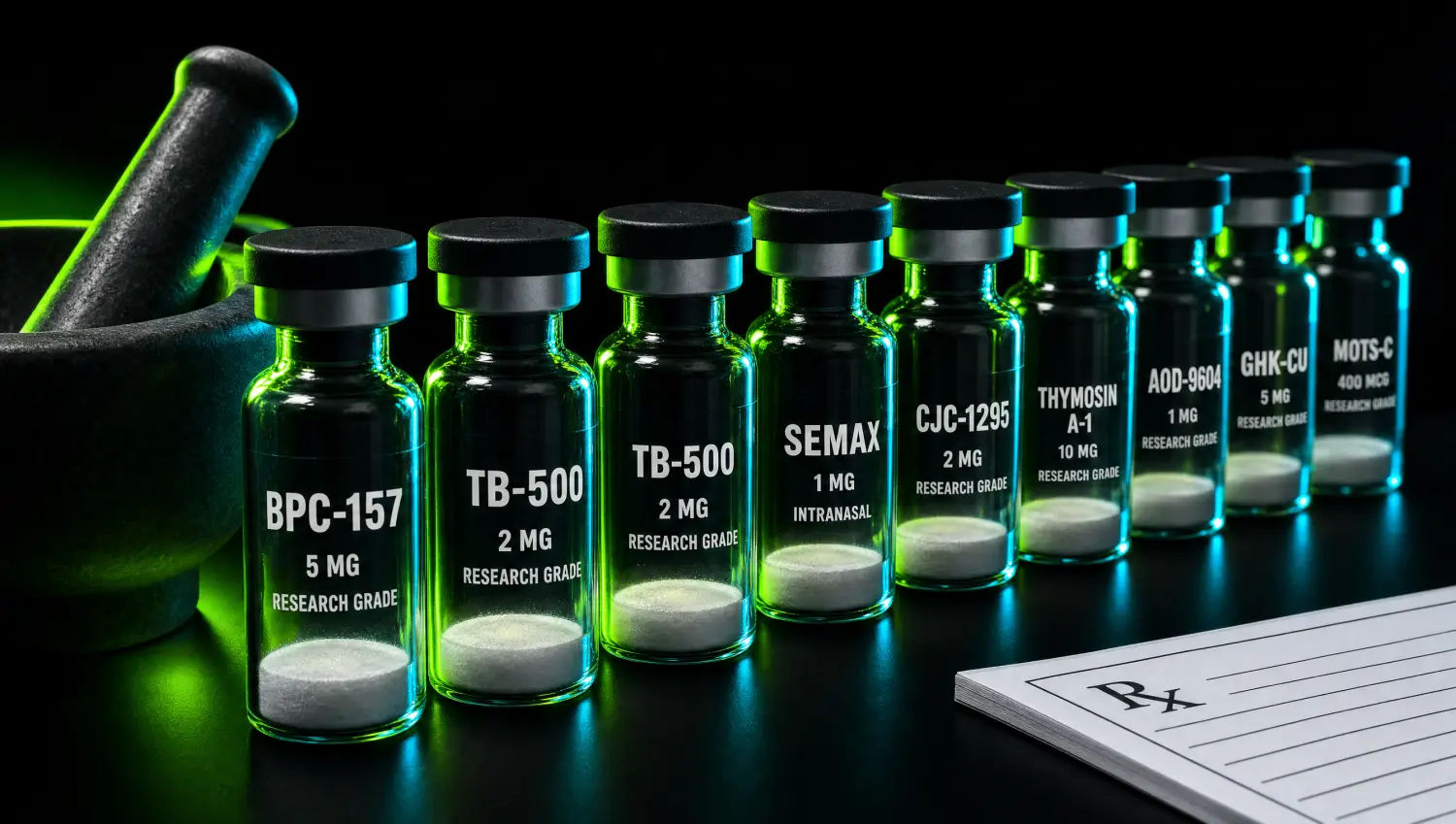
The eight drawing most attention now are BPC-157, TB-500, Semax, CJC-1295, Thymosin Alpha-1, AOD-9604, GHK-Cu and MOTS-c. This guide walks the legal rules first. Then it takes each compound in turn: what the research shows, and what FDA found when it looked. Evidence grades are stated plainly.
Affiliate disclosure: Underground Biohacking keeps vendor-neutral sourcing standards. For suppliers checked by outside labs, see our recommended sources page.
What Peptides Are Legal in the US Right Now?
None of the eight is an FDA-approved drug, and none is on the 503A bulks list. Non-injectable GHK-Cu is the one partial exception. It sits in FDA's Category 1, where FDA does not intend to act against a pharmacy while it evaluates the substance. The other seven have no lawful 503A route today.
Read the last column against the third one. Evidence and legal position move independently here. A compound can carry human trial data and still have nowhere lawful to come from.
| Peptide | What the research covers | Human evidence FDA found | US status, September 2026 |
|---|---|---|---|
| BPC-157 | Tissue repair and gut protection, in animal studies | Five small, short studies, including one controlled trial in 53 people with ulcerative colitis, known only from a meeting abstract | No 503A route. FDA's July 2026 review proposed not listing it |
| TB-500 | Lab and animal work, mostly on its parent protein, thymosin beta-4 | None for TB-500 itself | No 503A route. FDA's July 2026 review proposed not listing it |
| Semax | Brain signalling in rodents; a registered drug in Russia | Small studies in healthy adults, and stroke and pain data FDA judged insufficient | No 503A route. FDA's July 2026 review proposed not listing it |
| MOTS-c | Metabolism, in rodent (mouse) models | None found by FDA | No 503A route. FDA's July 2026 review proposed not listing it |
| CJC-1295 | Growth hormone release | Three studies in 63 healthy adults. A Phase 2 trial (a mid-stage test of whether a drug works) was terminated in 2006 and never published | No 503A route. FDA's advisers voted against listing it in December 2024 |
| Thymosin Alpha-1 | Immune signalling | Randomised trials (people assigned to groups by chance), including trials in sepsis, a life-threatening reaction to infection. FDA found a lack of evidence that it works; the studies were inconclusive and limited by small size and design flaws | No 503A route. FDA's advisers voted 4 to 17 against listing it in December 2024 |
| AOD-9604 | Fat metabolism in rodents | Company trials in people with obesity. The largest, a Phase 2B (mid-stage) trial in 502 people, missed its weight-loss goal | No 503A route. FDA's advisers voted 0 to 12 against listing it in December 2024 |
| GHK-Cu | Skin repair and collagen | No FDA review yet. Topical cream studies in women, summarised in a 2015 review | Non-injectable form in Category 1. Injectable form in no category and not on the bulks list |
So the honest answer is short. If legal means approved for human use, none of the eight qualify. If legal means a pharmacy can compound it for you, the answer is no for seven of them. Non-injectable GHK-Cu has only FDA's Category 1 policy, which is a choice not to act, not a listing.
The rest of this section explains where that last column comes from.
Are Injectable Peptides Legal Under Section 503A?
Section 503A gives a raw ingredient three ways into a pharmacy-made drug. In July 2026, FDA reviewed four of the peptides on this page. It found none of them qualifies by any of the three ways today. FDA's slides add that a listed ingredient can be used for any purpose and any route, unless its entry says otherwise.
The whole legal question sits on one law, section 503A of the Food, Drug, and Cosmetic Act. It lets a pharmacy compound (custom-make) a drug from a raw bulk ingredient on one of three grounds. The ingredient has a USP or NF monograph (an official quality standard). Or it is part of an FDA-approved drug. Or it is on the 503A bulks list.
FDA set out those three grounds in its briefing introduction for the July 2026 meeting. It then looked at BPC-157, TB-500, Semax and MOTS-c one by one. None had a USP or NF monograph. None was part of an approved drug. FDA's 2024 reviews found the same for CJC-1295, AOD-9604 and thymosin alpha-1. The list itself, 21 CFR 216.23, names six ingredients. None of them is a peptide.
Category 1 is not a listing. It is a holding pen. FDA's 503A page says it does not intend to act against a pharmacy using a Category 1 ingredient while it reviews it. The conditions in its guidance must be met. For Category 2, FDA says it would consider taking action. An ingredient in no category has no such policy behind it.
What did happen in July is a vote. FDA's question list for 23 and 24 July 2026 put seven peptides to its advisers. Each vote asked whether a peptide should go on the 503A bulks list. FDA's meeting page says its advisers make recommendations that do not bind FDA. As of 25 September 2026, FDA had posted no minutes. So this page does not report the tally. Adding a peptide to the list takes a full public rule process: a proposed rule, a comment period, then a final rule. The Federal Register (the government's daily journal of rules) shows no such proposed rule this year. Our report on the July 2026 FDA peptide vote covers the meeting itself.
Two facts from FDA's meeting slides bear directly on injections. Compounders working under 503A "are not required to report adverse events associated with compounded drug products to the FDA". A quiet safety record is not the same as a clean one. A listing also carries no default limits. Unless its entry says otherwise, a listed ingredient "can be compounded for any use or via any route of administration". Follow that through. A peptide put forward for a cream could lawfully be injected once it is listed.
A Research Label Is Not a Legal Clearance
Research use is a label, not a clearance.
It is not proof that the contents match the sticker. And none of the eight is FDA approved for human use. In December 2024, FDA sent a warning letter to Summit Research Peptides. The products were labelled "RESEARCH USE ONLY". FDA said the seller's own website showed they were meant for people. That made them unapproved new drugs.
FDA's July 2026 reviews dealt with pharmacy compounding, not with the research supply chain. The identity problem is the part that carries across. FDA's TB-500 review found several salts (chemical forms of the same molecule) and related molecules sold under the one name. A research label tells you nothing about purity. Nor does it tell you whether the powder in the vial is the molecule named on it.
Are Peptides Legal to Buy Online?
Nothing about the July vote makes these compounds lawfully available to buy. The votes are advisory and non-binding, and no rule has followed. For the seven FDA has reviewed, no lawful 503A route exists today.
For sellers, FDA has spelled out the law. In the Summit letter, FDA said that shipping unapproved new drugs across state lines breaks the Food, Drug, and Cosmetic Act. It warned that failing to fix this could lead to seizure and injunction. Do not treat any of these compounds as available through a lawful 503A route because of the vote. The recommendation changed the politics of the question, not the answer to it.
One lawful option does exist: joining a clinical trial. Search ClinicalTrials.gov, and check who sponsors each listing. Approval in other countries gives no lawful US access. FDA's review cites approvals of Thymosin Alpha-1 in Italy, India and Hong Kong, and a company report of wider approvals it could not verify. Semax is a registered drug in Russia, FDA notes. Neither fact changes US compounding.
If you do source anything, the vendor standard matters more than the marketing. We set out how we pick vendors in Reliable Peptide Sources: How We Choose Who Makes the List. Always work with a qualified clinician before making changes to your health protocol.
That is the legal picture, and it applies to all eight. What separates them is the science, so the rest of this page takes them compound by compound.
The Two Repair Peptides: BPC-157 and TB-500
These two are known mainly from animal research, and their human record is thin.
Neither has a completed human trial for muscle, tendon or ligament use, which is the use almost everyone is asking about. The animal work is deep. The human work barely exists, and what does exist sits in tissues nobody was thinking about.
| Measure | BPC-157 | TB-500 |
|---|---|---|
| Size | 15-amino-acid peptide derived from human gastric juice | 7-amino-acid fragment (amino acids 17 to 23) of thymosin beta-4, which is 43 amino acids long |
| Main action studied | Raised growth hormone receptor levels in rodent (rat) tendon cells | Carries the actin-binding stretch of thymosin beta-4 (actin is a protein that helps cells move) |
| Key preclinical (lab and animal) figure | Increasingly better tail motor function, and spasticity (muscle stiffness) resolved by day 15. This followed one dose of 200 or 2 micrograms per kilogram in rodent (rat) spinal cord injury | Thymosin beta-4, not TB-500, raised keratinocyte (skin cell) migration two to three times over controls with as little as 10 picograms (trillionths of a gram) |
| Human data | One meeting abstract, 53 subjects, 80 mg rectal enema (a liquid dose given into the rectum), plus four smaller studies | None for TB-500. Thymosin beta-4 has a Phase I (first safety test in people) trial in 84 volunteers and two small eye-drop trials |
BPC-157
A 2025 systematic review of BPC-157 in orthopaedic sports medicine covered 36 studies. Of those, 35 were lab or animal studies and 1 was clinical. The authors say the studies suggest the peptide raises growth hormone receptor levels and lowers markers of inflammation. In animal models it improved outcomes in muscle, tendon, ligament and bone injuries. Vasireddi et al.
At cell level the effect rises with the dose. In rodent (rat) tendon fibroblasts, the cells that build tendon, BPC-157 raised growth hormone receptor levels. The rise showed at both mRNA level (the gene's working copy) and protein level. Chang et al.
In rodent (rat) models of spinal cord injury, a single dose of 200 or 2 micrograms per kilogram was given. The rats showed increasingly better tail motor function, and spasticity resolved by day 15. The authors state that no lethal dose (LD1) of BPC-157 has been reached. Perovic et al.
The gut work is in animals too. In the rodent (rat) studies FDA reviewed, BPC-157 prevented colonic fistulas, liver lesions and gut lesions caused by different challenges. FDA added that no dose-response has been set and the molecular targets are unknown.
What FDA weighed in July was narrower than that picture. The case for it working rested on one meeting abstract. It described a multicentre (run at several sites) randomised double-blind placebo-controlled trial. In such a trial, some people get a dummy treatment, and neither they nor staff know who got what. It enrolled 53 people with mild-to-moderate ulcerative colitis, a bowel disease. They were split one to one between an 80 mg BPC-157 rectal enema and a placebo. FDA wrote that reading it was "limited by the lack of details provided in the meeting abstract and the exploratory nature of the study". It found no studies at all by the oral, subcutaneous (under the skin), nasal or transdermal (through the skin) routes in those patients. FDA notes BPC-157 is marketed as a supplement ingredient in capsules and tablets. The injection and nasal spray are the forms the nominations proposed.
Evidence grade: animal studies. Small human studies that FDA judged inadequate. No randomised trial for muscle, tendon or joint use.
TB-500
TB-500 carries LKKTET, the stretch of thymosin beta-4 known to bind actin, FDA's TB-500 review notes. Actin is a protein that helps a cell move. Thymosin beta-4 itself, not TB-500, sped wound healing in a rodent (rat) model. The same study ran a lab test on keratinocytes (skin cells). Their migration rose two to three times over controls, with as little as 10 picograms (trillionths of a gram) added. Malinda et al.
The human trials all used thymosin beta-4, not TB-500. In a Phase I trial, the first safety test in people, 84 healthy volunteers got a lab-made thymosin beta-4 or placebo into a vein. Side effects were mild to moderate, with no serious ones. Wang et al.
Two eye-drop trials followed. In a randomised, double-masked (double-blind) Phase II (mid-stage) trial, nine people with severe dry eye got thymosin beta-4 drops or a vehicle (inactive) drop. In all, 12 eyes got the drug and 6 the vehicle. At day 56, compared with the vehicle drop, the drug cut eye discomfort by 35% and corneal staining (a sign of surface damage) by 59%. The drops were safe and well tolerated. Sosne et al., 2015
A Phase III (late-stage) trial then tested the drops in 18 people with neurotrophic keratopathy, a nerve-damage disease of the cornea. By week 4 the cornea had fully healed in 6 of 10 on the drops and 1 of 8 on placebo. That gap fell just short of statistical significance. No significant side effects were seen. Sosne et al., 2022
TB-500 and full-length thymosin beta-4 are not the same substance, FDA stresses. TB-500 also carries an acetyl group, a small chemical cap. FDA says such a cap can change how long a peptide lasts and what it binds. In a 2024 cell study, TB-500 did not significantly speed wound closure, while one of its breakdown products did. Rahaman et al.
FDA's July review flagged a risk worth carrying. TB-500 was proposed for injection into muscle or under the skin. FDA said a shot could pose a significant risk of an immune reaction to the peptide, "potentially amplified by aggregation" (clumping). It also said the safety risks in humans are unknown. That is a short file for a compound with this reputation. Our TB-500 side effects guide sets out that record in full.
Evidence grade: no human data for TB-500 itself. Its parent protein, a different substance, has small human trials: a Phase I safety trial and two eye-drop trials.
Brain and Immune Peptides: Semax and Thymosin Alpha-1
These two show two very different kinds of evidence.
Semax is a registered drug in Russia, and much of its clinical literature is in Russian. Thymosin Alpha-1 has randomised trials, including some in sepsis, a life-threatening reaction to infection. The pooled result softens under close reading. One has a clinical literature FDA largely set aside, because it was not in English. The other has the trial format FDA wants, and a result that thins when you look at the best studies alone.
| Measure | Semax | Thymosin Alpha-1 |
|---|---|---|
| What it is | Synthetic seven-amino-acid analogue of the ACTH(4-10) fragment (part of a pituitary hormone) | 28-amino-acid peptide first isolated from calf thymus in 1977 |
| Main action studied | BDNF (brain-derived neurotrophic factor, a growth factor for brain cells) and TrkB (the receptor BDNF acts on) signalling in the rodent (rat) brain | Raises immune signals, including interferon-gamma and interleukin-2 (chemical messengers that switch on immune cells) |
| Key figures | Single intranasal dose in rodents (rats) raised hippocampal (memory-centre) BDNF protein 1.4-fold, BDNF mRNA 3-fold and TrkB mRNA 2-fold | Sepsis meta-analysis (a pooled analysis) of 11 randomised trials and 1,927 patients: 28-day all-cause mortality OR 0.73, 95% CI 0.59-0.90, p=0.003. The odds ratio (OR) means the odds of death were 27% lower. The 95% confidence interval (CI) is the likely range of that figure. The p-value says the result is unlikely to be chance |
| Status abroad | Registered drug in Russia | Approved in Italy, India and Hong Kong for set uses, per FDA's sources |
Semax
FDA's review describes Semax as a registered drug in Russia, sold there as 0.1% and 1% nasal drops. It is a seven-amino-acid analogue of a fragment of ACTH, a pituitary hormone. FDA did not consider its Russian-language stroke studies, because full English versions were not available.
The mechanism centres on BDNF, a growth factor for brain cells. A single intranasal (into the nose) dose of 50 micrograms per kilogram in rodents (rats) raised hippocampal BDNF protein 1.4-fold. It raised BDNF mRNA 3-fold and TrkB mRNA 2-fold. Dolotov et al.
FDA's July 2026 review found too little evidence for the uses it examined. For stroke-related brain damage, the only usable data was one meeting abstract. It lacked the key clinical results. For safety, FDA found human data only for the nasal route. It covered 33 to 47 healthy adults, 69 adults with medical conditions and 451 children. Three of the reports were meeting abstracts. Only one said anything about side effects: that none were seen.
The review raised two cautions. In rodents (mice), Semax boosted the dopamine release that amphetamine triggers in the striatum, a brain reward area. FDA called this "concerning because increased dopaminergic tone in the striatum is a response typically induced by drugs of abuse such as cocaine". One small uncontrolled open-label study (no comparison group, and everyone knew what they were given) also fell short. FDA said Semax "was not effective in resolving headache pain for the majority of subjects with migraine". It said the same for the majority of subjects with trigeminal neuralgia, a nerve disorder that causes bouts of face pain.
Evidence grade: registered drug in Russia. Rodent (rat) BDNF work. FDA found too little evidence for stroke, migraine and trigeminal neuralgia.
Thymosin Alpha-1
Thymosin alpha-1 occurs naturally in the body. It was first taken from calf thymus in 1977. FDA's review notes it can raise immune signals, including interleukin-2 and interferon-gamma. A 2020 review says it has long been known to adjust, boost and restore immune function. Dominari et al.
The clinical signal is real but mixed, and this is the caveat the marketing tends to lose. A 2025 review pooled eleven randomised trials in sepsis patients. Death rates at 28 days fell, and the table above has the numbers. The benefit did not hold in the high-quality or multicentre trials alone. Gu et al.
A separate 2025 review says studies show thymosin alpha-1 can improve vaccine response in older adults. It adds that it can ease immunosenescence, the drop in immune function that comes with age. The authors say the long-term benefit and safety of thymosin alpha-1 in older people still need proof. Simonova et al.
FDA's advisers were not persuaded. In December 2024 they voted 4 to 17 against listing each form. Several who voted no said there was no compelling proof that it worked and was safe in the uses reviewed. FDA cites approvals in Italy, India and Hong Kong. It adds that it could not verify a company report of wider approvals, mainly for hepatitis B and as a vaccine add-on (adjuvant).
Evidence grade: human randomised trials, including a sepsis meta-analysis. The result is mixed in the best trials. Approved in some other countries, per FDA's sources.
Are Peptides for Muscle Growth Legal, and Do They Work?
No on the legal side. CJC-1295 and AOD-9604 were not in the July 2026 review. But FDA reviewed both in 2024. It found no USP monograph and no approved drug containing either. Its advisers voted against listing both. On the evidence side, the human studies FDA reviewed looked at hormone levels for CJC-1295. For AOD-9604 they looked at weight and fat. None of that measures muscle growth. FDA reviewed CJC-1295 for growth hormone deficiency and AOD-9604 for obesity. FDA notes both are marketed for muscle building.
CJC-1295 is a lab-made copy of growth hormone releasing hormone, altered to last longer. It prompts the pituitary to release growth hormone. AOD-9604 is a piece of growth hormone itself, developed for obesity. CJC-1295 has three small studies in healthy adults and a Phase 2 trial that was never published. AOD-9604 has a clean idea and a failed Phase 2B trial, a mid-stage test of whether a drug works. Read the table before you read the marketing.
| Measure | CJC-1295 with DAC | AOD-9604 |
|---|---|---|
| Half-life (time for half a dose to clear) | About six to eight days in healthy adults | Not stated here |
| Effect in people | Mean GH rose 2 to 10 times for 6 days or more. Mean IGF-1 (insulin-like growth factor 1, a hormone that growth hormone raises) rose 1.5 to 3 times for 9 to 11 days | The company's studies reported no significant IGF-1 change |
| Structure | Growth hormone releasing hormone analogue with a drug affinity complex (DAC) that binds albumin, a blood protein | Growth hormone amino acids 177-191, plus one added tyrosine |
| Human data | Three studies in 63 healthy adults. A Phase 2 trial was terminated in 2006 and never published | A 12-week trial in 300 people, known from a meeting abstract. The Phase 2B OPTIONS trial (METAOD006) in 502 people failed to repeat it |
CJC-1295
How long it lasts matters most here. CJC-1295 with DAC (drug affinity complex) binds to albumin in the blood. FDA notes this is thought to make it more stable and longer lasting. In two studies in healthy adults, its half-life (the time for half of it to clear) was about six to eight days. Mean GH rose 2 to 10 times for 6 days or more. After one shot, mean IGF-1 rose 1.5 to 3 times and stayed raised for 9 to 11 days. Teichman et al., FDA CJC-1295 review
CJC-1295 is also sold without DAC. FDA found websites selling both forms for research use only. The human studies FDA found all appear to refer to the DAC form. In rodent (mouse) pituitary cells in a lab dish, the DAC form raised growth hormone release. It also caused DNA damage in those cells, FDA reports.
A Phase 2 trial in people with HIV and belly fat build-up is registered (NCT00267527). It was stopped in 2006. Internet anecdotal reports (online news items) cited by FDA say 192 people enrolled. They describe a death after an eleventh weekly dose. The treating doctor thought silent (symptom-free) heart artery disease was the likeliest cause. The results were never published. In the three published studies, 63 healthy adults got the DAC form. Reactions at the injection site were the most common side effect.
In December 2024 FDA's advisers voted 0 to 13 against listing four of the five CJC-1295 forms. The vote on the fifth was 1 to 12. Always work with a qualified clinician before making changes to your health protocol.
Evidence grade: three small studies in 63 healthy adults. Phase 2 never published.
AOD-9604
The design idea is simple. AOD-9604 takes a small piece of the growth hormone molecule, amino acids 177 to 191, and adds one more amino acid. FDA's review says no one knows yet what it binds to or how it works. In the company's human studies, the authors reported no clear change in IGF-1. FDA AOD-9604 review
In obese rodents (Zucker rats), oral AOD-9604 for 21 days cut weight gain by about half against vehicle. Fat tissue showed more lipolysis, the breakdown of stored fat. Unlike growth hormone, it did not cause insulin resistance (cells responding poorly to insulin), FDA's review reports.
Human data is messier. A 12-week trial in 300 people with obesity is known only from a 2005 meeting abstract. People on 1 mg a day lost about 0.22 kg a week, against 0.07 kg a week on placebo. The authors called the largest effect significant for women. FDA noted the differences were small. The Phase 2B OPTIONS trial (METAOD006) then randomised 502 people and found no significant weight-loss difference against placebo. The company ended development for obesity in February 2007.
AOD-9604 is often said to have GRAS (Generally Recognised as Safe) status. FDA's review searched its GRAS notice files and cites no GRAS notice. The nomination's "USA GRAS status" pointed to a notice on the Australian stock exchange. In December 2024, FDA's advisers voted 0 to 12 against listing AOD-9604.
The honest summary: a clean idea, an early trial with small losses, and a disappointing Phase 2B. On its own, its fat-loss effect in people is unproven. That failed Phase 2B trial is the most informative result on this page. Always work with a qualified clinician before making changes to your health protocol.
Evidence grade: rodent data. Small early losses in people. Phase 2B negative. No FDA GRAS notice.
Copper Peptide and Mitochondrial Peptide: GHK-Cu and MOTS-c
These two work in very different ways.
One is described as changing the activity of thousands of genes, and has cream studies in people. The other is coded in your own mitochondrial DNA, and FDA found no human studies of it at all. They sit at very different points on the evidence scale.
| Measure | GHK-Cu | MOTS-c |
|---|---|---|
| What it is | Copper-binding tripeptide (three amino acids), isolated in 1973 | 16-amino-acid peptide coded in mitochondrial DNA (the DNA in the cell's power units) |
| Main action studied | Stimulated both the building and breakdown of collagen and glycosaminoglycans (sugar-chain molecules that hold water in skin). This was at one to ten nanomolar (billionths of a mole per litre) | Folate cycle (a chain of reactions that uses the vitamin folate) and AICAR-AMPK pathway (the cell's energy-sensing switch), mainly in skeletal muscle |
| Key figures | Described as raising or lowering at least 4,000 human genes. A topical cream raised collagen in 70% of women treated | Prevented insulin resistance and diet-induced obesity in rodent (mouse) models |
| Human data | Topical cream studies, summarised in a 2015 review | None found by FDA |
GHK-Cu
Loren Pickart isolated GHK-Cu in 1973. He found it as an activity in human albumin that made old human liver tissue make proteins like younger tissue. The active factor turned out to be the glycine-histidine-lysine copper complex. At tiny concentrations of one to ten nanomolar, it spurs both the building and the breakdown of collagen and related skin molecules. Nanomolar means billionths of a mole per litre. It also tunes metalloproteinases (enzymes that remodel a wound) and their inhibitors (TIMP-1/2). Pickart et al.
The gene data is striking. The same review describes GHK as able to turn at least 4,000 human genes up or down. It cites this to a study that used the Broad Institute's Connectivity Map, a gene-profiling tool. The authors call this essentially resetting DNA to a healthier state. A later review by the same group draws on in vivo (animal) and in vitro (lab) studies. It lists faster wound closure and skin cover, more growth factors and stronger antioxidant enzymes. Pickart and Margolina
Human data exists for the topical form. In one study the 2015 review describes, women applied creams to their thighs for a month. Collagen rose in 70% of those using GHK-Cu, against 50% for vitamin C cream and 40% for retinoic acid. The review adds that GHK-Cu appears to pass the skin's outer layer (stratum corneum) in useful amounts.
The legal split matters here. FDA's Category 1 entry reads "GHK-Cu (except for injectable routes of administration)", on FDA's list updated 14 May 2026. FDA took it out on 22 April 2026. It put it back after one nominator said it had meant to withdraw only the injectable form. Injectable GHK-Cu was in Category 2 from September 2023 until April 2026. It is now in no category.
Evidence grade: lab and animal work. Topical cream studies in people, summarised in a review. No FDA review yet. FDA plans to consult its advisers by the end of February 2027.
MOTS-c
MOTS-c is unlike the rest of this list. It is a 16-amino-acid peptide coded in the mitochondrial DNA, and a 2023 review describes it as a peptide hormone. Gao et al.
Its main target appears to be skeletal muscle. It blocks the folate cycle and the purine building tied to it. Purines are building blocks of DNA. In lab cells, this built up AICAR, a halfway product of purine making. AICAR switches on AMPK, the cell's energy sensor. In rodent (mouse) models this prevented insulin resistance from both age and a high-fat diet. It also prevented diet-induced obesity. Lee et al.
One gap matters more than all of that. In its July 2026 review, FDA found no clinical studies or human exposure data for MOTS-c by any route. It concluded that the safety risks in humans are unknown. The preclinical case is interesting, and the human record is empty.
Evidence grade: preclinical, in rodent (mouse) models. No human data found by FDA.
Where to buy BPC-157
Explore third-party-verified sources for the peptides covered in this guide via our recommended sources page.
See the sources that passed →Evidence and Legal Status Are Two Different Questions
Match what you read to the evidence, then read the legal column again.
No single peptide here has strong human evidence and a lawful route. The eight fall into five groups:
- Tissue repair: BPC-157 and TB-500. Mostly animal data. BPC-157 has small human studies that FDA found too weak. TB-500 has none.
- Immune: Thymosin Alpha-1. Randomised trials, with a sepsis benefit that fades in the best trials.
- Brain: Semax. Registered in Russia. FDA found too little evidence for the uses it reviewed.
- Growth hormone and body shape: CJC-1295 and AOD-9604. Hormone data in healthy adults for CJC-1295. A failed Phase 2B for AOD-9604.
- Longevity and metabolism: MOTS-c and GHK-Cu. Rodent data and no human data for MOTS-c. Topical cream data for GHK-Cu.
Evidence grade tells you whether a compound is worth watching. It does not tell you that you can lawfully obtain it. The compound with the most human trial data here, thymosin alpha-1, has no lawful 503A route. For how these peptides stand in sport, see our WADA banned peptides overview.
References
- Vasireddi et al. (2025). Emerging Use of BPC-157 in Orthopaedic Sports Medicine: A Systematic Review. HSS J. PubMed 40756949.
- Chang et al. (2014). Pentadecapeptide BPC 157 Enhances the Growth Hormone Receptor Expression in Tendon Fibroblasts. Molecules. PMC6271067.
- Perovic et al. (2019). Stable Gastric Pentadecapeptide BPC 157 Can Improve the Healing Course of Spinal Cord Injury and Lead to Functional Recovery in Rats. J Orthop Surg Res. PMC6604284.
- Malinda et al. (1999). Thymosin Beta4 Accelerates Wound Healing. J Invest Dermatol. PMID 10469335.
- Sosne et al. (2015). Thymosin Beta4 Significantly Improves Signs and Symptoms of Severe Dry Eye in a Phase 2 Randomized Trial. Cornea. PMID 25826322.
- Wang et al. (2021). A First-in-Human, Randomized, Double-Blind, Single- and Multiple-Dose, Phase I Study of Recombinant Human Thymosin Beta4 in Healthy Chinese Volunteers. J Cell Mol Med. PMID 34346165.
- Sosne et al. (2022). 0.1% RGN-259 (Thymosin Beta4) Ophthalmic Solution Promotes Healing and Improves Comfort in Neurotrophic Keratopathy Patients in a Randomized, Placebo-Controlled, Double-Masked Phase III Clinical Trial. Int J Mol Sci. PMID 36613994.
- Rahaman et al. (2024). Simultaneous Quantification of TB-500 and Its Metabolites. J Chromatogr B. PMID 38382158.
- Dolotov et al. (2006). Semax, an Analog of ACTH(4-10) With Cognitive Effects, Regulates BDNF and trkB Expression in the Rat Hippocampus. Brain Res. PMID 16996037.
- Dominari et al. (2020). Thymosin Alpha 1: A Comprehensive Review of the Literature. World J Virol. PMC7747025.
- Gu et al. (2025). Efficacy of Thymosin Alpha-1 for Sepsis: A Systematic Review and Meta-Analysis of RCTs. Front Cell Infect Microbiol. PMID 40969554.
- Simonova et al. (2025). Aging and Thymosin Alpha-1. Int J Mol Sci. PMC12692621.
- Pickart et al. (2015). GHK Peptide as a Natural Modulator of Multiple Cellular Pathways in Skin Regeneration. Biomed Res Int. PMC4508379.
- Pickart and Margolina (2018). Skin Regenerative and Anti-Cancer Actions of Copper Peptides. Cosmetics.
- Gao et al. (2023). MOTS-c Functionally Prevents Metabolic Disorders. Metabolites. PMID 36677050.
- Lee et al. (2015). The Mitochondrial-Derived Peptide MOTS-c Promotes Metabolic Homeostasis and Reduces Obesity and Insulin Resistance. Cell Metabolism.
- FDA (2026). Briefing Document Introduction, Pharmacy Compounding Advisory Committee, 23-24 July 2026.
- FDA (2026). Evaluation of BPC-157-Related Bulk Drug Substances.
- FDA (2026). Evaluation of TB-500-Related Bulk Drug Substances.
- FDA (2026). Evaluation of Semax-Related Bulk Drug Substances.
- FDA (2026). Evaluation of MOTS-c-Related Bulk Drug Substances.
- FDA (2026). FDA Presentations, 23 July 2026 PCAC Meeting.
- FDA (2024). Evaluation of CJC-1295-Related Bulk Drug Substances.
- Teichman et al. (2006). Prolonged Stimulation of Growth Hormone (GH) and Insulin-Like Growth Factor I Secretion by CJC-1295, a Long-Acting Analog of GH-Releasing Hormone, in Healthy Adults. J Clin Endocrinol Metab. PMID 16352683.
- FDA (2024). Evaluation of AOD-9604-Related Bulk Drug Substances.
- FDA (2024). Evaluation of Thymosin Alpha-1-Related Bulk Drug Substances.
- FDA (2025). Final Summary Minutes, Pharmacy Compounding Advisory Committee, 4 December 2024.
- FDA (2026). Bulk Drug Substances Nominated for Use in Compounding Under Section 503A, updated 14 May 2026.
This content is for educational purposes only. These compounds are intended for research use. Nothing here is medical advice. Always work with a qualified clinician before making changes to your health protocol.
Share this article
Frequently Asked Questions
Is BPC-157 legal in the United States in 2026?
What is the difference between TB-500 and full thymosin beta-4?
What is Semax, and what did FDA find?
How does CJC-1295 with DAC differ from CJC-1295 without DAC?
What is the strongest clinical evidence among these 8 peptides?
Did AOD-9604 achieve FDA approval, and what happened with the trials?
Read Next

Disclaimer: This content is for educational purposes only. These compounds are intended for research use. Nothing here is medical advice. Always work with a qualified clinician before making changes to your health protocol.