
HGH Secretagogue vs HGH: How Each Works, Safety and US Law

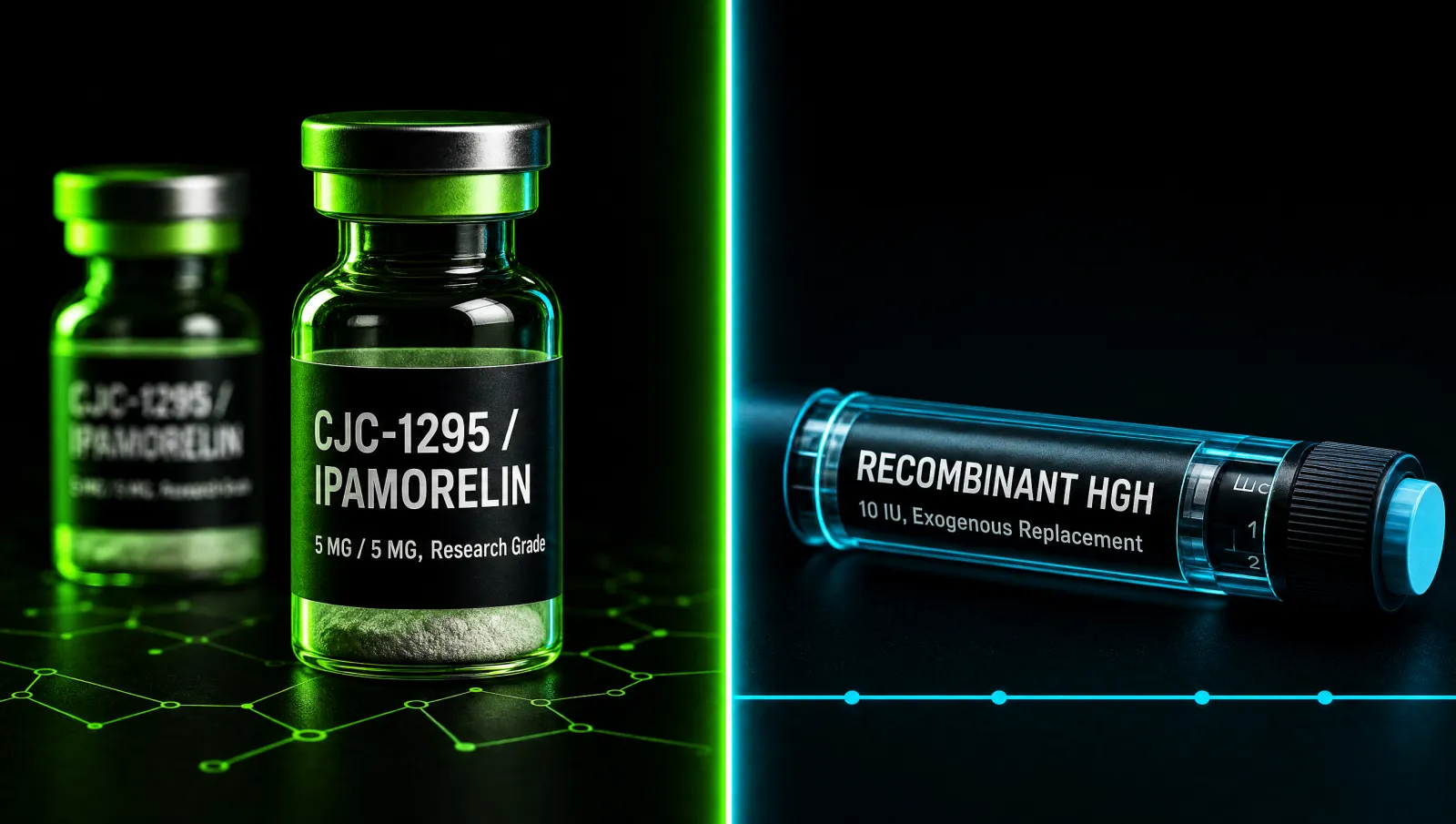
HGH Secretagogue vs HGH: The Real Difference for Men 35+
An HGH secretagogue prompts your own pituitary to release growth hormone (GH). Your body's feedback still acts on that release. Exogenous HGH is the hormone itself, injected. It bypasses the pituitary, and feedback turns your own output down. Of the secretagogues on this page, only tesamorelin is sold as an FDA-approved treatment, for one narrow use.
Research growth hormone for long enough and you hit a fork. One road is recombinant human growth hormone, or rhGH. Recombinant means it is made by cells given the human GH gene. It is a prescription drug that FDA has approved for a few narrow uses.
The other road is a class of drugs called growth hormone secretagogues. CJC-1295, ipamorelin, sermorelin and tesamorelin are all in it. They work upstream, on the pituitary's own release of GH.
This guide maps the biology, the safety record and the US law as it stands in 2026. Then it sets out who each one has actually been tested in.
Affiliate disclosure: This post contains links to research-grade suppliers via our recommended sources page. We earn a commission if you purchase through those links at no extra cost to you.
What Is a Secretagogue, and What Does It Do?
A secretagogue is a signalling molecule. It asks the pituitary to do more of what it already does.
Secretagogues act upstream, in the hypothalamic-pituitary axis (the chain of command from brain to pituitary). Your body's feedback loop keeps working. Somatostatin, the brake hormone, and IGF-1 (insulin-like growth factor 1, a hormone the body makes in response to GH) still hold GH release in check.
That was the hope behind them. A 2011 review by Bedimo says drugs that copy GHRH were expected to give a more natural GH pattern. That was meant to avoid the side effects of high, steady HGH levels. The same review shows they did not remove the risk, as the safety section below explains.
There are two separate pathways. Knowing which is which explains why some pairings release more GH than either compound alone.
Pathway One: GHRH Analogs (CJC-1295, Sermorelin, Tesamorelin)
These copy growth hormone-releasing hormone, or GHRH. GHRH is the hypothalamus telling the pituitary to build and release GH. The analogs bind GHRH receptors on somatotroph cells (the GH-making cells) in the front of the pituitary. That raises GH output.
CJC-1295 is a modified GHRH analog built to last. It carries a drug affinity complex, a chemical tail that bonds to albumin, a protein in your blood. Natural GHRH has a short half-life of only minutes, per figures cited in Norman 2013. CJC-1295 has a half-life (the time the body takes to clear half a dose) of roughly eight days.
A study by Ionescu and Frohman gave one shot to healthy men aged 20 to 40. A week later, mean GH was up 46%. Trough levels (the low points between pulses) were up 7.5-fold. The number and size of the GH pulses did not change. So the pulse pattern held.
Sermorelin is the first 29 amino acids of GHRH. That short piece does the work. A blood enzyme, DPP-IV, breaks GHRH down quickly. It does not last as long as CJC-1295. FDA once approved sermorelin, sold as Geref. Geref is now discontinued.
Tesamorelin is a stabilised GHRH analog. It is all 44 amino acids of GHRH with an added chemical group that resists that enzyme. FDA approved it in 2010 as Egrifta. The approved use is reducing excess belly fat in adults with HIV and lipodystrophy, a shift in body fat linked to HIV treatment.
FDA has approved other secretagogues too. Sermorelin was one. Macimorelin (Macrilen) was approved later, as a test for low GH in adults. It acts on the ghrelin receptor. Both are now discontinued.
Bedimo's review covers two large Phase III trials of tesamorelin, the late-stage kind run before approval. Both were randomised and placebo-controlled. Each enrolled about 400 people with HIV. Belly fat around the organs fell, and the drop was significant. Blood fats improved in the pooled data, though not clearly in each trial alone. The fat came back when people stopped.
A study by Stanley and colleagues gave tesamorelin to 13 healthy men for two weeks. It raised GH at rest and in pulses. Insulin sensitivity (how well the body responds to insulin) did not change significantly.
Want the head-to-head on these two? See our analysis of tesamorelin vs sermorelin GHRH analogs.
Pathway Two: GHS-R Agonists (Ipamorelin, GHRP-2, GHRP-6, MK-677)
These act on the ghrelin receptor, GHS-R1a. That is a different door from GHRH. Drugs that switch a receptor on like this are called agonists. They copy ghrelin, a hormone made in the gut and the brain that also triggers GH release.
Ipamorelin stands out for its selectivity. The landmark study is Raun et al. 1998, in rodents (rats) and pigs. Ipamorelin released GH with a potency like GHRP-6. In pigs, GHRP-2 and GHRP-6 also raised ACTH and cortisol, two stress hormones. Ipamorelin did not, even at over 200 times its ED50. That is the dose that gives half the maximum GH response. None of the drugs changed FSH or LH (reproductive hormones), TSH (thyroid-stimulating hormone) or prolactin, another pituitary hormone.
The authors called ipamorelin a very interesting candidate for drug development. Human safety data are thinner. FDA's safety page notes serious harms, including death, in a study that gave ipamorelin into a vein to speed up the gut.
For the full evidence, read our ipamorelin selective growth hormone secretagogue guide.
Why the Two Pathways Are Paired
CJC-1295 acts on the GHRH receptor. Ipamorelin acts on a second one, the ghrelin receptor.
A study by Norman et al. 2013 tested a related pair in 26 healthy older men. Native GHRH pulses and the ghrelin-type drug GHRP-2 together released more GH than either alone. The effect was synergistic, meaning more than the sum of the parts. The study did not test CJC-1295 or ipamorelin.
How Exogenous HGH Works Inside the Body
Exogenous HGH is recombinant growth hormone, injected under the skin and absorbed into the blood. It bypasses the hypothalamic-pituitary axis. GH and IGF-1 then raise somatostatin, and your own GH release falls. The dose you inject is not held back by that brake, because it never passes through the pituitary.
Recombinant human growth hormone is a 191-amino-acid protein. Its amino acid sequence matches the GH your pituitary makes. Inject it under the skin and it enters the blood. Tissues across the body then make IGF-1 in response, as Bedimo's review describes.
The difference is the delivery pattern. Your body releases GH in bursts. In men, the largest burst comes soon after falling asleep, in deep (slow-wave) sleep. About 70% of a man's daily GH comes out early in sleep, per a 1998 review by Van Cauter and colleagues.
Those pulses matter. Ionescu and Frohman note that pulsed release is thought to be important for many of GH's effects.
An injection gives sustained high levels instead of the body's pulses. Bedimo's review says HGH's side effects in HIV trials were put down to these sustained high levels, rather than natural pulses. Meanwhile your hypothalamus and pituitary keep reading the GH in your blood. A high level raises somatostatin, and that blunts your own release.
A commentary by Cianfarani weighs the long-term safety of rhGH. It notes reported links to cancer and type 2 diabetes. It calls the question still controversial.
The Frontiers in Aging clinical review (2025) confirms the approved use. FDA approval for rhGH in adults covers three indications only. Those are GH deficiency, HIV-associated muscle wasting, and short bowel syndrome. The drug labels say the same. Federal law makes it a crime to distribute HGH for anti-ageing use.
Growth Hormone Secretagogue vs HGH: Which Is Safer?
Injected HGH carries logged risks. Fluid build-up, carpal tunnel syndrome (a pinched nerve at the wrist), joint pain and high blood sugar show up as short-term harms in trials. Cancer is a longer-term worry. Secretagogues keep the feedback loop, though IGF-1 can still rise above normal. No study on this page compared the two head to head. The secretagogue data are small and short, apart from tesamorelin's.
The HGH Risk Profile
The Frontiers review (Frontiers in Aging 2025) lists the short-term harms logged in adults.
Fluid retention is among the most frequent, reported in 11% to 100% of people. Carpal tunnel syndrome was the most common musculoskeletal problem (bones, joints and muscles), in 7% to 50%. Joint pain showed up in 14% to 77%. High blood sugar can follow, because GH works against insulin. Breast tenderness or gynaecomastia (breast tissue growth) was reported in 7% to 14%.
The longer-term worry is cancer. The review calls GH's role in speeding tumour growth well documented, mostly in people already prone to tumours. It adds that GH itself does not necessarily start a cancer. Cianfarani adds that the human evidence on cancer is weak. Even so, holding GH and IGF-1 at drug-level doses for years carries a theoretical risk that is not one to wave away.
The review sums up HGH as an anti-ageing therapy in one word: controversial. Serious harms have been rare across its approved uses, Cianfarani notes. But long-term follow-up studies of people treated as children are few.
Then there is suppression. Injected GH trips the same feedback your own GH does. GH and IGF-1 raise somatostatin, which holds back the pituitary's own release.
The Secretagogue Safety Profile
The hoped-for edge is that the feedback loop stays in place. Somatostatin and IGF-1 still act on the pituitary's release.
Even so, IGF-1 can overshoot. In the tesamorelin trials, people on the drug were more likely than those on placebo to have IGF-1 above the normal range. An FDA briefing cited by Bedimo also found more new diabetes on tesamorelin. Glucose measures in the trials themselves did not change significantly.
FDA counts 63 healthy adults in the published CJC-1295 studies, and most had one dose. Injection-site reactions were the most common problem. Headache, flushing and a faster heart rate also showed up, per FDA's 2024 review. A registered Phase 2 trial in people with HIV ended in 2006. Phase 2 is the mid-stage test of whether a drug works. Reports FDA cites say a participant died. FDA says the attending doctor's "most likely explanation" was coronary artery disease that had caused no symptoms. That is a narrowing of the arteries that feed the heart. The results were never published.
Ipamorelin avoided the cortisol and ACTH rise seen with older GHRPs, in pigs (Raun et al. 1998). For MK-677 (ibutamoren), FDA's advisers raised fluid retention, heart failure and high blood sugar.
Secretagogues are still not free of trade-offs. IGF-1 rises with use, so it is the marker the trials tracked. These drugs work through the pituitary. Always work with a qualified clinician before making changes to your health protocol.
HGH vs Secretagogues: Legal Status in 2026
HGH is a prescription drug with three approved adult uses. Distributing it for anything else is a federal crime. Most research secretagogues are unapproved drugs. None of them is a controlled substance. Selling an unapproved one for human use still breaks federal drug law, as FDA's warning letters show.
HGH: Prescription-Only and Narrowly Approved
HGH is not on the US lists of controlled drugs, 21 CFR part 1308. A separate law covers it. Under 21 USC 333(e), distributing HGH for a use FDA has not approved, or without a doctor's order, is a crime. The penalty is up to five years in prison.
The legal adult uses stay narrow. They are GH deficiency, HIV-associated wasting, and short bowel syndrome. Use for anti-ageing or body composition falls outside them.
Pharmacy-grade rhGH comes from brands like Norditropin, Genotropin and Humatrope. FDA licenses these as biologics, medicines made in living cells. Compounding means a pharmacy mixing its own version of a drug. Since March 2020, FDA says, biologics cannot be compounded under sections 503A or 503B of federal drug law. Black-market sellers face the same HGH law as anyone else.
Secretagogues: Mostly Unapproved Drugs
Secretagogues sit in a different legal slot. None of them is on the controlled drug lists. Tesamorelin is FDA-approved, as Egrifta. None of the others named here has an approved product on sale.
A research-use label does not change that. In a December 2024 warning letter to a peptide seller, FDA said a "research use only" label did not stop products being unapproved new drugs. The seller's own website showed they were meant for people. That letter concerned other peptides, such as semaglutide.
Pharmacy compounding is closed to CJC-1295 today. Under 21 USC 353a, a pharmacy has three routes. The ingredient needs a USP monograph (an official quality standard), or it must be part of an approved drug. Otherwise it must be on FDA's bulks list, a short list of raw ingredients pharmacies may use. FDA found no monograph for CJC-1295 and no approved drug that contains it. The bulks list does not name it.
FDA's advisers voted against putting CJC-1295 on that list in December 2024. They voted the same way on ipamorelin and MK-677 in October 2024. FDA's current 503A list still puts MK-677 in category 2, for drugs with serious safety risks. A second list, 503B, is for outsourcing facilities: large compounders that register with FDA. It puts ipamorelin, GHRP-2 (as a shot or nasal spray), GHRP-6 and MK-677 in category 2 too. It lists sermorelin acetate in category 1, as part of an approved drug.
Tested athletes face a separate rule. The World Anti-Doping Agency (WADA) bans HGH and every secretagogue named here, in and out of competition. They sit in section S2 of its 2026 Prohibited List.
Note: The above is a general characterisation. Regulatory positions vary by jurisdiction and change over time. Confirm current status in your specific country before proceeding.
GH Secretagogue vs HGH: Who Has Each Been Tested In?
The CJC-1295 and tesamorelin studies cited here used healthy adults and people with HIV. Other secretagogues have been studied more widely. FDA's advisers looked at MK-677 for uses from low GH to hip fracture. They looked at ipamorelin for gut problems after surgery. Approved HGH is for people whose own GH supply has failed, or who have one of two other conditions. Some trials in healthy older adults report benefits, mainly in body composition and metabolism. The Frontiers review says long-term safety and efficacy for healthy ageing remain uncertain.
Where the Secretagogue Research Applies
The secretagogue studies cited here fit a narrow profile.
- Healthy adults with a working pituitary. Teichman's two randomised, placebo-controlled, double-blind CJC-1295 trials took healthy adults aged 21 to 61. Double-blind means neither staff nor volunteers knew who got the drug. Ionescu and Frohman's study took men aged 20 to 40.
- An intact pituitary is the baseline. Ionescu and Frohman suggest long-acting GHRH drugs may be useful in people whose pituitary can still make GH. FDA adds that in complete GH deficiency, the body's own GH would likely not rise in response to these drugs.
- Adults with HIV and excess belly fat, for tesamorelin. That is its one approved use.
- Ageing itself, only indirectly. The Frontiers review cites a 1992 study of GHRH(1-29), the same chain as sermorelin. Two weeks of it raised GH and IGF-1 in healthy older men, but only the higher of two doses did so significantly. FDA found no published study of CJC-1295 in anyone with a disease or condition.
Our guide to peptides for men over 40 anti-aging covers the wider research picture for this group.
Where Approved HGH Applies
Injected HGH is approved for a narrow set of cases.
- A diagnosed GH deficiency in adults. If the pituitary cannot make enough GH, an upstream signal has little to act on. FDA makes this point about CJC-1295 and complete GH deficiency.
- HIV-associated wasting, or short bowel syndrome. For those, FDA has approved rhGH (Serostim, Zorbtive). For HIV-related belly fat, it approved tesamorelin.
- Cases where a doctor prescribes it inside those approved uses.
For healthy men over 35 with a working pituitary, those approvals do not apply. Distributing HGH for anti-ageing is a federal crime under 21 USC 333(e). It would also bring the side effects and the suppression set out above.
Stacking CJC-1295 and Ipamorelin: What Has Been Tested
CJC-1295 and ipamorelin are often sold as a pair. FDA's review found websites promoting the two together, saying they work in synergy.
The pairing logic is simple. CJC-1295 acts on the GHRH receptor. Ipamorelin acts on the ghrelin receptor, a second and separate input.
The evidence for synergy comes from related drugs. In Norman et al. 2013, native GHRH plus GHRP-2 released more GH than either alone, in older men. The three published human studies of CJC-1295 gave it on its own. No study cited here gave CJC-1295 and ipamorelin together.
For the trial data in full, see our CJC-1295 long-acting GHRH analog guide.
Pulsatile Secretion of Growth Hormone Persists During Continuous Stimulation by CJC-1295: Why That Matters
That heading is the title of a study.
It is Ionescu and Frohman's 2006 paper, in 12 healthy men, per FDA's review. A week after one shot of CJC-1295, GH was still raised and the pulses kept coming. The number and size of the pulses did not change.
What rose was the floor. Trough GH went up 7.5-fold, and mean GH by 46%. IGF-1 rose 45%.
That finding cuts against a neat story. The IGF-1 rise did not correlate with any measure of GH secretion, trough levels included. Even so, the authors concluded that the higher troughs matter for raising IGF-1.
An HGH injection gives steady high GH instead. Bedimo's review ties HGH's side effects in HIV trials to those sustained levels.
What that means for healthy adults is still being worked out. The study used one dose and sampled one night before it and one night a week after. Even so, one theoretical concern sits behind the cancer-risk flags in the safety papers. Hold IGF-1 above natural levels for years and tissue may pay for it.
Where to buy CJC-1295
Research-grade CJC-1295 and ipamorelin from verified suppliers with third-party purity testing. See our recommended sources for current availability.
See the sources that passed →Secretagogues HGH Comparison: How Do the Two Differ?
Most men over 35 have a working pituitary. That is the kind of volunteer the CJC-1295 studies used. The matrix below sets out the evidence and the law. Some trials in older adults report gains, mainly in body composition and metabolism, but the Frontiers review calls long-term safety and efficacy uncertain. Approved HGH has narrow legal uses, and most secretagogues are unapproved drugs.
| Factor | Secretagogues | Exogenous HGH |
|---|---|---|
| Mechanism | Stimulates pituitary; CJC-1295 kept GH pulses in one small study | Delivers GH directly; bypasses pituitary axis |
| Feedback loop | Still acts; tesamorelin raised IGF-1 above normal more often than placebo | Turns your own GH release down |
| FDA approval | Tesamorelin, for HIV-related belly fat; sermorelin and macimorelin were also approved, and both are now discontinued | Adult GH deficiency, HIV wasting, short bowel syndrome |
| Side effects reported | CJC-1295: injection-site reactions, headache, flushing; tesamorelin: more new diabetes than placebo | Fluid retention, carpal tunnel, joint pain, hyperglycaemia; long-term cancer concern debated |
| Human evidence | CJC-1295: FDA counts 63 healthy adults in published studies, mostly one dose; tesamorelin: two Phase III trials in HIV | Decades of use in approved conditions |
| Legal status (US) | Mostly unapproved drugs; a research-use label does not make sale for human use lawful | Prescription-only; distribution for unapproved uses is a federal crime |
| Tested in | Studies cited here: healthy adults (CJC-1295, tesamorelin) and adults with HIV (tesamorelin); FDA also reviewed MK-677 and ipamorelin for other conditions | Diagnosed GH deficiency; specific clinical indications |
Read the table down the row that matters most to you. Every row points back to a source above.
References
- Ionescu and Frohman 2006. Pulsatile secretion of growth hormone (GH) persists during continuous stimulation by CJC-1295, a long-acting GH-releasing hormone analog. Journal of Clinical Endocrinology and Metabolism.
- Teichman et al. 2006. Prolonged stimulation of growth hormone (GH) and insulin-like growth factor I secretion by CJC-1295, a long-acting analog of GH-releasing hormone, in healthy adults. Journal of Clinical Endocrinology and Metabolism.
- Raun et al. 1998. Ipamorelin, the first selective growth hormone secretagogue. European Journal of Endocrinology.
- Stanley et al. 2011. Effects of a growth hormone-releasing hormone analog on endogenous GH pulsatility and insulin sensitivity in healthy men. Journal of Clinical Endocrinology and Metabolism.
- Bedimo 2011. Growth hormone and tesamorelin in the management of HIV-associated lipodystrophy. HIV/AIDS: Research and Palliative Care. Full text on PubMed Central.
- Norman et al. 2013. Differential pulsatile secretagogue control of GH secretion in healthy men. American Journal of Physiology.
- Cianfarani 2012. Long-term safety of growth hormone therapy: still a controversial issue. Frontiers in Endocrinology.
- Van Cauter et al. 1998. Interrelations between sleep and the somatotropic axis. Sleep.
- Fernández-Garza et al. 2025. Growth hormone and aging: a clinical review. Frontiers in Aging.
This content is for educational purposes only. These compounds are intended for research use. Nothing here is medical advice. Always work with a qualified clinician before making changes to your health protocol.
Share this article
Frequently Asked Questions
How does an HGH secretagogue differ from an exogenous HGH injection?
Is CJC-1295 or ipamorelin better for anti-ageing?
Are growth hormone secretagogues safer than HGH?
Are growth hormone secretagogues legal in the US?
Does sermorelin stimulate IGF-1 directly?
What does pulsatile GH release mean, and why does it matter?
Read Next

Disclaimer: This content is for educational purposes only. These compounds are intended for research use. Nothing here is medical advice. Always work with a qualified clinician before making changes to your health protocol.