
BPC-157 and Testosterone Cypionate: What Studies Show

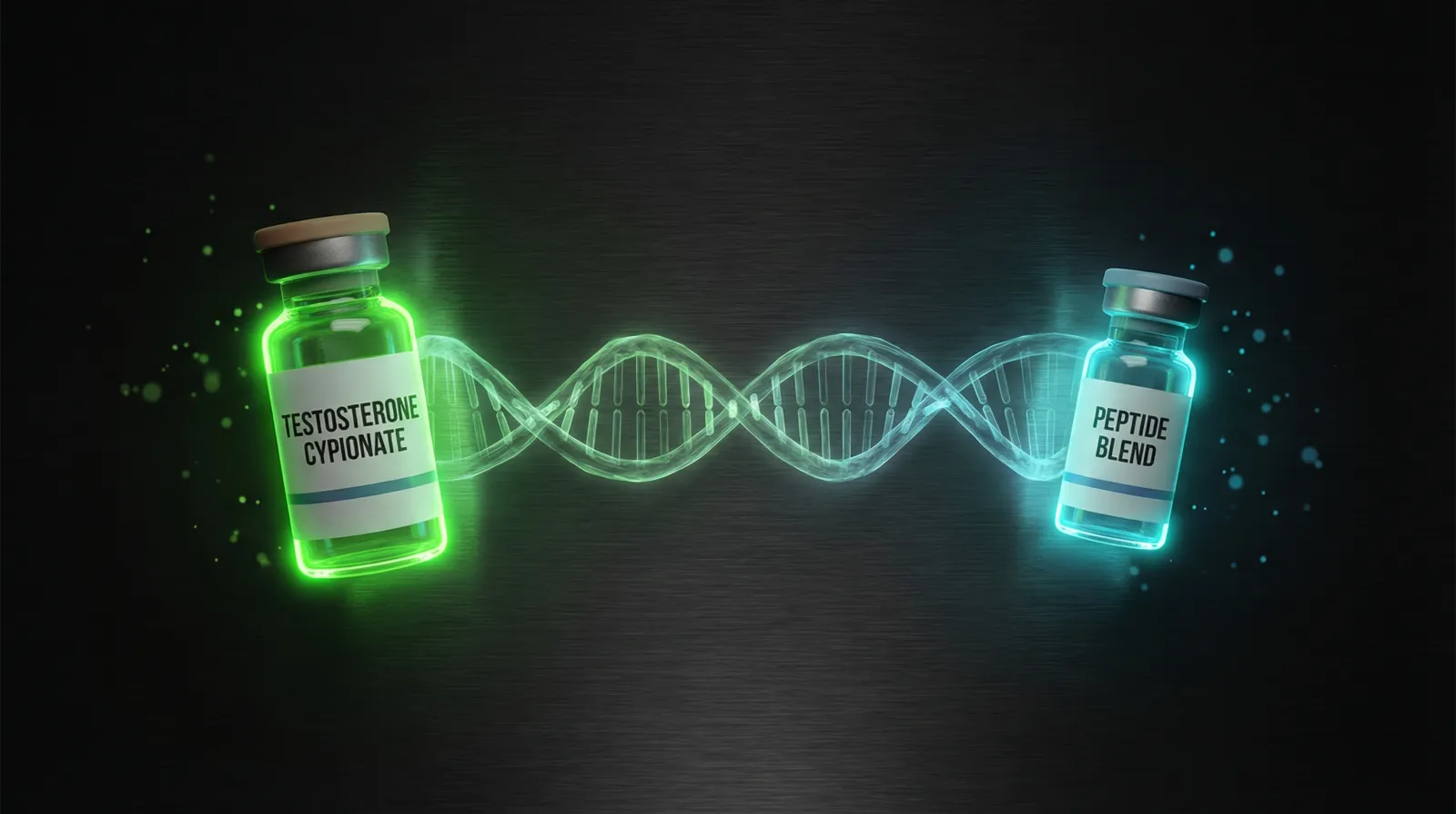
Can You Take BPC-157 With Testosterone Cypionate?
No study has tested BPC-157 with testosterone cypionate, so no source says if the pair is safe or useful. Each one has been studied on its own. BPC-157 has mostly animal and lab data. Testosterone therapy has large studies tied to more tendon tears.
TRT is short for testosterone replacement therapy. Testosterone cypionate is one form of it. In the two dose studies cited further down, it was given as a shot into muscle. The tendon studies below counted any form of testosterone therapy. We searched PubMed on 5 October 2026 for BPC-157 with testosterone. PubMed is the main US index of medical research. The search found no study of the two together. It turned up one 2025 editorial and one fish study that matched on a word.
The reason the two get paired is tendon injury. A 2025 study looked at men who started testosterone within 30 days of a doctor visit. These 112,242 men did not meet the criteria for low testosterone treatment. Each was matched with similar men who never had testosterone, 448,968 in all. This design is called a matched cohort. Within one and two years, the testosterone group had significantly higher rates of tendon tears and tendon repairs Waters et al. 2025. Tears of the patellar tendon, below the kneecap, rose the most. The authors said men thinking about testosterone should be told of this risk.
A separate study looked at the Achilles tendon. It took 423,278 patients aged 35 to 75 who filled at least 3 months of TRT prescriptions in a row. They had higher odds of an Achilles injury than matched controls. Of those injured, 9.0% on TRT had surgery, against 6.4% of controls Albright et al. 2023.
These studies show a link, not proof that testosterone causes tears. A 2026 review said the data come from records, not trials, and are "substantially confounded." That means other factors could explain the link. It said the studies cannot prove cause, and that the real number of injuries is generally low Farzam 2026. No study has tested whether BPC-157 changes that risk.
How Might BPC-157 And TRT Work Together?
No study has looked at how BPC-157 and TRT might work together in the body. What exists is lab and animal work on BPC-157 alone. It points to four effects.
Our BPC 157 guide covers the full research record.
What Did The Growth Hormone Receptor Study Find?
Chang et al. grew tendon fibroblasts from the Achilles tendons of male rats. Fibroblasts are the cells that build tendon tissue. BPC-157 raised growth hormone receptor levels in these cells. The rise was dose- and time-dependent, at both the mRNA and protein level. In other words, both the gene message and the finished receptor went up Chang et al. 2014. When the team then added growth hormone, the treated cells multiplied faster. The authors said this may help tendon healing. The work was done in a dish, not in a living animal or a person.
What Did Blood Vessel Studies Find?
Angiogenesis means the growth of new blood vessels. VEGFR2 is a receptor on the cells that line blood vessels. In rats with poor blood flow to a hind leg, BPC-157 sped up blood flow recovery and raised VEGFR2. It did the same to VEGFR2 in human vessel cells in a dish Hsieh et al. 2017. A 2025 systematic review of BPC-157 in sports medicine read 36 studies. Of these, 35 were preclinical, meaning lab or animal work, and 1 was clinical. It found they suggest BPC-157 acts on pathways for cell growth and angiogenesis Vasireddi et al. 2025.
What Did The Tendon Cell Study Find?
Chang et al. also cultured small pieces of tendon. BPC-157 significantly sped up how fast fibroblasts grew out of them. The cells they then tested came from rat Achilles tendon. It did not directly change how fast the cells multiplied. It raised cell survival under stress from hydrogen peroxide, a chemical that damages cells. It also raised in vitro cell migration in a dose-dependent way. In vitro means in a dish, not in a body. FAK and paxillin are proteins that help cells move. Their phosphorylation, a chemical switch that turns them on, rose with the dose Chang et al. 2011. Our guide to BPC-157 for tendon and ligament repair goes deeper on that.
What Do Reviews Say About Inflammation?
A 2025 review says BPC-157 eases inflammation in animal work McGuire et al. 2025. The 2025 systematic review says it seems to lower cytokines. These are signals that drive inflammation (Vasireddi et al. 2025). Neither review tested it in men on testosterone.
BPC-157 Interactions With Testosterone Cypionate: Is There A Study?
No. We found no study of BPC-157 interactions with testosterone cypionate, in people or in animals. So no interaction has been shown, and none has been ruled out.
The human record on BPC-157 itself is small. In 2026 the FDA wrote a briefing on it for a panel that advises on compounded drugs. It lists five human studies FDA BPC-157 briefing, 2026. Two gave BPC-157 as an enema and compared it with a placebo, a dummy treatment. Three were small studies with no placebo group. One was a chart review, a look back at patient records, on knee pain. Some of those patients also got thymosin beta-4, a different peptide. Another was a pilot on a bladder pain condition called interstitial cystitis. The third was a pilot testing the safety of a drip into a vein. None of the five used testosterone. The FDA said the doses tested were "likely exploratory in nature."
| Claim | Evidence level | Source |
|---|---|---|
| Tendon fibroblast outgrowth, survival and migration; FAK-paxillin activation | Preclinical (tendon pieces and rat tendon cells in a dish) | Chang et al. 2011 |
| Growth hormone receptor upregulation in tendon fibroblasts | Preclinical (rat tendon cells in a dish) | Chang et al. 2014 |
| Pathways for cell growth and angiogenesis | Systematic review: 35 preclinical studies, 1 clinical | Vasireddi et al. 2025 |
| IV safety and tolerability | Limited human (n=2, pilot) | Lee & Burgess 2025 |
| Testosterone therapy linked to more tendon tears | Human, matched cohort, observational | Waters et al. 2025 |
| Side effects reported in the literature | Review: "only a few side effects have been reported" | Jóźwiak et al. 2025 |
| BPC-157 taken with testosterone | No study found | PubMed search, 5 October 2026 |
In short, most BPC-157 tendon findings come from cells and animals. The human data on testosterone and tendon tears is real. But it comes from health records, not trials. No randomized trial, where people are split by chance, has tested BPC-157 for tendon healing in humans. That holds with or without testosterone.
Stacking BPC-157 With Testosterone Cypionate: What Doses Have Studies Used?
No source gives a dose for stacking BPC-157 with testosterone cypionate. The table lists doses that named studies used for each one on its own. These are records of what was given, not advice. See our page on doses used in BPC-157 studies for the wider record, and our dose by weight page for the animal doses per kilogram.
| Study | Who | What was given |
|---|---|---|
| Lee & Padgett 2021, per the FDA briefing | A chart review of 17 people with knee pain, 16 of whom were contacted | BPC-157 into the knee joint, alone or with thymosin beta-4, 2 to 4 mg of BPC-157, 1 to 2 doses |
| Lee et al. 2024 | 12 women with interstitial cystitis | BPC-157, 10 mg in total, injected around the bladder in one procedure |
| Lee & Burgess 2025 | 2 adults who had had IV BPC-157 before | BPC-157 into a vein, 10 mg on day 1 and 20 mg on day 2 |
| Ruenzi 2005, per the FDA briefing | 53 people with ulcerative colitis | BPC-157 enema, 80 mg once daily for 2 weeks, or placebo |
| Rivero et al. 2023 | Men with low testosterone, in a randomized trial | Testosterone cypionate into muscle, 200 mg every 2 weeks |
| Choi et al. 2021 | 234 men with low testosterone, split across two treatments | Testosterone cypionate into muscle, 100 mg weekly, in one group |
What Do Studies Say About Taking BPC-157 By Mouth?
One human trial on record, NCT02637284, planned tablets taken by mouth. It has posted no results. Our page on oral vs. injectable BPC-157 sets out what is known about each form. Our page on BPC-157 gut health covers the gut studies.
How Long Does BPC-157 Last In The Body?
Half-life is the time it takes for half a dose to clear. In rats and dogs, the half-life of BPC-157 was less than 30 minutes He et al. 2022. The FDA found no information to judge how BPC-157 behaves in the human body.
How Long Have Human Studies Lasted?
The FDA notes that the human studies were of short duration. The two enema studies ran for a maximum of two weeks. The other three gave one procedure, one or two knee shots, or two drips on two days. No study has given BPC-157 to people for months, with or without testosterone.
Wolverine Stack And TRT: What Is Known?
"Wolverine stack" is a name used online for BPC-157 with TB-500. The FDA's TB-500 briefing cites a web page that calls the pair the "wolverine protocol" FDA TB-500 briefing, 2026. No study has tested the Wolverine stack and TRT together. The table shows what has been studied for each option.
| Option | What has been studied | Main gap |
|---|---|---|
| BPC-157 alone | Mostly cell and animal work; five small human studies | No randomized human trial for tendon healing |
| BPC-157 with TRT | Nothing on the pair; TRT alone is linked to more tendon tears | No study of the combination |
| BPC-157 + TB-500 (Wolverine stack) | No study of the pair; FDA found no human data on TB-500 by any route | Human risks of TB-500 unknown |
Does BPC-157 Increase Testosterone, Or Add Side Effects?
No study we found has measured whether BPC-157 changes testosterone levels. So there is no evidence that it raises them, and none that it does not.
On side effects, the FDA found "insufficient clinical safety information to characterize the safety profile" of BPC-157. In plain terms, there is too little data to say how safe it is. In one enema study of healthy people, headache and gas were most common. There was no clear difference from the dummy treatment. A 2025 pilot study gave two adults BPC-157 into a vein, up to 20mg. No side effects were reported. Tests of the heart, liver, kidneys, thyroid and blood sugar showed no measurable change Lee & Burgess 2025. That is two people, not a population.
The 2025 systematic review found no safety data from people. The McGuire review said the three small human pilot studies reported no side effects. It called BPC-157 investigational, which means it is still being studied.
One question is still open: angiogenesis. Hsieh et al. found BPC-157 promotes new blood vessel growth. No study we found has tested what that means for people with cancer. This is a theoretical risk, not a demonstrated one.
BPC-157 And Testosterone: What Do Regulators And Anti-Doping Rules Say?
A 2025 review says the FDA has not approved BPC-157 for use in standard medicine (Jóźwiak et al. 2025). USADA runs drug testing in US sport. It says no health body in the world has approved BPC-157 for medical use in people.
- WADA is the World Anti-Doping Agency. Its 2026 banned list puts drugs that have no approval in category S0. BPC-157 is named there WADA 2026 Prohibited List.
- S0 drugs are banned at all times, in and out of competition.
- A therapeutic use exemption, or TUE, is a medical waiver to use a banned drug. USADA says a TUE for BPC-157 is unlikely, since allowed options exist. It looks at each request case by case USADA.
- Testers can look for BPC-157 in urine. A 2017 lab method found it down to 0.1 ng/mL Cox et al. 2017.
See our page on BPC-157's WADA status for more on bans and tests.
Where to buy BPC-157
The hard part with BPC-157 isn't the protocol. It's finding a supplier that can prove what's in the vial. We assessed dozens against per-batch, third-party testing. A handful passed.
See the sources that passed →What Do Reviews Say About BPC-157 Quality?
No health agency has approved BPC-157. The 2025 systematic review says side effects could come from unregulated making or from contamination (Vasireddi et al. 2025). The McGuire review says it is widely sold by sellers no one regulates.
A certificate of analysis, or COA, is a lab report on what is in a batch. See our recommended sources for the vendors we list. Our page on reliable peptide sources explains how we choose them.
What To Stack With Testosterone Cypionate Beyond BPC-157?
We found no study that tests any peptide with testosterone cypionate. Some readers ask about TB-500 for injuries. The FDA's TB-500 briefing found no clinical studies or human exposure data for it by any route. Our TB-500 dosage page shows what has and has not been tested.
This content is for educational purposes only. These compounds are intended for research use. Nothing here is medical advice. Nothing on this page is a recommendation to combine BPC-157 with testosterone cypionate, and it does not replace advice from a qualified clinician.
If you're researching this compound, we've linked our recommended sources below. It supports the channel.
Where to buy BPC-157
The hard part with BPC-157 isn't the protocol. It's finding a supplier that can prove what's in the vial. We assessed dozens against per-batch, third-party testing. A handful passed.
See the sources that passed →Share this article
Frequently Asked Questions
What doses have studies used for BPC-157 and testosterone cypionate?
Has anyone studied BPC-157 and testosterone in the same syringe?
Does BPC-157 interfere with testosterone replacement therapy?
How long have BPC-157 studies in people lasted?
Is BPC-157 safe to use with testosterone long term?
Can BPC-157 show up on a drug test?
Read Next


Disclaimer: This content is for educational purposes only. These compounds are intended for research use. Nothing here is medical advice. Always work with a qualified clinician before making changes to your health protocol.