
TB-500 Hair Growth: What the Evidence Really Shows

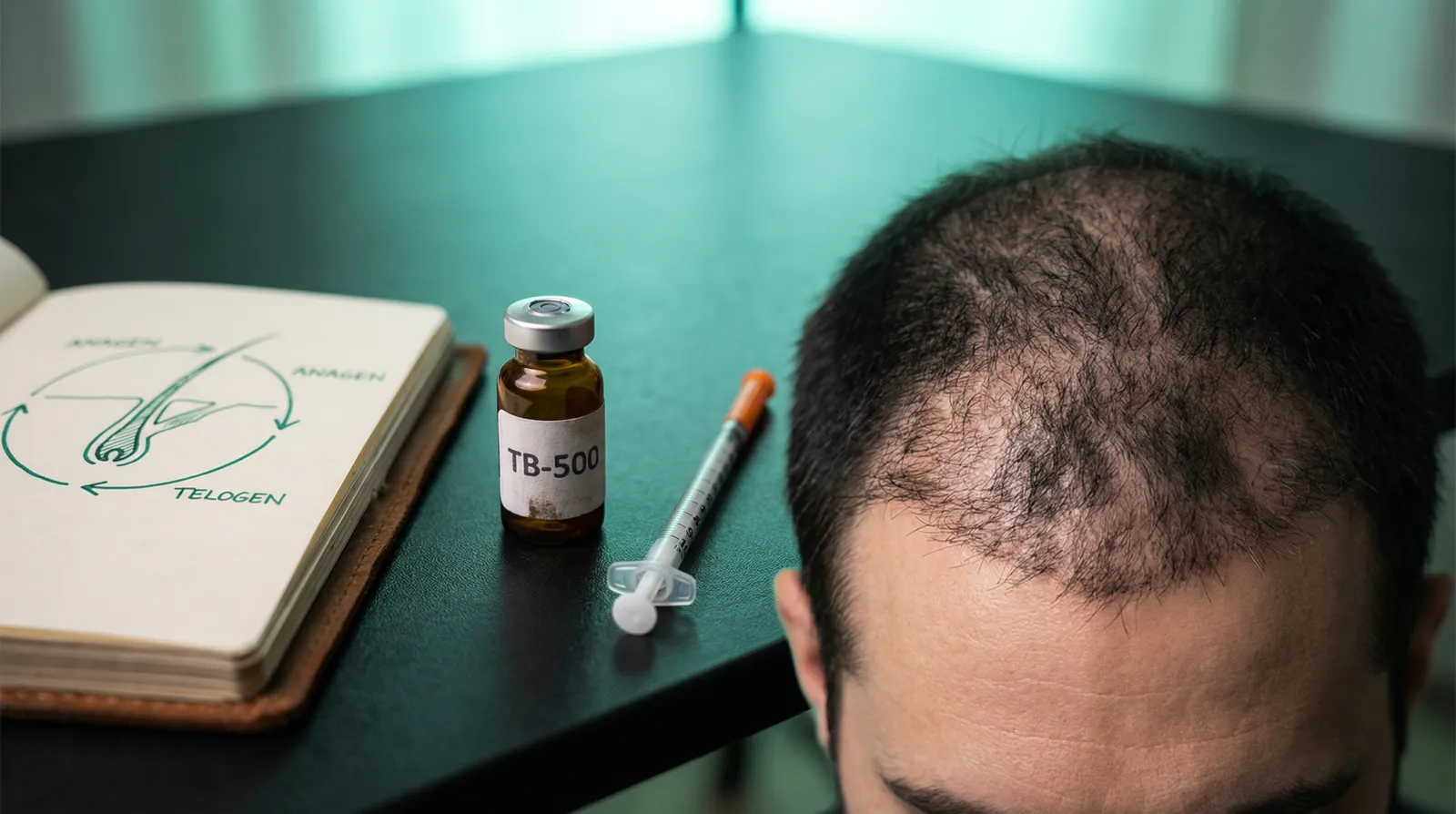
Does TB-500 Help With Hair Growth?
TB-500 hair growth evidence is preclinical only. Three rodent studies from 2004 and 2007 show thymosin beta-4 waking hair follicle stem cells. No human trial exists. Protocols typically run 2 to 5 mg a week across 8 to 12 weeks, beside proven finasteride and minoxidil.
This content is for educational purposes only. TB-500 is a research peptide not approved for human use. Nothing here is medical advice.
TB-500 is a synthetic fragment of thymosin beta-4 (Tβ4). Tβ4 is a 43-amino acid protein found in nearly all human and animal cells. TB-500 keeps the actin-binding domain, amino acids 17 to 23. That part drives cell migration, angiogenesis (new blood vessels) and tissue repair. The same three jobs matter to a hair follicle. That is the only reason hair growth came up at all. Human data remains limited.
What Do the TB-500 Thymosin Beta-4 Hair Growth Studies Say?
Four papers carry the weight here. Three are rodent hair studies. The fourth maps which part of the molecule does the work. For everything else on the compound, see our TB-500 complete guide.
What Did Philp 2004 Find in Rats and Mice?
Thymosin beta-4 stimulated hair growth in normal rats and mice (Philp et al., FASEB J, 2004). Some hair follicular keratinocytes, the cells that build a hair, made Tβ4 in step with the hair growth cycle. Those cells come from the bulge region. That is a niche for skin stem cells. Rat vibrissa (whisker) follicle cells were then grown in a dish. Their migration and differentiation increased at nanomolar concentrations of Tβ4. The paper also found more matrix metalloproteinase-2 (MMP-2). MMP-2 breaks down the scaffolding between cells. So one paper tied Tβ4 to both stem cells and MMP-2.
What Did the Ageing and Wound Paper Add?
The same laboratory reported that Tβ4 promotes angiogenesis, wound healing and hair follicle development (Philp, Goldstein and Kleinman, 2004). It reported effects in normal and aged rodents. The authors say it acts by raising angiogenesis and cell migration. So the hair effect is at least partially mediated by that blood vessel work. Capillary density around the follicle goes up. The dual mechanism suggests TB-500 may hit two bottlenecks at once.
What Did Philp 2007 Confirm?
A later paper ran in the Annals of the New York Academy of Sciences. It reported that Tβ4 induces hair growth through stem cell migration and differentiation (Philp et al., 2007). It used various rat and murine (mouse) models. One was a transgenic mouse that makes extra Tβ4. The authors looked at follicle stem cell growth, migration and protease production.
Which Part of the Molecule Does the Work?
TB-500 is only a fragment. So this question decides everything above it. A review of Tβ4's active sites answers it (Sosne et al., FASEB Journal). The short sequence LKKTETQ is the central actin-binding domain, amino acids 17 to 23, plus one extra amino acid. That short piece promotes angiogenesis, wound healing and cell migration. TB-500 is not a dead, cut-down version of Tβ4. It keeps the active part.
What Can the Animal Data Not Show?
All three hair studies used rodent models. Hair biology differs between rodents and people. Follicle density differs. So does cycle timing. So does androgenetic alopecia, the DHT-driven shrinking of follicles. That pathway is largely absent in rodents. Good results in animal models cannot be assumed to carry over. No controlled human trial has tested TB-500 for hair loss.
How Does TB-500 Act on the Hair Follicle?
Three paths, each one a different bottleneck.
How Do Stem Cells Start a New Hair?
Hair follicles rely on stem cells in the bulge region. These cells start anagen, the active growth phase. They move to the base of the follicle. There they turn into the matrix cells that make hair. Preclinical work shows Tβ4 raises the migration and differentiation of these follicular keratinocytes at nanomolar concentrations. Without enough stem cell work, follicles stall in telogen, the resting phase. In time they miniaturise.
Why Does Blood Supply Matter?
Every growing hair follicle needs its own blood supply. Tβ4 raises vascular endothelial growth factor (VEGF). It also moves endothelial cells, which line blood vessels. Capillary density goes up in the tissue it reaches. In the scalp that means more food and oxygen for follicles in anagen.
What Is Extracellular Matrix Remodelling?
The extracellular matrix (ECM) around a follicle works as scaffolding. It holds cells in place and lets them move. TB-500 raises MMP-2, which breaks down and rebuilds that scaffolding. Stem cells and dermal papilla cells can then move and touch. That contact has to happen before anagen starts. Without ECM work, even woken stem cells cannot finish the job.
How Does the Wnt Pathway Fit In?
Newer research points to a link between thymosin beta-4 and Wnt/β-catenin signalling. Wnt is one of the master switches for hair follicle cycling. Anagen cannot start without it. Tβ4's effects on stem cell migration appear to be at least partially Wnt-dependent. That may explain why Tβ4 works best during the natural telogen-to-anagen switch.
What Does the TB-500 Hair Growth Evidence Show in People?
Very little. That is the honest answer. No published randomised controlled trial has tested TB-500 or thymosin beta-4 for hair loss in humans. The human record is anecdotal self-reports plus open-label notes. Neither meets the bar needed to draw conclusions about efficacy.
The anecdotal reports do cluster. Most people who report hair changes were using TB-500 primarily for injury recovery. Hair was a secondary thing they noticed. They report better scalp texture, less shedding and modest gains in density. Nearly all of them describe stress-related or diffuse hair loss. Few describe settled androgenetic alopecia.
Users with significant pattern baldness report little to no hair benefit. That fits the mechanism. TB-500 works on stem cell migration and angiogenesis. It does not work on DHT signalling. If follicles have already miniaturised significantly, more blood and more stem cell movement may not undo the damage.
So the honest read is narrow. The mechanisms are credible. The animal data is reproducible. The anecdotal signal is consistent enough to be worth monitoring. But TB-500 cannot be recommended for hair loss the way minoxidil or finasteride can. Both of those carry robust human clinical data.
Does TB-500 Cause Hair Loss?
Nothing in the research record says it does. The side effect list below carries no hair loss and no shedding. All three animal hair studies point the other way, towards growth. But no controlled human trial exists. So nothing about human hair is settled either way. An absence of reports is not a clean safety finding.
One real caution does exist. It has nothing to do with hair. It sits in the safety section below.
Can TB-500 Replace Minoxidil or Finasteride?
No. Here is what each one does.
How Does Minoxidil Work?
Minoxidil makes anagen last longer. It improves blood flow in the scalp. It also opens potassium channels in follicular cells. It is FDA-approved for androgenetic alopecia as a topical at 2% and 5%, and as a pill. It must be used indefinitely. Stopping returns hair loss to baseline within months. It shares the angiogenesis target with TB-500. But it has 40 years of human clinical data behind that claim.
How Does Finasteride Work?
Finasteride blocks 5-alpha reductase. That enzyme turns testosterone into dihydrotestosterone (DHT). DHT is the primary driver of androgenetic alopecia in men who are prone to it. Finasteride is FDA-approved at 1 mg/day for male pattern baldness. Trials show it keeps hair in approximately 83% of users. Around 66% see regrowth. Some users report sexual side effects. Those include reduced libido and erectile dysfunction.
Where Does TB-500 Sit?
TB-500 does not touch the DHT pathway. It does not block 5-alpha reductase. It does not lower androgen receptor sensitivity at the follicle. It cannot undo settled miniaturisation from long DHT exposure. If androgenetic alopecia is the concern, TB-500 is not an alternative. It works on a completely different axis.
It may have a rationale as an add-on while DHT is handled by finasteride or dutasteride. Better scalp blood flow and stem cell work could theoretically help the main treatment. That stays speculative without combined-use human data.
Which Hair Loss Types Respond Best to TB-500?
Two are most likely to respond. One is not.
Who Fits the Telogen Effluvium Picture?
Telogen effluvium is diffuse shedding. Stress can trigger it. So can illness, poor nutrition or hormonal shifts. It is a mass shift of follicles from anagen into telogen. TB-500 promotes the telogen-to-anagen transition through stem cell work. That makes it a good mechanical fit here. It is the most credible use case on current evidence.
Who Has Poor Scalp Circulation?
Smokers tend to. So do people with heart disease, and people with chronically high cortisol. All three tend to have fewer small blood vessels in the scalp. That starves the follicle. The angiogenic effect of TB-500, meaning more VEGF and new capillary growth, targets this directly.
Who Is Unlikely to Benefit?
Men with settled androgenetic alopecia are unlikely to see much from TB-500 alone. That is truest at Norwood scale III and above. Follicles under long DHT exposure need DHT blockade first.
How Do People Dose TB-500 for Hair Growth?
The table below comes from the research literature and from anecdotal reports. This is not medical advice, and TB-500 is not approved for human use. Any protocol should be designed and supervised by a qualified clinician.
| Phase | Dose | Frequency | Weekly total | What the source says |
|---|---|---|---|---|
| Loading, weeks 1 to 6 | 2 to 2.5 mg | Twice a week, subcutaneously | 4 to 5 mg | Builds tissue saturation. Most observed effects tend to emerge here. Hair growth effects in animal research were observed during sustained treatment, not after a single dose. |
| Maintenance, week 7 onwards | 2 mg | Once every 1 to 2 weeks | Varies | Animal hair effects persisted for approximately 30 days during sustained treatment, then returned to baseline within 2 weeks of stopping. |
| Cycle length | As above | 10 to 12 week cycle, then an equal off-period | As above | Continuous use beyond this has not been studied for safety. |
| Reported anecdotal range | 2 to 5 mg a week | Across 8 to 12 weeks | 2 to 5 mg | Run alongside proven baseline treatments such as finasteride and minoxidil, never instead of them. |
The pattern matters more than the numbers. Effects look treatment-dependent, not permanent. For reconstitution guidance, see our complete peptide reconstitution guide. Our TB-500 dosage guide carries the full schedule.
Where to buy
The hard part isn't the protocol. It's finding a supplier that can prove what's in the vial. We assessed dozens against per-batch, third-party testing. A handful passed.
See the sources that passed →How Risky Is TB-500 for Hair Growth Use?
Side effects are generally mild and transient. Long-term safety data in humans does not exist.
The most common reports are fatigue and lightheadedness in the hours after a shot. Localised injection site reactions happen too, meaning redness and mild swelling. Temporary headache early in the loading phase is common. A smaller number of users report fever, muscle aches or generalised flu-like symptoms. Blistering at the injection site and hives have been reported rarely and warrant discontinuation.
One concern outweighs all of those. Tβ4 is pro-angiogenic and pro-migratory. Those are the same pathways involved in tumour growth and metastasis. This has not been observed in normal animal models at research doses. Even so, individuals with a personal or family history of cancer should not use TB-500 without medical supervision. For a full review of the safety data, see our TB-500 side effects guide.
Should You Stack BPC-157 or TB-500 for Hair Growth?
The most established TB-500 stack is with BPC-157. For hair, BPC-157 may calm the scalp because it damps inflammation. TB-500 handles the stem cell and blood vessel side. For the full healing stack protocol, see our Wolverine Stack guide. The head-to-head breakdown sits in BPC-157 vs TB-500.
TB-500 and topical minoxidil do not overlap mechanically. Minoxidil acts by opening potassium channels and raising prostaglandin E2. TB-500 acts through VEGF and stem cell work. If minoxidil is already part of a protocol, TB-500 does not double up on it.
The compounds discussed are supplied for research use and are not approved medicines. Always consult a qualified clinician before considering any protocol, and review our recommended sources for supplier vetting criteria.
Where to buy
The hard part isn't the protocol. It's finding a supplier that can prove what's in the vial. We assessed dozens against per-batch, third-party testing. A handful passed.
See the sources that passed →Share this article
Frequently Asked Questions
Does TB-500 actually work for hair growth in humans?
How long does TB-500 take to show hair growth effects?
Can TB-500 reverse male pattern baldness?
What is the difference between TB-500 and thymosin beta-4?
What type of hair loss responds best to TB-500?
Is TB-500 safe to use for hair growth?
Read Next



Disclaimer: This content is for educational purposes only. These compounds are intended for research use. Nothing here is medical advice. Always work with a qualified clinician before making changes to your health protocol.