
Grey Market Peptides: Purity, Endotoxins and the Law

What Are Grey Market Peptides?
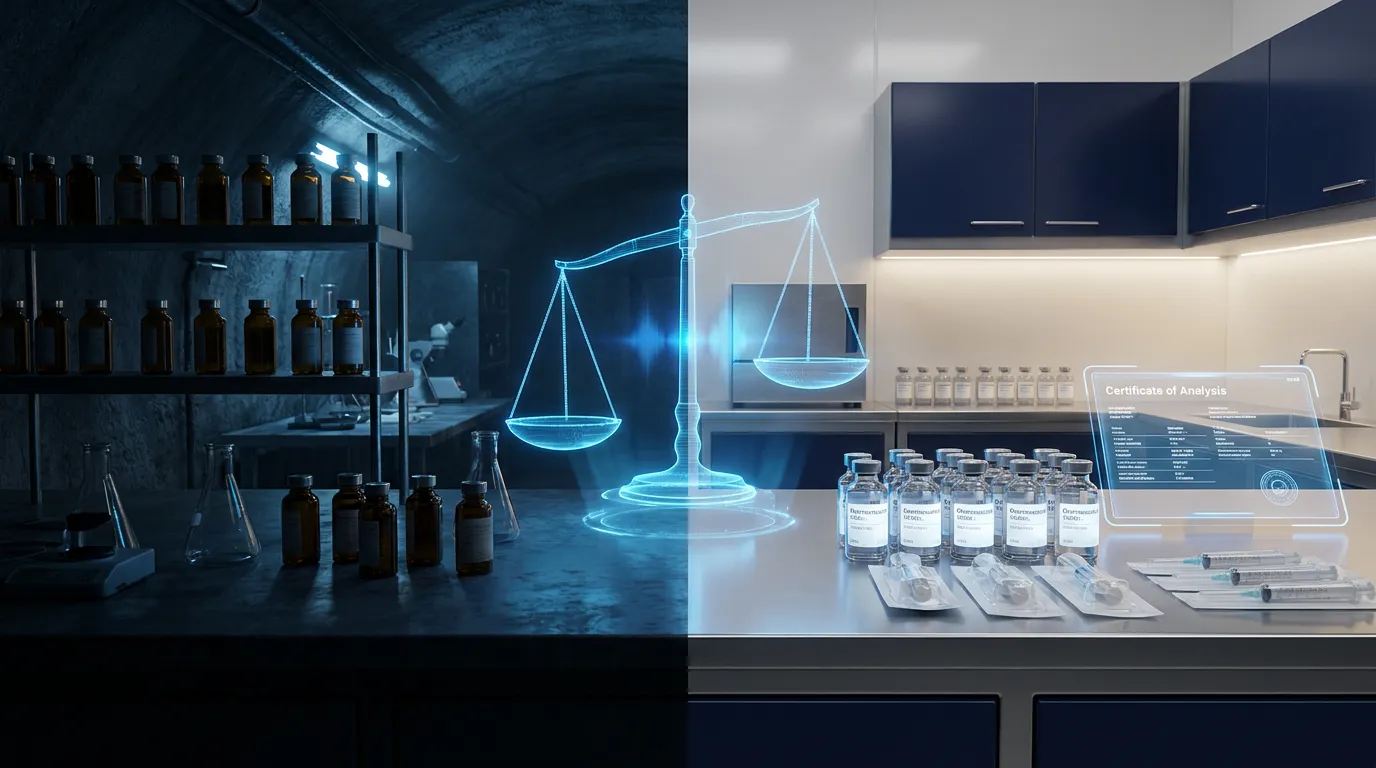
Grey market peptides are compounds sold outside legal pharmacy channels, under labels like "for research use only". FDA says such labels do not stop a product sold for human use from being a drug. In one study, all three semaglutide vials bought from illegal online pharmacies held endotoxin (toxic bacterial debris).
The grey market is not a shortcut around a lawful route. For the seven peptides FDA's advisers voted on in July 2026, no lawful compounding route is open today. That is the part the argument keeps missing. And the bill does not arrive as a knock at the door. It arrives as a vial no regulator checked.
Start with the label. A grey market peptide is sold outside legal pharmacy channels. The vial may say "for research use only" or "not for human use". That wording does not move legal risk off the seller. In a warning letter to one seller, FDA said that despite "research use only" labels, the products were intended as drugs for human use. It called them unapproved new drugs. And no regulator reviews what is in the vial before it is sold.
The label does not change what the product is. FDA's letter said products meant to treat disease, or to affect the body, are drugs. Even lawfully compounded drugs (made up by a pharmacy for one patient) get no FDA premarket review for safety, effectiveness or quality. Bays et al. 2024 quote FDA saying so. Grey market vials sit outside even that system.
So a man chasing better recovery or sleep is betting on a factory he cannot name. Sometimes the bet pays. Sometimes it does not.
The Lawful Door Is Not Open Today
It is easy to think 2023 shut a door.
The better question is whether any door is open today. On 29 September 2023, FDA added 19 substances to Category 2 for pharmacy compounding. Most were peptides. That means FDA said it would consider taking action against a compounder who used them. The risks it named included an unwanted immune reaction (immunogenicity) and peptide-related impurities. For several, FDA said it had "no, or only limited, safety-related information". FiercePharma summed up both sides. Promoters of compounded peptides call the 2023 action an overreach of FDA's power. Former FDA officials say safety concerns backed it.
Demand did not stop. ProPublica reported in April 2026 that demand for these peptides has exploded since 2023, as influencers flooded social media with promises. It reported that this demand has built a growing grey market, where sellers offer vials labelled "not for human use". A compounding trade group argues that regulated pharmacies would be a safer source than that market.
Underneath that fight sits a harder fact. Under Section 503A (the federal law on pharmacy compounding), a bulk ingredient can qualify in one of three ways. It can meet a USP or NF monograph (an official quality standard). It can be a component of an FDA-approved drug. Or it can sit on the 503A bulks list (FDA's list of other ingredients pharmacies may compound from). None of the seven peptides FDA reviewed in July 2026 qualifies by any of the three routes today. FDA's briefing on each one found no USP or NF monograph and no approved drug that contains it. The bulks list itself, 21 CFR 216.23, names none of them.
So the demand is real, the supply is real, and for these seven no lawful channel joins them today. That is the shape of the problem. Everything below is what fills the space.
The July 2026 FDA Vote: What It Moved, and What It Did Not
FDA's Pharmacy Compounding Advisory Committee met on 23 and 24 July 2026. It is a panel of outside experts who advise FDA. It voted on seven peptides for the Section 503A bulks list. That list names extra ingredients a pharmacy may compound from. The committee voted to recommend six: BPC-157, KPV, TB-500, MOTS-c, epitalon and Semax. It voted against emideltide (DSIP), the National Community Pharmacists Association reported. FDA's meeting page lists no minutes or vote record. The vote is advisory. It is not binding, and it approved nothing.
Two facts on FDA's own record matter more than the vote. FDA's briefing on each of the seven concluded that "a balancing of the criteria weighs against" adding it to the list. And FDA's category 2 page lists all seven as withdrawn nominations that were previously in category 2. FiercePharma covered the run-up to the meeting. Our report on the July 2026 FDA peptide vote covers the meeting in more detail.
The statute adds substances to that list only through federal regulations. For a rule like this, FDA normally publishes a proposed rule for public comment before a final one. As of 25 September 2026, the Federal Register (the government's daily rule journal) shows no proposed rule to add any of them. Only a final rule could add a substance to the list. Until one does, your position is the one you had before the meeting. Even listing would not make a drug FDA approved. FDA's rule says calling a drug compounded from a listed substance "FDA approved" misbrands it (a federal labelling violation).
The vote also left many compounds out. CJC-1295, ipamorelin, MK-677 (ibutamoren) and AOD-9604 were not in it. Neither were LL-37, PEG-MGF or GHRP-2. None of these, and none of the seven, is on the 503A bulks list today. GHRP-2 has one narrow exception. FDA's 503B list puts it in category 1, "under evaluation", except for use by injection or nasal spray. That list is for outsourcing facilities (compounders registered with FDA under section 503B), not pharmacies. FDA does not plan to act against them for using a category 1 substance, if other conditions are met, its interim policy says. For the rest, what is inside the grey market vial is the whole question.
What Does Pharmaceutical-Grade Mean for Grey Market Peptides?
Pharmaceutical-grade means a drug is made and tested to written standards. For peptide drugs, guidelines from FDA, EMA (Europe's drug regulator) and ICH (a global body that writes drug guidelines) cover four stages. They are raw materials, a site that meets Good Manufacturing Practice (GMP), validated lab tests and stability studies.
Elsayed et al. 2025, a review in the Journal of Peptide Science, sets out that framework. The lab methods must be validated. They must pick up impurities and breakdown products, so the final product meets its specification. Stability studies test how the drug holds up in storage.
The checks depend on the route a drug takes.
- The maker of an FDA-approved drug must follow current good manufacturing practice (cGMP). If not, the law treats the drug as adulterated.
- A pharmacy compounding under section 503A is exempt from those cGMP rules by law.
- Its bulk ingredient must come from a maker registered with FDA. It needs a valid certificate of analysis (a lab report on the batch).
- USP 797 (the national standard for sterile compounding) applies to anyone who makes a sterile preparation. It requires endotoxin testing only for some injectables, covered below.
- USP 797 does not require sterility testing for Category 1 preparations. Category 3 preparations always need it. For Category 2, it depends on how long the preparation may be used.
A grey market seller works inside none of these routes. In Ashraf et al. 2024, researchers bought three semaglutide vials from illegal online pharmacies. The sellers claimed at least 99% purity. Measured purity was between 7.7% and 14.37%.
What is not the peptide matters too. Manufacturing can introduce impurities, such as bacteria or heavy metals, ProPublica reports. Even so, purity is the friendliest number in this story, and it cannot show endotoxin. That needs a test of its own.
Why Do Endotoxins Matter More Than Purity in Grey Market Peptides?
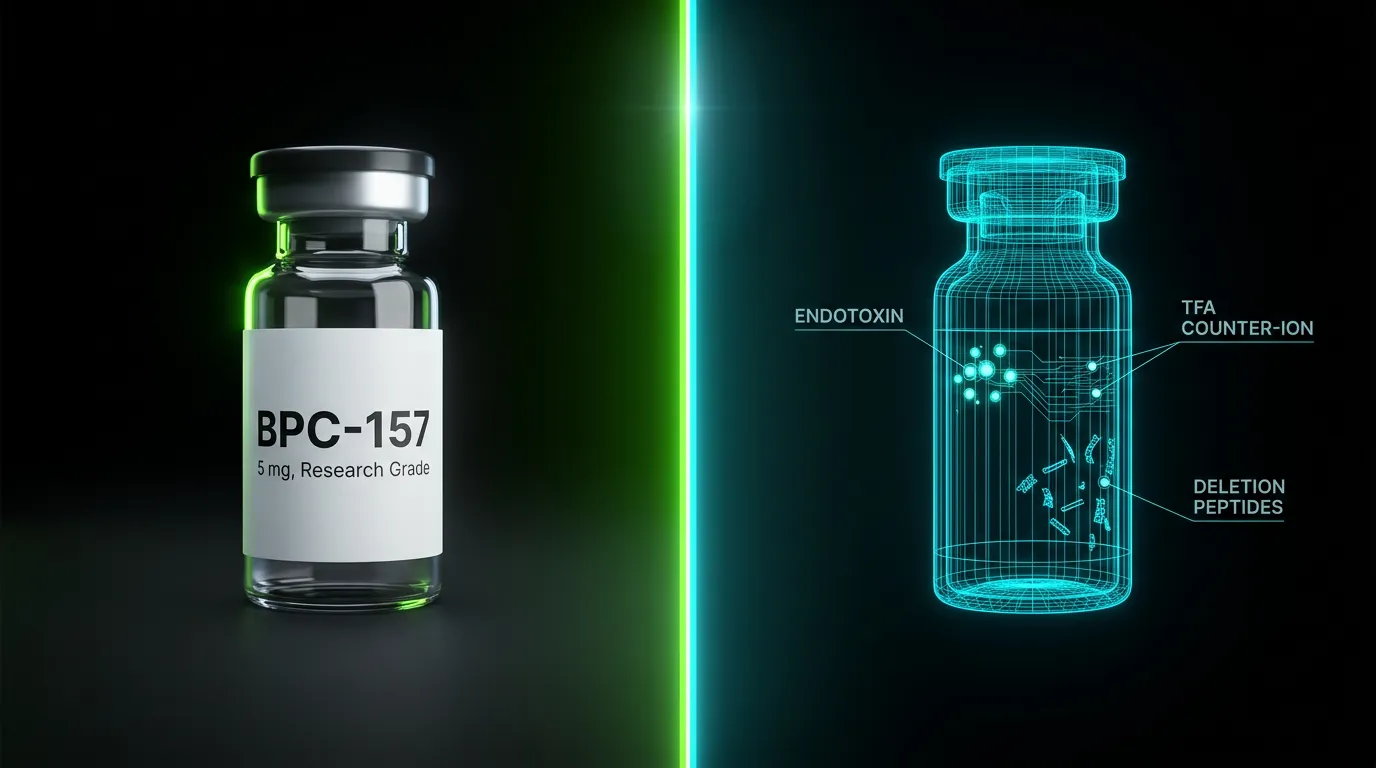
A purity figure measures how much of the sample is the peptide. It says nothing about bacterial toxins. Endotoxins need their own test, such as the LAL test (a lab test that detects endotoxin). Steam sterilisation does not remove them.
Endotoxins are lipopolysaccharides, left over from the cell walls of certain bacteria. In the Ashraf study, the authors traced them most likely to the water or non-sterile ingredients used to make the vials. Steam sterilisation (autoclaving) and filtering do not remove them, USP says. USP adds that in the bloodstream, enough of them can cause fever and septic shock. In the most severe cases they can be fatal. Khan et al. 2018, a review of peptide toxicity, reported negligible toxicity for peptides made by chemical and biotechnological methods. It still called for checking each peptide for immune reactions and toxicity before use as a treatment.
A certificate of analysis showing high purity on HPLC (a standard lab purity test) does not answer this. Endotoxin needs its own test. One standard method is the Limulus Amebocyte Lysate (LAL) test, which FDA has accepted for more than 30 years. In the Ashraf study, the authors reported endotoxin in all three vials, while the sellers claimed at least 99% purity.
USP 797 applies to anyone who makes a sterile preparation. USP does not enforce it; regulators such as state boards of pharmacy do. USP sorts sterile preparations into categories by how they are made and how long they may be used. Its endotoxin rule covers some injectables, not all. It covers Category 2 injectables made from a non-sterile ingredient that need a sterility test. It also covers Category 3 injectables made from a non-sterile ingredient. Grey market vials are sold outside that system. My read, offered as a read and not a finding: the endotoxin test is where most of the real risk sits.
The Harm That Never Gets Counted
There is a second cost, and it is quieter.
Pharmacovigilance is the tracking of drug safety after a drug reaches the market. FDA's system draws on reports sent to it. Health professionals, patients and consumers can report a problem to FDA's MedWatch program. When appropriate, FDA then publishes a safety alert.
That system counts only what someone reports. FDA warns that its reports cannot be used to estimate how often a problem happens. A reaction to a grey market vial that nobody reports leaves no trace in it. So a quiet record is not proof of safety.
BPC-157 has a Phase 1 trial on record, NCT02637284. Phase 1 is a first small safety study in people. This one was registered as a randomised, placebo-controlled pilot of oral BPC-157 tablets. It planned an estimated 42 healthy volunteers. It set out to measure safety and pharmacokinetics (how the body absorbs and clears a drug). The registry lists its status as unknown, last verified in October 2015, with no results posted.
How Do Grey Market Peptides Compare With a Compounding Pharmacy?
"It has worked for me and the forum agrees" is not manufacturing control. Bays et al. 2024 describe a 503A pharmacy at its best. A licensed pharmacist follows state board rules. The active ingredient comes from an FDA-registered maker with a certificate of analysis. As a best practice, the pharmacist may also send samples for periodic independent testing for sterility, potency, endotoxins and impurities.
Read the middle column as the standard a lawful route would have to meet, not as a door open to you today.
| Factor | Section 503A compounding (where lawful) | Grey market vial |
|---|---|---|
| Who makes it | Licensed pharmacist in a state-licensed pharmacy, or a licensed physician | Does not apply |
| Prescription | Valid prescription for an identified patient | Does not apply |
| Bulk ingredient source | Maker registered with FDA | Does not apply |
| Certificate of analysis | Valid certificate for each bulk ingredient | Does not apply |
| Sterile compounding standard | USP 797, enforced by regulators such as state boards | Does not apply |
| Endotoxin testing | USP 797 requires it for some injectables made from non-sterile ingredients | Does not apply; one study found endotoxin in all three vials it bought |
| FDA premarket review | None for compounded drugs | None; FDA treats such products as unapproved new drugs |
"Does not apply" means the section 503A rule does not govern the sale. The product is not lawfully compounded.
It is not a close comparison. A lawful route brings a prescription, a registered ingredient maker, a valid certificate of analysis and USP 797 standards for sterile work. Grey market sourcing brings none of those legal checks. And for these seven peptides, that lawful route does not exist today. That is the loop this article keeps closing.
Risk Management, Not Paranoia
It is easy to treat regulators as the enemy. Sometimes that suspicion is earned. But this is not really a question about politics. It is a question about whether you can verify what you are putting in your body. Our overview of what is and is not legal in 2026 sets out the wider picture.
Say you are rebuilding after a bad injury, or managing body composition in your 40s. You are running a protocol on yourself. A 98% pure compound with endotoxin testing and a 72% pure compound with unknown contaminants are not close cousins. One is a tool you can assess. The other is a variable you cannot see.
Verification is the only lever you actually hold, so pull it hard. Ask for an independent, per-batch certificate of analysis rather than a vendor's in-house sheet. Ask whether endotoxin testing was run at all. A seller who cannot answer either question has answered both.
With BPC-157, the supplier matters as much as the dose. We only list sources that publish an independent, per-batch certificate of analysis. See the ones that clear it.
So the grey market problem stands. A vote did not solve it, and a headline will not. Knowing exactly where your stack sits is not paranoia. It is basic risk management.
For the other side of the access debate, read our case for peptide regulation.
Where to buy BPC-157
The hard part with BPC-157 isn't the protocol. It's finding a supplier that can prove what's in the vial. We assessed dozens against per-batch, third-party testing. A handful passed.
See the sources that passed →Bibliography
- Bays et al. 2024 - Frequently asked questions to the 2023 Obesity Medicine Association position statement on compounded peptides: A call for action. Obesity Pillars.
- Ashraf et al. 2024 - Multifactor Quality and Safety Analysis of Semaglutide Products Sold by Online Sellers Without a Prescription. Journal of Medical Internet Research.
- Elsayed et al. 2025 - Regulatory Guidelines for the Analysis of Therapeutic Peptides and Proteins. Journal of Peptide Science.
- NCT02637284 - PCO-02 Safety and Pharmacokinetics Trial (BPC-157). ClinicalTrials.gov.
- Khan et al. 2018 - Toxicity of Biologically Active Peptides and Future Safety Aspects: An Update. Current Drug Discovery Technologies.
- ProPublica 2026 - An FDA Reversal on Peptides Could Open the Market to Unsafe Drugs.
- FiercePharma 2026 - FDA advisory committee set to weigh taking action on certain unapproved peptides.
- NCPA 2026 - FDA advisory committee nominates six peptides for pharmacies to compound. National Community Pharmacists Association.
- FDA 2026 - July 23-24, 2026 Meeting of the Pharmacy Compounding Advisory Committee: FDA briefing documents.
- FDA 2026 - Certain Bulk Drug Substances for Use in Compounding that May Present Significant Safety Risks.
- FDA 2025 - Bulk Drug Substances Nominated for Use in Compounding Under Section 503B of the Federal Food, Drug, and Cosmetic Act.
- FDA 2025 - Interim Policy on Compounding Using Bulk Drug Substances Under Section 503B of the Federal Food, Drug, and Cosmetic Act. Guidance for Industry.
- 21 CFR 216.23 - Bulk drug substances that can be used to compound drug products under section 503A. Electronic Code of Federal Regulations.
- 21 U.S.C. 353a - Pharmacy compounding. United States Code.
- 21 U.S.C. 351 - Adulterated drugs and devices. United States Code.
- 5 U.S.C. 553 - Rule making. United States Code.
- FDA 2024 - Warning letter to Summit Research Peptides.
- USP 2023 - General Chapter 797 FAQs. United States Pharmacopeia.
- FDA 2026 - Pyrogen and Endotoxins Testing: Questions and Answers (Edition 2).
- FDA - MedWatch: The FDA Safety Information and Adverse Event Reporting Program.
- FDA - FDA Adverse Event Monitoring System (AEMS) Public Dashboard.
This content is for educational purposes only. These compounds are intended for research use. Nothing here is medical advice. Always work with a qualified clinician before making changes to your health protocol.
Share this article
Frequently Asked Questions
What exactly is a grey-market peptide?
Why did the FDA restrict 19 peptides in 2023?
What is the real difference between compounded and grey-market peptides?
Can I trust a purity report to tell me if a grey-market peptide is safe?
What does the July 2026 FDA advisory vote actually change for users?
Why doesn't fixing the regulatory framework eliminate the grey market?
Read Next


Disclaimer: This content is for educational purposes only. These compounds are intended for research use. Nothing here is medical advice. Always work with a qualified clinician before making changes to your health protocol.