Underground Biohacking
Peptide Essentials

Peptide Cycling Protocols: On/Off Cycles, Tolerance, and Long-Term Best Practices (2026)

Underground Biohacking||15 min read
Add as a preferred source on Google
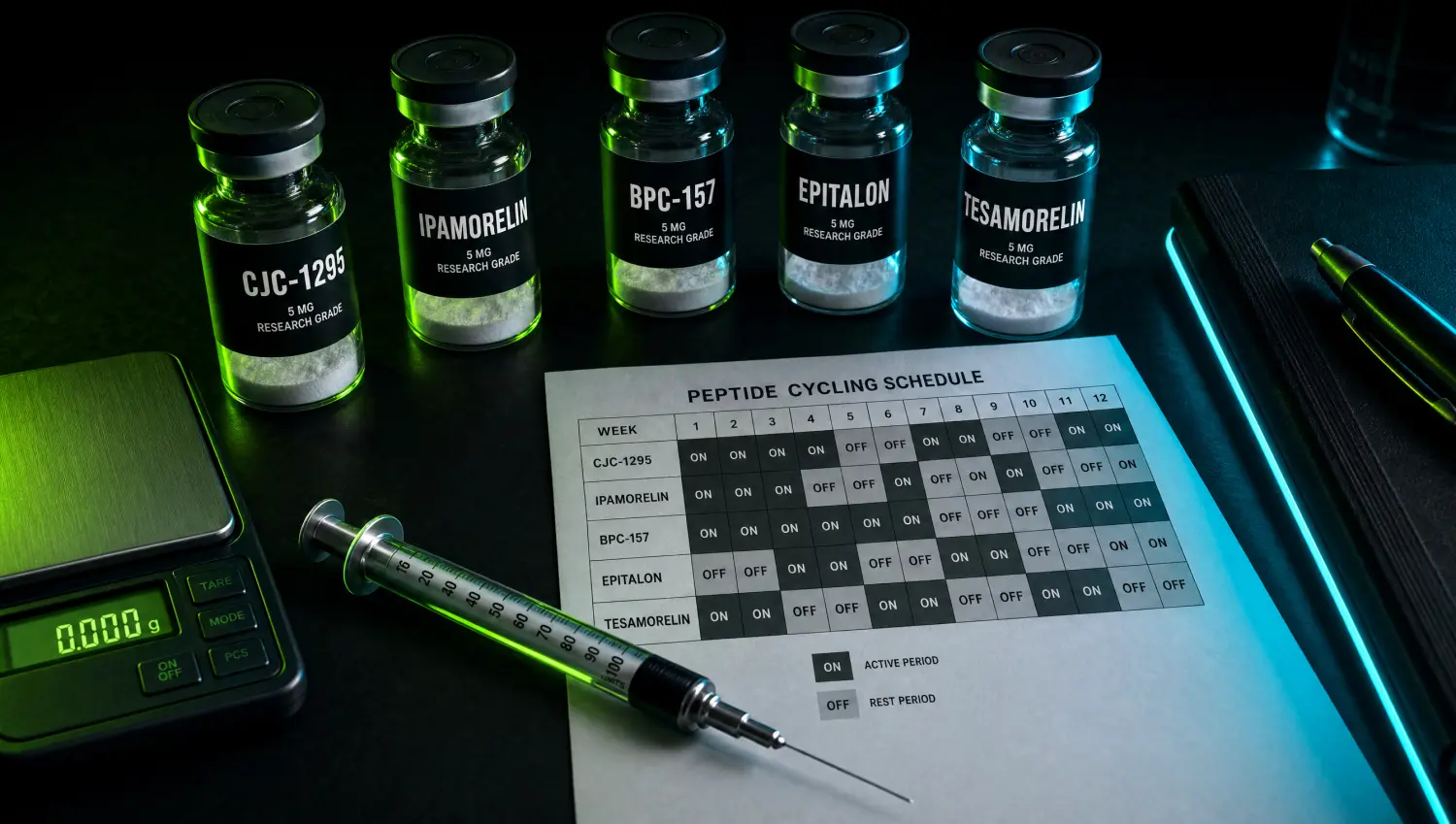
Neon-lit research bench with labelled peptide vials arranged on a peptide cycling protocols schedule alongside a calendar, syringe and notebook

What Are Peptide Cycling Protocols?

Peptide cycling protocols are structured on and off dosing schedules that alternate active peptide use with recovery periods, timed to how a specific peptide's receptor or pathway responds to repeated exposure. The right schedule depends entirely on mechanism: some peptides need it, others don't, and getting this wrong wastes money and blunts results.

If you're coming back from a layoff, whether that's a torn tendon, a season lost to a joint that never fully settled, or just the grind of fitting training around a job and a family, you've probably seen a dozen different cycling templates online. Most of them get copied from bodybuilding forums with zero regard for what the peptide actually does inside the body. That's the gap this guide closes.

Not every peptide desensitizes the same way, and not every peptide needs a break at all. Treating a growth hormone secretagogue the same way you'd treat a tissue repair peptide is the single most common mistake in this space, and it either wastes a cycle or leaves recovery gains on the table.

Why Some Peptides Need Cycling and Others Don't

Whether a peptide needs cycling comes down to its mechanism, not tradition. Peptides that activate G-protein-coupled receptors trigger desensitization with repeated exposure, so they benefit from scheduled off-periods. Peptides that work through other pathways, like tissue repair cascades, don't desensitize the same way and can often run without the same rigid breaks.

G-protein-coupled receptor desensitization happens in two distinct phases. The fast phase, minutes to hours, is driven by kinase enzymes tagging the receptor so a protein called beta-arrestin can uncouple it from its signalling machinery. The slower phase, hours to days, involves the receptor physically being pulled inside the cell and either recycled or degraded, with a drop in the mRNA that would otherwise rebuild it. Rajagopal 2018 lays this two-phase model out clearly, and it's the mechanistic backbone for why any GPCR-dependent peptide needs a recovery window built into the schedule.

Clinical data on pulsatile dosing backs this up directly. In a study on the insulinotropic peptide GIP, pulsed bolus dosing produced far less loss of response than continuous exposure to the same total amount. Nauck 2020 found the receptor stayed responsive under a pulsed pattern in a way it simply didn't under constant stimulation. That's the whole logic behind on/off scheduling: give the receptor gaps, not a steady drip.

Tachyphylaxis vs Tolerance: Two Timescales of Desensitization

Tachyphylaxis is rapid loss of response, sometimes inside a single hour, driven by receptor uncoupling at the cell membrane. Tolerance develops slower, over days, as receptors are pulled inside the cell and degraded. Both blunt your results, but they demand different recovery windows because the timelines are not the same.

The rapid end of this spectrum is more aggressive than most people assume. Bernsand 2007 showed that a low dose of a related peptide given as a pretreatment was enough to abolish the response to a full challenge dose given inside the same hour. That's not a slow fade, that's a near-instant shutdown of the signalling pathway.

The mechanism connecting both timescales runs through the same enzyme family. GRK phosphorylation flags the receptor, beta-arrestin binds and physically blocks the G-protein coupling, and from there the receptor either recycles back to the surface within minutes or gets routed to the lysosome for degradation over hours to days. Carrara 2021 walks through this cascade in detail, and it's the reason a single missed off-period can compound: you're not just fighting fast desensitization, you're also building up the slower structural downregulation underneath it.

GH Secretagogue Cycling: CJC-1295, Ipamorelin and Tesamorelin

Growth hormone secretagogues like CJC-1295, ipamorelin and tesamorelin work by stimulating pituitary receptors directly, and those receptors desensitize with sustained pressure. Most protocols run 8 to 12 weeks on followed by 4 to 6 weeks off, sometimes with 5 days on and 2 days off micro-cycling layered inside the macro-cycle to give receptors small recovery windows.

Phase 1 human data on CJC-1295 without DAC combined with ipamorelin showed a marked growth hormone pulse, roughly two to ten fold over baseline, sustained across a multi-day dosing window, with IGF-1 climbing one and a half to three fold over nine to eleven days. That's a strong pulsatile response, but it's built on a receptor system that is well documented to desensitize under sustained pressure, which is exactly why the 8-12 week on-cycle exists rather than continuous year-round dosing. If you're running tesamorelin specifically, the full dosing breakdown is worth reading alongside this piece: our Tesamorelin Dosage Protocol guide covers the on-cycle mechanics in more depth.

The 5/2 micro-cycle inside the macro-cycle is a reasonable extrapolation from the pulsatile dosing data above, but be honest with yourself about the evidence tier here. No controlled human trial has directly tested that specific micro-cycling pattern against continuous dosing for these compounds. It's a sound mechanistic bet, not a proven protocol.

Healing Peptides Don't Play by the Same Rules: BPC-157 and TB-500

BPC-157 and TB-500 don't rely on a single receptor the way GH secretagogues do. They work through multi-pathway mechanisms, nitric oxide signalling and actin regulation among them, so classic receptor desensitization isn't the driver of their cycling logic. Breaks here are about assessing whether the goal has been reached, not receptor recovery.

Typical protocols run BPC-157 at 250 to 500 mcg once or twice daily, and TB-500 with a loading phase of 4 to 8 mg per week for 4 to 6 weeks followed by a lighter maintenance dose and a break of four or more weeks. Because these peptides also promote angiogenesis, the same caution that applies to any pro-angiogenic compound applies here: extra care is warranted if you have an active malignancy or a personal history of cancer, and this is exactly the kind of decision to make alongside a qualified clinician rather than off a forum thread.

Epitalon and the Short, Intensive Cycle

Epitalon is cycled short and hard rather than long and steady, typically two intensive weeks followed by an extended break of a month or more. The rationale isn't receptor desensitization at all, it is that telomerase activation is meant to be a transient signal, and running it continuously has no established benefit and raises theoretical safety questions.

Doses in the 2 to 10 mg per day range for a two week block are the common pattern, with the compound then set aside entirely rather than tapered. Because the signal it's triggering is meant to be a brief pulse rather than a sustained state, there's no logical case for stacking longer runs on top of each other, and doing so pushes you into territory with no published safety data behind it.

GLP-1 Agonists: The Exception That Doesn't Cycle

GLP-1 agonists are the clearest exception to peptide cycling logic. Long-term cohort data shows no true pharmacologic tolerance develops even after five years of continuous use, so cycling isn't necessary for maintaining effect. The real risk with GLP-1 compounds is stopping: appetite suppression reverses quickly and weight regain follows discontinuation, not desensitization.

A large retrospective cohort spanning more than twelve thousand people per group found sustained efficacy across five years of continuous exposure, with no evidence of the receptor-level tolerance you'd expect if this class behaved like the GPCR peptides discussed above. Huang 2024 is worth reading in full if you're weighing whether a break makes sense here; the short answer is that it doesn't, and if anything an off-cycle undermines the entire point of the therapy by letting appetite regulation snap back.

Building Your Own Cycling Framework

A workable cycling framework starts with mechanism, not a generic template pulled from a forum. Identify whether your peptide is GPCR-dependent, multi-pathway, or continuous-use by design, then set on/off windows that match. Track subjective response and any relevant biomarker weekly, because the schedule that works for one peptide class will fail for another.

Start by sorting your compound into one of the three buckets covered above. If it's a GH secretagogue, build in the 8-12 week on, 4-6 week off structure and consider micro-cycling inside it. If it's a healing peptide, set your break around the recovery goal rather than a fixed receptor-recovery clock. If it's GLP-1 class, don't cycle it at all unless you're intentionally stopping treatment.

Whatever bucket you're in, keep a simple log: dose, timing, subjective effect on a one to ten scale, and any biomarker you're tracking. Before you buy anything, it's worth reading through how to vet what you're actually getting; our guide on How to Know If Peptides Are Real covers the practical checks. For a vendor-neutral rundown of where people in this space actually source research peptides, see our recommended sources page.

Signs Your Peptide Protocol Has Stopped Working

The clearest sign a cycle has run its course is diminishing return: strong effects in weeks one through four fading to barely noticeable by weeks eight to twelve despite unchanged dosing. Other flags include a biomarker plateau, needing to push the dose to get the old effect back, or new side effects appearing without added benefit.

Where to source it

If you're researching this compound, I've linked a trusted source below. It supports the channel.

See the sources that passed →

None of these signs on their own is proof, but stacked together they're a reasonable trigger to end the on-cycle early rather than push through on the assumption that more time will fix it. Pushing dose upward to chase a fading effect is usually the wrong move; it's a sign the receptor needs a break, not more pressure.

Safety, Monitoring and When to Stop

Cycling isn't just about efficacy, it's a safety practice too. Compounds that promote angiogenesis carry theoretical caution around active malignancy or a cancer history, copper-based peptides carry accumulation limits over long runs, and GH-axis compounds need IGF-1 monitoring beyond a few months of continuous use.

Long-term human safety data beyond twelve weeks is limited for most of the GH secretagogue class, and no controlled human trial directly validates the common 5/2 micro-cycling or 8-12 week macro-cycle pattern for any of these compounds. Treat the schedules in this guide as a mechanistically sound starting point, not a settled protocol. Always work with a qualified clinician before making changes to your health protocol.

References

  • Rajagopal 2018, GPCR desensitization: acute and prolonged phases.
  • Nauck 2020, no evidence of tachyphylaxis for insulinotropic actions of GIP.
  • Huang 2024, long-term safety and efficacy of GLP-1 receptor agonists.
  • Bernsand 2007, tachyphylaxis of the ECL-cell response to PACAP.
  • Carrara 2021, the autonomic nervous system in septic shock and its role as a future therapeutic target.

This content is for educational purposes only. These compounds are intended for research use. Nothing here is medical advice. Always work with a qualified clinician before making changes to your health protocol.

Share this article

Frequently Asked Questions

Why do some peptides need cycling while others don't?
Peptides that activate G-protein-coupled receptors, like GH secretagogues, desensitize with sustained exposure and need scheduled off-periods to recover. Multi-pathway healing peptides such as BPC-157 don't depend on a single receptor, so their breaks are about assessing progress rather than receptor recovery. GLP-1 agonists are designed for continuous use and generally shouldn't be cycled at all.
What is the difference between tachyphylaxis and tolerance?
Tachyphylaxis is rapid loss of response, sometimes within a single hour, caused by receptor uncoupling at the membrane. Tolerance develops more slowly, over hours to days, as receptors are internalised and degraded with reduced replacement. Both reduce how much effect you get from the same dose, but they operate on very different clocks and need different recovery windows.
Is the 5-on/2-off micro-cycling schedule evidence-based?
The underlying principle is sound: pulsatile dosing produces less desensitization than continuous exposure in the clinical literature on related peptide classes. But no controlled human trial has directly tested the specific 5/2 pattern against continuous dosing for GH secretagogues or other common research peptides. Treat it as a reasonable extrapolation, not a proven protocol.
How long should I wait between peptide cycles?
It depends entirely on the compound. GH secretagogues typically use 4 to 6 week off-periods after 8 to 12 weeks on. Healing peptides like BPC-157 and TB-500 use shorter, goal-based breaks of a few weeks. Epitalon uses long off-periods after short, intensive two-week runs. GLP-1 agonists generally don't need an off-cycle at all.
Can I rotate between different peptides to avoid tolerance?
Rotating between two peptides that hit the exact same receptor won't prevent tolerance; the receptor doesn't care which agonist is attached to it. Pairing compounds that use genuinely different pathways, such as a GHRH-type peptide alongside a GHRP-type peptide, may spread the pressure more evenly, but this hasn't been directly tested as a tolerance-avoidance strategy in controlled trials.
What signs indicate a peptide protocol has stopped working?
Watch for fading subjective effects between the early and late weeks of a cycle despite an unchanged dose, a biomarker that plateaus instead of continuing to move, needing more of the compound to get the effect you started with, or new side effects showing up without any added benefit. Any of these is a reasonable trigger to end the cycle early.

Read Next

Disclaimer: This content is for educational purposes only. These compounds are intended for research use. Nothing here is medical advice. Always work with a qualified clinician before making changes to your health protocol.