
CJC-1295 + Ipamorelin: The Growth Hormone Stack Protocol (2026)
What Are CJC-1295 and Ipamorelin?
CJC-1295 and ipamorelin is a growth hormone peptide stack that amplifies your natural GH pulses by pairing a GHRH analogue with a selective secretagogue. Used in 8-12 week cycles, it drives measurable improvements in body composition, sleep quality, training recovery, and skin integrity for men optimising performance in 2026.
If you're researching growth hormone optimisation (and you've already read our guide to the best peptides for men over 40), you'll encounter CJC-1295 and ipamorelin constantly paired together. This isn't marketing speak. The pairing works because these two peptides operate through entirely different mechanisms on your pituitary, creating a synergistic effect that either peptide alone cannot achieve.
CJC-1295 is a synthetic analogue of growth hormone releasing hormone (GHRH). Think of GHRH as the body's natural signal that tells the pituitary gland to release growth hormone. The molecule has been modified at four key positions (2, 8, 15, and 27) with amino acid substitutions that prevent rapid enzymatic degradation. This is why you'll also see it called Modified GRF (1-29) or Mod GRF when discussing the no-DAC version. The modification keeps the peptide intact and active in your bloodstream far longer than natural GHRH would survive.
Ipamorelin is a selective growth hormone secretagogue receptor (GHSR) agonist. It works through a completely different pathway. Where CJC-1295 nudges the pituitary with a long, sustained signal, ipamorelin triggers acute, sharp GH pulses. Critically, ipamorelin does this without raising cortisol or prolactin significantly, which distinguishes it sharply from other GHRPs like GHRP-6 or GHRP-2. The lack of cortisol elevation matters more than most guides acknowledge; elevated cortisol from certain peptide stacks will undo your gains and degrade sleep quality.
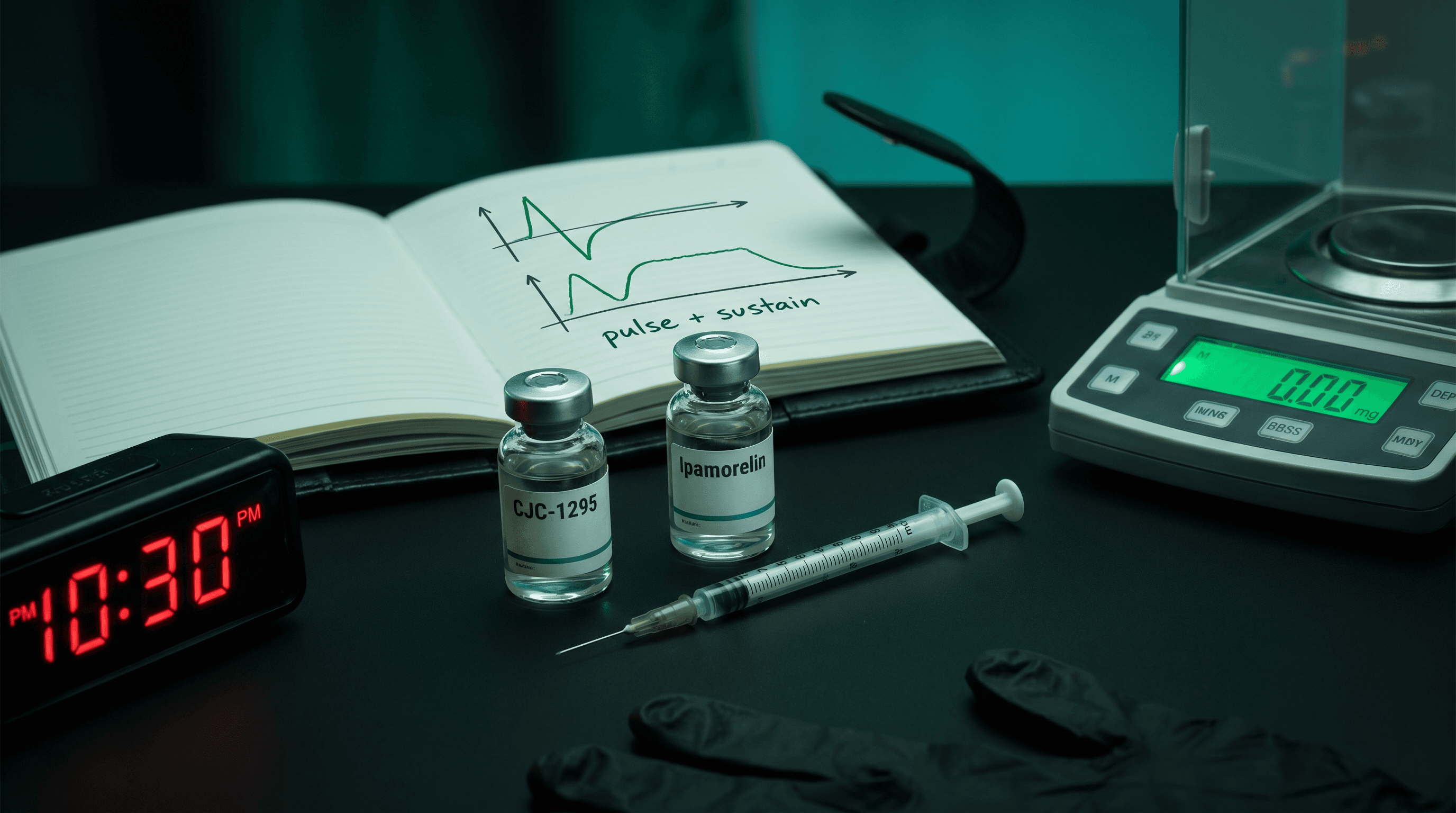
Together, these peptides create what researchers call a "pulse and sustain" pattern. Your pituitary naturally releases growth hormone in distinct pulses, particularly during deep sleep and after intense training. The stack mimics and amplifies this natural pulsatile rhythm rather than creating an artificial, flat elevation in GH. This physiological alignment is why the combination feels cleaner and produces better outcomes than either compound alone.
How the Stack Works
Understanding the mechanism helps explain why dosing timing and fasting matter so much.
When you inject ipamorelin, it binds to growth hormone secretagogue receptors on somatotroph cells in your pituitary and triggers a strong, rapid release of stored growth hormone. This creates a sharp peak in your blood GH and IGF-1 levels within 15-30 minutes of injection. The effect is quick but temporary; GH levels return toward baseline within a couple of hours without additional support.
CJC-1295 works differently. It stimulates GHRH receptors, signalling the pituitary to synthesise and store more GH whilst also promoting its release. Critically, because CJC-1295 resists enzymatic breakdown, it maintains a sustained stimulatory signal. The no-DAC version lasts 30 minutes to 2 hours; the DAC version persists for days. During the window when CJC-1295 is active, your pituitary is primed and sensitised to further stimuli.
When combined, ipamorelin's acute pulse hits during a window when CJC-1295 has already elevated baseline GH secretion and prepared the pituitary for response. The result is a much larger GH release than either peptide would produce independently. Studies measuring GH and IGF-1 response show the stack produces significantly greater area-under-the-curve values compared to monotherapy.
This is amplification through complementary mechanisms, not simple addition. Your pituitary has a limited secretory capacity; these peptides don't force superhuman output. Rather, they work within your natural physiology to pull out more of what your body is capable of producing.
DAC vs No-DAC: Which Version?
This distinction is critical and often muddled in biohacking guides. You must choose between two entirely different CJC-1295 formulations, and the choice shapes your entire protocol.
CJC-1295 without DAC (Modified GRF 1-29) has a half-life of approximately 30 minutes to 2 hours. This short window means you need to inject it multiple times daily to maintain sustained effect. A typical protocol runs morning (fasted), midday or pre-workout (optional), and evening before bed. The short half-life means each injection creates a distinct GH pulse, mimicking the body's natural pulsatile GH release pattern. Most experienced biohackers prefer this version because it stays true to physiology. Your GH levels rise and fall rhythmically rather than remaining chronically elevated.
CJC-1295 with DAC (Drug Affinity Complex) is modified with a linker that binds to serum albumin in your bloodstream. This slows clearance dramatically; the half-life extends to 6-8 days. A single injection per week maintains elevated GH throughout the week. The convenience is obvious. What's less obvious is the cost: you're trading a pulsatile GH rhythm for a sustained, flattened elevation. Your GH levels stay relatively constant rather than spiking naturally.
The research literature shows both approaches elevate GH and IGF-1. The question is which pattern aligns better with your goals. If you're optimising for body composition and recovery within a training program, the no-DAC version's pulsatile pattern more closely mirrors natural physiology and tends to feel cleaner in practice. Water retention is generally less pronounced, and many users report better sleep quality. The drawback is injection frequency; you're committing to two or three injections daily.
If convenience and simplicity matter more than physiological precision, DAC makes sense. You inject once weekly and maintain elevation without daily commitment. Some users find this approach produces better fat loss results because sustained GH elevation enhances lipolysis more effectively. The choice depends on your priorities and tolerance for daily injections.
Most established protocols in the research literature and practitioner guides recommend no-DAC for health optimisation in younger, athletic populations. DAC is often preferred by individuals prioritising convenience or those using the stack purely for body composition with less concern for training performance.
Benefits: What the Research Supports
Growth hormone's effects on body composition are well-documented. The stack amplifies these effects by sustaining elevated GH and IGF-1.
Body composition changes emerge as the most visible and reliable benefit. GH promotes lipolysis (fat breakdown) whilst preserving lean mass during caloric deficit. With this stack, users typically notice measurable changes within 4-6 weeks of consistent training and appropriate nutrition. The mechanism is straightforward: elevated IGF-1 increases protein synthesis whilst GH-induced lipolysis mobilises stored fat. In trained individuals, this creates favourable recomposition even without aggressive caloric restriction. The changes aren't dramatic in a 2-week window; they're progressive and sustained through a full 8-12 week cycle.
Sleep quality improvements are among the most commonly reported subjective benefits, and the mechanism is understood. GHRH activity increases slow-wave sleep duration. Users consistently report deeper, more restorative sleep; many notice improved morning alertness and reduced daytime fatigue even at lower doses. If poor sleep quality has been your limiting factor for recovery, this stack often produces noticeable improvements within 1-2 weeks. This benefit isn't trivial; better sleep amplifies all other training adaptations.
Training recovery improves measurably. Soreness diminishes, strength returns faster between sessions, and the overall training frequency you can sustain without degrading performance increases. GH and IGF-1 accelerate myofibrillar protein synthesis and reduce muscle protein breakdown, particularly during recovery windows. Users regularly report being able to increase training volume by 20-30% whilst maintaining or improving recovery markers.
Skin quality improvements are reported frequently. GH stimulates collagen synthesis and increases skin thickness and elasticity. After 8-12 weeks, many users notice reduced fine lines, improved skin texture, and a generally more youthful appearance. This benefit is less dramatic than body composition changes but consistent enough to mention.
Cognitive function improvements are anecdotal but mentioned consistently. Some users report improved focus, mental clarity, and mood stability. The mechanism likely involves GH's effects on brain-derived neurotrophic factor (BDNF) and its neuroprotective properties. These effects are less formally studied than body composition or sleep, so expectations should be tempered.
Be honest about the evidence hierarchy here. Clinical data robustly supports GH elevation and its effects on body composition and recovery. Sleep and recovery improvements are strongly reported by users but less formally studied in structured trials. Cognitive benefits are anecdotal and individual variability is high.
Dosing Protocols
Dosing varies based on which CJC-1295 version you choose. Start conservatively; you can always increase, but you can't unknow side effects once you've experienced them.
| Protocol | Ipamorelin | CJC-1295 | Frequency | Notes |
|---|---|---|---|---|
| No-DAC (Recommended) | 200-300 mcg per injection | 100-200 mcg per injection | 2-3x daily (fasted) | More physiological; requires daily discipline |
| No-DAC Conservative | 150 mcg per injection | 100 mcg per injection | 2x daily (morning, bedtime) | Lower total daily volume; good starting point |
| DAC (Convenience) | 100-300 mcg daily | 1 mg once weekly | Ipamorelin daily; CJC weekly | Simple scheduling; sustained elevation |
| DAC Potent | 300 mcg daily | 2 mg once weekly | Ipamorelin daily; CJC weekly | Higher response; more pronounced side effects |
| Pre-Mixed Blend | 200-300 mcg per injection (50/50 blend) | 2-3x daily (fasted) | Convenient; verify blend ratio from pharmacy | |
No-DAC Protocol (Most Common)
The standard approach uses three injection windows daily. Morning injection (fasted, ideally 2+ hours after waking) primes GH release during the active day. Pre-workout injection (optional but valuable) amplifies training-driven GH response. Evening injection before bed aligns with your natural GH peak during deep sleep and maximises recovery hormone support.
Starting dose: 100 mcg CJC-1295 and 150-200 mcg ipamorelin per injection. After 1-2 weeks at this dose, assess your response. If toleration is good and you want more aggressive response, increase to 100-200 mcg CJC and 250-300 mcg ipamorelin. Run this protocol for 8-12 weeks continuously. After 12 weeks, take 4 weeks completely off the stack to allow your natural GH axis to reset and avoid desensitisation.
DAC Protocol
Much simpler scheduling. Inject 1 mg CJC-1295 DAC once per week (typically Monday or Friday). Inject ipamorelin daily at 100-300 mcg, titrated based on response. You can inject ipamorelin any time daily, though pre-bed is traditional to align with natural GH rhythm. Run for 8-16 weeks; the extended half-life of DAC allows for longer cycles without desensitisation concern.
Pre-Mixed Blends
Many compounding pharmacies produce pre-mixed CJC-1295 (no-DAC) and ipamorelin blends at fixed ratios. A 10 mg vial might contain 5 mg CJC and 5 mg ipamorelin. A typical dose from this blend is 200-300 mcg injected 2-3 times daily. The advantage is simplicity; one reconstitution, one injection per session. The disadvantage is that you're locked into a fixed ratio and can't adjust compounds independently. Verify the exact blend composition from your pharmacy; ratios vary.
Cycle Recommendations
Eight to twelve weeks on, four weeks off, is the standard recommendation for no-DAC protocols. This gives your body a reset window whilst avoiding chronic desensitisation. For DAC, 12-16 weeks on followed by 4-6 weeks off is typical, as the longer half-life means your system doesn't fully clear the compound until 3-4 weeks post-injection.
Some practitioners use longer on-cycles (16+ weeks) without planned off-periods, particularly with DAC. The evidence on whether this increases desensitisation risk is mixed. Conservative approach: follow standard cycling until you have personal experience with your own response.
Timing and Practical Considerations
Fasting state is non-negotiable. Insulin and elevated blood glucose suppress GH release. This is the single most important practical rule. Wait at least 2 hours after your last meal before injecting. Many practitioners inject upon waking, before coffee, on an empty stomach. This guarantees minimal interference from food-derived insulin spikes. Your morning injection will produce significantly higher GH response fasted than fed. Evening injection before bed naturally occurs in a fasted state if you finish eating 2-3 hours before sleep.
Pre-bed injection is arguably your most important dose. Growth hormone naturally peaks during slow-wave sleep, particularly in the first 3-4 hours of deep sleep. Injecting before bed synchronises your peptide dosing with this natural rhythm. Many practitioners report this is where they feel the greatest recovery and sleep quality benefits.
Reconstitution and storage matter. Peptides arrive as lyophilised powder. Reconstitute with bacteriostatic water (not normal saline; the preservative prevents bacterial growth in the vial). After reconstitution, store vials in the refrigerator (2-8°C). Properly stored reconstituted peptides remain stable for approximately 4 weeks; use this as your practical window before discarding the vial and moving to a fresh one. Some practitioners extend this to 6-8 weeks without issues, but 4 weeks is the conservative, published recommendation. Never freeze reconstituted peptides; this degrades them.
Injection technique is straightforward. Use insulin syringes (typically 28-30 gauge). Subcutaneous injection into the abdomen, thigh, or upper arm works equally well. Rotate injection sites to avoid lipohypertrophy (fatty lumps). The needle barely penetrates skin; there's minimal discomfort. Most users experience a slight pinch, nothing more.
Measuring doses accurately. If using powder-to-water ratio dosing, calculate your concentration precisely. A 2 mg vial reconstituted in 2 mL bacteriostatic water gives you 1 mg/mL concentration. A 100 mcg dose is 0.1 mL. Use a tuberculin (1 mL) syringe for accuracy. Sloppy measurement compounds (particularly at lower doses) will produce wildly inconsistent responses.
Link integration: For detailed reconstitution walkthrough, see How to Reconstitute Peptides Safely.
Side Effects and Safety
Most side effects are minor and diminish within 1-2 weeks of consistent dosing. Some users experience none at all. Manage expectations; this stack isn't free from effects, but they're generally well-tolerated.
Common side effects include injection site reactions (minor redness, slight itching), water retention (particularly in the first week, usually resolves quickly), tingling or mild numbness in extremities (paraesthesia; temporary and benign), head rush or flushing immediately after injection (resolves within minutes).
Less common but reported: Increased hunger, particularly in the evening and night. This is more pronounced with GHRP-6 than ipamorelin, but ipamorelin can still trigger mild appetite elevation. Manage this through conscious food choice; the appetite increase won't derail your protocol if you're mindful. Mild joint pain or sensation of joints "working harder" can occur, particularly in individuals with prior joint stress. This is often a sign GH is working and typically resolves as tissues adapt. Vivid dreams are common and harmless; they result from enhanced REM sleep.
Rare or more serious concerns: Potential for glucose dysregulation, particularly with chronic long-term use. GH is somewhat insulin-antagonistic; individuals with metabolic syndrome or prediabetes should monitor fasting glucose and consider periodic HbA1c testing. Theoretical concern about GH and cancer in individuals with existing malignancies or predisposition; the relationship is complex and not proven, but avoid this stack entirely if you have active cancer or strong family history of early-onset cancer.
Contraindications: Do not use if you have active cancer or history of cancer (unless cleared explicitly by your doctor). Do not use if you have type 1 or type 2 diabetes without medical supervision. Do not use if pregnant or breastfeeding. Use extreme caution if you have pre-existing joint problems; GH increases collagen synthesis and joint loading, which can exacerbate existing damage.
Regulatory status: Neither CJC-1295 nor ipamorelin is FDA-approved for human use in the United States. Both are available through compounding pharmacies under the category 1 compounding framework. You must obtain a prescription from a practitioner. These peptides are not available over-the-counter.
Stacking with Other Peptides
Some practitioners combine this stack with other compounds for enhanced recovery. The most common addition is the "Wolverine Stack" combining CJC/Ipamorelin with BPC-157 and TB-500.
BPC-157 and TB-500 rationale: These peptides accelerate tissue healing independent of GH elevation. BPC-157 enhances collagen deposition and angiogenesis; TB-500 upregulates repair processes. Combined, they create a powerful recovery synergy: GH and IGF-1 elevate from the CJC/Ipa stack whilst BPC and TB-500 maximise tissue responsiveness to those signals. This combination is popular with strength athletes managing accumulated tissue damage.
Do not combine CJC/Ipamorelin with other GH secretagogues. Stacking with MK-677 (ibutamoren) or other GHRPs like GHRP-6 is counterproductive. Multiple GH secretagogues used simultaneously will drive desensitisation faster and waste compound. Stick to one GH elevation strategy at a time.
Links: See Wolverine Stack: BPC-157 + TB-500 for Athletic Recovery and BPC-157 Dosing Protocol.
Legal Status in 2026
Both CJC-1295 and ipamorelin are included in the 14 peptides reclassified to Category 1 compounding status in the United States following the FDA/HHS announcement in February 2026. This means they can be manufactured by compounding pharmacies and dispensed by prescription. They are not scheduled substances. They are not illegal to possess with a valid prescription.
This status is relatively new; prior to the reclassification, access was unclear. The 2026 change clarified legal availability. However, they remain prescription-only; you cannot purchase them over-the-counter. You must see a practitioner (many functional medicine and sports medicine doctors will prescribe) who agrees these compounds are appropriate for your health goals.
Link: Peptides Are Legal Again in 2026: What Changed and Why.
Important Disclaimer
This content is for educational purposes only. These compounds are intended for research use. Nothing here is medical advice.
CJC-1295 and ipamorelin are not FDA-approved medications. This stack carries potential risks, particularly for individuals with metabolic disorders, cancer history, or other health conditions. Always work with a qualified clinician before making changes to your health protocol. A qualified practitioner can evaluate your individual situation, order appropriate baseline testing, and monitor your progress.
This stack is powerful. Use it thoughtfully, with proper medical oversight, clear goals, and realistic timelines. The benefits are real but not instantaneous. Patience, consistency, and honest assessment of your response over 8-12 weeks will determine your outcomes far more than optimising the protocol to death on the first cycle.
Frequently Asked Questions
Can I use CJC-1295 and ipamorelin if I have a history of diabetes?
What's the difference between no-DAC and DAC, and which should I choose?
How long does it take to see noticeable results from this stack?
Is water retention from the stack permanent, or does it resolve?
Can I stack CJC-1295 and ipamorelin with MK-677?
How do I know if my peptides are properly reconstituted and stable?
Read Next
Disclaimer: This content is for educational purposes only. These compounds are intended for research use. Nothing here is medical advice. Always work with a qualified clinician before making changes to your health protocol.