
Peptides for Loss of Smell: What the Evidence Shows
What Do Peptides for Loss of Smell Actually Do?
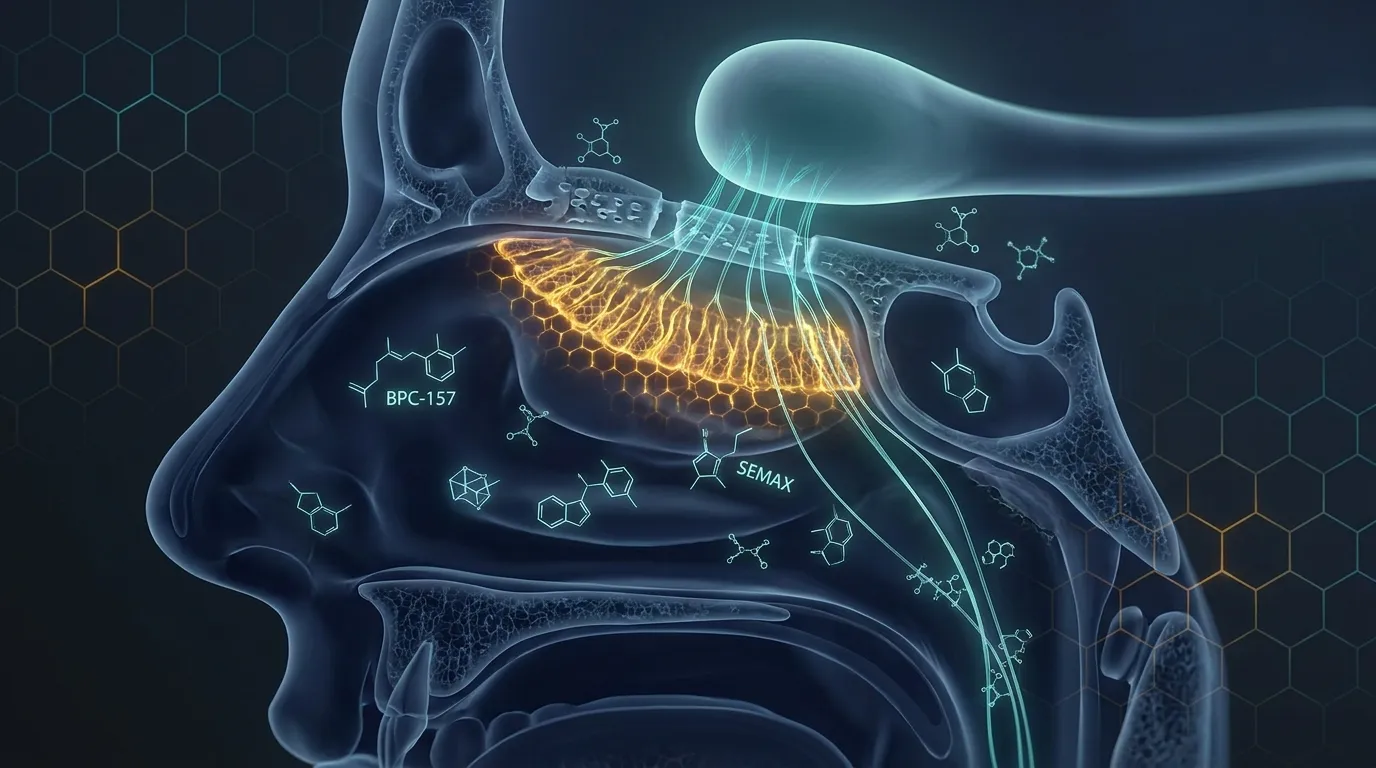
Peptides for loss of smell rest on real biology and no human trial data. Zero randomised trials test Semax, BPC-157 or TB-500 for anosmia. Most post-COVID patients recover anyway, 60-80% inside 12 months. The best clinical signal comes from platelet-rich plasma, not a peptide. Mechanism is not evidence.
With BPC-157, the supplier matters as much as the dose. We only list sources that publish an independent, per-batch certificate of analysis. See the ones that clear it.
Why Is the Standard Peptide Story Wrong?
The peptide community tells a tidy story. The olfactory epithelium, the smell-sensing tissue high in the nose, makes new nerve cells for life. Peptides raise nerve growth factor (NGF) and brain-derived neurotrophic factor (BDNF). Both are proteins that keep young nerve cells alive. So peptides should treat anosmia, the medical term for losing your sense of smell.
The story is not exactly wrong. It just skips the awkward parts. No regulator has approved any peptide for smell loss. No physician experimenting in this space has published human data anyone can repeat.
The awkward parts start with biology. For a peptide to help, several things have to be true at once. In the patients who want treatment most, they often are not.
What Does the Olfactory Epithelium Need to Regenerate?
Two kinds of stem cell sit under the smell tissue, and they do very different jobs. Globose basal cells (GBCs) are the everyday workers. They divide constantly and make new olfactory receptor neurons (ORNs) within days of mild injury. They run through a chain of control genes: Sox2, Ascl1, Neurog1 and NeuroD1.
Horizontal basal cells (HBCs) are the reserve. They sit still until the damage is severe. Then they rebuild the whole tissue, including the sustentacular support cells, Bowman's gland cells and the GBCs themselves. Schwob et al. 2017 set out that hierarchy in detail.
This matters because every peptide proposed for anosmia acts downstream of the GBCs. If the GBCs survive, the tissue can rebuild itself. A neurotrophic peptide might then speed the timeline up.
If the GBCs are gone, nothing rescues them. Severe chemical burns, long viral inflammation and radiation can all wipe them out. No signal, however strong, can instruct a stem cell pool that no longer exists. Respiratory metaplasia then fills the space, and the smell architecture is replaced for good.
Post-COVID anosmia usually spares the GBCs. That is why 60-80% of patients recover at least partly within 12 months, with no treatment at all. Read that implication carefully. In the very cases where a peptide has its best theoretical shot, the nose is often already healing itself. Any trial then faces a brutal signal-to-noise problem.
Do Neurotrophins Finish the Repair Job?
The mechanism the advocates describe is genuine science. NGF binds TrkA receptors on newborn ORNs and helps their fibres grow towards the olfactory bulb. BDNF binds TrkB receptors, which supports ORN survival and new neuron growth inside the bulb. Both rise sharply in the smell tissue 24-72 hours after injury. That looks like a built-in repair signal. NGF's role across the olfactory system is reviewed by Miwa et al. 2002.
Other growth factors do separate jobs. FGF-2 pushes GBCs to divide. TGF-beta-2 tips young cells towards becoming neurons rather than support cells. PDGF keeps new neurons alive before their fibres reach a target.
So this is a sequence, timed step by step. It is not one switch. The peptide story quietly swaps "raises NGF and BDNF" for "completes the whole repair sequence". Those are not the same claim.
Raising BDNF around the body does not put BDNF in the smell tissue. It does not set the dose, the timing, the duration or the cell context. That gap is the reason clinical translation has failed.
How Strong Is the Case for Semax?
Semax is a seven-amino-acid analogue of ACTH(4-10). Of all the candidates, its link to olfactory neurotrophin biology is the most direct. Russia approved it for stroke and optic nerve atrophy. Part of the reason is the delivery route: a spray into the nose carries signals along olfactory and trigeminal nerves straight into the brain.
The rodent data is real, and narrower than the claims made for it. Agapova et al. 2007 gave rats a single intranasal dose. One hour later, NGF and BDNF gene expression had risen in the hippocampus. BDNF also rose in the brainstem and cerebellum. NGF fell in the frontal cortex. No olfactory tissue was measured in that study.
The delivery argument still holds up. Intranasal Semax reaches the central nervous system (CNS) roughly 9-fold better than an injection into a vein. The olfactory nerve gives it a route around the blood-brain barrier. So the smell tissue is both the doorway and the target. If you want a neurotrophic signal in olfactory structures, the nose is the right door.
The argument breaks at the clinical endpoint. No published randomised trial has tested Semax for anosmia in humans. The Russian literature covers optic atrophy and cognitive disorders, not smell loss. Anyone saying Semax "treats anosmia" is reading across from pharmacology, not from outcome data. Our Semax complete guide covers the pharmacology in full.
For educational purposes only: research protocols in this space typically use 200-300 mcg per nostril, aimed at the superior turbinate, twice daily. Pursue that only under a qualified clinician familiar with experimental peptide use.
Does BPC-157 Help With Smell Loss?
BPC-157, or Body Protection Compound 157, is a 15-amino-acid peptide. It is cut from a protective protein sequence found in the stomach. Its best-documented preclinical effects are new blood vessel growth through VEGF. It also lowers inflammatory signals such as TNF-alpha and IL-6. It alters the nitric oxide system. And it speeds peripheral nerve repair.
Two observations drive the anosmia argument. Post-viral smell loss involves lasting inflammation in the smell lining. BPC-157 calms inflammation, so it might ease the environment that stops GBCs dividing. Separately, BPC-157 sped up recovery in crushed sciatic nerve models.
Neither observation carries across cleanly. The olfactory epithelium is not peripheral nerve. Its repair runs on a stem cell chain, not on Schwann cell remyelination. The inflammation in a post-COVID nose differs from gut and joint inflammation, where BPC-157 has actually been studied. No animal model of anosmia has ever tested it.
BPC-157 turns up in anosmia threads because of its broad repair reputation. There is no olfactory-specific mechanism or data behind it. It remains one of the more interesting experimental peptides. We cover it in our BPC-157 dosing protocol guide and our best peptides for injury recovery overview. Its place in an anosmia stack is guesswork.
Can TB-500 Repair Olfactory Nerves?
TB-500 is the synthetic fragment of Thymosin Beta-4 (TB4). TB4 is a common protein that binds actin and has documented roles in wound healing, inflammation control and tissue repair.
Its most relevant finding for any sense organ comes from the eye. Topical TB4 sped up healing of the corneal surface and nerve regrowth after injury. That held in animal models and in one small human trial.
Advocates cite the corneal work as proof that TB-500 repairs sensory nerves, so it should help smell. That is a category error. Corneal nerves are trigeminal, not olfactory. Corneal surface repair does not run on the GBC chain. The corneal trials say TB4 can support one trigeminal nerve supply. They do not say it switches on the Sox2 and Ascl1 cascade that olfactory neurons need. Our TB-500 complete guide covers its documented uses.
Is There Any Case for Selank?
Selank is a seven-amino-acid analogue of tuftsin. It has well-documented anxiolytic (calming) and mild nootropic effects. These run partly through blocking enkephalin breakdown and through GABA-A modulation.
It appears in anosmia threads for two soft reasons. Anxiety and depression often travel with long-term smell loss. And, like Semax, Selank goes up the nose.
No pathway connects Selank's pharmacology to olfactory nerve regrowth. It does not meaningfully raise the neurotrophins that matter here. It does not touch the GBC stem cell chain. It has never been tested in any olfactory injury model. Its place in these stacks is pattern-matching, not reasoning. Our Semax vs Selank comparison sets the two side by side.
Could GHK-Cu Clear Scar Tissue?
GHK-Cu, the copper peptide, has documented effects on fibroblast growth, collagen production, blood vessel growth and anti-inflammatory gene expression. In wound healing it speeds up remodelling and reduces scarring.
The anosmia argument runs like this. After a head injury, scar tissue around the cribriform plate can block regrowing ORN fibres from reaching the olfactory bulb. GHK-Cu might soften that scar.
This is the most defensible stretch in the toolkit, and it is still entirely speculative. Scarring at the cribriform plate is a physical blockage. A nasal dose of GHK-Cu would have to reach the bone lining. It would have to remodel scar over weeks or months. And it would have to leave the delicate smell tissue above it alone. No model has shown any of that. Our GHK-Cu complete guide covers what it does do.
Why Has No Clinical Trial Been Run?
If the biology is real and the need is obvious, why has no major academic centre run a peptide trial for anosmia? Four structural problems, none of them conspiratorial.
Does the Regulatory Status Block Trials?
Most relevant peptides sit in a grey zone in Western markets. That includes Semax, BPC-157 and TB-500. The FDA's 2020 guidance on compounded peptides narrowed their availability. Some routes stay open. But filing an Investigational New Drug (IND) application is very hard when a compound has no sponsor, no patent and no commercial return. Researchers also cannot easily source these compounds at pharmaceutical purity. The rules are shifting, as our FDA reclassification explainer describes. The disincentive has been severe.
How Does Spontaneous Recovery Confound the Data?
Most post-COVID patients regain smell within 12 months on their own. So any uncontrolled case series is contaminated from the start. Without a randomised placebo arm, nobody can say whether the peptide or time did the work. This is not a statistical footnote. It means every positive anecdote in the peptide community is uninterpretable as evidence.
Why Is Outcome Measurement So Hard?
Proper smell testing uses Sniffin' Sticks, the University of Pennsylvania Smell Identification Test (UPSIT), or butanol threshold testing. Trained examiners have to run them. Patients' own reports of improvement match the objective tests poorly. Most peptide case reports lean on self-report. Anosmia patients are highly motivated, so placebo and expectation bias run large.
Why Is the Delivery Route So Demanding?
The dose has to land on the superior turbinate, high in the nose. Squirting it into the front of the nostril puts it on respiratory lining instead. Hitting the superior turbinate needs specific devices and technique. Most patients and many clinicians have never been shown either. Poor technique means the peptide never reaches the target, which makes the whole exercise pharmacologically inert.
What Does the PRP Trial Tell Us?
The closest clinical analogue is platelet-rich plasma (PRP), injected under the lining at the olfactory cleft. PRP carries many growth factors at once, including PDGF, TGF-beta, VEGF and EGF. That is a broader set of signals than any single peptide delivers.
Yan et al. 2023 ran a randomised controlled trial in patients with COVID-related smell loss of 6 to 12 months. Patients got three injections of PRP or sterile saline into the olfactory cleft. At three months the PRP group improved by 3.67 Sniffin' Sticks points more than placebo. The trial recruited 35 patients and 26 finished. No biopsy was used to select them.
What does that say about peptides? First, even a full growth-factor cocktail placed directly on the target gives a modest, variable result. A single peptide sprayed into the nose faces far worse odds of arriving at all. Second, the effect took three months to appear. Any peptide experiment shorter than 3 months is unlikely to show a real signal even if one exists.
Which Anosmia Types Have Any Rationale?
None of the above dismisses peptides outright. There is a narrow window where the logic is tight and the patient is well chosen. It looks like this.
| Anosmia Type | GBC Status | Peptide Rationale | Evidence Quality |
|---|---|---|---|
| Post-COVID (early, under 6 months) | Usually intact | Moderate: Semax neurotrophin upregulation may accelerate GBC-driven recovery | Preclinical only |
| Post-COVID (chronic, over 12 months) | Variable: may have partial metaplasia | Low: metaplastic areas cannot respond to neurotrophins | Preclinical only |
| Post-infectious (non-COVID viral) | Usually intact | Moderate: similar rationale to early post-COVID | Preclinical only |
| Post-traumatic | Often intact but axon path obstructed | Very low: physical obstruction at cribriform plate limits value of neurotrophins | Theoretical |
| Congenital (Kallmann syndrome) | Absent or structurally deficient | None: developmental deficit not amenable to neurotrophin support | No basis |
| Toxic/chemical injury | Variable: severe cases lose HBCs and GBCs | Low to moderate depending on injury severity | Animal models only |
The honest summary is narrow. Semax, delivered to the superior turbinate, in confirmed post-viral anosmia, with GBCs believed intact, has the most defensible rationale of any peptide here. GBC status is inferred from short duration and from preserved olfactory bulb volume on MRI, or confirmed by biopsy. That rationale is still preclinical. Every other peptide's case is weaker again.
How Do Peptides Compare With Proven Treatments?
| Intervention | Mechanism | Evidence Level | Effect Size (Human) | Availability |
|---|---|---|---|---|
| Olfactory training | Activity-dependent neuroplasticity, promotes ORN survival and bulb reorganisation | Multiple RCTs | Modest, consistent | Widely available, low cost |
| Intranasal corticosteroids | Reduces inflammatory obstruction of olfactory cleft | RCTs | Modest, mainly in inflammatory anosmia | Prescription, widely available |
| PRP submucosal injection | Multi-growth-factor trophic support at olfactory cleft | Small randomised trials | Small, variable | Specialist centres only |
| Vitamin A intranasal drops | Supports epithelial differentiation and ORN maturation | Retrospective series | Small signals in case series | Specialist compounding pharmacies |
| Semax intranasal | NGF/BDNF upregulation via olfactory delivery pathway | Preclinical + mechanism-inferred | Unknown in humans | Research peptide suppliers |
| BPC-157 intranasal | Anti-inflammatory, angiogenic; no olfactory-specific data | Preclinical (non-olfactory) | Unknown in humans | Research peptide suppliers |
| TB-500 systemic | Actin modulation, anti-inflammatory; corneal nerve precedent only | Preclinical + one small human trial (corneal) | Unknown for anosmia | Research peptide suppliers |
Olfactory training is still the only option with several randomised trials behind it. Its effect sizes repeat across studies, and its mechanism is grounded in how activity shapes nerve connections. If you try a peptide, add it to training rather than swapping training out. The logic is sound: training drives ORN activity, which may raise the body's own neurotrophins, which could amplify anything a peptide adds.
What Would Dosing and Delivery Actually Require?
If you have read all of the above and still want to explore peptides for research use, these constraints are not optional. They apply whichever compound you pick.
Superior turbinate targeting is essential. The smell tissue sits on the superior turbinate and the facing part of the nasal septum. Standard nasal sprays drop over 90% of the dose below that, in the front of the nose. Reaching the upper nasal vault needs purpose-built devices. Breath-powered bidirectional devices and angled-nozzle sprays are the usual answer. This is a prerequisite, not a refinement.
Concentration matters more than volume. The reachable smell surface is small. A small volume at high concentration beats flooding the nose. Research discussions of Semax sit around a 100 mcl spray at 200-500 mcg/ml, at the top of that range.
Oral peptides are inert here. Stomach acid at pH 1.5-3.5 breaks peptide bonds before anything is absorbed. Oral BPC-157 may act locally in the gut by a different route, which our BPC-157 gut health overview explains. It cannot deliver intact peptide to the smell tissue. Claims of oral efficacy for anosmia have no pharmacokinetic basis.
Twelve weeks is the minimum before judging anything. Growing a new ORN from a GBC, with its fibre reaching the olfactory bulb, takes 4-6 weeks in rodents and probably longer in people. Trials or personal experiments shorter than 3 months cannot produce interpretable data.
This content is provided for educational purposes only. Peptides discussed here are research use compounds not approved by any regulatory agency for anosmia treatment. Anyone considering these interventions should work with a qualified clinician experienced in experimental peptide medicine who can assess individual suitability, monitor outcomes with validated psychophysical testing, and discontinue if adverse effects arise.
With BPC-157, the supplier matters as much as the dose. We only list sources that publish an independent, per-batch certificate of analysis. See the ones that clear it.
Where to buy BPC-157
The hard part with BPC-157 isn't the protocol. It's finding a supplier that can prove what's in the vial. We assessed dozens against per-batch, third-party testing. A handful passed.
See the sources that passed →What Would a Meaningful Trial Need to Show?
The field is stuck in a loop of plausible mechanisms and anecdotes. Getting out of it means agreeing what a real signal looks like. It is not one patient saying they can smell coffee again. It is this:
- Randomised allocation with a placebo arm. It uses the identical delivery device and protocol.
- Grouping by cause: post-viral, post-traumatic or toxic. Grouping again by GBC status, on biopsy or a stand-in measure.
- A primary endpoint of change in Sniffin' Sticks TDI score, at 12 and 24 weeks.
- Secondary endpoints including olfactory bulb volume on MRI. Quality of life too, using SQOL-7 or similar.
- Intent-to-treat analysis that allows for the high spontaneous recovery rate in the control arm.
- A sample size built from that recovery rate, roughly 60% partial recovery at 12 months. It must be large enough to detect any extra peptide effect.
No such trial exists for any peptide. Until one does, claims of benefit stay at the level of hypothesis. The hypothesis is interesting enough to justify running the trial. It is not enough to justify the confidence with which some people recommend these compounds to desperate patients.
Is Mechanism the Same Thing as Evidence?
No, and that gap is the whole story here. The biology underneath the peptide argument is genuine. The olfactory epithelium does regenerate. Neurotrophins do support that. Semax does raise NGF and BDNF, and it travels the same nasal route that reaches olfactory tissue. BPC-157 does reduce inflammation in preclinical models. TB-500 did speed corneal sensory recovery in one small human trial.
None of that shows these compounds improve human smell in a controlled setting. The jump from plausible mechanism to clinical advice is long, and the peptide community keeps making it without the evidence to land on. The reasons trials have not run are structural. There is no patent, and so no sponsor. The high natural recovery rate makes placebo arms essential and expensive. And the delivery problem is one most clinics are not set up to solve.
If you have lost your sense of smell, the evidence-based first steps have not changed. Olfactory training comes first: rose, eucalyptus, lemon and clove, 20 seconds each, twice daily, for at least 3 months. Add intranasal corticosteroids if inflammation is part of the picture. If you want to explore a peptide on top, Semax delivered properly to the superior turbinate has the most coherent rationale. Explore it with a clinician measuring outcomes properly, not off forum anecdotes. The biology is compelling. The clinical evidence is not there yet. Both of those are true at once, and pretending otherwise helps nobody.
Where to buy BPC-157
The hard part with BPC-157 isn't the protocol. It's finding a supplier that can prove what's in the vial. We assessed dozens against per-batch, third-party testing. A handful passed.
See the sources that passed →Share this article
Frequently Asked Questions
Can peptides actually restore sense of smell after COVID?
Which peptide is most likely to help with anosmia based on current evidence?
Why haven't researchers run clinical trials of peptides for smell loss?
Does BPC-157 help with loss of smell?
Does taking peptides orally work for anosmia?
How long would a peptide protocol for anosmia need to run to see results?
Read Next

Disclaimer: This content is for educational purposes only. These compounds are intended for research use. Nothing here is medical advice. Always work with a qualified clinician before making changes to your health protocol.