
Ipamorelin Complete Guide: The Cleanest GH Secretagogue

What Is Ipamorelin, and What Does It Actually Do?
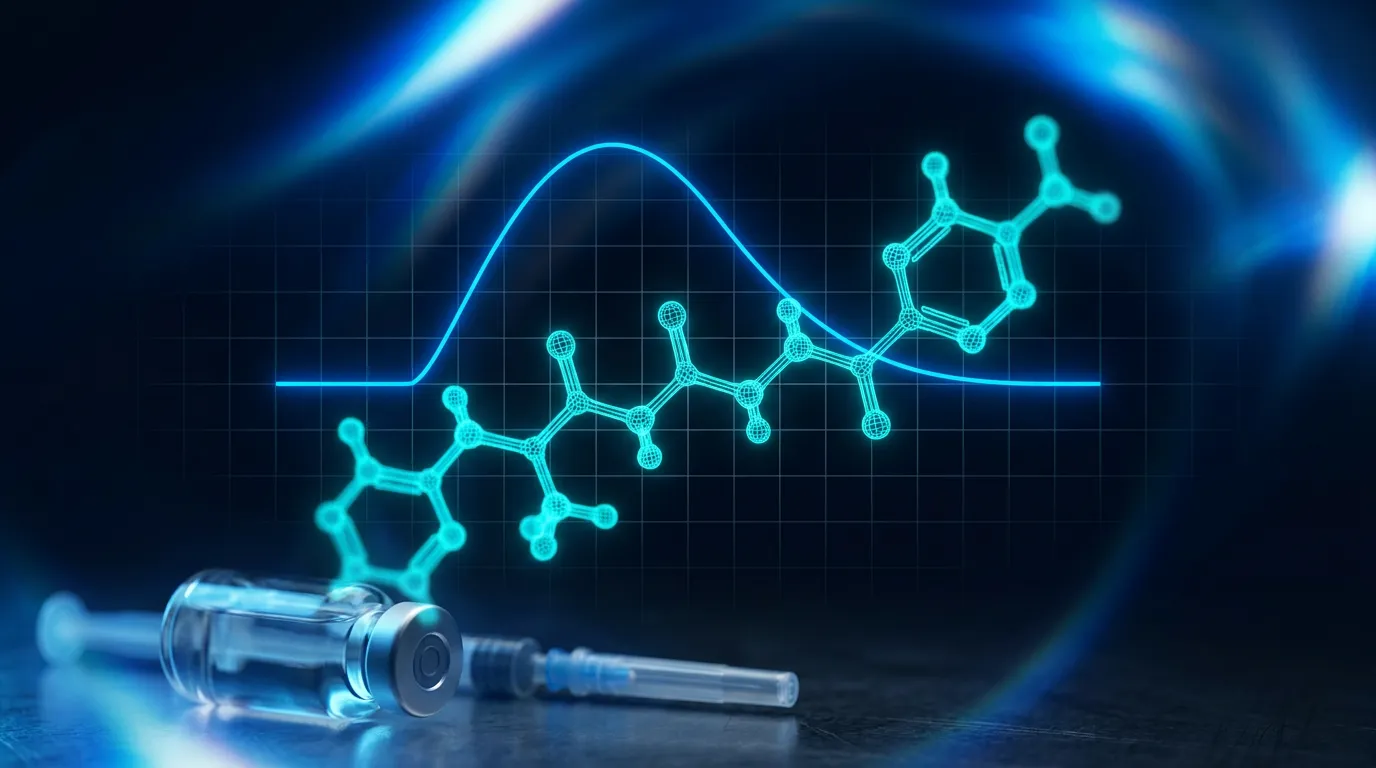
Ipamorelin is a small peptide that tells the pituitary to release growth hormone. In 1998 swine tests, it did not raise cortisol beyond GHRH. Nor did it change prolactin (the milk hormone) or the pituitary signals for the thyroid and sex glands. Novo Nordisk made it and called it the first selective GH secretagogue (GH releaser). Raun et al. 1998
The formal name is NNC 26-0161. Ipamorelin (NNC 26-0161) is a pentapeptide with the sequence Aib-His-D-2-Nal-D-Phe-Lys-NH2. A pentapeptide is a chain of five amino acids. That is tiny, as peptides go.
It binds the ghrelin receptor. Ghrelin is the hunger hormone. It was the first drug of that kind to release GH as cleanly as GHRH. GHRH is the brain signal that sets off a GH pulse. Older peptides like GHRP-6 and GHRP-2 also raised ACTH and cortisol in swine.
With Ipamorelin, the supplier matters as much as the dose. We only list sources that publish an independent, per-batch certificate of analysis. That is a lab report on what each batch holds. See the ones that clear it.
Why does being clean matter?
GHRP-6 and GHRP-2 do release GH well. In swine, they also pushed up ACTH and cortisol. ACTH is the pituitary signal that tells the adrenal glands to make cortisol. Cortisol is catabolic. That means it breaks tissue down. It also blunts the immune system. So it fights most of the goals this class is studied for.
Ipamorelin skips that problem. The Novo Nordisk study is the source. It found that ipamorelin did not release ACTH or cortisol in levels significantly different from those seen after GHRH. That held at doses more than 200-fold above the ED50. The ED50 is the dose that gives half the top effect. Raun et al. 1998
That one fact earned it the "cleanest" label.
This content is for educational purposes only. These compounds are intended for research use. A qualified clinician can advise on any health decision.
How Does Ipamorelin Work in the Body?
One receptor. Mostly one place.
Which receptor does it bind?
It binds GHS-R1a. The full name is growth hormone secretagogue receptor 1a. Ghrelin uses the same one. GHS-R1a sits on somatotroph cells in the front of the pituitary. Somatotrophs make and store GH. Binding there sets off a GH release.
How long does one pulse last?
The human numbers are solid. A dose-escalation trial gave ipamorelin as a 15-minute IV drip to healthy men. Eight men took part at each of five dose levels. GH peaked at about 0.67 hours. It then fell to a negligible level at every dose. Ipamorelin itself had a terminal half-life of about two hours. That is the time its blood level takes to halve, late in clearance. Clearance, the rate the body clears the drug from the blood, was 0.078 L/h/kg. Gobburu et al. 1999
So each dose gave one GH pulse, not a steady rise.
What does it leave alone?
In swine, it did not change prolactin, FSH, LH or TSH. Raun et al. 1998 FSH and LH are the pituitary signals that drive the sex glands. TSH drives the thyroid. Those signals are part of the hypothalamic-pituitary-gonadal axis, the loop that runs sex hormones. The abstract reports no testosterone measurement.
How Does Ipamorelin Compare With GHRP-6 and GHRP-2?
The pecking order here gets muddled a lot. Here is what the evidence shows.
How does GHRP-6 differ?
In rats and swine, GHRP-6 released GH with a potency and efficacy close to ipamorelin. Potency is how little drug it takes. Efficacy is the top GH level it reaches. The side effects are the split. In a 1998 swine study it raised ACTH and cortisol. It did not change prolactin. Ipamorelin did not raise cortisol beyond what GHRH does. Raun et al. 1998
How does GHRP-2 differ?
In swine, GHRP-2 needed a smaller dose than ipamorelin to reach half its top effect. But its top GH level was lower. In the same swine study it also raised ACTH and cortisol, but not prolactin. Raun et al. 1998
Where does MK-677 sit?
MK-677 is another GH secretagogue people ask about next. Svensson et al. 2000 We put the two side by side in ipamorelin against MK-677.
Summary table
| Compound | Cortisol Elevation | Prolactin Elevation |
|---|---|---|
| Ipamorelin | No rise beyond GHRH (swine) | None (swine, Raun 1998) |
| GHRP-6 | Raised (swine) | None (swine, Raun 1998) |
| GHRP-2 | Raised (swine) | None (swine, Raun 1998) |
Ipamorelin vs Sermorelin: What Is the Difference?
People line these two up as rivals. They are not the same kind of thing.
Sermorelin is a 29 amino acid copy of human GHRH, with its full activity. Prakash & Goa 1999 Ipamorelin works on the ghrelin receptor instead. So the two use different doors into the same cell.
No head-to-head human trial has picked a winner.
Ipamorelin vs Tesamorelin: Which One Is Studied for What?
Tesamorelin also copies GHRH. It is the one with real regulatory history. The FDA approved it in 2010. The use is to cut excess belly fat in adults with HIV and lipodystrophy. FDA label 2010 That is fat that sits in the wrong places. That gives it human evidence ipamorelin does not have.
Ipamorelin sits elsewhere. Its human data is small. It covers drug levels, GH release, safety and gut movement. The recovery and bone data is all in animals. We lay both out in tesamorelin against ipamorelin.
What is a tesamorelin ipamorelin blend?
It is one vial holding both compounds. No controlled human trial has tested that blend.
How Is Ipamorelin Dosed in Published Protocols?
What follows comes from published studies. It is here for educational purposes. A qualified clinician can advise on any health decision. Our dosing protocol page goes deeper.
What does the reference table show?
It lists each dose exactly as the study reports it, in the study's own units. None of them is a dose for a person to use.
| Study | Who was dosed | Dose as reported | Route and length |
|---|---|---|---|
| Gobburu et al. 1999 | Healthy men, eight per dose level | 4.21, 14.02, 42.13, 84.27 or 140.45 nmol/kg | IV drip over 15 minutes |
| Beck et al. 2014 | Adults after bowel surgery | 0.03 mg/kg twice daily | IV drip, day 1 to day 7 or discharge |
| Johansen et al. 1999 | Adult female rats | 18, 90 or 450 µg/day | Under the skin, three times daily, 15 days |
| Svensson et al. 2000 | Young adult female rats | 0.5 mg/kg per day | Under the skin by pump, 12 weeks |
| Andersen et al. 2001 | 8-month-old female rats, alone or with a glucocorticoid | 100 µg/kg three times daily | Under the skin, 3 months |
Note: The Phase 2 trial dose was 0.03 mg/kg, given by IV drip twice a day. It ran in hospital, after bowel surgery. Beck et al. 2014
What About the CJC-1295 and Ipamorelin Stack?
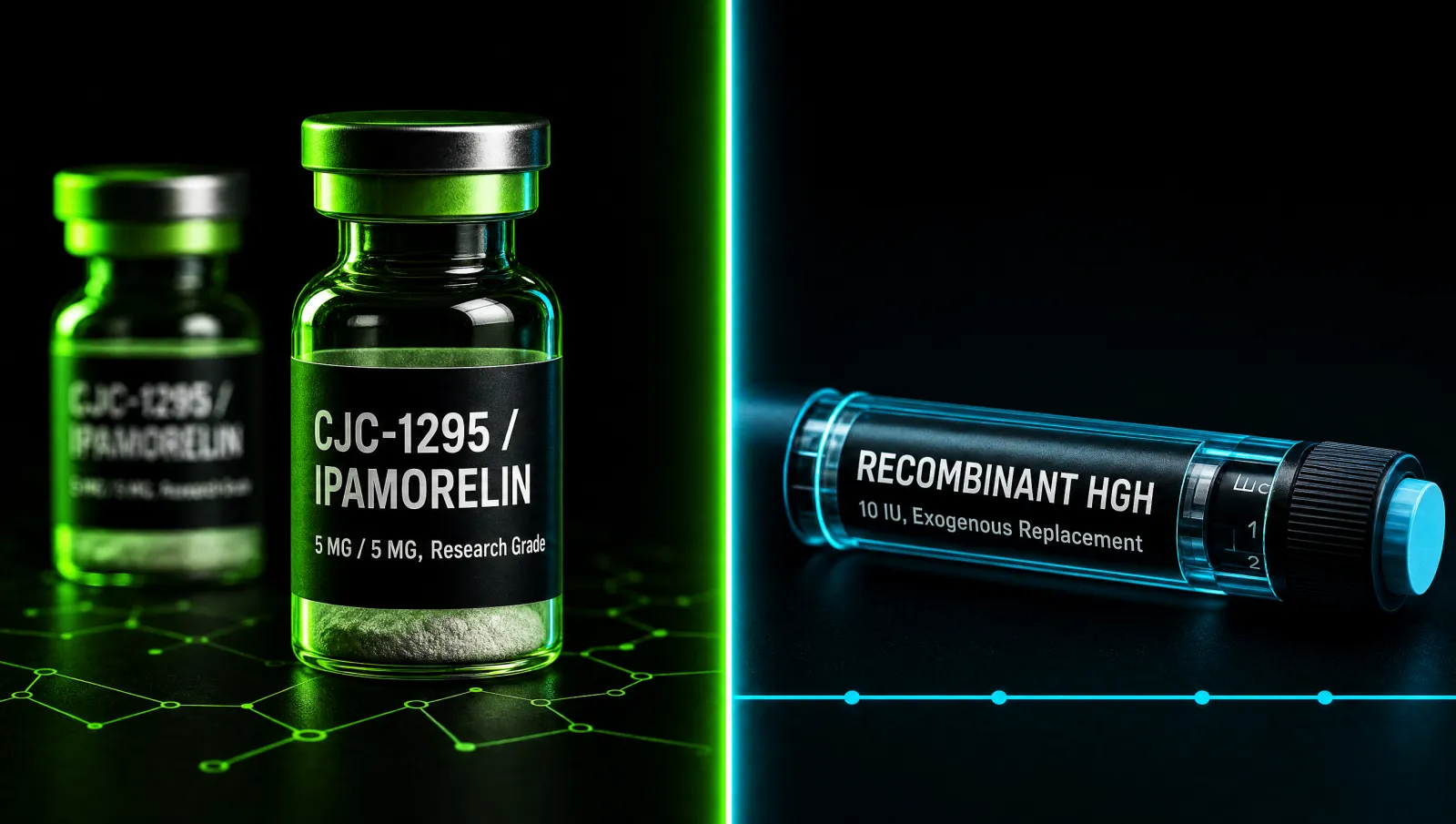
No study cited on this page gave CJC-1295 and ipamorelin together. So this page makes no claim about what the pair does.
Our CJC-1295 and ipamorelin protocol guide has the full design. The wider case sits in why this pair keeps growing. And our CJC-1295 guide covers that one alone.
A 2020 review traces this drug class. It covers drugs that act on the ghrelin receptor and drugs that act on the GHRH receptor. It sets out the history and drug action of each one that reached randomised clinical trials. It also lists the trials made public. Ishida & Saitoh 2020
What Does Ipamorelin Do for Bone and Muscle Recovery?
All of this work is in rats.
What happened to bone mineral content?
A 15-day dose-dependent study ran in adult female rats. Bone growth rate rose from 42 µm/day in vehicle-treated controls to 52 µm/day at the top dose. Vehicle-treated controls got the same shots with no drug in them. Body weight rose with the dose too. IGF-I levels and standard bone markers did not move. IGF-I is a growth factor made mainly in the liver when GH rises. Johansen et al. 1999
A later 12-week study used Sprague-Dawley rats, a common lab strain. It ran 0.5 mg/kg/day under the skin, through osmotic minipumps. These are small implanted pumps that release a steady dose. Total tibial and vertebral (shin bone and spine) bone mineral content rose on a DXA scan (dual X-ray absorptiometry, an X-ray that measures bone mineral). Tibial area bone mineral density rose as well. Once corrected for the gain in body weight, total bone mineral content did not change. Svensson et al. 2000
Can it offset glucocorticoid loss of muscle strength?
In rats, yes. Glucocorticoids are anti-inflammatory drugs. Over time they strip bone and muscle. A three-month study used eight-month-old female rats on methylprednisolone, a glucocorticoid drug. Ipamorelin was given with it, at 100 µg/kg three times daily, under the skin.
Maximum tetanic tension rose significantly against the glucocorticoid-only group. That is a direct measure of muscle force. The periosteal bone formation rate rose four-fold. That is the rate of new bone laid down on the bone surface. Andersen et al. 2001
This is preclinical data. It cannot be read across to people. Still, the size of the effect is notable. It gives a reason to study the compound where GH support may offset tissue loss.
What Does the Gut Research on Ipamorelin Show?
GHS-R1a is not only in the pituitary. It sits all through the gut. So a ghrelin copy reaches gut movement too.
One rodent study tested that. It modelled postoperative ileus. Ileus is the stall in gut movement that can follow surgery. Ipamorelin sped up stomach emptying. The authors linked this to ghrelin receptor-driven stomach contraction. At the lowest IV dose, the share of the meal still in the stomach fell from 78% to 52%. Greenwood-Van Meerveld et al. 2012
That work led to the human Phase 2 trial. It tested ipamorelin in ileus after bowel resection. The double-blind, placebo-controlled multicentre trial enrolled 117 patients, and 114 made up the safety group. Double-blind means neither patients nor staff knew who got the drug. Placebo-controlled means some got a dummy drip. Multicentre means it ran at several hospitals. The dose was 0.03 mg/kg twice daily IV, for up to seven days. It was well tolerated. Any side effect logged during treatment was seen in 87.5% on ipamorelin and 94.8% on placebo. It did not meet its main efficacy endpoint in that group. That endpoint was the time until patients could keep down a solid meal. Beck et al. 2014
That trial is the best human safety evidence we have. It covers up to a week of repeat IV dosing in patients after bowel surgery.
What Are the Main Ipamorelin Benefits in Research?
None of this is a promised result. It is where the published work sits, and how strong each part is.
| Area | Evidence type | Strength |
|---|---|---|
| GH release | Rat and swine studies plus a human dose trial | Strong |
| No cortisol rise beyond GHRH | One swine study | Moderate, animal only |
| Bone mineral content and bone growth | Rat studies, two designs | Moderate, preclinical only |
| Protection against glucocorticoid catabolism | Three-month rat study | Moderate, preclinical only |
| Stomach emptying and gut movement | Rodent model plus one Phase 2 trial | Mechanism strong, endpoint missed |
| Body composition change in people | No controlled trial cited | Not shown |
The honest summary is short. Ipamorelin releases GH in people. Its hormone selectivity was shown in swine. Nearly everything after that is still animal work.
What Are the Ipamorelin Side Effects?
The safety picture splits in two. There is what is known, and what is only reported.
What is known?
- Dose-escalation trial: healthy men got IV drips from 4.21 to 140.45 nmol/kg. Its abstract reports drug and GH levels, not side effects. Gobburu et al. 1999
- Phase 2 trial: well tolerated over up to seven days. The dose was 0.03 mg/kg twice daily IV, in a 114-patient safety group after bowel surgery. Beck et al. 2014
- In swine, no change in prolactin, FSH, LH or TSH. Raun et al. 1998
- In swine, cortisol after ipamorelin did not differ significantly from cortisol after GHRH, even at more than 200 times the ED50. Raun et al. 1998
What is not known?
No study cited here gave repeated shots under the skin to people. So side effects from that use have not been measured in a trial.
Does it cause acromegaly?
The question comes up with anything that raises GH. Acromegaly is bone and tissue overgrowth from years of excess GH. It takes constant high output to get there.
Ipamorelin gives short pulses. In the human trial, GH fell to a negligible level after each peak. That is nothing like a steady GH drip. No study cited here reported acromegaly. The human studies lasted a week or less.
Is Ipamorelin Legal, and What Is Its Regulatory Status?
It is not FDA-approved as a medicine.
Other countries differ. Our guide to vetting a peptide supplier sets out what to ask for.
With Ipamorelin, the supplier matters as much as the dose. We only list sources that publish an independent, per-batch certificate of analysis.
Who Is Ipamorelin Research Most Relevant For?
The data point at four groups. None of them is a use case.
- Work on the GH and IGF-1 axis with no cortisol along for the ride. A clean signal is what they need.
- Bone mineral content and bone formation after glucocorticoid exposure.
- Gut movement, mostly after surgery or in a slow gut.
- Body composition work in men with low testosterone.
A 2020 clinical review looked at hypogonadal males. That means men with low testosterone. It named ipamorelin among the drugs with potential in body composition care for them. It also said more human studies are needed. It noted that ipamorelin acts selectively on GHS-R1a. It also noted the gut effects. Those run through the same receptor in gut tissue. Sinha et al. 2020
Where to buy Ipamorelin
The hard part with Ipamorelin isn't the protocol. It's finding a supplier that can prove what's in the vial. We assessed dozens against per-batch, third-party testing. A handful passed.
See the sources that passed →Bibliography
- Raun K, et al. Ipamorelin, the first selective growth hormone secretagogue. Eur J Endocrinol. 1998. PMID 9849822
- Gobburu JV, et al. Pharmacokinetic-pharmacodynamic modeling of ipamorelin, a growth hormone releasing peptide, in human volunteers. Pharm Res. 1999. PMID 10496658
- Johansen PB, et al. Ipamorelin, a new growth-hormone-releasing peptide, induces longitudinal bone growth in rats. Growth Horm IGF Res. 1999. PMID 10373343
- Svensson J, et al. The GH secretagogues ipamorelin and GH-releasing peptide-6 increase bone mineral content in adult female rats. J Endocrinol. 2000. PMID 10828840
- Andersen NB, et al. The growth hormone secretagogue ipamorelin counteracts glucocorticoid-induced decrease in bone formation of adult rats. Growth Horm IGF Res. 2001. PMID 11735244
- Beck DE, et al. Prospective, randomized, controlled, proof-of-concept study of the ghrelin mimetic ipamorelin for the management of postoperative ileus in bowel resection patients. Int J Colorectal Dis. 2014. PMID 25331030
- Greenwood-Van Meerveld B, et al. Efficacy of ipamorelin, a ghrelin mimetic, on gastric dysmotility in a rodent model of postoperative ileus. J Exp Pharmacol. 2012. PMC4863553
- Prakash A, Goa KL. Sermorelin: a review of its use in the diagnosis and treatment of children with idiopathic growth hormone deficiency. BioDrugs. 1999. PMID 18031173
- Ishida J, Saitoh M, et al. Growth hormone secretagogues: history, mechanism of action, and clinical development. JCSM Rapid Communications. 2020. DOI 10.1002/rco2.9
- Sinha DK, et al. Beyond the androgen receptor: the role of growth hormone secretagogues in the modern management of body composition in hypogonadal males. Transl Androl Urol. 2020. PMC7108996
This content is for educational purposes only. These compounds are intended for research use. Nothing here is medical advice. A qualified clinician can advise on any health decision.
Where to buy Ipamorelin
The hard part with Ipamorelin isn't the protocol. It's finding a supplier that can prove what's in the vial. We assessed dozens against per-batch, third-party testing. A handful passed.
See the sources that passed →Share this article
Frequently Asked Questions
What makes ipamorelin different from GHRP-6 and GHRP-2?
How long does an ipamorelin GH pulse last?
What are typical ipamorelin dosing protocols in research settings?
Can ipamorelin be combined with other peptides?
What does the clinical safety data actually show for ipamorelin?
Does ipamorelin affect testosterone or other sex hormones?
Read Next

Disclaimer: This content is for educational purposes only. These compounds are intended for research use. Nothing here is medical advice. Always work with a qualified clinician before making changes to your health protocol.