
Best Nootropic Peptides for Focus and Memory: Ranked

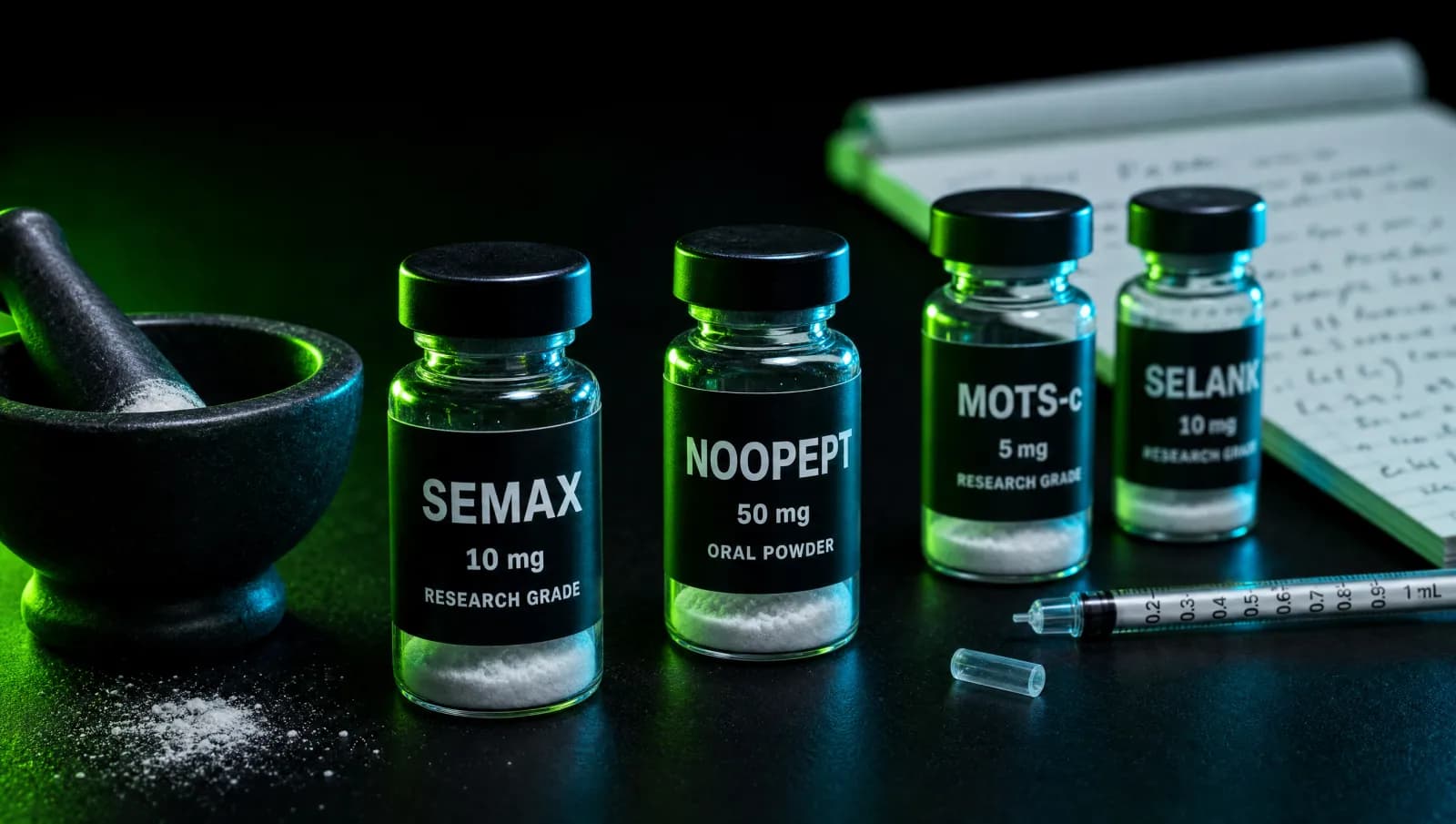
The Rankings Are Wrong (Or at Least Incomplete)
The conventional "Semax, Noopept, MOTS-c" ranking recycles Russian clinical data from stroke and anxiety populations, not healthy men chasing focus. Selank is buried despite comparable evidence, and MOTS-c gets misclassified as a nootropic when its actual mechanism is mitochondrial, not cognitive. The real framework is use case, not a top-three list.
Every biohacking blog runs the same three names in the same order: Semax first, Noopept second, MOTS-c third. The logic looks sound on the surface. Semax has the deepest clinical history, Noopept has the broadest mechanism, and MOTS-c is the trendy mitochondrial peptide riding the longevity wave. If you have spent time in serious circles, you already know this list by heart because everyone repeats it.
The problem is not that these three peptides lack evidence. The problem is what that evidence actually measures, and who it was measured in. Most of the human data behind Semax comes from stroke recovery trials in Russia, not from healthy 40 year old men trying to hold focus through a demanding training block. Most of the Selank data, which barely makes the rankings, comes from generalized anxiety disorder patients, yet the mechanism overlaps heavily with what a returning sportsman under competition stress actually needs. This is a contrarian read built from the primary literature, not a reshuffled top-three list.
What the Primary Literature Actually Shows
Dolotov et al. found a single intranasal Semax dose produced measurable BDNF and TrkB changes in rat hippocampus within 90 minutes, not in humans performing cognitive tasks. Dolotov et al. 2006 The strongest human trials sit in disease recovery, not performance enhancement.
This matters because rodent hippocampal gene expression and subjective human focus are not the same endpoint. The mechanism is real: Semax does upregulate BDNF and TrkB phosphorylation, and that pathway genuinely matters for synaptic plasticity. But the leap from "BDNF went up in a rat brain" to "you will concentrate better during a training session" is a leap the rankings never explain. They just present the mechanism as if it settles the question.
Noopept has a similar gap. The dipeptide increases hippocampal BDNF and NGF expression after both acute and chronic dosing, and chronic administration does not appear to build tolerance. Ostrovskaya et al. Separately, Noopept modulates alpha-7 nicotinic acetylcholine receptors on hippocampal interneurons, which is a plausible route to improved signal-to-noise in attention circuits. Zhang et al. Both findings come from slice preparations and rodent models. Neither one is a controlled human trial measuring reaction time, working memory, or sustained attention in cognitively healthy adults.
MOTS-c tells a different story entirely. A cell-penetrating MOTS-c analogue improved memory performance and reduced amyloid-beta and LPS-induced memory impairment in rodent models, largely by suppressing neuroinflammation through AMPK signalling. peripheral MOTS-c analogue study That is a mitochondrial and anti-inflammatory mechanism, not a direct cognition-boosting one. Ranking MOTS-c alongside Semax and Noopept as a "nootropic" stretches the word past what the data supports.
Why the Conventional List Misses the Sportsman Use Case
The men reading this are not stroke patients and they are not lab rodents. Many of you played competitive sport at a high level and are either still chasing performance at 35 plus or working your way back into competition after injury, a career shift, or years spent raising a family instead of training. Your cognitive demand profile looks different from a generalized anxiety patient or a post-stroke recovery case. You need sustained attention during long training blocks, quick decision-making under fatigue, and the ability to recover mentally between sessions, not baseline restoration of impaired function.
That distinction matters more than the rankings admit. A peptide with strong clinical data in a disease population is not automatically the best tool for a healthy performer looking for an edge. Sometimes the more mechanistically narrow, less hyped compound fits your actual situation better.
The Peptide the Rankings Bury: Selank
Selank, a tuftsin analogue, produced anxiolytic effects comparable to low-dose benzodiazepines in a controlled clinical trial of generalized anxiety and neurasthenia patients, without the same side effect profile. Zozulia et al. 2008 It rarely appears above fourth or fifth place in conventional rankings.
That omission is the clearest evidence of a flawed ranking method. Selank modulates GABA, serotonin, and dopamine systems simultaneously, and animal work shows it protects against stress-induced anxiety while supporting exploratory behavior and cognitive flexibility. Kolyasnikova et al. For a man returning to competitive sport after a long layoff, whether from injury or years away from the game, performance anxiety and mental noise are often bigger obstacles than raw memory encoding. A calming, focus-supporting peptide with clinical-grade human data on anxiety reduction is arguably more relevant to that scenario than a stroke recovery compound. Read the direct comparison in our Semax versus Selank breakdown for dosing and stacking specifics.
Head-to-Head: Evidence Grade by Actual Use Case
| Peptide | Strongest evidence source | Population studied | Best-fit use case | Honest evidence grade |
|---|---|---|---|---|
| Semax | Stroke recovery trials, rodent BDNF studies | Stroke patients, healthy rodents | General neuroprotection, motivation, mental drive | Clinical (disease population), mechanism (healthy use) |
| Noopept | Rodent hippocampal and receptor studies | Rodents, limited human cognitive impairment trials | Broad-spectrum neuroprotection, mild stimulant-free alertness | Preclinical strong, thin human data |
| Selank | Generalized anxiety disorder clinical trial | Anxiety and neurasthenia patients | Focus under stress, competition anxiety, mental clarity for returning athletes | Clinical (disease population) |
| MOTS-c | Rodent memory and neuroinflammation models | Rodents only for cognition endpoints | Mitochondrial support, recovery adjacent to cognition | Preclinical, mechanism-based |
Where MOTS-c Actually Fits (Not as a Nootropic)
MOTS-c is a mitochondrial-derived peptide, and its cognitive angle is downstream of metabolic and anti-inflammatory action, not a direct nootropic effect on neurotransmission. It does not cross the blood brain barrier easily in its native form, which is why researchers had to engineer a cell-penetrating analogue to test memory endpoints. That is an important detail the conventional rankings skip entirely. If your actual goal is sharper in-session focus, MOTS-c is not the tool. If your goal is supporting the metabolic substrate that focus depends on over months of training, the mechanism is worth understanding on its own terms rather than shoehorned into a nootropic top three.
A Framework Instead of a Ranking
Instead of asking "which peptide is best," ask what your actual bottleneck is. If your problem is scattered attention and low drive during long training days, Semax's BDNF and dopaminergic mechanism is a reasonable fit, understanding that the strongest human data comes from a different population. If your problem is broad cognitive fog with no single dominant symptom, Noopept's multi-pathway action makes sense as a starting point. If your problem is performance anxiety, racing thoughts before competition, or mental noise that blocks focus rather than a lack of raw processing power, Selank deserves a serious look, not a footnote. If you are chasing mitochondrial resilience and recovery capacity that supports cognition indirectly, MOTS-c belongs in that conversation, not the nootropic one.
This is the same logic we use across our performance peptide guide for men over 40, where matching the compound to the actual limiting factor beats chasing the peptide with the flashiest reputation.
Stacking Considerations Worth Taking Seriously
Semax and Selank are frequently discussed together because their mechanisms are complementary rather than redundant: one leans stimulating, the other leans calming. Noopept is sometimes layered underneath either for its broader neuroprotective coverage. MOTS-c sits in a different category entirely and is more commonly paired with recovery-focused compounds than cognition-focused ones. Our peptide stacking guide covers sequencing logic in more depth, including why stacking everything at once defeats the purpose of tracking what is actually working.
Intranasal delivery is common to Semax, Selank, and Noopept, which makes them practically accessible without injection equipment. Onset for the nasal route is typically reported within 30 to 60 minutes, and protocol lengths for meaningful neuroplastic effects generally run 4 to 8 weeks based on published dosing precedent, not indefinite daily use.
Safety, Sourcing, and What the Data Does Not Cover
None of the four compounds in this piece have large-scale, independently replicated human trials in cognitively healthy Western adults. That gap is the entire point of this piece. The mechanisms are credible, the rodent and disease-population data is real, but the extrapolation to healthy performance enhancement remains anecdotal at the individual level, even if widely reported anecdotally across the biohacking space. Purity and sourcing matter more when the human trial base is thin, since you are relying more heavily on the compound matching its label. Learn what to check before you buy in our guide on reading a peptide certificate of analysis, and see our recommended sources for vendors we trust for research-grade material.
This content is for educational purposes only. These compounds are intended for research use. Nothing here is medical advice, and you should always work with a qualified clinician before changing your health protocol.
Frequently Asked Questions
Is Semax actually the best nootropic peptide?
Semax has the deepest clinical track record of any peptide in this category, but that record comes primarily from stroke recovery, not healthy cognitive enhancement. It is a strong option, not automatically the best one for your specific bottleneck.
Why is Selank left off most nootropic peptide rankings?
Selank is often filed under "anxiolytic" rather than "nootropic" even though its clinical trial data in generalized anxiety patients is comparable in quality to Semax's stroke data. The categorization, not the evidence, is what pushes it down the list.
Is MOTS-c really a nootropic peptide?
Not directly. MOTS-c's cognitive benefits in research come from mitochondrial and anti-inflammatory mechanisms rather than direct neurotransmitter or growth factor action on attention circuits. It belongs in a recovery and metabolic conversation more than a pure focus conversation.
What is the difference between Semax and Noopept for focus?
Semax leans toward BDNF-driven motivation and drive with a more stimulating profile, while Noopept has a broader, more diffuse neuroprotective mechanism with less of a stimulant feel. Our Semax guide breaks down the mechanism in more detail.
Can these peptides help with competition anxiety for returning athletes?
Selank has the most directly relevant clinical data here, since its trials measured anxiety reduction specifically. Anecdotally, users in the recovery and performance space report calmer focus under pressure, though this has not been tested in athletic populations directly.
How long does it take to notice effects from nootropic peptides?
Many users report subjective changes within 30 to 60 minutes of intranasal dosing, but the neuroplastic effects tied to BDNF and receptor changes typically build over a 4 to 8 week protocol based on published research timelines.
Where to source it
Research-grade nootropic peptides including Semax, Noopept, and MOTS-c sourced from verified suppliers with third-party COAs.
See the sources that passed →Where to source it
Research-grade nootropic peptides including Semax, Noopept, and MOTS-c sourced from verified suppliers with third-party COAs.
See the sources that passed →Share this article
Frequently Asked Questions
Is Semax actually the best nootropic peptide?
Why is Selank left off most nootropic peptide rankings?
Is MOTS-c really a nootropic peptide?
What is the difference between Semax and Noopept for focus?
Can these peptides help with competition anxiety for returning athletes?
How long does it take to notice effects from nootropic peptides?
Read Next

Disclaimer: This content is for educational purposes only. These compounds are intended for research use. Nothing here is medical advice. Always work with a qualified clinician before making changes to your health protocol.