
BPC-157 Tendon Repair: Dosage, Evidence, Recovery Timeline

Does BPC-157 Help With Tendon Repair?
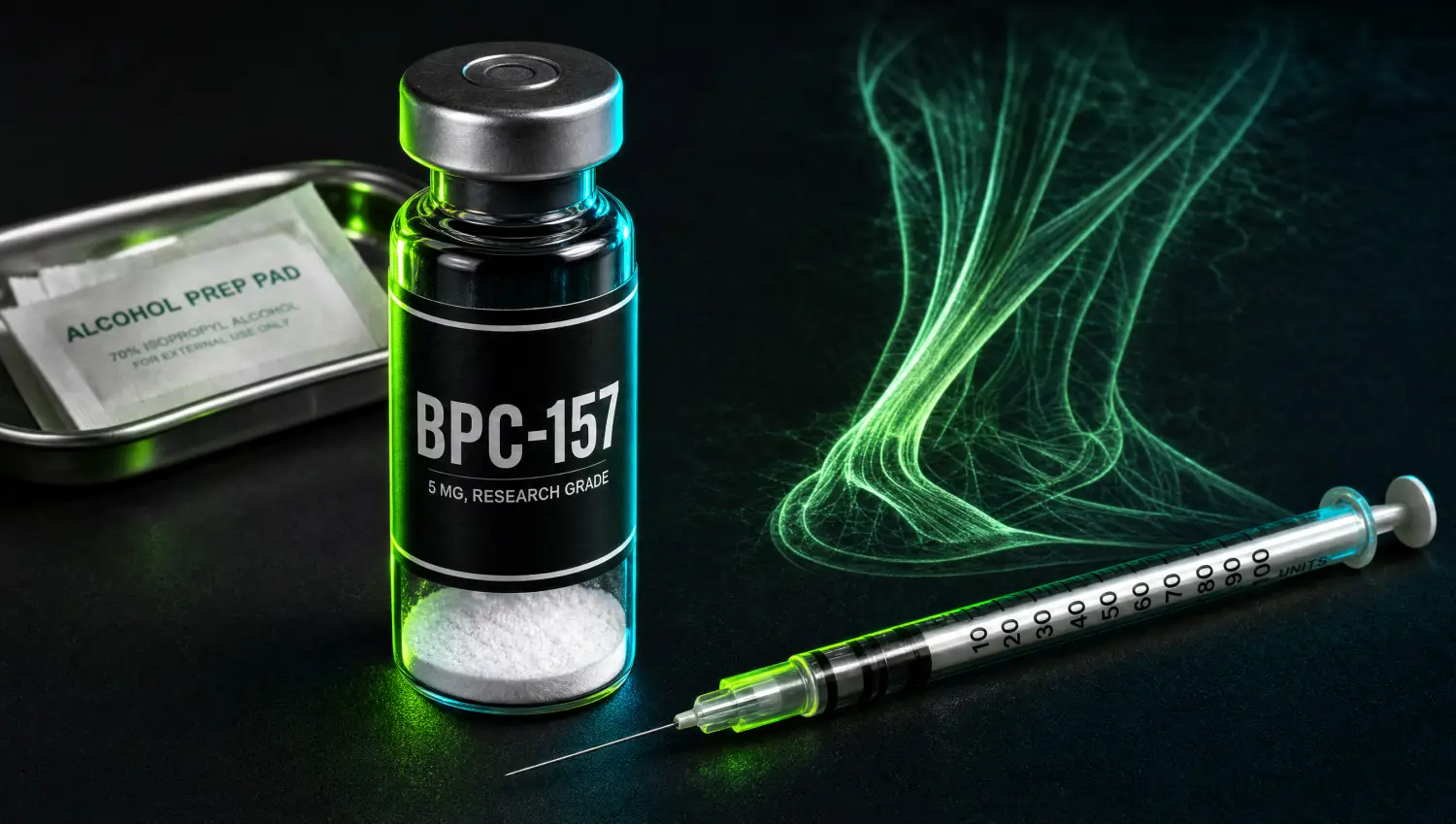
BPC-157 tendon repair works well in animals, but human proof is still thin. Rat studies on the Achilles tendon, knee ligaments and the muscle-tendon joint all show faster, stronger healing. A 2025 review screened 544 articles and found just one human study, so the mechanism is solid while the human evidence still lags behind.
Tendons heal slowly for a simple reason. They get a thinner blood supply than muscle does. That thin supply is the bottleneck, and it's the one BPC-157 seems to target.
How Does BPC-157 Work for Tendon Repair?
The mechanism of action behind BPC-157 tendon repair pulls three levers at once.
The first lever is blood supply. BPC-157 raises VEGF (vascular endothelial growth factor), a signal that tells the body to grow new blood vessels. It also switches on eNOS (endothelial nitric oxide synthase) through the Src-Caveolin-1 pathway, a chain of signals inside the cell wall. This widens blood vessels, more so at higher doses. More blood means more oxygen and nutrients reaching a tendon that had a weak supply line before (Hsieh 2020).
The second lever is cell movement. Researchers studied rodent (rat) Achilles tendon fibroblasts, the cells that build tendon. BPC-157 sped up how fast these cells grew out of injured tissue, and the effect scaled with dose. It works through the FAK-paxillin pathway, the signal route cells use to survive and travel toward a wound (Chang 2010).
The third lever is collagen. BPC-157 increases growth hormone receptor expression in tendon fibroblasts, meaning more docking points for growth hormone to act on. This effect depends on both dose and time. Paired with growth hormone, it speeds up how fast those cells multiply (Chang 2014). Blood supply, cell movement and collagen all move together.
What Does the Research Show About BPC-157 for Tendon Repair?
The ligament research is worth a closer look. Researchers gave rodents (rats) BPC-157 at 10 micrograms or 10 nanograms per kilogram. Every treated rat healed better than untreated ones. This held true whether the dose was injected, applied to the skin, or given by mouth. The improvement was still visible at 90 days (Cerovecki 2010).
Achilles tendon-to-bone reattachment tells a similar story. This injury is stubborn to treat. Researchers tested rats whose Achilles tendons were cut, then treated. Treated rats recovered load-to-failure (how much force the tendon takes before breaking), plus stiffness and elasticity. They did better than untreated rats. They also beat rats given corticosteroids, a drug class that usually slows tendon healing instead of helping it.
Injuries at the myotendinous junction follow the same pattern. That's where muscle meets tendon. The inflammatory infiltrate (the build-up of immune cells during inflammation) cleared away. Tissue orientation returned to normal. Full function returned by days 28 to 42 (Japjec 2021). Quadriceps muscle-to-bone studies found the same pattern using oral dosing. Improvement kept climbing through 90 days.
How Strong Is the Human Evidence for BPC-157 Tendon Repair?
The human evidence is thin. A 2025 systematic review screened 544 articles and found 36 studies of BPC-157 in sports medicine. Of those, 35 were preclinical, meaning done in animals or cells rather than people. Only one was clinical. In that single human study, twelve people with long-term knee pain got one injection. Seven felt relief that lasted six months or more. No randomised controlled trial has finished yet (Vasireddi 2025).
That ratio is the honest state of play. No finished, credible human trial changes it yet.
So the honest read stands. The mechanism is well mapped. Rodent results are consistent across tissue types. Human data is anecdotal or drawn from tiny pilot groups. That gap is normal for peptides at this stage. It should shape how much weight you put on any claim.
What Is the BPC-157 Dosage for Tendon Repair?
Research-based dosing runs 250 to 500 micrograms daily. It's injected under the skin, at or near the injury, for four to six weeks. Scaling up from animal studies suggests roughly 2.5 to 3.75 micrograms per kilogram twice daily. For most adults, that lands at 300 to 400 micrograms per day.
| Dosing basis | Amount | Duration |
|---|---|---|
| Research protocol | 250 to 500 micrograms daily | four to six weeks |
| Scaled from animal data | 2.5 to 3.75 mcg/kg, twice daily | four to six weeks |
| Typical adult total | 300 to 400 micrograms per day | four to six weeks |
Peri-lesional injection means placing the dose at or near the injury itself. Research protocols favour it for injuries you can reach, such as Achilles tendon pain, tennis elbow, or shoulder tendon problems. Deeper injuries usually get delivered under the skin or into the muscle instead.
Oral BPC-157 is unusual among peptides because it survives stomach acid. Animal studies show it still works by mouth for muscle-to-bone healing. Injections usually give stronger results for direct muscle and tendon injuries. The best route depends on where the injury sits, and a qualified clinician should work that out with you rather than you guessing. Our BPC-157 dosing protocol covers the injection schedule in full.
Higher doses have not produced proportionally bigger effects in animal studies. Consistent exposure across the four to six week window is the goal, not a bigger number. That window matches the remodelling timeline your body actually runs on.
How Long Until You See BPC-157 Tendon Repair Results?
In animal models, structural change shows up inside the first week, with the biggest shifts landing between days fourteen and twenty-one.
Tendon-to-bone healing takes longer. It has to rebuild a complex zone where tendon meets bone, and that zone is hard to rebuild. That is why the four-week mark keeps appearing across tendon-to-bone studies. A simpler tendon-to-tendon problem, like a lateral ligament sprain or an Achilles overuse issue, may feel better sooner. Longer rat protocols show improvement continuing through six weeks. That is where the standard four to six week window comes from.
Can BPC-157 Repair Cartilage or Labral Tears?
No. It does not rebuild cartilage, and it will not close a torn labrum.
Cartilage is a different tissue. It has little or no blood supply of its own, and that's the very lever BPC-157 pulls elsewhere. Without vascular access, its strongest mechanisms have little to work with. Animal research does point to chondroprotective effects (meaning it may slow cartilage breakdown), but that is not the same as regrowth. In rotator cuff models, it shows promise in the tissue around the joint. VEGF rose roughly 2.4-fold against controls, and collagen synthesis increased too, within 14 days.
The labrum has the same problem. It is dense fibrocartilage, a tough type of cartilage. Only the outer rim gets a blood supply. The inner two-thirds are avascular, meaning they have almost no blood vessels at all. That's why doctors usually treat labral tears with surgery rather than leaving them alone. One published case report described a person who injected 20 milligrams under the skin into the shoulder and hip over 36 days. They reported small gains in strength and stability, but did not expect the tear itself to heal. It can support symptoms and function. It does not mean the tear grows back.
If imaging shows major structural damage, the safe use is as an add-on, alongside physical therapy or to help recovery after surgery. It should not replace a surgical consultation.
BPC-157 vs TB-500 for Tendon Repair: Which Should You Use?
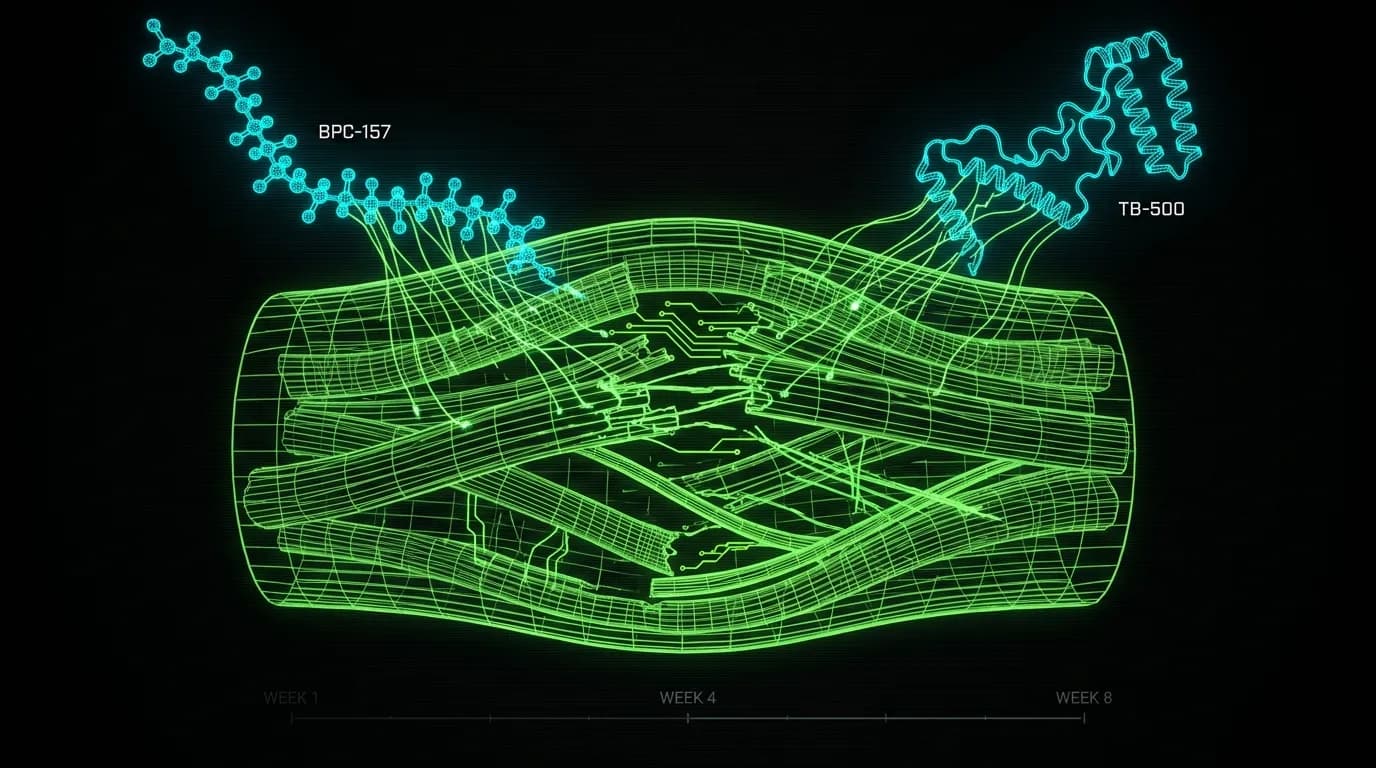
Different mechanisms, which is why people pair them. BPC-157 works mainly by growing new blood vessels and boosting growth hormone receptors on cells. TB-500 works differently. It helps cells move and calms inflammation across the whole body. It is usually studied for whole-body support, not tendon-specific repair. BPC-157 has more preclinical evidence specific to tendons. That covers the Achilles tendon, the knee ligament, the muscle-tendon join and the tendon-to-bone join. No controlled human trial confirms that combining them adds any benefit. Our full comparison of the two breaks down what each one's evidence actually covers.
Is BPC-157 Safe for Tendon Repair?
Animal studies report no toxicity at the doses tested. A small 2025 pilot trial found that intravenous BPC-157 was well tolerated in healthy adults, at doses up to 20 milligrams. Fewer than thirty human subjects have been studied across all trials. With a sample that small, rare side effects would likely go unnoticed.
There is a real hole in the record too. A 2015 Phase I human trial with 42 volunteers was registered, then cancelled in 2016 without published results. That is a gap, not a null result to lean on. BPC-157 is not FDA-approved for any use, and it remains a research compound. Sourcing quality matters as much as dosing here. We keep a vendor-neutral list on our recommended sources page.
Where to source it
If you're researching this compound, I've linked a trusted source below. It supports the channel.
See the sources that passed →Bibliography
- Chang et al. 2010, The promoting effect of pentadecapeptide BPC 157 on tendon healing
- Cerovecki et al. 2010, Pentadecapeptide BPC 157 improves ligament healing in the rat
- Japjec et al. 2021, BPC 157 as a Therapy for the Disable Myotendinous Junctions in Rats
- Chang et al. 2014, BPC 157 enhances growth hormone receptor expression in tendon fibroblasts
- Hsieh et al. 2020, Modulatory effects of BPC 157 on vasomotor tone and eNOS pathway
- Vasireddi et al. 2025, Emerging Use of BPC-157 in Orthopaedic Sports Medicine: A Systematic Review
This content is for educational purposes only. These compounds are intended for research use. Nothing here is medical advice. Always work with a qualified clinician before making changes to your health protocol.
Where to source it
If you're researching this compound, I've linked a trusted source below. It supports the channel.
See the sources that passed →Share this article
Frequently Asked Questions
How does BPC-157 promote tendon and ligament healing?
What is the standard BPC-157 dosing protocol for tendon and ligament injuries?
Can BPC-157 repair cartilage in the shoulder joint?
Can BPC-157 heal a torn labrum in the hip or shoulder without surgery?
What is the timeline for BPC-157 effects on tendon healing?
How does BPC-157 compare to TB-500 for tendon repair?
Read Next

Disclaimer: This content is for educational purposes only. These compounds are intended for research use. Nothing here is medical advice. Always work with a qualified clinician before making changes to your health protocol.