
Running Peptide Protocols: What I've Learned

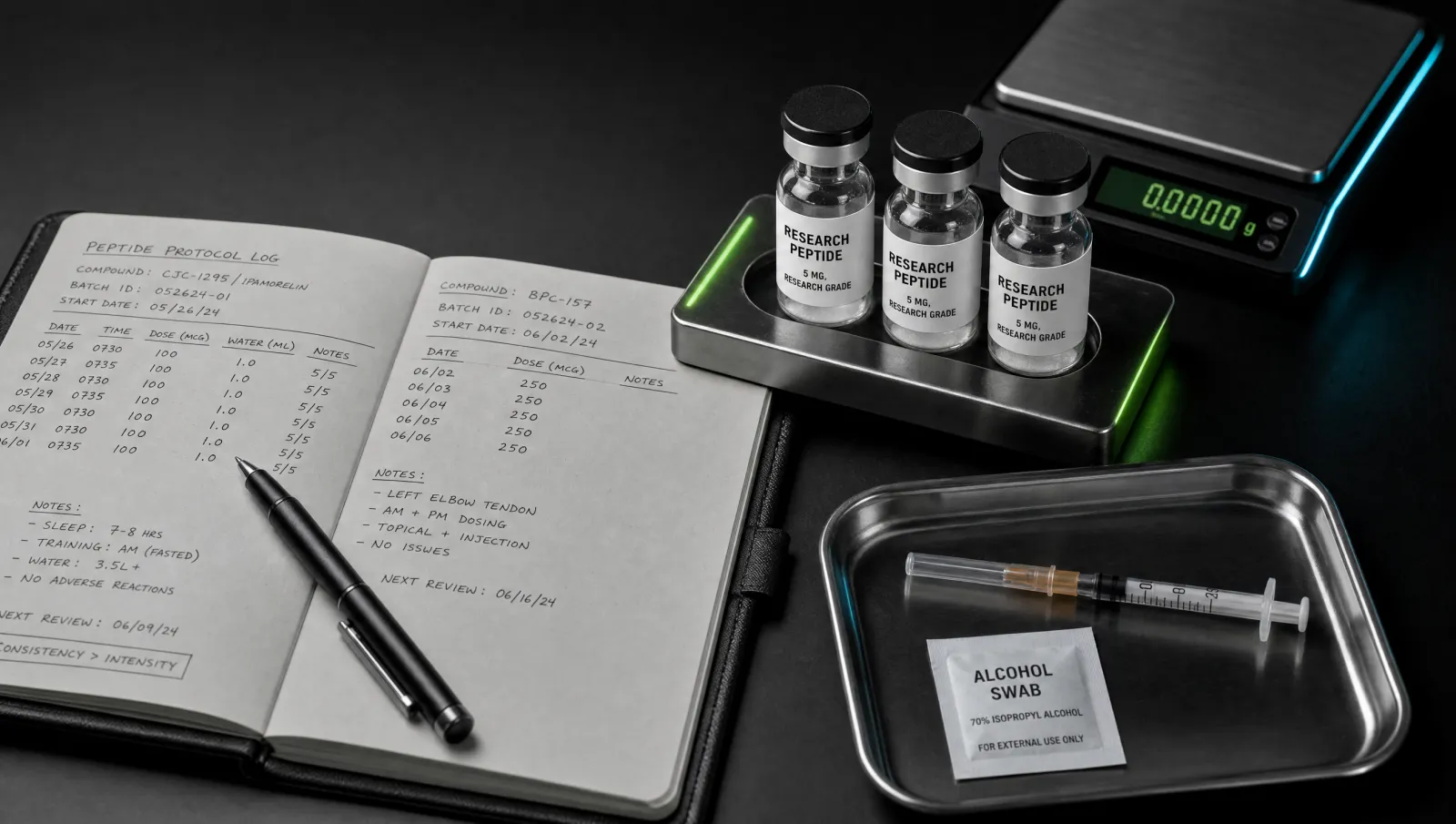
What Have I Learned From Running Peptide Protocols?
Running peptide protocols teaches one lesson above all others: the risk is not the compound, it is the confidence you build before the evidence does. Most dosing is a guess. Tolerance is not the same on every pathway. Your source drives antibody risk. And the best human safety trial here ran for weeks, not years.
You start out treating a protocol like a recipe. A dose, a frequency, a duration. Spend enough time here and that view changes. Most of what gets passed round as "the protocol" is a working idea, not a settled rule. That is not a reason to panic. It is a reason to be clear about what you know and what you are guessing.
Is Peptide Dosing Really Guesswork Dressed Up as Protocol?
It often is. Most non-approved peptide dosing does not come from dose-finding trials. It comes from animal work, single-dose studies and years of anecdotal use. That mix reads as solid online. It is not.
One review of peptides in ageing makes the gap plain (Mavrych 2026). It lists the best dosing regimens as a significant knowledge gap. It also reports that non-approved peptides lack long-term safety data and systematic validation.
That does not mean the compounds are unsafe. It means the honest position is a narrow one. We know a fair amount about short-term tolerability, which is how well a dose is handled over a few weeks. We know very little about what a decade of repeat protocols does. If you run anything for a long time, let that shape your dose rather than your nerve.
Does Tolerance Work the Same Way for Every Peptide?
No. It is real on some pathways and largely absent on others. What suits a growth hormone secretagogue will not transfer to a healing peptide like BPC-157. Nor will it transfer to a tissue-remodelling compound like GHK-Cu.
Tolerance is the drop in a drug's effect after repeated or prolonged use (Peptide Journal 2025). Whether it applies to you depends on the receptor system involved. Growth hormone secretagogues are the clearest case where the body pushes back.
Take CJC-1295. It is a long-acting GHRH analogue, a lab-made copy of the hormone that tells the pituitary to release growth hormone. Its half-life is around 8 days. One study found it kept natural GH pulsing while lifting trough GH and IGF-1 (Ionescu 2006). Pulsing is thought to matter, because a flat and constant signal is what dulls a receptor. Know that before you set any on-off pattern of your own.
What Is the Antibody Problem Nobody Talks About?
Antidrug antibodies. They are an unwanted immune response to a drug, and researchers call that immunogenicity. The risk rarely gets airtime outside the research papers. It is also the clearest reason your source matters more than your dose.
A review of peptide drug safety sets out how it works (Achilleos 2025). These antibodies can limit how well a peptide works and how safe it is. The response may be set off by the peptide itself. It may also be set off by impurities from the making or the mixing of the product.
The same review counts the rise of these drugs. Over 11% of new chemical entities authorised by the FDA between 2016 and 2024 were synthetic peptides. The field is growing fast, and checks on making them are growing too. So the name on the label matters far less than what went on in the vial.
What Does the Long-Term Safety Data Actually Show?
Better than the scare stories suggest, and thinner than most protocol guides admit. Short-term safety data exists for several compounds. Multi-year human data, the kind you want before running something for a decade, does not.
Toxicology work covered mice, rats, rabbits and dogs. BPC-157 was well tolerated, with no serious toxicity (Xu 2020). The local tolerance test found the irritation it caused was mild.
A separate review looked at BPC-157 in rodent tendon and ligament models. It reported few adverse reactions (Gwyer 2019). It was also upfront that most of that work sits in small rodent models. Human proof is still pending.
Thymosin beta-4 has the most direct human data of the group. A Phase I trial gave 54 healthy Chinese volunteers single doses into a vein, from 0.05 to 25 μg/kg (Wang 2021). Adverse events were mild to moderate. There were no dose-limiting toxicities, and no obvious build-up after continuous dosing. That is a reassuring signal. It is still one trial, one group and one dosing window. It is not a decade of data.
Does the Injection Route Change Your Results?
More than you would think. Most people inject under the skin, because that is the route you can manage without a clinic. It also delivers lower and more variable bioavailability than a drip into a vein. Bioavailability is the share of a dose that reaches your blood.
That swing is one quiet reason two people can run the same protocol and get different results. It matters most when the gap between a dose that works and one that does not is narrow. If you take up less on a given day, you have no clear way to know. Track your own markers across a block, both the way you feel and the numbers you measure. That beats copying someone else's exact number.
Where Is the Evidence Strong, and Where Is It Thin?
A structured review of injectable peptides in sports medicine found five classes (Villegas 2026). GLP-1 receptor agonists are the only class with repeat randomised controlled trial (RCT) evidence. That evidence is for symptom relief in knee osteoarthritis. Structural cartilage change is still unproven. Repair peptides and growth hormone secretagogues are still research compounds, and the review flags product quality too.
| Peptide class | Best human evidence | What is still missing |
|---|---|---|
| GLP-1 receptor agonists | Reproducible randomised trials in knee osteoarthritis | Proof of structural cartilage change |
| Collagen-derived injectables | Small single-centre prospective studies | Larger controlled trials |
| Regenerative peptides such as BPC-157 and thymosin derivatives | Animal toxicology and early-phase human safety work | Human outcome trials and long-term safety |
| Growth hormone axis secretagogues such as CJC-1295 and tesamorelin | Short human pharmacology studies | Long-term safety and product quality |
None of this means the other peptides do nothing. It means the weight behind two similar-sounding claims can differ a lot. Treating them as the same grade of evidence is where most protocol overconfidence starts.
What Would I Tell Someone Starting Their First Protocol?
Start conservative, track everything, and treat the first block as fact-finding rather than a sure thing. Even the compound with the best human safety data here was studied over weeks. Some people run these substances for years.
Source from somewhere that can prove what is in the vial. Our recommended sources page sets out what to look for. Our guide to reading a certificate of analysis shows how to check one. That step is not optional.
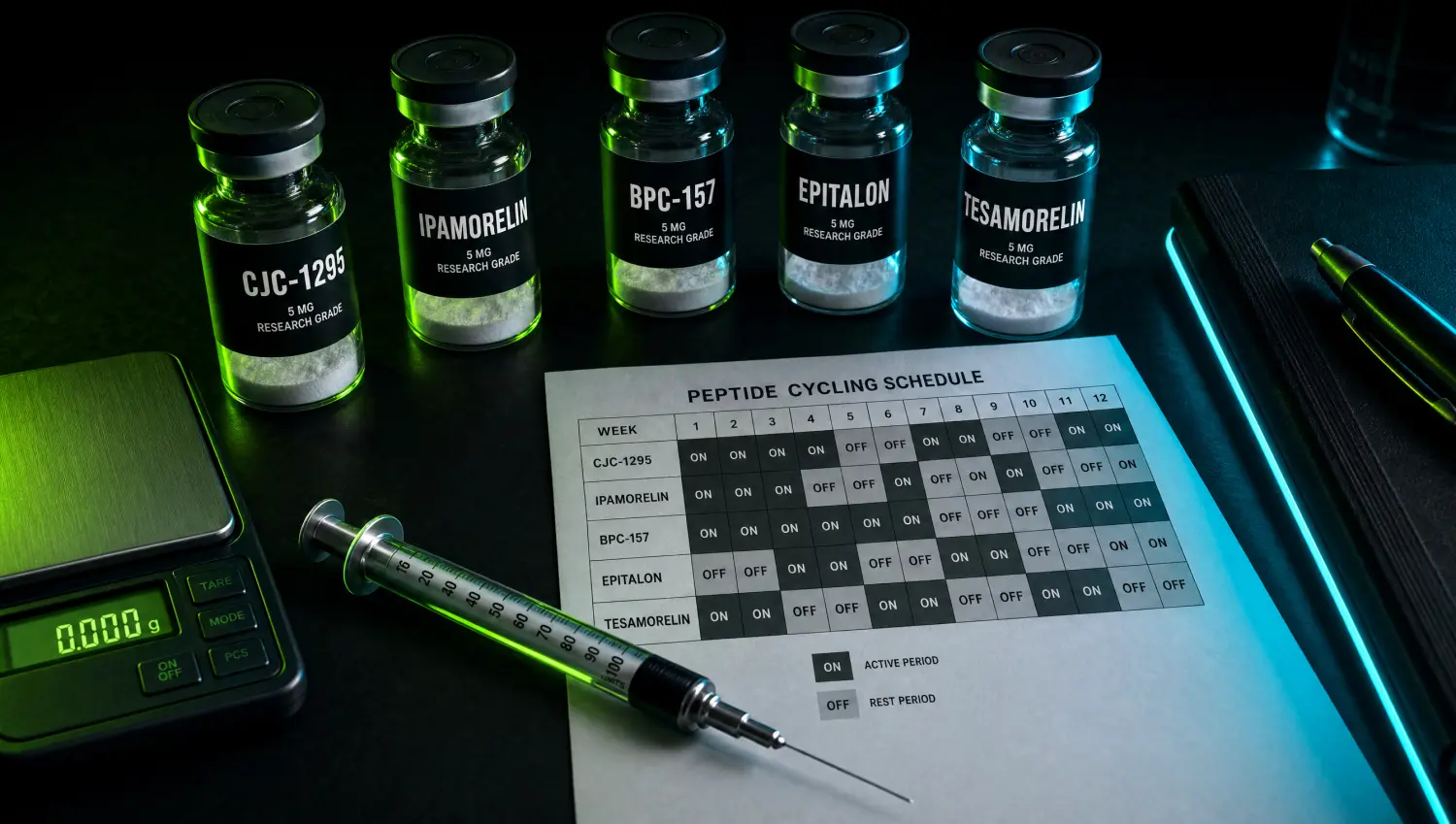
Then set fair hopes on tolerance. If you run a growth hormone secretagogue like the one in our tesamorelin dosing breakdown, plan an on-off structure from the start. Our guide to peptide cycling covers when breaks help and when they do not. Weighing up a tissue-remodelling peptide? Our GHK-Cu guide shows where the data is strongest and where it thins out.
The honest version of running peptide protocols is that you get more careful, not less. The confidence comes from process, tracking, a good source and a fair dose. It does not come from certainty the research cannot yet support.
Where to buy peptide protocols
If you're researching peptide protocols and want to see how sourcing and verification should work in practice, our recommended sources page breaks down what to check before you commit to any compound.
See the sources that passed →References
Mavrych, V., et al. (2026). Therapeutic peptides in gerontology: mechanisms and applications for healthy ageing. PMC13095733.
Achilleos, K., et al. (2025). Beyond Efficacy: Ensuring Safety in Peptide Therapeutics through Immunogenicity Assessment. PMC12010466.
Xu, C., et al. (2020). Preclinical safety evaluation of body protective compound-157. PubMed 32334036.
Gwyer, D., Wragg, N.M., Wilson, S.L. (2019). Gastric pentadecapeptide body protection compound BPC 157 and its role in accelerating musculoskeletal soft tissue healing. PubMed 30915550.
Wang, X., et al. (2021). A first-in-human, randomised, double-blind, single- and multiple-dose, phase I study of recombinant human thymosin β4. PMC8419156.
Ionescu, M., Frohman, L. (2006). Pulsatile secretion of growth hormone persists during continuous stimulation by CJC-1295. PubMed 17018654.
Villegas, J., et al. (2026). Injectable Peptides in Sports Medicine: A Structured Narrative Review of Evidence, Safety, and Antidoping Implications. PubMed 42160466.
Peptide Journal (2025). Can You Build Tolerance to Peptides?
This content is for educational purposes only. These compounds are intended for research use. Nothing here is medical advice. Always work with a qualified clinician before making changes to your health protocol.
Share this article
Frequently Asked Questions
What are the main lessons learned from running peptide protocols?
How do peptides like CJC-1295 maintain effectiveness over time?
What safety data exists for common recovery peptides?
Can you build tolerance to all peptides?
What is the risk of antidrug antibodies with peptide protocols?
How does subcutaneous versus intravenous administration change a peptide protocol?
Read Next
Disclaimer: This content is for educational purposes only. These compounds are intended for research use. Nothing here is medical advice. Always work with a qualified clinician before making changes to your health protocol.