
Thymosin Alpha 1 Dosage for Autoimmune Disease: Evidence

Thymosin Alpha-1 Dosage for Autoimmune Disease: What Do the Trials Use?
Thymosin alpha 1 dosage for autoimmune disease has no trial-tested number. Hepatitis B trials gave 1.6 mg for 24 to 52 weeks, twice a week where the schedule is stated. HIV work used 1.6 mg daily for two weeks, then twice a week for 22 weeks. No autoimmune trial has set a dose.
Every dose in the table below is lifted from a trial in another illness. Autoimmune use is off-label, and here it is genuinely investigational. A qualified clinician can advise on any health decision.
| Setting | Dose | Schedule | Length |
|---|---|---|---|
| Chronic hepatitis B, standard | 1.6 mg | Twice weekly (Chien, Mutchnick); under the skin in Chien | 24 to 52 weeks |
| Chronic hepatitis B, low dose (Iino) | 0.8 mg | Not stated in the trial summary | 24 weeks |
| HIV immune non-response | 1.6 mg | Daily, then twice a week | Two weeks, then 22 weeks |
| Sepsis, TESTS phase III trial in China. Also used in China during the SARS and COVID-19 pandemics, Mao reports. | 1.6 mg | Every 12 hours, under the skin | Seven days |
| Cancer adjuvant, colorectal cancer trial in progress | 1.6 mg | Twice a week, under the skin, after surgery | Six months |
| Chronic hepatitis C, pilot | 900 mcg per square metre | Twice weekly | Six months |
| Autoimmune disease | Not established | Not established | Not established |
The table records what researchers gave. It is not a plan to copy. Our thymosin alpha-1 dosing page goes through those schedules.
How Does Thymosin Alpha 1 for Autoimmune Disease Work?
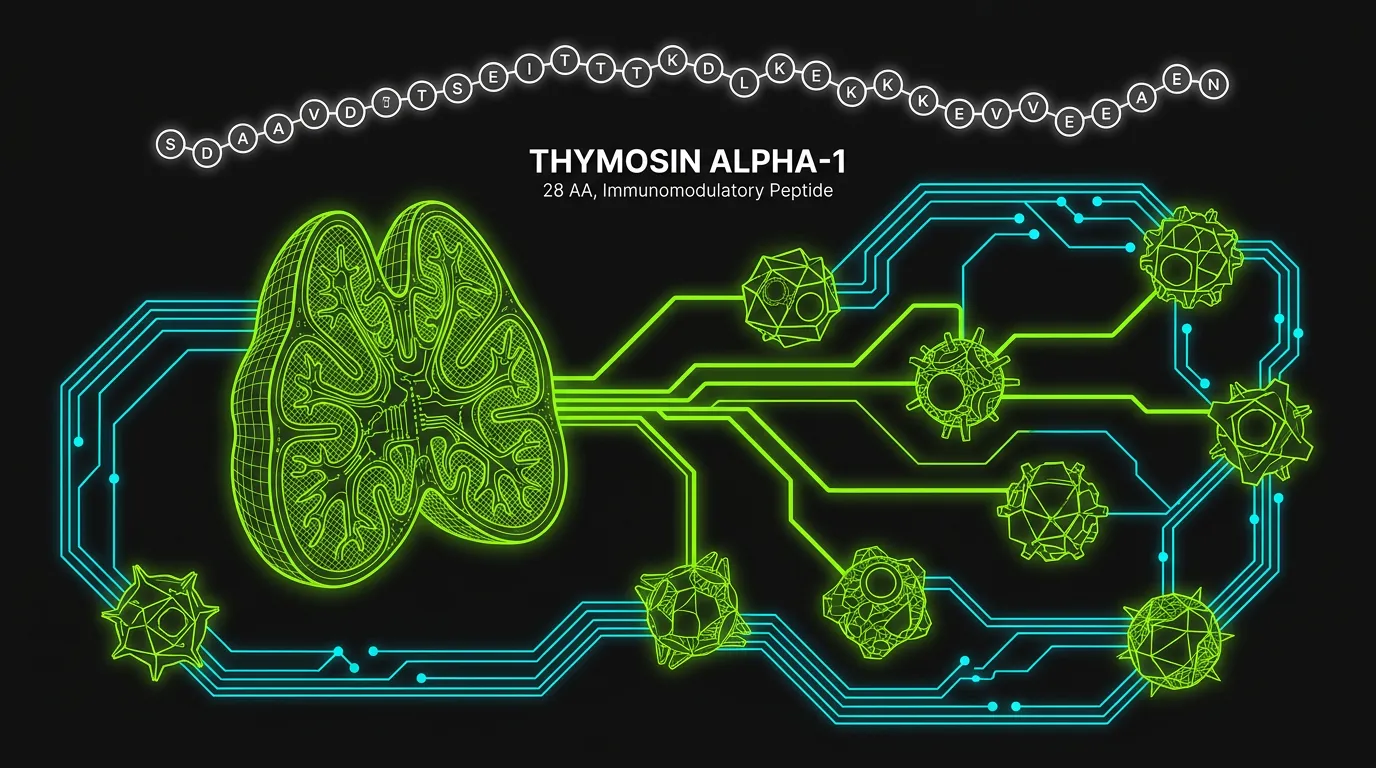
It acts on several kinds of immune cell. Pica et al. call it a powerful modulator of immunity and inflammation. Thymosin alpha 1, or Tα1, is a 28-amino-acid peptide. The thymus gland makes it. It is cut from a bigger protein called prothymosin alpha.
Tα1 binds Toll-like receptors 2 and 9. These are sensors that spot signs of infection. Through them it stirs dendritic cells, immune cells that find threats and show them to T cells. (Chen et al.) In lab work, Tα1 also acts on macrophages, cells that swallow germs and debris, through Toll-like receptor 7. Mao says Tα1 plays a key role in how T cells mature and take on their jobs. (Mao et al.) Mao works at SciClone Pharmaceuticals, the company named on the Zadaxin label.
- Dendritic cells: TLR-2 and TLR-9 binding stirs them into action. (Chen et al.)
- T-cell types: young T cells rise, and worn-out T cells fall. PD-1 is a brake protein that marks those worn-out cells. (Chen et al.)
Mao calls Tα1 a biological response modifier, a substance that adjusts how the immune system responds. Mao says it activates many kinds of immune cell, and expects it to help most where immune responses are weak. (Mao et al.) Jia et al. describe it as a drug that could balance immunity and tolerance in autoimmunity. Tolerance is the immune system leaving the body's own tissue alone.
What Does the Thymosin Alpha 1 and Autoimmune Disease Evidence Show?
It shows a shortage, not a cure.
A study by Pica et al. measured serum Tα1 in 120 blood donors. They were the healthy controls. It compared them with patients who had psoriatic arthritis, rheumatoid arthritis or systemic lupus erythematosus. Patient levels ran significantly below control levels (18.38 versus 53.08, P < 0.0001). The psoriatic arthritis group sat lowest of all.
The authors call Tα1 a powerful modulator of immunity and inflammation. They say further studies are needed to confirm these findings.
Here is the limit, stated plainly. No randomised trial has tested Tα1 as a treatment for any autoimmune illness. A shortage in the blood is a clue about mechanism. It is not proof of benefit. It cannot set a dose.
Which Doses Come From Hepatitis B Trials?
The hepatitis B rows in the table come from these trials. The other rows come from the studies named further down. Each hepatitis B trial measured response its own way, and the results were mixed.
The Japanese randomised trial by Iino et al. split 316 patients between 0.8 mg and 1.6 mg for 24 weeks. At the 72-week mark, ALT (a liver enzyme) went normal in 36.4% of the 1.6 mg group. HBV-DNA (virus genetic material in the blood) cleared in 30% on one lab test, called branched DNA. A second test, transcription-mediated amplification, found 15%. HBeAg (a protein the virus sheds) cleared in 22.8%. Those responses are durable, not transient.
A Taiwanese randomised controlled trial by Chien et al. took in 98 patients. The 26-week arm had 1.6 mg twice a week. Full viral response reached 40.6%. Controls reached 9.4% (P = 0.004). That gap is statistically significant.
A phase III multicentre, randomised, double-blind, placebo-controlled study by Mutchnick et al. did not confirm it. It gave 97 patients 1.6 mg or a placebo twice a week for six months. Complete response came in 14% on Tα1 and 4% on placebo (P = 0.084). That gap was not statistically significant. Its authors say their results do not confirm the benefit other trials reported. This page said the opposite before. That was wrong.
A review by Wu et al. still rated Tα1 as good as interferon-alpha, an injected antiviral drug, or better. That held in HBeAg-positive and HBeAg-negative chronic hepatitis B. Side effects were fewer and milder.
Hepatitis C caveat: an Italian pilot trial gave 19 patients 900 mcg per square metre twice a week. It did not work. One patient got ALT back to normal, then relapsed. (Andreone et al.)
What Do the Cancer and HIV Trials Add?
They add schedules and safety data. They add no autoimmune data.
With low-dose interferon or IL-2, two immune signalling proteins, Tα1 restores anti-tumour responses. Tumour growth and cytostatic drugs, which stop cells dividing, blunt those responses. It also cuts how toxic the treatment is. In advanced NSCLC (non-small cell lung cancer) that cannot be cut out, it lowers lymphopenia and pneumonia caused by chemoradiation (chemotherapy plus radiotherapy). Lymphopenia is a drop in white cells. Survival gains are reported in NSCLC and liver cancers that can be removed. (Garaci et al., Mao et al.)
Mao also reports early signs that Tα1 could boost checkpoint inhibitors. These drugs, such as anti-PD-1 therapies, release the PD-1 brake on T cells. Lab work suggests Tα1 may turn “cold” tumours into “hot” ones. A hot tumour holds more tumour-infiltrating lymphocytes, the T cells that get inside a tumour. Mao calls the gain to checkpoint drugs potential, not proven. (Mao et al.)
Animal work points the same way. In mice, daily Tα1 shots cut the number of lung tumours a chemical caused. (Moody et al.)
An ongoing trial is testing Tα1 after surgery for high-risk stage II and stage III colorectal cancer. Patients get 1.6 mg under the skin twice a week for six months. The main endpoint is three-year disease-free survival, the share of patients alive with no sign of the cancer returning. Fudan University is the lead sponsor. (ClinicalTrials.gov)
HIV gives the other schedule. CD4 counts measure helper T cells, the cells HIV destroys. Immune non-responders hold CD4 counts between 100 and 350. Their viral load is undetectable. A study by Chen et al. gave 20 such patients 1.6 mg Tα1 daily for two weeks. Doses twice a week followed for 22 weeks. Young T-cell shares rose, and worn-out PD-1 positive T cells fell.
Sepsis gives a third schedule. The TESTS trial, by Wu J et al., randomly assigned 1,106 adults with sepsis to 1.6 mg or a placebo under the skin every 12 hours for seven days. Deaths at 28 days were 23.4% on Tα1 and 24.1% on placebo. The authors found no clear evidence that it cut deaths.
Does Thymosin Alpha 1 Help COPD Flare-Ups?
An 84-patient randomised trial by Jia et al. added Tα1 or a placebo to routine care in acute COPD flare-ups. COPD is a long-term lung disease that narrows the airways. PaO2 (blood oxygen), PaCO2 (carbon dioxide in the blood) and lung function improved more on Tα1 than on placebo (p < 0.01). CD8 marks killer T cells, as CD4 marks helper T cells. CD4 counts and the CD4 to CD8 ratio rose, and CD8 counts fell, more on Tα1 than on placebo. Quality of life scores rose too.
The authors say Tα1 improved immune function and damped inflammation. They suggest this could cut how often COPD flare-ups return.
Is Thymosin Alpha 1 Autoimmune Disease Use Safe?
Most reported side effects are mild. This is not an autoimmune safety record.
FDA reviewed the trial record for its Pharmacy Compounding Advisory Committee in December 2024. The review covered hepatitis B and C, HIV, sepsis, melanoma, hepatocellular carcinoma (liver cancer) and non-small cell lung cancer, among other uses. It lists local irritation, redness and discomfort at the injection site as the most common side effects. It also lists serious events. Stem cell transplant patients had fatal immune hemolytic anemia (the immune system destroying red blood cells) and graft failure. (FDA bulk substances review)
Zadaxin's label draws on over 2,000 treated people. It lists mostly discomfort at the injection site. Rare effects were erythema (red skin), transient muscle atrophy (wasting), polyarthralgia (joint pain in several joints) with hand oedema (swelling), and rash. (Zadaxin label)
Key contraindication: an immune system that is being damped on purpose. Organ transplant patients are the clear case. An immune-boosting mechanism works against anti-rejection drugs. FDA adds that Tα1 could cause or worsen graft-versus-host disease in stem cell transplant patients, where transplanted cells attack the body.
Autoimmune warning: labels for Tα1 sold outside the United States carry warnings and contraindications for patients with autoimmune diseases. FDA's 2024 review notes this. (FDA bulk substances review)
The Zadaxin label and the FDA bulk substances review flag caution in:
- Autoimmune disease, as the label warnings above note.
- Pregnancy and breastfeeding, where safety data is thin.
- Use alongside other drugs that act on the immune system.
Zadaxin's label says each vial is made up with the sterile water supplied with it, just before use. Our guide to reconstituting peptides covers the technique.
Where Is Thymosin Alpha 1 Approved and Legal?
Thymalfasin, sold as Zadaxin, is approved in over 35 countries, a 2009 review reports. Uses there include hepatitis B and C, and use as an immune stimulant and adjuvant, a helper that boosts another treatment. (Goldstein and Goldstein) Regulators have approved it for hepatitis B and to help vaccines work in people with weak immune systems. (Mao et al.) FDA says it cannot check every approval claim itself. It is not approved in Japan or in Europe, except Italy. (FDA bulk substances review)
In the United States it is still investigational. FDA has approved no drug that contains it. In December 2024, FDA proposed that Tα1 not be added to the 503A Bulks List. That is the list of raw ingredients pharmacies may compound from. Its advisory committee voted 17 to 4 against adding each of the two forms. (PCAC minutes) A compounding vote is not the same as approving a new drug. Our write-up of the FDA bulks list vote sets out what that vote did.
In the UK, thymalfasin is not licensed. Specialist consultants can reach it under named-patient rules. Australia's TGA, its medicines regulator, runs a Special Access Scheme that is another route. In each case a doctor writes a clinical rationale.
With thymosin alpha-1, the supplier matters as much as the dose. We only list sources that publish an independent, per-batch certificate of analysis. See the ones that clear it.
Who Is Thymosin Alpha 1 Peptide for Autoimmune Disease Right For?
On current evidence, nobody, as a treatment on its own.
The strongest case for asking a doctor about Tα1 belongs to people with:
- Chronic hepatitis B, the use regulators have approved it for.
- Immune recovery after cancer treatment, and low white cell counts.
- HIV on antiretrovirals (HIV drugs), with CD4 counts that stay low despite viral control.
It is not indicated for general immune boosting in healthy people.
Where to buy Thymosin Alpha-1
The hard part with Thymosin Alpha-1 isn't the protocol. It's finding a supplier that can prove what's in the vial. We assessed dozens against per-batch, third-party testing. A handful passed.
See the sources that passed →References
- Iino S, et al. The efficacy and safety of thymosin alpha-1 in Japanese patients with chronic hepatitis B. 2005.
- Chien RN, et al. Efficacy of thymosin alpha1 in patients with chronic hepatitis B: a randomized, controlled trial. 1998.
- Pica F, et al. Serum thymosin alpha 1 levels in patients with chronic inflammatory autoimmune diseases. 2016.
- Mao L. Thymosin alpha 1: reimagine its broader applications in the immuno-oncology era. 2023.
- Jia Z, et al. Thymosin alpha1 plus routine treatment in AECOPD patients. 2015.
- Andreone P, et al. A double-blind, placebo-controlled, pilot trial of thymosin alpha 1 for chronic hepatitis C. 1996.
- Garaci E, et al. Thymosin alpha 1 in the treatment of cancer: from basic research to clinical application. 2000.
- Moody TW, et al. Thymosin alpha1 is chemopreventive for lung adenoma formation in A/J mice. 2000.
- Chen C, et al. Role of thymosin alpha1 in restoring immune response in immunological nonresponders living with HIV. 2024.
- Mutchnick MG, et al. Thymosin alpha1 treatment of chronic hepatitis B: phase III multicentre trial. 1999.
- FDA Pharmacy Compounding Advisory Committee. Summary minutes of the 4 December 2024 meeting. 2025.
- FDA. Thymosin alpha-1 related bulk drug substances. 2024.
- Wu J, et al. The efficacy and safety of thymosin α1 for sepsis (TESTS): multicentre, double blinded, randomised, placebo controlled, phase 3 trial. 2025.
- Goldstein AL, Goldstein AL. From lab to bedside: emerging clinical applications of thymosin alpha 1. 2009.
- Indonesian drug registry. Zadaxin (thymalfasin) product label.
- Wu X, et al. Thymosin alpha-1 treatment in chronic hepatitis B. 2015.
- ClinicalTrials.gov. NCT05086614: thymosin-alpha 1 for adjuvant treatment after radical resection of high-risk stage II and III colorectal cancer. 2021.
This content is for educational purposes only. These compounds are intended for research use. Nothing here is medical advice. A qualified clinician can advise on any health decision.
Share this article
Frequently Asked Questions
What is the thymosin alpha 1 dosage for autoimmune disease?
What do serum thymosin alpha 1 levels show in autoimmune disease?
What is the clinical evidence for thymosin alpha 1 in chronic hepatitis B?
Can thymosin alpha 1 be combined with cancer chemotherapy?
What are the contraindications for thymosin alpha 1?
Is thymosin alpha 1 approved, and where can you get it?
Read Next
Disclaimer: This content is for educational purposes only. These compounds are intended for research use. Nothing here is medical advice. Always work with a qualified clinician before making changes to your health protocol.