
Semax Dosage: Nasal Spray vs Injection in Published Studies

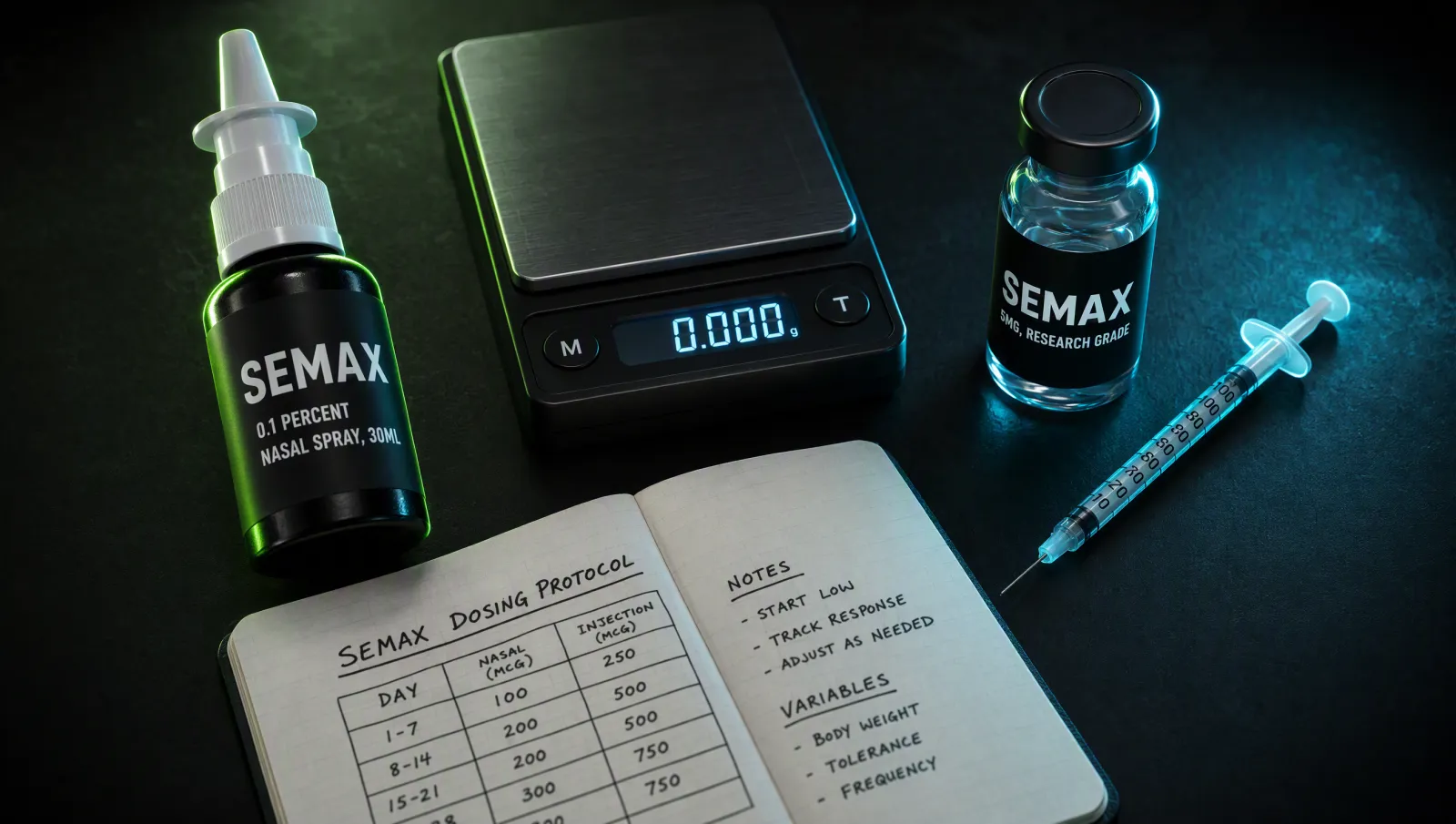
What Semax doses have published studies used?
The clearest human Semax dosage figures we found come from Russian stroke trials. One trial gave 6,000 mcg a day in two 10-day courses, with 20 days between them (Gusev 2018). An earlier trial named 12 mg and 18 mg a day as its most effective doses (Gusev 1997).
Semax is a lab-made chain of seven amino acids, Met-Glu-His-Phe-Pro-Gly-Pro. It is built from a fragment of ACTH (Eremin 2005). ACTH is a hormone in the HPA axis, a hormone system tied to stress. A 2024 paper calls Semax noncorticotropic. That means it does not act like the full hormone on the adrenal glands (Inozemtseva 2024).
Every other dose in this article comes from rats or mice. Those doses are given per kilogram of body weight, and the papers do not turn them into human doses.
What semax dosage protocol did the stroke trials use?
The 2018 trial followed 110 patients after an ischaemic stroke, a stroke caused by a blocked artery. Patients were split into early and late rehabilitation groups. The early group started at about 89 days after the stroke and the late group at about 214 days. Each group had a subgroup that got Semax and one that did not.
The standard regimen was two 10-day courses at 6,000 mcg a day, with a 20-day interval. Semax raised blood levels of BDNF, a growth factor that supports nerve cells. Those levels stayed high for the whole study. Semax and high BDNF went with faster gains on the Barthel index, a scale of everyday self-care (Gusev 2018).
The earlier trial gave Semax to 30 patients in the acute stage of stroke. A control group of 80 patients got standard therapy alone. Adding Semax had some effect on how fast lost functions came back, movement problems most of all. The most effective daily doses were 12 mg for moderate strokes and 18 mg for severe strokes. Courses ran for 5 and 10 days (Gusev 1997).
Neither abstract says how the drug was given.
Semax dosage injection: what did animal studies give?
The injection studies we found were all in rodents.
A rodent study, indexed on PubMed as a mouse study, injected 0.15 mg/kg of Semax into the belly cavity. The striatum, a deep brain area, then showed more of a serotonin breakdown product. Its level outside the cells rose to 180% within 1 to 4 hours. Semax alone did not change dopamine. Given 20 minutes before amphetamine, a stimulant drug, it strongly boosted the dopamine rise amphetamine caused (Eremin 2005).
A pain study injected Semax at 0.015 to 0.500 mg/kg in rats and mice. It lowered pain sensitivity in every model tested (Ivanova 2007).
A 2024 study gave male rats, some under chronic stress, a daily injection of 60 nmol/kg. A nanomole (nmol) counts molecules rather than weighing them. In the stressed rats, Semax reversed or eased their loss of interest in sweet water, a sign of low mood in rats. It also reversed or eased the drop in BDNF in the hippocampus, a memory area of the brain. It made no difference in a forced swim test, a common rodent test of low mood (Inozemtseva 2024).
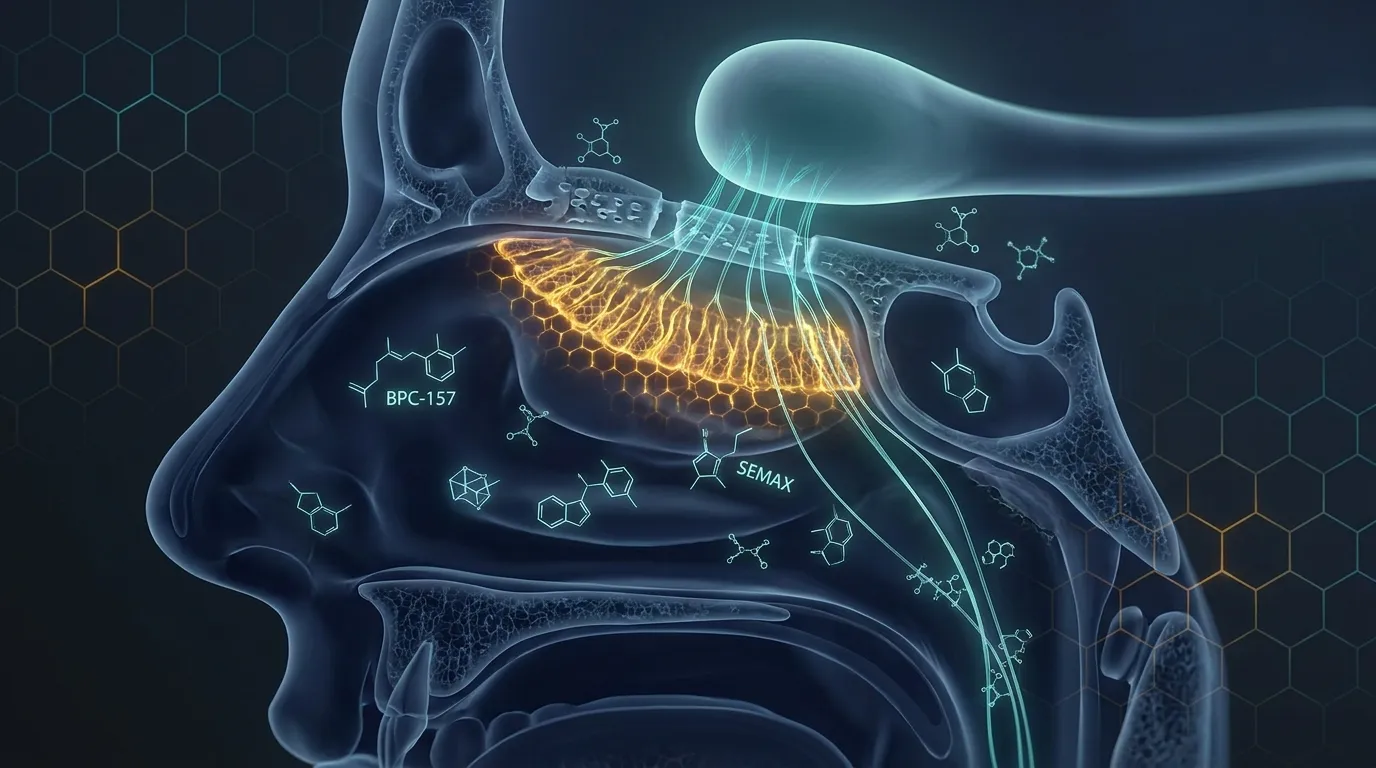
How does nasal Semax reach the brain?
The only study we found that measured brain uptake was in rats.
One rat study tracked a labelled form of Semax given into the nose at 50 mcg/kg. Two minutes later, each gram of brain held 0.093% of the dose's label. About 80% of that was intact Semax and the rest was breakdown products. The peptide broke down quickly, and the fragment Pro-Gly-Pro was the most common form in samples (Shevchenko 2006).
A second rat study looked at what one 50 mcg/kg dose did in the brain. Its PubMed record lists the nasal route. BDNF protein in the hippocampus rose as much as 1.4-fold. Activation of its receptor, trkB, rose 1.6-fold. The treated rats also made more conditioned avoidance responses, a learning measure (Dolotov 2006).
How do nasal and injected routes compare?
We found no study that tested the two routes against each other.
The brain-uptake and BDNF work above used nasal doses in rats. The serotonin, pain and stress work used injections in rodents. The doses differ, the animals differ and the outcomes differ. None of these papers shows that one route works better in people.
The concentration of a nasal product also matters. A solution's percentage strength, read as weight per volume, is the grams of peptide in each 100 millilitres. How much one spray delivers depends on how much liquid the pump releases.
How much semax should I take a day?
We found no trial that sets a daily Semax dose for healthy adults.
The human figures above come from stroke patients under medical care. This article reports what studies used. It is not dosing advice. For more on how Semax compares with a related Russian peptide, see our Semax vs Selank comparison.
Semax dosage chart: what each study used
| Study | Who | Route | Dose | Schedule |
|---|---|---|---|---|
| Gusev 2018 | 110 stroke patients | Not stated in abstract | 6,000 mcg a day | Two 10-day courses, 20-day interval |
| Gusev 1997 | 30 acute stroke patients, 80 controls | Not stated in abstract | 12 mg a day (moderate stroke), 18 mg a day (severe stroke) | Courses of 5 and 10 days |
| Shevchenko 2006 | Rats | Nasal | 50 mcg/kg | Single dose |
| Dolotov 2006 | Rats | Nasal (PubMed record) | 50 mcg/kg | Single dose |
| Eremin 2005 | Mice (PubMed record; abstract says rodents) | Injection into the belly cavity | 0.15 mg/kg | Single dose |
| Ivanova 2007 | Rats and mice | Injection | 0.015 to 0.500 mg/kg | Not stated in abstract |
| Inozemtseva 2024 | Male rats, stressed and unstressed | Injection into the belly cavity | 60 nmol/kg | Daily |
The rodent doses are per kilogram of body weight. None of these papers gives a matching human dose.
This is sourcing guidance, not a recommendation for one specific vendor. See our recommended sources page.
Bibliography
Gusev et al. 2018, PubMed. Gusev et al. 1997, PubMed. Dolotov et al. 2006, PubMed. Eremin et al. 2005, PubMed. Ivanova et al. 2007, PubMed. Inozemtseva et al. 2024, PubMed. Shevchenko et al. 2006, PubMed and Springer.
This content is for educational purposes only and is not medical advice. This article reviews research findings only and is written for research use and education. A qualified clinician can advise on any health decision.
Related: Peptides for Loss of Smell: The Evidence on Anosmia Repair
Where to buy Semax
If you're researching this compound, I've linked a trusted source below. It supports the channel.
See the sources that passed →Where to buy Semax
If you're researching this compound, I've linked a trusted source below. It supports the channel.
See the sources that passed →Share this article
Frequently Asked Questions
What is the difference between nasal spray and injection for Semax dosing?
How many micrograms of Semax are in one spray?
Does nasal Semax reach the brain?
How long were Semax courses in the stroke trials?
Is there a Semax dose for healthy people?
What did Semax do in the 2018 stroke trial?
Read Next

Disclaimer: This content is for educational purposes only. These compounds are intended for research use. Nothing here is medical advice. Always work with a qualified clinician before making changes to your health protocol.