
Retatrutide vs Tirzepatide vs Semaglutide: The Evidence

Retatrutide vs Tirzepatide vs Semaglutide: What Is the Core Difference?
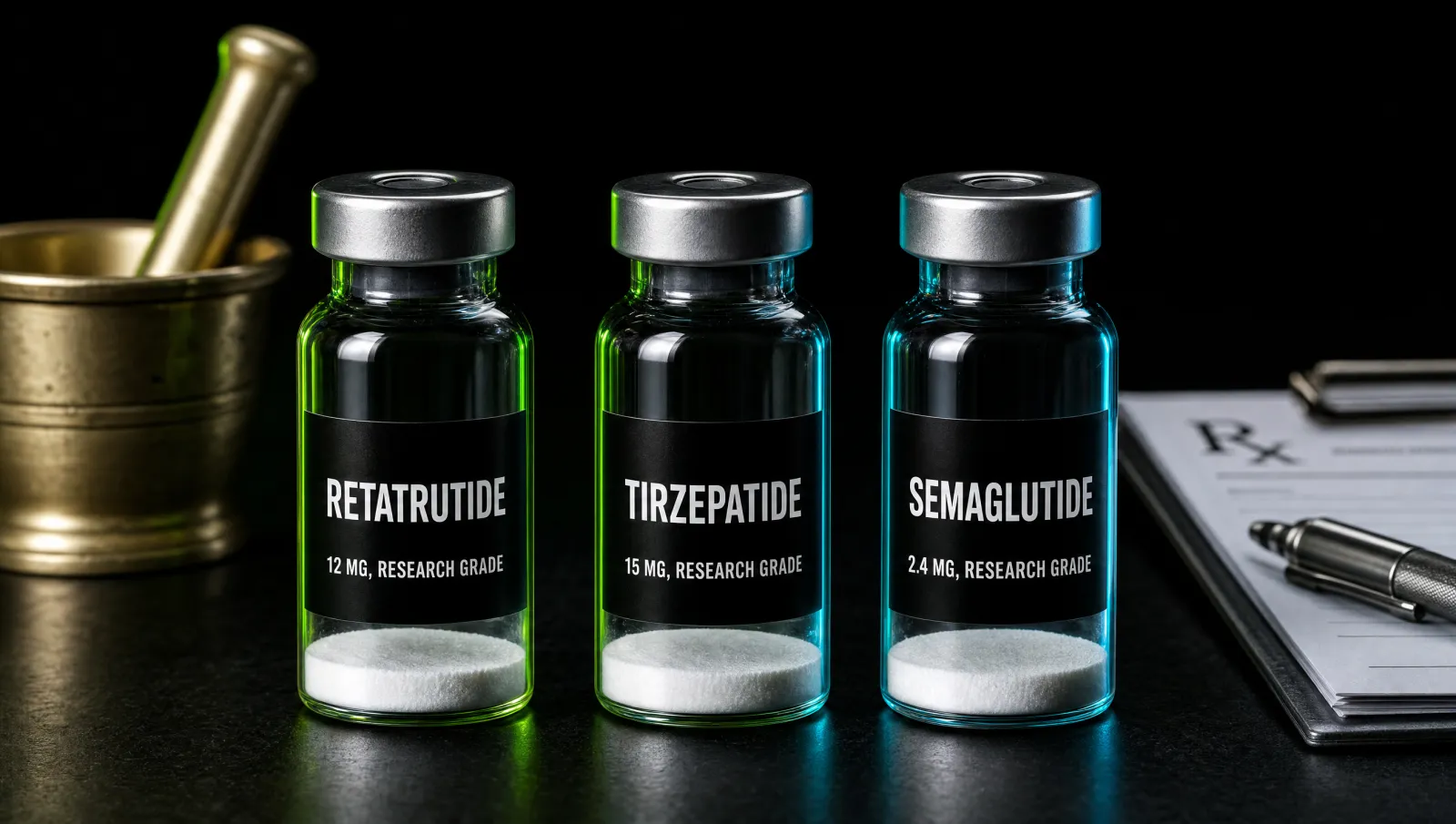
Retatrutide vs tirzepatide vs semaglutide comes down to receptor count. A receptor is a switch on a cell that a hormone or drug can turn on. Tirzepatide switches on two hormone receptors, GIP and GLP-1. Retatrutide adds a third, the glucagon receptor. Semaglutide switches on one, GLP-1. In the trials below, retatrutide's top dose gave the most weight loss.
GIP and GLP-1 are gut hormones the body releases after a meal. GIP and GLP-1 both act on the brain's fullness circuits to cut food intake. They are not twins. Glucagon is a hormone that raises blood sugar. GLP-1 lowers glucagon when blood sugar is high and slows how fast the stomach empties. GIP raises glucagon when blood sugar is low. Together they help keep blood sugar from running too high or too low. Liu 2024 sets out these mechanisms. It also reviews rodent studies where adding GIP boosted the weight loss seen with GLP-1.
Retatrutide's third target sets it apart. It switches on the glucagon receptor, which neither of the other two drugs targets. In animals, glucagon makes brown fat burn more energy. In humans, that effect has been modest, a review by Katsi 2025 notes. In one study in diabetic mice from that review, retatrutide cut body weight and food intake more than tirzepatide did. It also beat liraglutide, an older GLP-1 drug.
Is Retatrutide a GLP-1 Drug?
Partly.
Retatrutide does act on the GLP-1 receptor, so it is one of the drugs with GLP-1 activity. But it is not a pure GLP-1 drug. An agonist is a drug that switches a receptor on. Semaglutide is a pure GLP-1 agonist. Retatrutide hits GLP-1, GIP and glucagon receptors together. Even so, its side effects in a Phase 2, or mid-stage, trial matched those of other GLP-1 drugs. Rosenstock 2023
Tirzepatide vs Retatrutide: How Does the Trial Data Compare?
The figures below come from separate trials in different groups of people. None of them tested all three drugs side by side.
The Phase 2 trials cited here enrolled 281 and 338 people. Rosenstock 2023 Jastreboff 2023 TRIUMPH, a Phase 3 programme, is larger, with over 5,800 people. Giblin calls its trials registrational. That means their results are meant to be filed with regulators to seek approval. Giblin 2026
| Compound | Receptor targets | Trial result | Duration |
|---|---|---|---|
| Retatrutide | GIP + GLP-1 + glucagon | 24.2% mean weight loss (12 mg group) | 48 weeks, Phase 2 |
| Tirzepatide | GIP + GLP-1 | 20.9% mean weight loss (15 mg group) | 72 weeks, Phase 3 (SURMOUNT-1) |
| Semaglutide | GLP-1 only | 14.9% mean weight loss (2.4 mg group) | 68 weeks, Phase 3 (STEP 1) |
The retatrutide row is from a Phase 2 trial in 338 adults. They had obesity, or overweight plus a weight-related condition. Jastreboff 2023 The tirzepatide row is from SURMOUNT-1. It counts everyone, whether or not they stopped the drug. Jastreboff 2022 The semaglutide row is from STEP 1. Wilding 2021 Both of those trials left out people with diabetes. STEP 1 came out in 2021, two years before the retatrutide trial. So a ranking built from these numbers is not a head-to-head test.
Two more trials tested retatrutide in adults with type 2 diabetes. In the first, a Phase 2 trial in the US, weight fell by up to 16.94% at 36 weeks. On dulaglutide, an older GLP-1 drug, it fell by 2.02%. Rosenstock 2023 The second, TRANSCEND-T2D-1, is a Phase 3 trial. At 40 weeks, the 12 mg dose cut body weight by 15.3% on average. HbA1c is a blood test of average blood sugar over recent months. On the 12 mg dose, HbA1c fell by 1.94 points. The most frequent adverse events on retatrutide were generally mild to moderate gut effects, which eased over time. Bajaj 2026
SURMOUNT-1 tested tirzepatide at 5, 10 and 15 mg once weekly. The authors report large, lasting weight loss over 72 weeks. Jastreboff 2022 set this benchmark. A later review pooled 10 trials with 9,873 patients. Weight fell at all three doses, against placebo, GLP-1 drugs or insulin. Lin 2023 A newer trial now pits retatrutide against tirzepatide in adults with obesity. Its registry record lists it as active but no longer recruiting. It expects to finish collecting its main data around November 2026.
What Do Liver Fat and Body Composition Studies Show?
The scale does not tell you what is happening to visceral and liver fat.
MASLD is fatty liver disease tied to problems such as obesity. A Phase 2a substudy tested retatrutide in adults with MASLD and at least 10% liver fat. At 24 weeks, liver fat fell by 82.4% on average on 12 mg. It rose by 0.3% on placebo. The fall grew with dose, from 42.9% on 1 mg. On 12 mg, 86% of people reached normal liver fat, under 5%. Sanyal 2024 A second substudy, in people with type 2 diabetes, used a DXA scan. That is a low-dose X-ray scan that measures fat and lean mass. At 36 weeks, fat mass fell by 23.2% on 12 mg, against 4.5% on placebo. The share of weight lost as lean mass was like other obesity treatments, the authors report. Coskun 2025
Retatrutide Peptide vs Tirzepatide: What Separates Them Today?
The two also differ on approval. FDA approved tirzepatide as Zepbound for long-term weight control in November 2023. FDA 2023 Retatrutide is not FDA approved. Giblin 2026 describes four TRIUMPH Phase 3 trials. The registry lists all four as completed: TRIUMPH-1, TRIUMPH-2, TRIUMPH-3 and TRIUMPH-4. Other Phase 3 trials are still listed as active. They include TRIUMPH-5, which compares retatrutide with tirzepatide, and a heart and kidney outcomes trial. In its Phase 2 obesity trial, heart rate rose with dose. The rise peaked at 24 weeks and then declined. Jastreboff 2023
Tirzepatide vs Retatrutide: Where Does Tirzepatide Stand?
Zepbound is for adults with obesity, or with overweight plus at least one weight-related condition. It is meant for use with a lower calorie diet and more exercise. Tirzepatide is also sold as Mounjaro, for blood sugar control in type 2 diabetes. FDA 2023 In SURMOUNT-1, 57% of people on 15 mg lost 20% or more of their body weight. On placebo, 3% did. Jastreboff 2022 A review of the SURMOUNT trials found tirzepatide well tolerated. Its safety profile was like that of GLP-1 drugs. Hamza 2025
Retatrutide vs Ozempic: Where Does Semaglutide Stand?
Ozempic is a brand of semaglutide. FDA first approved it in 2017, for blood sugar control in adults with type 2 diabetes. Ozempic label Wegovy is the semaglutide brand approved for long-term weight control. In June 2021, FDA approved it at 2.4 mg once weekly. FDA 2021
What Side Effects Do the Three Share?
In each drug's trials, gut side effects were the most common. They include nausea, diarrhoea, vomiting and constipation. Most were mild to moderate.
For retatrutide, gut effects rose with dose. A lower first dose, 2 mg rather than 4 mg, partly eased them. Jastreboff 2023 For tirzepatide, they came mostly while the dose was being stepped up. Jastreboff 2022 For semaglutide, they mostly faded with time. Wilding 2021 Some people quit each drug because of side effects. In TRANSCEND-T2D-1, 2% to 5% quit retatrutide, against 0% on placebo. Bajaj 2026 In SURMOUNT-1, 4.3% to 7.1% quit tirzepatide, against 2.6% on placebo. Jastreboff 2022 In STEP 1, 4.5% quit semaglutide because of gut effects, against 0.8% on placebo. Wilding 2021 Stopping a drug can also undo the weight loss. In SURMOUNT-4, people switched from tirzepatide to placebo regained much of the weight they had lost. People who stayed on tirzepatide kept the weight off and lost more. Aronne 2024
Is Retatrutide FDA Approved?
No. Retatrutide is not FDA approved. FDA's list of new drugs approved in 2026 does not include it. That list was last updated in September 2026. FDA 2026 Of the three drugs, only tirzepatide and semaglutide are FDA approved for weight control. A trial report from June 2026 says retatrutide is still in development. Bajaj 2026
Retatrutide is investigational. That means it is still being tested in people.
Retatrutide FDA Approval Status 2026
Still in testing.
TRIUMPH is the Phase 3 programme meant to support approval. It has four trials with over 5,800 people. Two are basket trials. A basket trial tests one drug across several linked conditions under one plan. TRIUMPH covers obesity, obstructive sleep apnoea and knee osteoarthritis. Each condition can be judged on its own. Giblin 2026
When Will Retatrutide Be Available?
None of the sources cited here gives an approval or launch date.
Until FDA approves it, retatrutide is not an approved prescription medicine.
Retatrutide vs Tirzepatide: How Do the Trial Doses Compare?
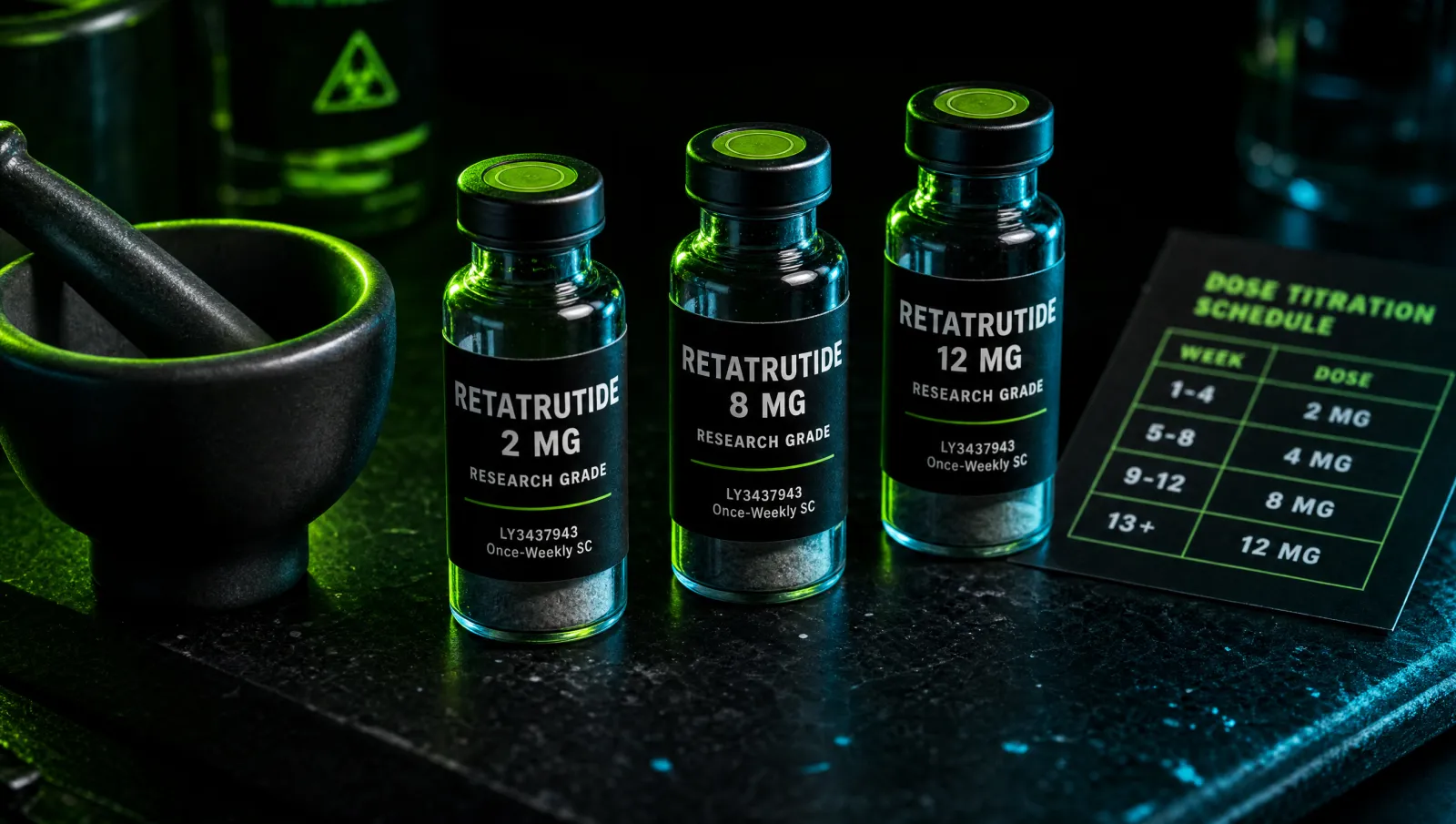
Each trial tested set doses, given once a week as a shot under the skin. TRIUMPH-1 and TRIUMPH-2 tested retatrutide at 4, 9 and 12 mg. People reach their dose on a fixed step-up plan. Giblin 2026 SURMOUNT-1 tested tirzepatide at 5, 10 and 15 mg, with a 20-week step-up. Jastreboff 2022 STEP 1 tested semaglutide at 2.4 mg. Wilding 2021
Researching how these compounds are sourced and verified? Our guide on how to know if peptides are real covers the questions worth asking first. For a vendor-neutral overview of where researchers source compounds discussed here, see our recommended sources page.
Where to buy Retatrutide
If you're researching this compound, I've linked a trusted source below. It supports the channel.
See the sources that passed →References
- Liu. Mechanisms of action and therapeutic applications of GLP-1 and dual GIP/GLP-1 receptor agonists. 2024.
- Katsi et al. Retatrutide: A Game Changer in Obesity Pharmacotherapy. 2025.
- Bajaj et al. TRANSCEND-T2D-1 Phase 3 trial. 2026.
- Jastreboff et al. Tirzepatide Once Weekly for the Treatment of Obesity. 2022.
- Lin et al. Weight loss efficiency and safety of tirzepatide: A Systematic review. 2023.
- Rosenstock et al. Retatrutide Phase 2 trial conducted in the USA. 2023.
- Coskun et al. Effects of retatrutide on body composition in people with type 2 diabetes. 2025.
- Hamza et al. Tirzepatide for overweight and obesity management. 2025.
- Aronne et al. SURMOUNT-4 Randomized Clinical Trial. 2024.
- Giblin et al. TRIUMPH registrational clinical trials rationale and design. 2026.
- Jastreboff et al. Triple-Hormone-Receptor Agonist Retatrutide for Obesity: A Phase 2 Trial. 2023.
- Wilding et al. Once-Weekly Semaglutide in Adults with Overweight or Obesity (STEP 1). 2021.
- Sanyal et al. Triple hormone receptor agonist retatrutide for metabolic dysfunction-associated steatotic liver disease: a randomized phase 2a trial. 2024.
- US Food and Drug Administration. FDA Approves New Medication for Chronic Weight Management (Zepbound). 2023.
- US Food and Drug Administration. June 2021 Office of Women's Health e-Update (Wegovy approval). 2021.
- US Food and Drug Administration. Ozempic (semaglutide) prescribing information.
- US Food and Drug Administration. Novel Drug Approvals for 2026.
- ClinicalTrials.gov. NCT05929066 (TRIUMPH-1), NCT05929079 (TRIUMPH-2), NCT05882045 (TRIUMPH-3), NCT05931367 (TRIUMPH-4), NCT06662383 (retatrutide compared to tirzepatide) and NCT06383390 (retatrutide cardiovascular and kidney outcomes trial). Eli Lilly and Company.
This content is for educational purposes only. Semaglutide and tirzepatide are FDA-approved prescription medicines. Retatrutide is investigational and not FDA approved. This page summarises published studies for education and research use. Nothing here is medical advice. A qualified clinician can advise on any health decision.
Where to buy Retatrutide
If you're researching this compound, I've linked a trusted source below. It supports the channel.
See the sources that passed →Share this article
Frequently Asked Questions
What is the difference between retatrutide, tirzepatide, and semaglutide?
Which one causes the most weight loss?
Are all three available right now?
What are the main side effects across the three?
What happens if I stop taking one of these medications?
How much liver fat reduction can these compounds achieve?
Read Next

Disclaimer: This content is for educational purposes only. These compounds are intended for research use. Nothing here is medical advice. Always work with a qualified clinician before making changes to your health protocol.