
Retatrutide Peptide Explained: How the Triple Agonist Works

What Is Retatrutide Peptide?
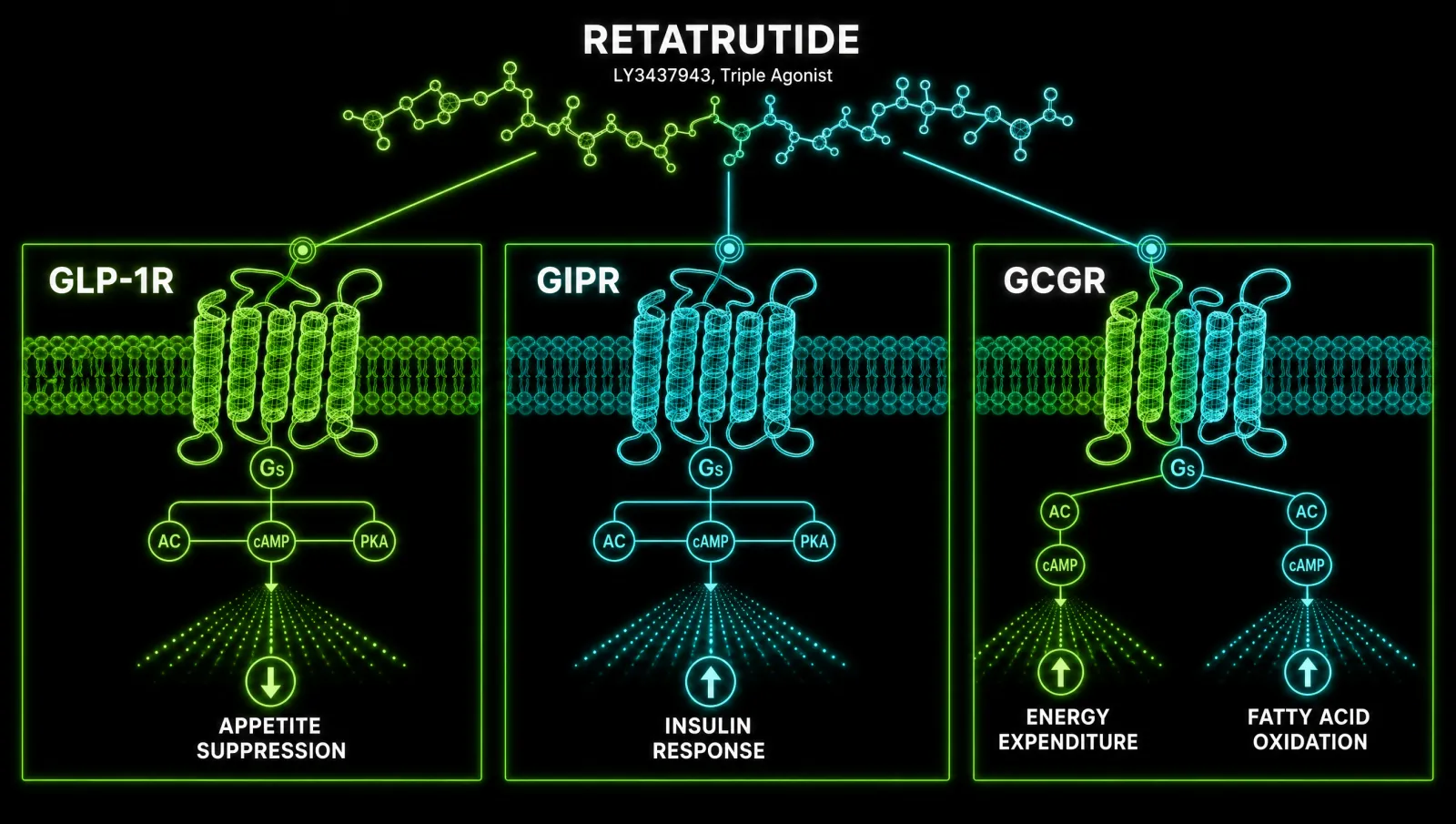
Retatrutide peptide is a single molecule that switches on three hormone receptors at once: GLP-1, GIP and glucagon. No approved weight-loss drug targets all three. That is what sets it apart. It is also why Phase 3 results have produced weight loss figures the field has not seen before.
Eli Lilly developed it under the research code LY3437943. That code is the other name you will see for it in papers. It is investigational, meaning still in testing, and currently in Phase 3 trials. The FDA has not approved it.
The mechanism is worth understanding now. It marks a real shift in how metabolic drugs attack obesity. Instead of hitting one pathway, three hormonal axes fire together.
This article explains that process step by step. It covers what each receptor does. It also shows what the trial data reveals. You'll see how retatrutide compares to tirzepatide and semaglutide. Finally, it covers where safety and approval stand today. Every claim comes from a primary scientific source.
New to the basics? Our guide to what peptides are covers how these short chains of amino acids work.
This content is for educational purposes only. These compounds are intended for research use. Nothing here is medical advice. Always work with a qualified clinician before making changes to your health protocol.
What Is Retatrutide Mechanism of Action? The Three Receptors
Each receptor does a different job. GLP-1R cuts appetite and slows the stomach. GIPR sharpens insulin release and glucose handling. GCGR raises how much energy the liver mobilises and burns. Hitting all three at once is what drives the weight loss past single and dual agonists. An agonist is a drug that switches a receptor on.
| Receptor | What it does | Drugs that target it | Phase 3 weight loss |
|---|---|---|---|
| GLP-1R | Cuts appetite, slows gastric emptying, prompts insulin release | Semaglutide (Wegovy, Ozempic) | About 15% |
| GLP-1R + GIPR | Adds better insulin response and glucose handling | Tirzepatide (Mounjaro, Zepbound) | About 22.5% |
| GLP-1R + GIPR + GCGR | Adds liver energy mobilisation and fat burning | Retatrutide | 28.3% |
GLP-1 Receptor (GLP-1R)
GLP-1 receptors sit across several tissues: the pancreas, brain, gut and cardiovascular system. GLP-1 signalling cuts appetite through the hypothalamus, the brain area that controls hunger. It slows the stomach, so calories are absorbed more slowly. It also prompts insulin release when glucose is present.
GLP-1R and GIPR are class B G protein-coupled receptors (receptors that sit in the cell membrane and pass a signal inside). They signal through the Gas-cAMP pathway. That pathway links hormone binding to insulin release and glucose uptake. Liu 2024
GIP Receptor (GIPR)
GIP receptor signalling boosts the insulin response to meals. It improves how muscle and fat take up glucose. It also seems to guard against low blood sugar when GLP-1R is switched on alongside it.
GIP and GLP-1 both matter across the pancreas, fat tissue and brain. Liu 2024
Glucagon Receptor (GCGR)
This is the receptor that separates retatrutide from what came before.
Switching on the glucagon receptor drives glucose output from the liver. It breaks down stored glycogen (the liver's sugar store). Katsi et al. 2025 It also promotes fat oxidation, which is burning fat for fuel. Goldney et al. 2025
So retatrutide does not only suppress appetite. It also raises energy expenditure directly. The GLP-1 and GIP arms cannot do this. Animal data backs this up. Retatrutide caused more weight loss in obese rodents (mice) than tirzepatide. This happened through GCGR-driven energy expenditure. Li et al. 2024
The structure behind that triple activation has been mapped. A 2024 study in Cell Discovery used cryo-electron microscopy. That means freezing molecules to photograph their shape. It showed that one retatrutide molecule binds and switches on all three receptors. Its strength is not equal, though. It is stronger than the body's own hormone at GIPR, and weaker at GLP-1R and GCGR. Li et al. 2024
What Is Retatrutide Used For? What the Phase 2 Data Showed
Retatrutide is being tested for weight loss first. Weight loss rose with dose. It reached 24.2% at 48 weeks on the 12 mg dose. That beat anything recorded for a drug at that point. These were randomised controlled trials, not observational data.
A meta-analysis pools the results of many trials. One found people lost an average of 10.66 kg in body weight. BMI (body mass index) dropped by 4.53 kg/m2. Large groups of people hit the 5%, 10%, 15% and 20% weight-loss marks compared to placebo. Pasqualotto et al. 2024
The dose-response was clear. At 24 weeks, participants on 12 mg had lost 17.5% of body weight. By 48 weeks the review reports 24.4%. Kaur et al. 2024
| Weight loss threshold | Relative risk vs placebo |
|---|---|
| 5% | 2.92 |
| 10% | 9.32 |
| 15% | 18.40 |
| 20% | 16.61 |
These are not marginal effects. An 18-fold rise in the chance of losing 15% of body weight, against placebo, is a signal on the scale of bariatric surgery.
Phase 3 TRIUMPH-1: The 28.3% Weight Loss Data
The headline number is 28.3%.
TRIUMPH-1 was announced in May 2026. It reported 28.3% average weight loss at the 12 mg dose over 80 weeks. That's about 71 pounds on average. No plateau showed up through week 80. This is the highest result ever recorded for a drug in a major registration trial.
The TRIUMPH programme enrolled more than 5,800 people. The trials covered obesity, obstructive sleep apnoea and knee osteoarthritis. Giblin et al. 2026 This mixed design makes a simple point. Obesity rarely stands alone. Its related health problems are the real issue doctors face. A drug that improves body weight, liver fat, blood sugar control and joint stress all at once changes the whole picture.
The key finding in the announcement is this. Weight loss did not plateau, meaning it did not level off, through week 80. Lilly 2026 This is different from semaglutide, which plateaus around weeks 60 to 65 in the STEP trials. Scientists don't know for sure why yet. One theory is that GCGR, a receptor that boosts energy burning, keeps working the whole time. This idea has not been proven, but it matches data from animal studies.
Phase 3 also included TRANSCEND-T2D-1, the first Phase 3 trial in type 2 diabetes. At 40 weeks, it cut A1C by up to 2.0%. A1C is a blood test that tracks average blood sugar. People also lost a lot of weight. Again, there was no plateau. Lilly 2026
How Retatrutide Compares to Tirzepatide and Semaglutide
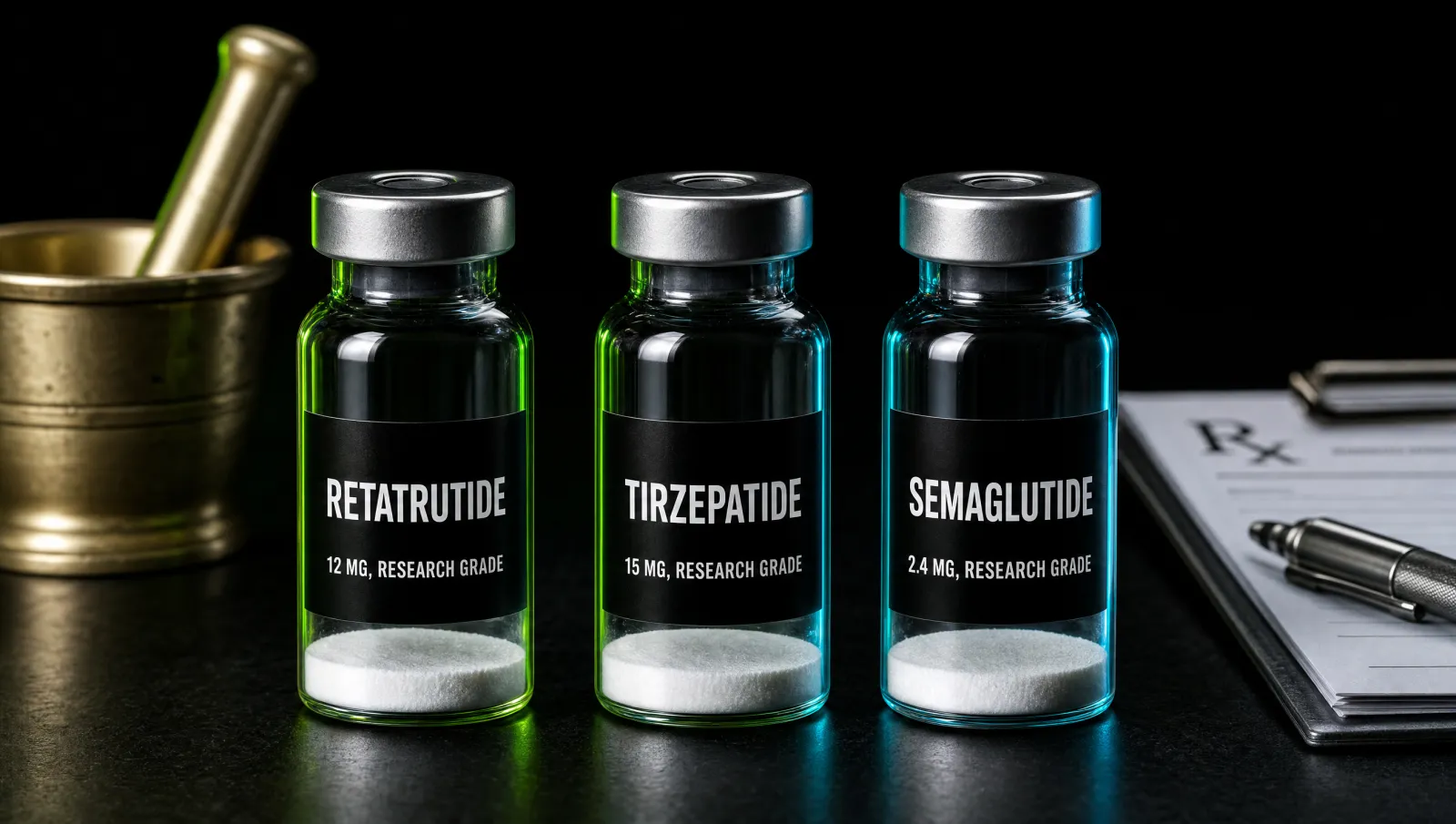
A network meta-analysis compares results from many trials at once. One put retatrutide ahead of tirzepatide on both measures. Against placebo, retatrutide cut 16.34 kg on average. Tirzepatide cut 11.82 kg. As a share of body weight, retatrutide reached 23.77% and tirzepatide 16.79%. Retatrutide also carried a higher rate of side effects against placebo than tirzepatide did. Salhab et al. 2025
Semaglutide hits one target only, the GLP-1 receptor. Switching it on curbs appetite, and that is what drives the weight loss. Semaglutide leads to about 15% weight loss. That is roughly half of retatrutide's Phase 3 result.
The key mechanical difference is GCGR, the glucagon receptor. Tirzepatide has no glucagon arm. It targets GIP and GLP-1 to control appetite and insulin. But it lacks the energy-burning boost that retatrutide's glucagon arm adds.
The main difference is availability. Doctors can prescribe tirzepatide and semaglutide today. Both drugs have FDA approval. Retatrutide is still in testing. Scientists call this stage "investigational." Its maker plans to file an NDA (new drug application) in Q4 2026. That filing is the step needed for approval. Experts expect approval in late 2027 or early 2028.
Want the full side-by-side comparison? It checks how well each drug works, how well people tolerate it, and how easy it is to get. See our comparison of retatrutide, tirzepatide and semaglutide. For the wider field, see our review of peptides for weight loss.
What Is Retatrutide Peptide Used For Beyond Weight Loss? Liver Fat and MASLD
Liver fat is the most striking secondary result in the whole dataset.
A Phase 2a substudy looked at metabolic dysfunction-associated steatotic liver disease [MASLD]. This means fat builds up in the liver. The 12 mg dose cut liver fat by 82.4% at 24 weeks. At that dose, 86% of people reached normal liver fat levels, below 5%. None of the people on placebo reached that level (0%).
MASLD, formerly called NAFLD, is one of the largest unmet needs in metabolic medicine. Few approved drugs treat it. The reduction rose with dose.
| Weekly dose | Liver fat reduction at 24 weeks |
|---|---|
| 1 mg | 42.9% |
| 4 mg | 57.0% |
| 8 mg | 81.4% |
| 12 mg | 82.4% |
The mechanism has three parts. GLP-1R activation cuts fat production in the liver. GIP signalling improves how the body handles fat elsewhere. GCGR activation drives the liver to burn fatty acids directly. Together they exceed what any single or dual agonist has managed in comparable time.
Safety Profile and Side Effects
The side effects are mostly in the gut: nausea, vomiting, diarrhoea and constipation. They rise with dose, and they fade. Serious adverse events matched placebo in Phase 2, at 4% in both arms. Pooled trials found no statistically significant rise in serious adverse events. Pasqualotto et al. 2024 Gradual dose escalation is the main way to manage them, and it is built into the protocol.
The gut pattern fits the drug class and the mechanism. GLP-1R slows gastric emptying, which produces nausea and early fullness. It is worst when starting and when stepping up.
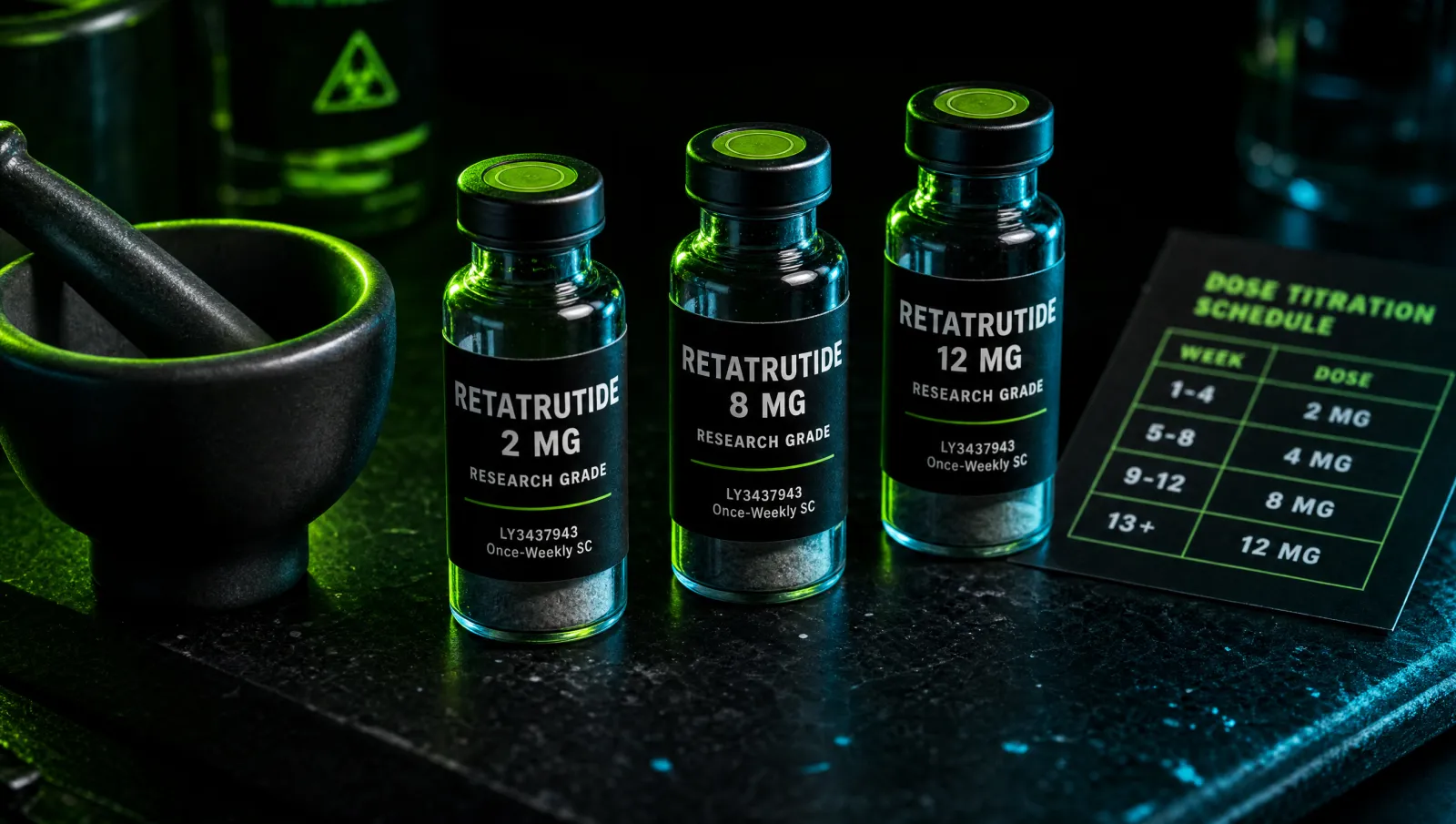
One finding matters more than the rest. In the Phase 2 trial, a lower starting dose (2 mg rather than 4 mg) partly reduced the gut side effects. Jastreboff et al. 2023
The Phase 3 trials raise the dose on a fixed schedule. People reach 4, 9 or 12 mg once weekly. In TRIUMPH-1 the step-up phase lasts 16 weeks. A permanent dose cut is allowed if gut side effects do not settle. Giblin et al. 2026
Gradual escalation is not optional. It is a safety-critical part of the design. Our retatrutide dosage and titration guide sets out each ladder in full.
Phase 2 data showed a modest heart rate rise of up to 6.7 bpm. It rose with dose. It peaked at 24 weeks and then fell. Jastreboff et al. 2023 That fits the GLP-1 drug class as a whole. The TRIUMPH heart programme is tracking it. A meta-analysis of 4 randomised trials confirmed the safety profile was comparable to control. It also found retatrutide beat placebo on the outcomes studied. Tewari et al. 2025 For the full side-effect breakdown, see our guide to retatrutide side effects.
Regulatory Status and What Happens Next
Retatrutide is still investigational, meaning it is being tested. The FDA has not approved it yet. The TRIUMPH Phase 3 trials are running now. Lilly plans to file an NDA in Q4 2026. That is the formal request for approval. Approval could come in late 2027 or early 2028. Doctors cannot prescribe it yet.
TRIUMPH is a large, four-trial programme. More than 5,800 people are enrolled. It covers obesity, type 2 diabetes, obstructive sleep apnoea and knee osteoarthritis. Giblin et al. 2026 This wide scope shows Eli Lilly's goal. The company wants retatrutide to help the whole cardiometabolic system, meaning heart and metabolism together. That goal goes far beyond simple weight loss.
TRIUMPH-1 results came out in May 2026. This is the first major Phase 3 data. TRANSCEND-T2D-1 diabetes data came out in March 2026. Lilly 2026 Trials for sleep apnoea and osteoarthritis are still ongoing.
The practical point: retatrutide is not available through prescribers today. Learning the published evidence now helps you judge the clinical options when they arrive. For vetted research-grade suppliers of compounds under investigation, see our recommended sources page. Our guide on how to vet a peptide supplier shows what to check first.
Retatrutide Peptide: Why the Triple Mechanism Matters
Retatrutide uses a new approach called systems pharmacology [treating the whole body system, not just one part]. Older drugs target a single hormone pathway. They hit a limit there. Retatrutide works on appetite, insulin sensitivity and energy expenditure all at once. Energy expenditure means how many calories the body burns. Clinical data suggests these effects multiply together. They don't just add up.
A major review calls retatrutide a paradigm shift, meaning a fundamental change in approach. It marks a new way to treat the body with multi-hormonal pharmacotherapy, meaning drugs that work on several hormones at once. Ganamurali et al. 2026
For decades, obesity drugs focused on one pathway at a time. Some blocked appetite. Others improved insulin. Each approach hit a limit. This happens because metabolic balance involves many factors, not just one. The body simply adjusts around a single-target treatment.
A triple agonist blocks the body's escape routes all at once. GLP-1R activation (a switch that lowers hunger) cuts how much you eat. GIPR activation (a switch that steadies blood sugar) keeps glucose levels even, so eating less doesn't trigger a backlash. GCGR activation (a switch that raises energy burn) makes the body burn more fuel. Together, these three switches stop the body from defending a higher weight.
This is why people keep comparing retatrutide to bariatric surgery, meaning weight-loss surgery. Surgery causes 25 to 35% weight loss. It limits stomach size. It also changes hormones in ways scientists don't fully understand yet. Retatrutide reached 28.3% weight loss in 80 weeks, using drugs alone. Serious side effects occurred in 4% of people. That matched the placebo group exactly.
Whether it resets long-term metabolic setpoints, or needs indefinite use to hold the effect, is still open. The TRIUMPH data at 80 weeks and beyond will start to answer it. For now the mechanism is the story, and it is genuinely new.
Where to buy Retatrutide
Explore research-grade peptides and metabolic compounds from vetted suppliers on our recommended sources page.
See the sources that passed →References
- PMC12190491 - Retatrutide: A Game Changer in Obesity Pharmacotherapy (2025)
- PubMed 41545327 - The Triple-Agonist Revolution: Retatrutide and the Paradigm Shift (2026)
- PMC11420505 - Meta-analysis of Retatrutide RCTs: Weight and Metabolic Markers (2024)
- Lilly TRIUMPH-1 - Phase 3 TRIUMPH-1 Results: 28.3% Weight Loss (2026)
- Lilly TRANSCEND-T2D-1 - Phase 3 Diabetes Trial Results (2026)
- Cell Discovery 2024 - Structural Insights into Triple Agonism at GLP-1R, GIPR, GCGR
- PMC11255275 - Triple Agonism: GLP-1R, GIPR, GCGR (2024)
- PMC12304053 - Triple Agonism Based Therapies for Obesity (2025)
- PubMed 38367045 - A review of an investigational drug retatrutide (2024)
- PMC11304055 - Mechanisms of GLP-1 and Dual GIP/GLP-1 Receptor Agonists (2024)
- PMC11271400 - Retatrutide for MASLD: Phase 2a Liver Steatosis Trial (2024)
- PubMed 41090431 - TRIUMPH Phase 3 Trial Design (2026)
- PubMed 39817343 - Systematic Review and Meta-analysis: Retatrutide Efficacy and Safety (2025)
- Jastreboff et al. 2023 - Triple-Hormone-Receptor Agonist Retatrutide for Obesity, Phase 2
- PMC12544991 - Comparative Efficacy: Tirzepatide vs Retatrutide Network Meta-Analysis (2025)
- PMC12026077 - Retatrutide Systematic Review and Meta-analysis (2025)
This content is for educational purposes only. These compounds are intended for research use. Nothing here is medical advice. Always work with a qualified clinician before making changes to your health protocol.
Where to buy Retatrutide
Explore research-grade peptides and metabolic compounds from vetted suppliers on our recommended sources page.
See the sources that passed →Share this article
Frequently Asked Questions
What is retatrutide and how does it differ from other weight-loss medications?
How does retatrutide actually work in the body?
What weight loss results have been reported in clinical trials?
What are the main side effects of retatrutide?
Has retatrutide been FDA approved?
How does retatrutide compare to tirzepatide and semaglutide for weight loss?
Read Next

Disclaimer: This content is for educational purposes only. These compounds are intended for research use. Nothing here is medical advice. Always work with a qualified clinician before making changes to your health protocol.