
KPV for Gut Health: IBD, Inflammation, Oral vs Injectable

What Do Studies Show About KPV for Gut Health?
KPV for gut health has been tested in human cells grown in a lab and in mice, not in people. In mice, KPV in the drinking water reduced chemically caused colitis. FDA's 2026 review found no clinical studies or human exposure data for KPV by any route. So there is no human dose on record.
KPV is a tripeptide, a chain of three amino acids: lysine, proline and valine (Lys-Pro-Val). FDA's review describes it as a fragment of alpha-MSH. Alpha-MSH, or alpha-melanocyte-stimulating hormone, is a peptide made in the pituitary gland (FDA, 2026). KPV is the last three building blocks of that hormone, positions 11 to 13 (Cutuli 2000). A 1989 mouse study first tested that tail alone. KPV cut ear swelling caused by a chemical, and larger doses worked better (Hiltz and Lipton 1989).
A 2010 review says KPV keeps almost all of the hormone's anti-inflammatory capacity. It lacks the sequence the hormone uses to bind its melanocortin receptors. Those receptors are the docking points the full hormone acts through. The review also reports that KPV shows no effect on skin pigment (Brzoska 2010). The authors of the main gut study wrote that KPV "might be a new therapeutic agent" for inflammatory bowel disease, or IBD (Dalmasso 2008).
For the wider compound picture beyond the gut, see our KPV peptide complete guide.
What Is the KPV Gut Health Mechanism Inside the Gut Wall?
The main gut study tested two things. It asked how KPV gets into gut cells, and what it does once inside.
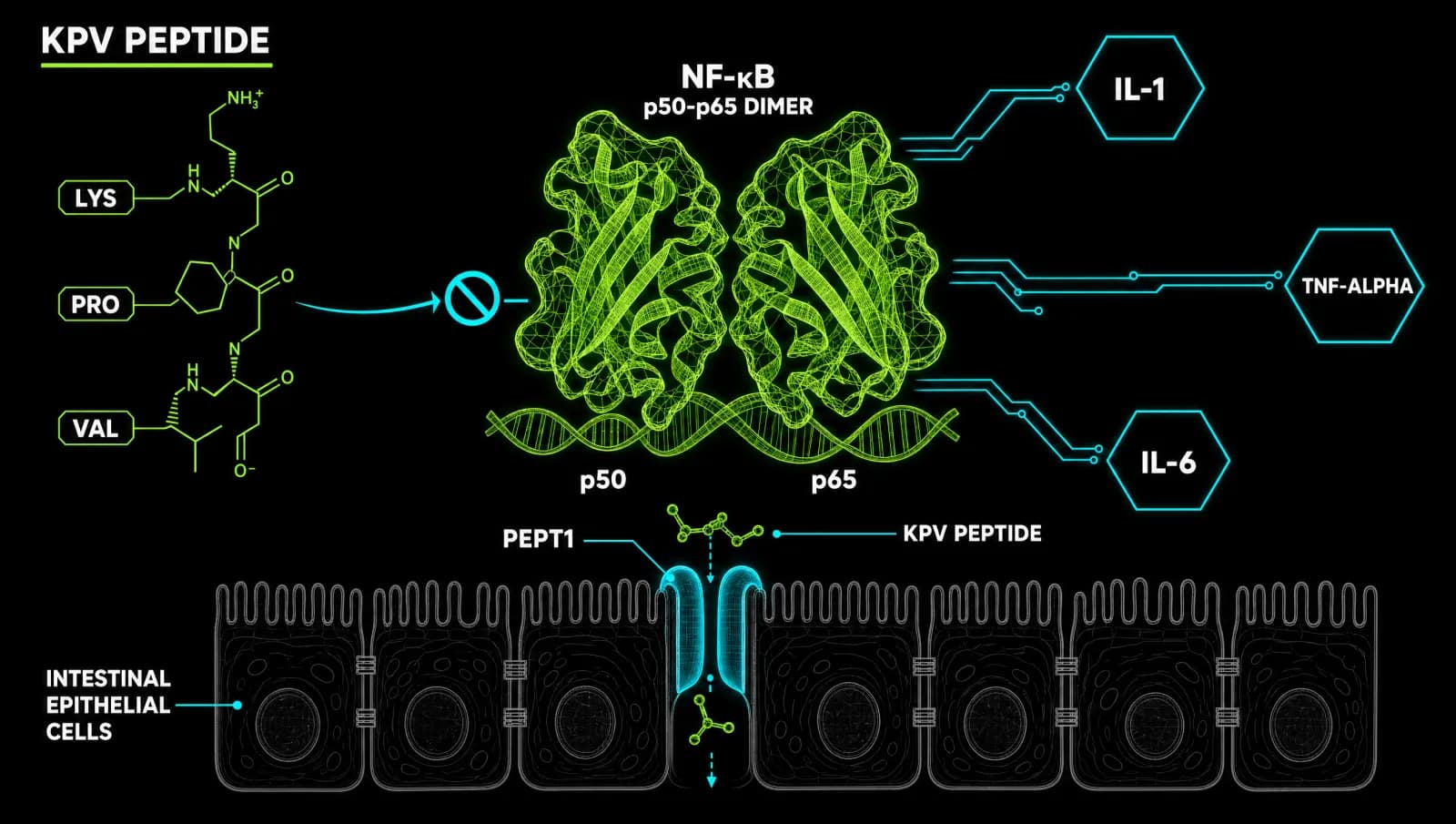
The team used human gut lining cells and human immune T cells grown in a lab. Nanomolar amounts of KPV, meaning billionths of a mole per litre, held back two signalling routes. These were NF-kB and MAP kinase. Think of those two as switches that turn inflammation on inside a cell. KPV also cut the release of pro-inflammatory cytokines, the chemical alarm signals cells send out (Dalmasso 2008).
The same study found KPV acts through PepT1. PepT1 is a transporter, a kind of door in the cell wall that lets in small peptides. It is normally found in the small intestine. It is switched on in the colon during IBD (Dalmasso 2008). A later mouse study by the same group reports PepT1 at low levels in the healthy colon and raised in IBD. In that study, KPV did not curb tumour growth in mice bred without PepT1 (Viennois 2016).
A second 2008 study tested KPV in two mouse colitis models. One used the chemical DSS. The other moved immune cells into mice to cause colitis. In the DSS model, treated mice recovered sooner and regained more weight. Their colons showed less inflammation, and less of an enzyme (MPO) that marks white cell activity. In the transfer model, KPV also led to recovery. In mice with a faulty melanocortin-1 receptor, KPV saved every treated animal from death during DSS colitis. The authors said the effects were at least partly independent of that receptor. The abstract does not give the dose or the route (Kannengiesser 2008).
Three older studies add to the picture, though none was a gut model. In mice with an inflamed belly lining, KPV cut the build-up of white blood cells called polymorphonuclear leukocytes. A drug that blocks two melanocortin receptors did not stop that effect. The authors concluded KPV is unlikely to act through melanocortin receptors (Getting 2003).
A dimer, or two KPV units joined together, is called (CKPV)2. It cut TNF-alpha, an inflammation signal, from human blood immune cells in a dish. It did so more strongly than KPV alone. In rats injected with endotoxin, a bacterial toxin, it also cut the rise in blood TNF-alpha (Gatti 2006). In lab tests, alpha-MSH and KPV also held back two germs, Staphylococcus aureus and Candida albicans. Against S. aureus, this held across a broad range of amounts. That included the picomolar range, meaning trillionths of a mole per litre, found in the body. Small amounts also cut the survival of C. albicans. The authors suggest alpha-MSH plays a role in the body's defences in barrier organs such as the gut and skin (Cutuli 2000).
Has Oral or Injectable KPV for Gut Health Been Compared?
No study we found compares oral and injected KPV for gut health. FDA found no human exposure data for KPV by any route. That includes by mouth and by injection under the skin, known as subcutaneous.
In two of the mouse gut studies, KPV was given by mouth. In one, KPV was added to the drinking water. It reduced the incidence of colitis caused by two chemicals, DSS and TNBS. Colitis here means an inflamed colon. Pro-inflammatory cytokine levels fell too (Dalmasso 2008). In another, KPV was packed into tiny particles coated with hyaluronic acid, a long sugar chain, and given by mouth inside a gel. In a mouse model of ulcerative colitis, this protected the gut lining and lowered TNF-alpha. It did so better than KPV particles without the hyaluronic acid, given in the same gel (Xiao 2017).
One rodent (rat) study used a third route. KPV was mixed into a hydrogel and put into the rectum of rats with colitis. The colitis was caused by TNBS, a chemical. Body weight loss and the disease activity score both fell. The colon did not shorten as much, and the colon lining looked healthier. The cytokines TNF-alpha and interleukin 6 also dropped (Sun 2021).
With no human exposure data, there is no measure of how much KPV reaches the blood in people by either route. That share of a dose is called bioavailability. We also found no published half-life for KPV in people. Half-life is how long the body takes to clear half a dose.
What Dose of KPV for Gut Health Has Been Studied?
No human dose has been studied. FDA states that it has not identified "any clinical studies or human exposure data for KPV via any route of administration" (FDA, 2026). So no trial has set an amount, a schedule or a length of use. The table lists the studies on this page, who was studied and how KPV was given.
| Study | Who or what was studied | How it was given | What was reported |
|---|---|---|---|
| Dalmasso 2008 | Human gut and T cells in a lab; mice with chemical colitis | Added to cells; in drinking water for mice | Less NF-kB and MAP kinase signalling; less colitis |
| Xiao 2017 | Mice with a model of ulcerative colitis | By mouth, in coated particles inside a gel | Less damage to the gut lining; lower TNF-alpha |
| Kannengiesser 2008 | Mice with two kinds of colitis | Not stated in the abstract | Earlier recovery; less colon inflammation |
| Sun 2021 | Rats with chemical colitis | Into the rectum, in a hydrogel | Less weight loss; lower TNF-alpha and interleukin 6 |
| Viennois 2016 | Mice with colitis-linked tumours | KPV given to normal mice and to mice without PepT1 | Prevented tumour formation in normal mice only |
| Getting 2003 | Mice with an inflamed belly lining (not the gut) | Whole-body treatment | Fewer white blood cells built up |
| Gatti 2006 | Human blood cells; rats given endotoxin | The dimer (CKPV)2 | Lower TNF-alpha |
| FDA review, 2026 | People | Any route | No clinical studies or human exposure data found |
KPV is often named alongside BPC-157 for the gut. Our PubMed search on 5 October 2026 found no study that tested the two together. Our KPV and BPC-157 gut stack guide covers what each has been studied for. We weigh KPV against other compounds in our round-up of peptides for gut health.
Nothing here is medical advice. IBD is a diagnosed disease, and its care sits with a qualified clinician.
What Is the KPV Peptide Gut Health Evidence in People?
There is none on record. FDA's 2026 review found no clinical studies and no human exposure data for KPV by any route (FDA, 2026). A search of ClinicalTrials.gov on 5 October 2026 for KPV as the treatment returned no registered trials. Every result on this page comes from cells, mice or rats.
KPV is not an FDA-approved drug. FDA's review says KPV has no United States Pharmacopeia (USP) or National Formulary (NF) monograph, the official quality standard. It is not part of any approved drug. A monograph is an official quality standard for a drug substance. FDA's safety-risk page, updated in April 2026, lists KPV among substances whose nominations were withdrawn. Those substances were previously in category 2 of its interim policies. Category 2 was FDA's interim list of bulk drug substances that may present significant safety risks (FDA, 2026).
FDA's Pharmacy Compounding Advisory Committee reviewed KPV on 23 July 2026. A compounding pharmacy makes up a drug for one named patient. Per the pharmacists' group NCPA, the committee voted to recommend KPV for the 503A bulks list. That is the list of substances such pharmacies may use (NCPA, 2026). FDA's own review, written for that meeting, proposed not adding KPV to that list (FDA, 2026). Advisory committee votes are advice, and FDA is not bound to follow them. That lane is not the same as an FDA-approved drug claim. Nothing here should be read as one.
Where Do You Source KPV for Gut Health Research?
If you are researching KPV, source quality decides what you are actually studying. It is either the compound described in these papers, or a mislabelled substitute. Third-party testing, clear certificates of analysis and open vendors are the usual checks.
We keep a vendor-neutral list of what to check on our recommended sources page. It covers how to read a certificate of analysis. That is the lab sheet that says what is in the vial. It also covers the red flags to watch for. Our guide on how to know if peptides are real goes deeper.
Where to buy KPV
If you're researching this compound, I've linked a trusted source below. It supports the channel.
See the sources that passed →References
- Dalmasso G, et al. PepT1-mediated tripeptide KPV uptake reduces intestinal inflammation. 2008. PubMed
- Dalmasso G, et al. PepT1-mediated tripeptide KPV uptake reduces intestinal inflammation (full text). 2008. PMC
- Viennois E, et al. Critical role of PepT1 in promoting colitis-associated cancer and therapeutic benefits of the anti-inflammatory PepT1-mediated tripeptide KPV in a murine model. 2016. PubMed
- Xiao B, et al. Orally targeted delivery of tripeptide KPV via hyaluronic acid-functionalized nanoparticles efficiently alleviates ulcerative colitis. 2017. PubMed
- Hiltz ME, Lipton JM. Antiinflammatory activity of a COOH-terminal fragment of the neuropeptide alpha-MSH. 1989. PubMed
- Kannengiesser K, et al. Melanocortin-derived tripeptide KPV has anti-inflammatory potential in murine models of inflammatory bowel disease. 2008. PubMed
- Sun J, et al. Self-cross-linked hydrogel of cysteamine-grafted gamma-polyglutamic acid stabilized tripeptide KPV for alleviating TNBS-induced ulcerative colitis in rats. 2021. PubMed
- Getting SJ, Schioth HB, Perretti M. Dissection of the anti-inflammatory effect of the core and C-terminal (KPV) alpha-MSH peptides. 2003. PubMed
- Gatti S, et al. Inhibitory effects of the peptide (CKPV)2 on endotoxin-induced host reactions. 2006. PubMed
- Brzoska T, et al. Terminal signal: anti-inflammatory effects of alpha-MSH related peptides beyond the pharmacophore. 2010. PubMed
- Cutuli M, et al. Antimicrobial effects of alpha-MSH peptides. 2000. PubMed
- US Food and Drug Administration. Evaluation of KPV, Pharmacy Compounding Advisory Committee, July 2026. FDA
- US Food and Drug Administration. Certain bulk drug substances for use in compounding that may present significant safety risks. 2026. FDA
- National Community Pharmacists Association. FDA advisory committee nominates six peptides for pharmacies to compound. 31 July 2026. NCPA
This content is for educational purposes only. Nothing here is a guide to research use or to treatment. Nothing here is medical advice.
Where to buy KPV
If you're researching this compound, I've linked a trusted source below. It supports the channel.
See the sources that passed →Share this article
Frequently Asked Questions
What is KPV and where does it come from?
How might KPV act on gut inflammation?
Has oral KPV been compared with injected KPV for gut health?
Is there a studied KPV dose for gut inflammation in people?
Has KPV been tested in humans with IBD?
What is KPV's legal status in 2026?
Read Next

Disclaimer: This content is for educational purposes only. These compounds are intended for research use. Nothing here is medical advice. Always work with a qualified clinician before making changes to your health protocol.